

Recognizing Biological Motion and Emotions from Point-Light Displays in Autism Spectrum Disorders
Open accessThe DOI matches its Crossref record; 53 of the 53 references it cites were found in a registry or an index.
Abstract
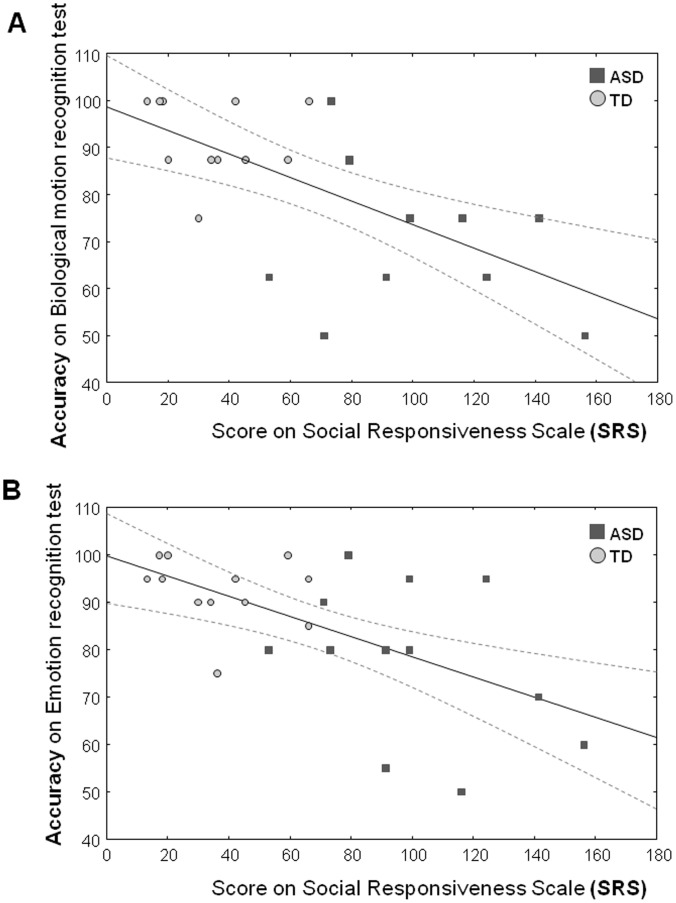
One of the main characteristics of Autism Spectrum Disorder (ASD) are problems with social interaction and communication. Here, we explored ASD-related alterations in 'reading' body language of other humans. Accuracy and reaction times were assessed from two observational tasks involving the recognition of 'biological motion' and 'emotions' from point-light displays (PLDs). Eye movements were recorded during the completion of the tests. Results indicated that typically developed-participants were more accurate than ASD-subjects in recognizing biological motion or emotions from PLDs. No accuracy differences were revealed on two control-tasks (involving the indication of color-changes in the moving point-lights). Group differences in reaction times existed on all tasks, but effect sizes were higher for the biological and emotion recognition tasks. Biological motion recognition abilities were related to a person's ability to recognize emotions from PLDs. However, ASD-related atypicalities in emotion recognition could not entirely be attributed to more basic deficits in biological motion recognition, suggesting an additional ASD-specific deficit in recognizing the emotional dimension of the point light displays. Eye movements were assessed during the completion of tasks and results indicated that ASD-participants generally produced more saccades and shorter fixation-durations compared to the control-group. However, especially for emotion recognition, these altered eye movements were associated with reductions in task-performance.
Overview
The claims and statistics of this paper haven’t been checked yet.
Free: it reads the open-access text and checks the first 5 claims that cite a source we can check. Create a free account to check every claim.
Integrity signals
Registry
Cites
Statistics
Figures
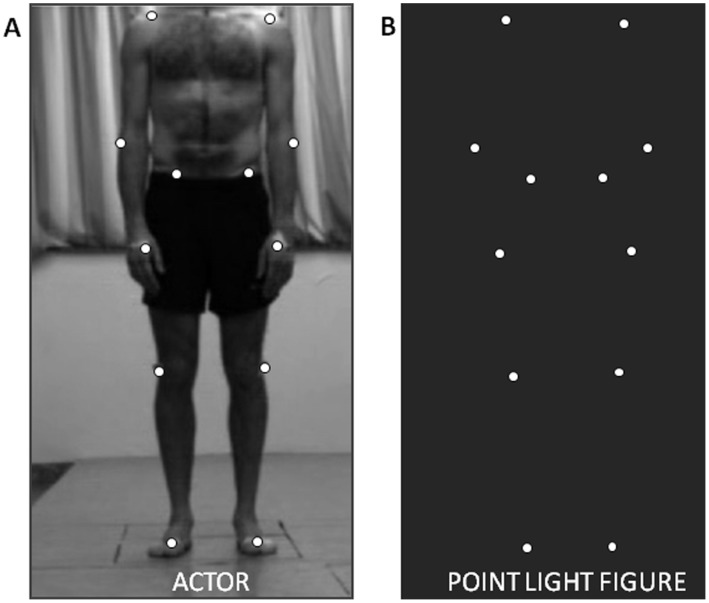
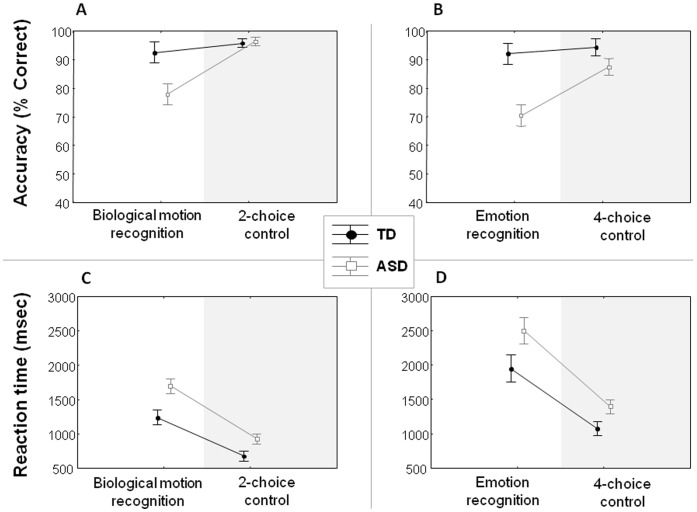
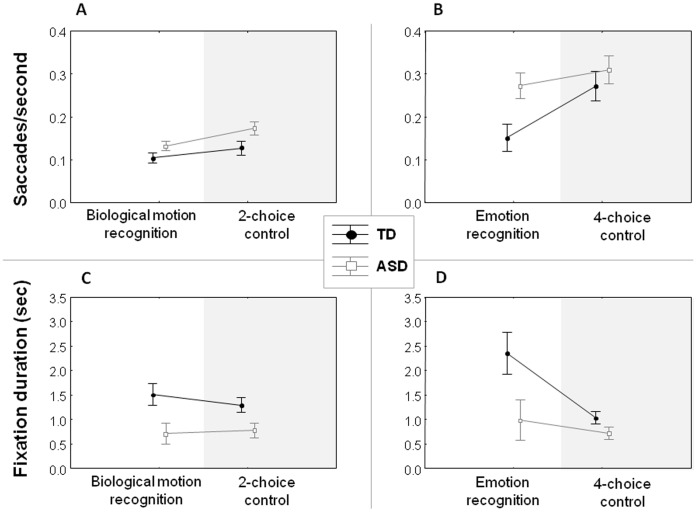
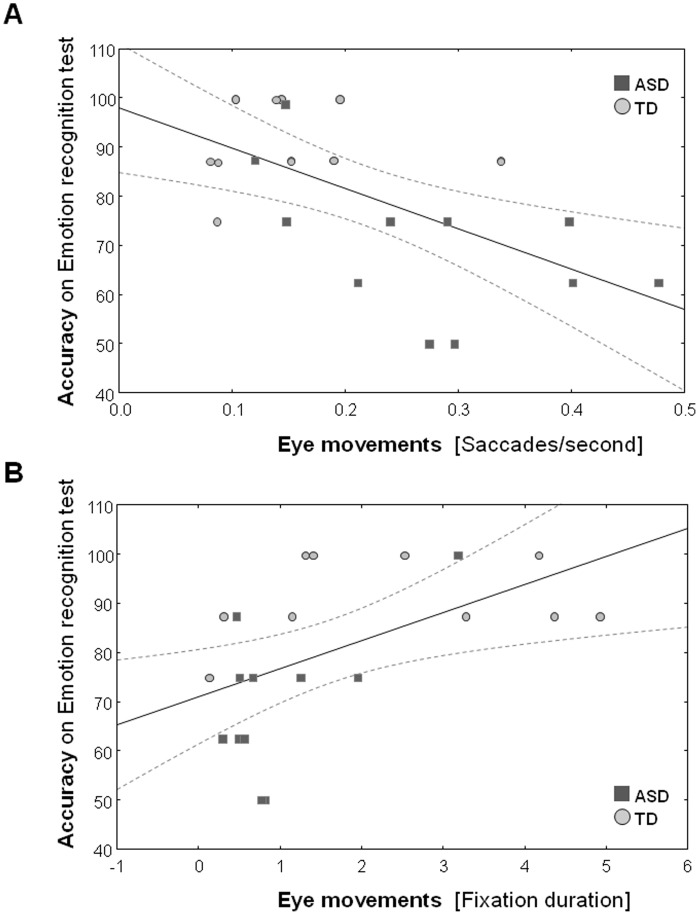
Verification
Claims the paper makes
The claims and statistics of this paper haven’t been checked yet.
Free: it reads the open-access text and checks the first 5 claims that cite a source we can check. Create a free account to check every claim.
Claims other papers make about this one
Each is checked against this paper’s own text: does it say what the citing paper says it does?
The source backs part of the claim, not all of it — or backs it for a different population, condition or comparison.
In the citing paper
“For example, Kemner and colleagues21 found that 8-12-year-old children with ASD made more saccades (reflecting shorter fixation durations) than children with typical development or ADHD when viewing static geometric shapes (see also Refs. 22, 23 - although findings on fixation durations in adults with ASD are not consistent24).”
From Shorter spontaneous fixation durations in infants with later emerging autism (2015) · cites this paper as [23]
Experimental — accuracy not yet measuredIn the citing paper
“Moreover, individuals with ASD have difficulty using information from biological motion to infer emotions (Nackaerts et al., 2012), recognize faces (O'Brien et al., 2014) and follow pointing (Swettenham et al., 2013).”
From The impact of atypical sensory processing on social impairments in autism spectrum disorder (2018) · cites this paper as Nackaerts et al., 2012
Self-check
Percentages, sums and reported differences re-computed from the paper’s own numbers.
The self-check needs the paper’s full text.
Citations
Cites
Diagnostic and Statistical Manual of Mental Disorders
Williams, J. B. W., & First, M. (2013) · Encyclopedia of Social Work · doi:10.1093/acrefore/9780199975839.013.104 · Cited by 109,519
Diagnostic and Statistical Manual of Mental Disorders
Siegel, L. J., & Fletcher‐Janzem, E. (2008) · Encyclopedia of Special Education · doi:10.1002/9780470373699.speced0655 · Cited by 8,477
Visual perception of biological motion and a model for its analysis
Johansson, G. (1973) · Perception & Psychophysics · doi:10.3758/bf03212378 · Cited by 4,462 · cited 2×
“he/she is engaged [4] and, even, the emotional state of the actor”
BackgroundThe weak coherence account: detail-focused cognitive style in autism spectrum disorders
Happé, F., & Frith, U. (2006) · Journal of Autism and Developmental Disorders · doi:10.1007/s10803-005-0039-0 · Cited by 2,884
Klin, A., Jones, W., Schultz, R., Volkmar, F., & Cohen, D. (2002) · Archives of General Psychiatry · doi:10.1001/archpsyc.59.9.809 · Cited by 2,120 · cited 1×
“, reduced preference for the eyes and increased preference for the mouth when looking at facial expressions [31–33]).”
BackgroundConstantino, J. N., Davis, S. A., Todd, R. D., Schindler, M. K., Gross, M. M., Brophy, S. L., Metzger, L. M., Shoushtari, C. S., Splinter, R., & Reich, W. (2003) · Journal of Autism and Developmental Disorders · doi:10.1023/a:1025014929212 · Cited by 1,611 · cited 13×
“Across participants, performance on the Biological motion and Emotion recognition test was related to scores on the social responsiveness scale (SRS) [22], indicating reduced performance”
BackgroundInfluentialAutism: beyond “theory of mind”
Frith, U., & Happé, F. (1994) · Cognition · doi:10.1016/0010-0277(94)90024-8 · Cited by 1,450
Visual scanning of faces in autism
Pelphrey, K. A., Sasson, N. J., Reznick, J. S., Paul, G., Goldman, B. D., & Piven, J. (2002) · Journal of Autism and Developmental Disorders · doi:10.1023/a:1016374617369 · Cited by 1,187 · cited 1×
“, reduced preference for the eyes and increased preference for the mouth when looking at facial expressions [31–33]).”
BackgroundRecognizing friends by their walk: Gait perception without familiarity cues
Cutting, J. E., & Kozlowski, L. T. (1977) · Bulletin of the Psychonomic Society · doi:10.3758/bf03337021 · Cited by 1,075 · cited 1×
“In TDsubjects, PLDs have been shown to provide sufficient information for recognizing the gender of an actor [5], the activity in which”
BackgroundHarms, M. B., Martin, A., & Wallace, G. L. (2010) · Neuropsychology Review · doi:10.1007/s11065-010-9138-6 · Cited by 1,028 · cited 1×
“recognition [3].”
Research works printed but not linked: 1
- [19]Wechsler D (1997) WAIS-III: Wechsler Adult Intelligence Scale-third edition administration and scoring manual. The Psychological Corporation, San Antonio.
Cited by
Items 101–170 of 170
Oomen, D., Wiersema, J. R., Orgs, G., & Cracco, E. (2024) · Biological Psychology · doi:10.1016/j.biopsycho.2024.108820 · Cited by 4
Bidet-Ildei, C., Ahmed, O. B., Bouidaine, D., Francisco, V., Decatoire, A., Blandin, Y., Pylouster, J., & Fernández-Maloigne, C. (2024) · Behavior Research Methods · doi:10.3758/s13428-024-02478-1 · Cited by 4
“For the discrimination task, we obtained a median correct response rate of 86.4%, in line with previous studies (Alaerts et al., 2011; Nackaerts et al., 2012), and a response time of about 1600 ms for biological PLDs, which is slightly longer (about 250 ms more) than in a previous study.”
InfluentialSchneider, J. N., Brick, T. R., & Dziobek, I. (2020) · Frontiers in Psychology · doi:10.3389/fpsyg.2020.577494 · Cited by 5
EEG frequency tagging evidence of intact social interaction recognition in adults with autism
Oomen, D., Cracco, E., Braß, M., & Wiersema, J. R. (2023) · Autism Research · doi:10.1002/aur.2929 · Cited by 4
“Overall, however, findings have been somewhat mixed, with some studies reporting differences in, for example, biological motion processing, face processing, and processing of the eyes between individuals with and without autism (e.g., Annaz et al., 2010; Clark et al., 2008; Holt et al., 2014; Koldewyn et al., 2010; Na…”
ResultJung, E. L., Zadbood, A., Lee, S., Tomarken, A. J., & Blake, R. (2013) · Frontiers in Psychology · doi:10.3389/fpsyg.2013.00795 · Cited by 4
“, 2010), as well as in clinical populations including people with autism (Moore et al., 1997; Blake et al., 2003; Kaiser and Shiffrar, 2009; McKay et al., 2012; Nackaerts et al., 2012), prosopagnosia (Lange et al.”
BackgroundBakroon, A., & Lakshminarayanan, V. (2018) · Clinical Optometry · doi:10.2147/opto.s179336 · Cited by 4
“As such, those with ASD may be fairly unaffected in their perceptual processing of BM per se, but exhibit specific impairments in emotion-related judgments and emotion processing of the point-light displays (PLDs) that are used as BM stimuli (Figure 3).(60,73,75,76) Hubert et al(77) found that those with ASD were able…”
BackgroundChard, J., Edey, R., Yon, D., Murphy, J., Bird, G., & Press, C. (2019) · Journal of Experimental Psychology Human Perception & Performance · doi:10.1037/xhp0000634 · Cited by 4
Social cognition in individuals with schizophrenia, autism spectrum disorder and controls
Negrão, J. G., Osório, A., Bressan, R. A., Gadelha, A., Lederman, V. R. G., Tafla, T. L., Fonseca, A. O., Mecca, T. P., Berberian, A. D. A., Edelstein, M. L., et al. (2023) · Jornal Brasileiro de Psiquiatria · doi:10.1590/0047-2085000000400 · Cited by 6
Perception of Biological Motion in Central and Peripheral Visual Fields
Laicāne, I., Šķilters, J., Lyakhovetskii, V., Zimaša, E., & Krūmiņa, G. (2017) · Proceedings of the Latvian Academy of Sciences Section B Natural Exact and Applied Sciences · doi:10.1515/prolas-2017-0056 · Cited by 4
“…discriminate the direction of the movement as well as different characteristics of the object including gender, mood and emotions (Cutting and Kozlowski, 1977; Kozlowski and Cutting, 1977; Clarke et al., 2005; McKay et al., 2006; Blake and Schiffrar, 2007; Atkinson, 2009; Nackaerts et al., 2012).”
BackgroundDella-Torre, M. E., Zavagno, D., & Actis-Grosso, R. (2021) · Vision · doi:10.3390/vision5020017 · Cited by 3
Mohan, S. N., Mukhtar, F., & Jobson, L. (2016) · BMJ Open · doi:10.1136/bmjopen-2016-012774 · Cited by 3
Neuropsychologie et remédiations des troubles du spectre de l’autisme
Plumet, M. (2018) · De Boeck Supérieur eBooks · doi:10.3917/dbu.breti.2018.01.0105 · Cited by 3
Mazzoni, N. (2017) · Unitn-eprints PhD (University of Trento) · doi:10.15168/11572_367929 · Cited by 4
Inokuchi, R., Ichikawa, H., Yamamoto, M., & Takemura, H. (2022) · Research Square · doi:10.21203/rs.3.rs-2037171/v2 · Cited by 4
Perception of biological motion and actions in Autism: A systematic review
Bai, Y., Poliakoff, E., & Gowen, E. (2025) · Neuroscience & Biobehavioral Reviews · doi:10.1016/j.neubiorev.2025.106343 · Cited by 2
Silva, A. E., Harding, J. E., Chakraborty, A., Dai, D. W. T., Gamble, G. D., McKinlay, C. J. D., Nivins, S., Shah, R. K., Thompson, B. S., & for the Children with HYpoglycemia and their Later Development (CHYLD) Study Team (2023) · Journal of Autism and Developmental Disorders · doi:10.1007/s10803-023-06035-1 · Cited by 2
“ASD is also associated with impaired discrimination of point-light biological motion displays depicting emotion (Federici, et al., 2020; Nackaerts, et al., 2012; Todorova, et al., 2019; Van der Hallen, et al., 2019).”
Particularités visuelles dans l’autisme : apport des techniques de morphing et eye-tracking
Han, B., Tijus, C., & Nadel, J. (2015) · Enfance · doi:10.4074/s0013754515001068 · Cited by 2
Critical Ingredients for Proper Social Interactions
Torres, E. B. (2018) · Elsevier eBooks · doi:10.1016/b978-0-12-804082-9.00002-2 · Cited by 2
Foster, N. C. (2019) · Liverpool John Moores University · doi:10.24377/ljmu.t.00010122 · Cited by 2
“Consistent with this interpretation is the work of Nackaerts et al. (2012), who found that autistic participants were less accurate than controls in recognising biological motion from point light displays, with differences in the processing of facial expressions having also been shown (Harms,…”
BackgroundResultDeStefani, S., Blain, S. D., Kraft, J. D., Locarno, L. R., Mathis, K., Lasagna, C. A., Colombi, C., Burton, C. Z., Turner, J. A., Thakkar, K. N., et al. (2026) · Research in Autism · doi:10.1016/j.reia.2026.202821 · Cited by 1
Skaribas, E. E. (2020) · SMU Journal of Undergraduate Research · doi:10.25172/jour5.1.5 · Cited by 1
“This pathway has been examined through lightpoint experiments and suggests that biological motion processing involves parts of the fusiform gyrus, extrastriate body area, and parietal and frontal cortices primarily on the right hemisphere (Nackaerts et al., 2012).”
BackgroundComparing Attention to Biological Motion in Autism across Age Groups Using Eye-Tracking
Hochhauser, M., Dommer, K. J., Atyabi, A., Li, B., Ahn, Y. A., Aubertine, M., Kim, M., Corrigan, S., Pelphrey, K. A., & Shic, F. (2023) · ACM Symposium on Eye Tracking Research and Applications (ETRA) · doi:10.1145/3588015.3590126 · Cited by 1
“Research suggests that individuals with ASD may express atypical visual preferences for looking at biological motion [Mason et al. 2021; Todorova et al. 2019], which may relate to difficulties found in recognizing the emotions conveyed by a person’s movements [Atkinson 2009; Nackaerts et al. 2012].”
BackgroundAn Examination of Eye Tracking in Videos and 3D Animations in Children with ASD and TD Children
Özdemir, S., Bülbül, I. A., Eren, S. U. N. A., & Akkuş, Ş. K. (2023) · TED EĞİTİM VE BİLİM · doi:10.15390/eb.2023.11750 · Cited by 3
Recognizing communicative intentions from single- and dyadic point light displays in autistic adults
Krawczyk, M., Pinkham, A. E., Golec-Staśkiewicz, K., Wysocka, J., & Okruszek, Ł. (2025) · Social Neuroscience · doi:10.1080/17470919.2025.2491676 · Cited by 2
“Moreover, difficulties have been observed in recognizing and describing emotions presented by point-light displayed agents (Atkinson, 2009; Hubert, 2007; Nackaerts et al., 2012).”
Inokuchi, R., Ichikawa, H., Yamamoto, M., & Takemura, H. (2022) · Research Square · doi:10.21203/rs.3.rs-2037171/v3 · Cited by 1
Multi-level processing of emotions in life motion signals revealed through pupil responsesPreprint
Yuan, T., Wang, L., & Jiang, Y. (2023) · eLife · doi:10.7554/elife.89873.1 · Cited by 1
Recognition and emotional valence of isolated gestures in autism spectrum disorder.
Pagmert, S. (2013) · University Library of Skövde (University of Skövde) · Cited by 1
Facial motion perception in autism spectrum disorder and neurotypical controls
Girges, C. (2015) · Brunel University Research Archive (BURA) (Brunel University London)
Visual Analysis of Large, Time-Dependent, Multi-Dimensional Smart Sensor Tracking Data
James, W. (2017) · Cronfa (Swansea University) · doi:10.23889/suthesis.36342
On the Study of Autistic Individuals’ Biological Motion Perception and Its Clinical Application
李, 开. (2018) · Advances in Psychology · doi:10.12677/ap.2018.85081
The role of human movement kinematics in internal state inference
Edey, R. (2017) · Birkbeck Institutional Research Online (BiRO) - Theses · doi:10.18743/pub.00040311
The Devil Is In The DetailsEnhanced visual processing and language comprehension in autism
Martin, D. A. K. (2018) · Spectrum Research Repository (Concordia University)
Visual motion perception in Autism Spectrum Disorder
Li, K., Chen, G., & Fu, X. (2018) · Advances in Psychological Science · doi:10.3724/sp.j.1042.2018.00831
“…2.1 对光流刺激的弱姿态反应 当个体在环境中运动时, 外界环境投射到视 网膜上的图像也相应移动, 这种由观察者自身运 动引起的视网膜图像变化为光流 (optical flow) (Gibson, 1950)。光流信息加工是生物体判断自身 运动 (self-motion)及识别环境变化所必须依赖的 基本过程之一, 是大脑视运动觉感知的一个重要 方面。探讨光流信息加工实验中, 刺激是一个随 机点构成的区域场, 通过计算机模拟或者让被试 坐在运动座椅上来模拟自身运动。模拟情形主要 有垂直平面、地平面和三维的点云, 要求被试根…”
InfluentialThe History of the Neuropsychology of Emotion
Teague, E. B., Meltzer, E. P., Stafford, R. J., Twaite, J. T., Filangieri, C. M., & Borod, J. C. (2019) · Oxford University Press eBooks · doi:10.1093/oxfordhb/9780199765683.013.25
Psychophysical Studies Of Motion Perception In Autism Spectrum Disorders
Bakroon, A. (2019) · UWSpace (University of Waterloo)
Computational approaches for emotion research
Schneider, J. N. (2020) · publish.UP (University of Potsdam) · doi:10.25932/publishup-45927
Motion processing in children with autism
Manning, C. (2014) · IOE EPrints · Cited by 1
Inokuchi, R., Ichikawa, H., Yamamoto, M., & Takemura, H. (2022) · Research Square · doi:10.21203/rs.3.rs-2037171/v1
Tian, J., Yang, F., Wang, Y., Wang, L., Wang, N., Jiang, Y., & Yang, L. (2024) · eLife · doi:10.7554/elife.90313.2
Multi-level processing of emotions in life motion signals revealed through pupil responsesPreprint
Yuan, T., Wang, L., & Jiang, Y. (2024) · eLife · doi:10.7554/elife.89873.2
Yuan, T., Wang, L., & Jiang, Y. (2024) · eLife · doi:10.7554/elife.89873.2.sa0
Correlations Between Dynamic Facial And Body Emotion Perception And Autistic Traits
Gvalia, T. (2024) · Journal for ReAttach Therapy and Developmental Diversities · doi:10.53555//jrtdd.v7i6.3310
Stefanidou, C. A. (2014) · University of Birmingham Institutional Research Archive (University of Birmingham) · Cited by 1
A Review of Research on Emotion Perception in Biological Motion
杜, 依. (2025) · Advances in Psychology · doi:10.12677/ap.2025.156357
Cracco, E., Oomen, D., & Wiersema, J. R. (2025) · Visual Cognition · doi:10.1080/13506285.2025.2588232
“…large variability, with some studies indicating that adults with autism are less able to detect biological motion than typically developed adults (e.g., Hsiung et al., 2019; Nackaerts et al., 2012), but other studies finding no such differences (e.g., Cusack et al., 2015; Edey et al., 2019).”
Additional file 1 of Biological motion perception in autism spectrum disorder: a meta-analysis
Todorova, G. K., Hatton, R. E. M., & Pollick, F. E. (2019) · Figshare · doi:10.6084/m9.figshare.11405835
Knight, E. J., Krakowski, A. I., Freedman, E. G., Butler, J. S., Molholm, S., & Foxe, J. J. (2022) · Figshare · doi:10.6084/m9.figshare.20336939
Knight, E. J., Krakowski, A. I., Freedman, E. G., Butler, J. S., Molholm, S., & Foxe, J. J. (2022) · Figshare · doi:10.6084/m9.figshare.20336957
Visual perception and cognition in healthy aging
Chard, J. (2025) · BIROn (Birkbeck, University of London) · doi:10.18743/pub.00054996
Knight, E. J., Krakowski, A. I., Freedman, E. G., Butler, J. S., Molholm, S., & Foxe, J. J. (2022) · Figshare · doi:10.6084/m9.figshare.20336936
Additional file 2 of Biological motion perception in autism spectrum disorder: a meta-analysis
Todorova, G. K., Hatton, R. E. M., & Pollick, F. E. (2019) · Figshare · doi:10.6084/m9.figshare.11405841
Knight, E. J., Krakowski, A. I., Freedman, E. G., Butler, J. S., Molholm, S., & Foxe, J. J. (2022) · Figshare · doi:10.6084/m9.figshare.20336951
Knight, E. J., Krakowski, A. I., Freedman, E. G., Butler, J. S., Molholm, S., & Foxe, J. J. (2022) · Figshare · doi:10.6084/m9.figshare.20336945
Knight, E. J., Krakowski, A. I., Freedman, E. G., Butler, J. S., Molholm, S., & Foxe, J. J. (2022) · Figshare · doi:10.6084/m9.figshare.20336948
Knight, E. J., Krakowski, A. I., Freedman, E. G., Butler, J. S., Molholm, S., & Foxe, J. J. (2022) · Figshare · doi:10.6084/m9.figshare.20336942
Vettori, S., der Donck, S. V., Nys, J., Moors, P., Wesemael, T. V., Steyaert, J., Rossion, B., Dzhelyova, M. P., & Boets, B. (2020) · Figshare · doi:10.6084/m9.figshare.13279895
Knight, E. J., Krakowski, A. I., Freedman, E. G., Butler, J. S., Molholm, S., & Foxe, J. J. (2022) · Figshare · doi:10.6084/m9.figshare.20336954
Additional file 3 of Biological motion perception in autism spectrum disorder: a meta-analysis
Todorova, G. K., Hatton, R. E. M., & Pollick, F. E. (2019) · Figshare · doi:10.6084/m9.figshare.11405850
Shim, L. S. (2025) · Enlighten: Theses (The University of Glasgow) · doi:10.5525/gla.thesis.85483
Understanding emotions through biological motion in autism spectrum disorder: A systematic review
Gavrilova, E., Novoselova, K., Myachykov, A., & Юрьевич, Ш. Ю. (2026) · Research in Autism · doi:10.1016/j.reia.2026.202833
Godde, A. (2017) · theses.fr (ABES) · doi:10.70675/c600aaafz6fa5z4c3cz9c48zd2fef405134f · Cited by 2
Gavrilova, E., Novoselova, K., Myachykov, A. V., & Юрьевич, Ш. Ю. (2026) · Research in Neurodiversity · doi:10.1016/j.rin.2026.100023
Affective meaning from unlabeled biological motion: Associations with social–perceptual sensitivity
Jaime, M., & daSilva, E. B. (2026) · PLoS ONE · doi:10.1371/journal.pone.0352873
“For example, Nackaerts et al. [30] reported reductions in biological motion and emotion recognition in ASD, whereas Saygin et al. [56] found unaffected perceptual thresholds for biological and non-biological form-from-motion perception.”
Gavrilova, E., Izmalkova, A. I., Novoselova, K., Myachykov, A., & Юрьевич, Ш. Ю. (2026) · Психология Журнал Высшей школы экономики · doi:10.17323/1813-8918-2026-3-498-511
Buffle, P. L. (2015) · Archive ouverte UNIGE (University of Geneva)
Metadata
- Authors
- Nackaerts, E., Wagemans, J., Helsen, W., Swinnen, S. P., Wenderoth, N., & Alaerts, K.
- Affiliations
- KU Leuven (BE)
- ETH Zurich (CH)
- Corresponding author
- Alaerts, Kaat
- ORCID
- Venue
- PLoS ONE
- Publisher
- Public Library of Science (PLoS)
- Published
- 2012-09-06
- Volume
- 7
- Issue
- 9
- Pages
- e44473
- ISSN
- 1932-6203 (ISSN-L)
- PMC
- PMC3435310
- OpenAlex
- W2064949646
- Cited by
- 160
- References
- 53
- Citations by year
- 2026: 4 · 2025: 6 · 2024: 9 · 2023: 9 · 2022: 20 · 2021: 9 · 2020: 13 · 2019: 15 · 2018: 12 · 2017: 16 · 2016: 8 · 2015: 13 · 2014: 12 · 2013: 13 · 2012: 1
- FWCI
- 6.39
- Type
- journal article
- Language
- en
- Open access
- gold
- doi.org
- Locations
- PLoS ONE (publishedVersion, cc-by)
- Europe PMC (PubMed Central) (publishedVersion, cc-by)
- PubMed Central (publishedVersion, cc-by)
- PubMed (publishedVersion)
- Lirias (submittedVersion, other-oa)
- RePEc: Research Papers in Economics (submittedVersion)
- DOAJ (DOAJ: Directory of Open Access Journals) (submittedVersion)
- Figshare (submittedVersion, cc-by)
- Repository for Publications and Research Data (ETH Zurich) (submittedVersion, cc-by)
- ETH Zürich Research Collection (cc-by)
- Funders
- Australian Government
- Vrije Universiteit Amsterdam
- Fonds Wetenschappelijk Onderzoek (P6/29)
- Vlaamse regering (METH 08/02)
- Topics
- Life Sciences › Neuroscience › Cognitive Neuroscience › Autism Spectrum Disorder Research
- Social Sciences › Psychology › Social Psychology › Action Observation and Synchronization
- Life Sciences › Neuroscience › Cognitive Neuroscience › Face Recognition and Perception
- Keywords
- autism spectrum disorder, biological motion recognition, emotion recognition, point-light displays, body language, eye movements, saccades, fixation duration, social cognition, reaction time
- MeSH terms
- Adult, Child, Child Development Disorders, Pervasive, Emotions, Eye Movements, Female, Humans, Light, Male, Motion
About these checks
Registry, retraction, Cites and statistics results are computed, not judged, with one exception: a printed reference that no index lists is read once by a model before it counts as a citation error. Claims are extracted by a model and kept only when their quote appears verbatim in the text; each cited source is then checked, with a model’s help, for whether it says what the claim relies on. Those verdicts can be wrong — read the claim’s quote and the cited source before relying on one.
Statistics and arithmetic are recomputed, not judged.
Confidence bands are shown only for fields calibrated on our annotated test set. None is calibrated yet, so no band is shown.
What counts as a claim ›How we measure confidence ›How we check this ›
Are you an author, or do you see a problem with this page? Request a review
Data sources
Bibliographic data: Semantic Scholar, OpenAlex, Crossref.
Contains information from the Semantic Scholar Academic Graph Datasets, made available under the ODC Attribution License (ODC-BY 1.0).
Semantic Scholar’s data is described in: Kinney, R., et al. (2023). The Semantic Scholar Open Data Platform. arXiv:2301.10140.
