

The DOI matches its Crossref record; 56 of the 57 references it cites were found in a registry or an index.
Marine N-3 Polyunsaturated Fatty Acids Are Inversely Associated with Risk of Type 2 Diabetes in Asians: A Systematic Review and Meta-Analysis
Open accessAbstract
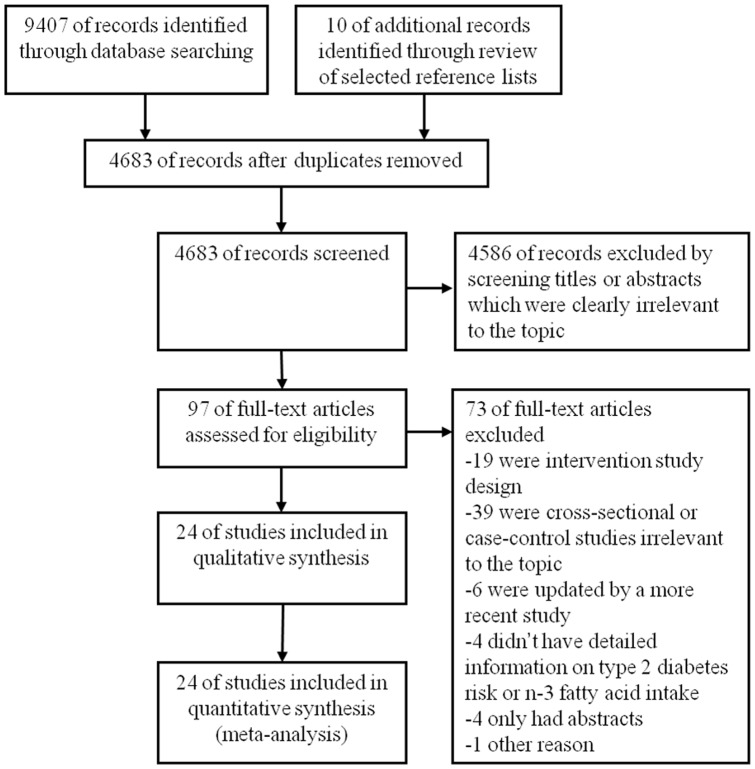
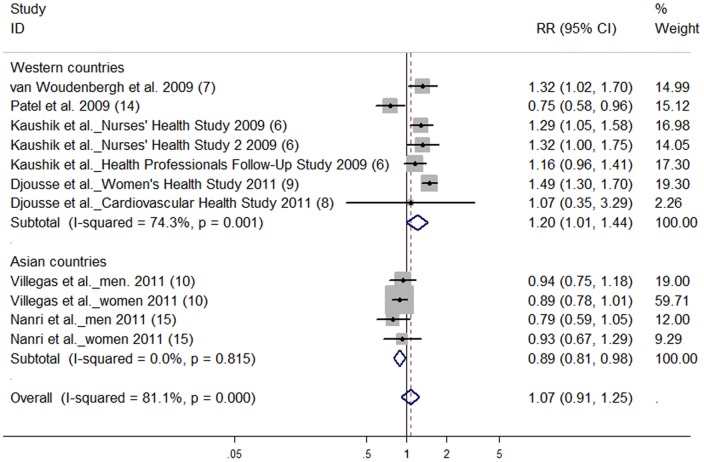
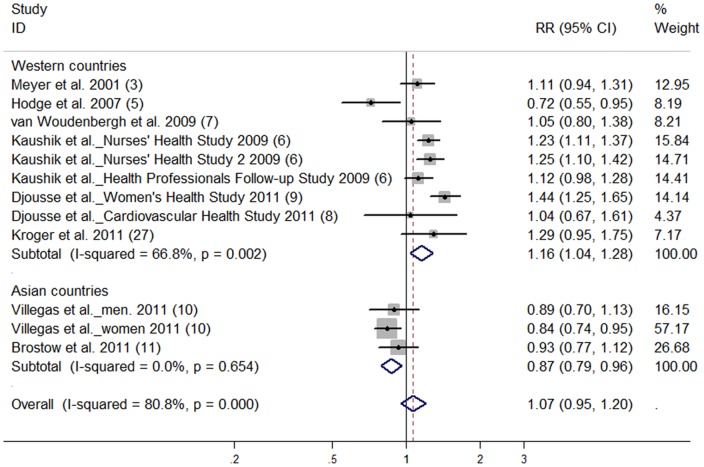
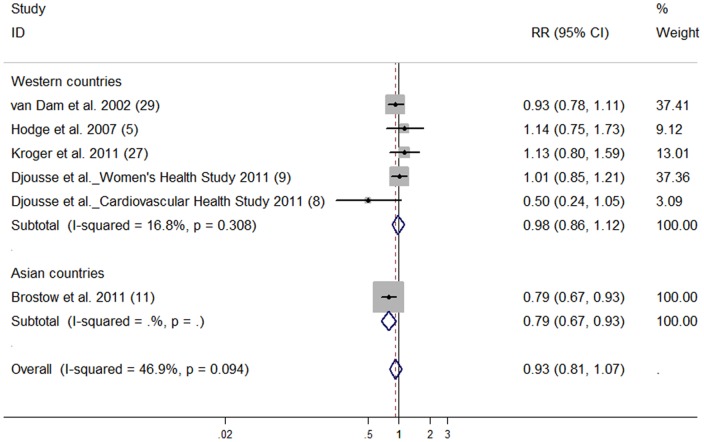
BACKGROUND: Prospective cohort studies in relation to the associations between n-3 polyunsaturated fatty acids (PUFA) and risk of type 2 diabetes (T2D) were inconsistent. Differences in tissue n-3 PUFA compositions in subjects with and without T2D were also inconsistent in both cohort and case-control studies. We conducted a systematic review and meta-analysis of prospective cohort studies to examine the associations of fish and n-3 PUFA intake with T2D risk. The differences in tissue n-3 PUFA compositions in subjects with and without T2D were investigated based on cohort and case-control studies. METHODS AND FINDINGS: PubMed, Embase, Cochrane library, China National Knowledge Infrastructure (CNKI) and Chinese VIP database up to January 2012 was used to identify relevant studies, and reference lists from retrieved studies were reviewed. Two authors independently extracted the data. Random-effects models were used to pool the summary relative risk (RR). Twenty-four studies including 24,509 T2D patients and 545,275 participants were identified. For cohort studies, the summary RR of T2D for the highest vs lowest categories of total fish, marine n-3 PUFA and alpha-linolenic acid intake was 1.07 (95% CI: 0.91, 1.25), 1.07 (95% CI: 0.95, 1.20) and 0.93 (95% CI: 0.81, 1.07), respectively. Subgroup analyses indicated that summary RR (highest vs lowest category) of T2D for fish and marine n-3 PUFA intake was 0.89 (95% CI: 0.81, 0.98) and 0.87 (95% CI: 0.79, 0.96) for Asian populations, and 1.20 (95% CI: 1.01, 1.44) and 1.16 (95% CI: 1.04, 1.28) for Western populations. Asian subjects with T2D had significantly lower tissue compositions of C22:6n-3 (SMD: -1.43; 95% CI: -1.75, -1.12) and total n-3 PUFA (SMD: -1.41; 95% CI: -2.23, -0.59) compared with those without T2D. CONCLUSION: This systematic review and meta-analysis provides evidence that marine n-3 PUFA have beneficial effects on the prevention of T2D in Asian populations.
Overview
The claims and statistics of this paper haven’t been checked yet.
Run the check — free, no account needed. It reads the open-access text and checks the sources it cites.
Integrity signals
Registry
Cites
Statistics
Figures
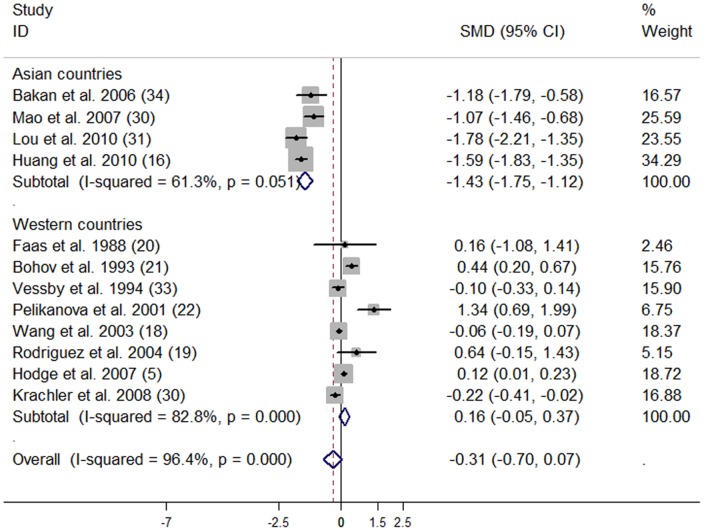
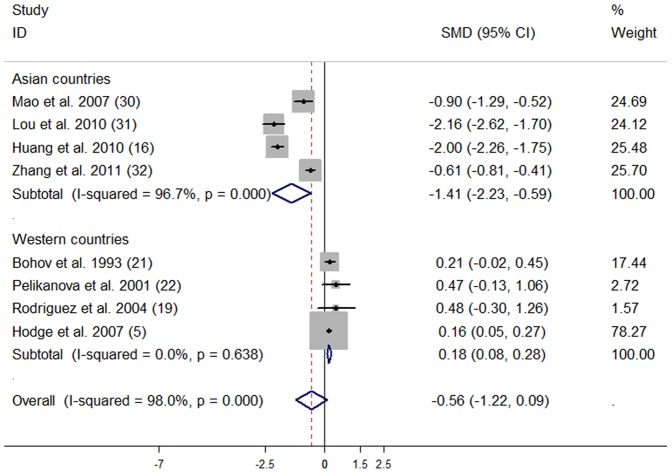
Verification
Claims the paper makes
The claims and statistics of this paper haven’t been checked yet.
Run the check — free, no account needed. It reads the open-access text and checks the sources it cites.
Claims other papers make about this one
Each is checked against this paper’s own text: does it say what the citing paper says it does?
In the citing paper
“Fish and omega-3 intake also have little association with diabetes risk, although protective associations are seen in Asian populations209-211 and fish oil supplementation modestly raises adiponectin.212”
From Dietary and Policy Priorities for Cardiovascular Disease, Diabetes, and Obesity: A Comprehensive Review (2016) · cites this paper as [209]
Self-check
Percentages, sums and reported differences re-computed from the paper’s own numbers.
The self-check needs the paper’s full text.
Citations
Cites
Measuring inconsistency in meta-analyses
Higgins, J. P. T., Thompson, S. G., Deeks, J. J., & Altman, D. G. (2003) · BMJ · doi:10.1136/bmj.327.7414.557 · Cited by 63,139
Meta-analysis of Observational Studies in Epidemiology<SUBTITLE>A Proposal for Reporting</SUBTITLE>
Stroup, D. F. (2000) · JAMA · doi:10.1001/jama.283.15.2008 · Cited by 20,623
Global estimates of the prevalence of diabetes for 2010 and 2030
Shaw, J. E., Sicree, R. A., & Zimmet, P. Z. (2010) · Diabetes Research and Clinical Practice · doi:10.1016/j.diabres.2009.10.007 · Cited by 7,216
Hindorff, L. A., Sethupathy, P., Junkins, H. A., Ramos, E. M., Mehta, J. P., Collins, F. S., & Manolio, T. A. (2009) · Proceedings of the National Academy of Sciences · doi:10.1073/pnas.0903103106 · Cited by 4,013
Methods for Trend Estimation from Summarized Dose-Response Data, with Applications to Meta-Analysis
Greenland, S., & Longnecker, M. P. (1992) · American Journal of Epidemiology · doi:10.1093/oxfordjournals.aje.a116237 · Cited by 2,353
Generalized Least Squares for Trend Estimation of Summarized Dose–response Data
Orsini, N., Bellocco, R., & Greenland, S. (2006) · The Stata Journal Promoting communications on statistics and Stata · doi:10.1177/1536867x0600600103 · Cited by 1,248
Storlien, L. H., Jenkins, A. B., Chisholm, D. J., Pascoe, W. S., Khouri, S., & Kraegen, E. W. (1991) · Diabetes · doi:10.2337/diab.40.2.280 · Cited by 967
Borkman, M., Storlien, L. H., Pan, D. A., Jenkins, A. B., Chisholm, D. J., & Campbell, L. V. (1993) · New England Journal of Medicine · doi:10.1056/nejm199301283280404 · Cited by 835
Dietary Patterns and Risk for Type 2 Diabetes Mellitus in U.S. Men
van Dam, R. M., Rimm, E. B., Willett, W. C., Stampfer, M. J., & Hu, F. B. (2002) · Annals of Internal Medicine · doi:10.7326/0003-4819-136-3-200202050-00008 · Cited by 801
Fish Oil Prevents Insulin Resistance Induced by High-Fat Feeding in Rats
Storlien, L. H., Kraegen, E. W., Chisholm, D. J., Ford, G. L., Bruce, D. G., & Pascoe, W. S. (1987) · Science · doi:10.1126/science.3303333 · Cited by 648
Research works printed but not linked: 1
- [32]Zhang B, Wang ZZ, Song HP (2011) The change of plasma long-chain polyunsaturated fatty acids in type 2 diabetes (in Chinese). Journal of China Traditional Chinese Medicine Information 3: 353– 354.
Cited by
Sorted by citations
Items 101–126 of 126
Schmidt, W., Chen, F., Broadhurst, C. L., & Crawford, M. A. (2020) · Journal of Molecular Liquids · doi:10.1016/j.molliq.2020.113376 · Cited by 4
Cheloi, N., Asgari, Z., Ershadi, S., Naseri, R., & Sharifi, A. (2024) · Journal of Research in Health Sciences · doi:10.34172/jrhs.2025.174 · Cited by 5
Modified Lipids as Functional Ingredients for Chronic Disease Management
Amenyenu, E., Abbah, Q. S., Fawole, A. O., & Onuh, J. O. (2025) · Journal of Food Science · doi:10.1111/1750-3841.70526 · Cited by 3
Beneficial effects of long-chain n-3 fatty acids on insulin-resistance: basic and clinical aspects
Delarue, J. (2025) · Biochimie · doi:10.1016/j.biochi.2025.09.014 · Cited by 8
Özdemir, E., & Bayır, M. (2022) · Animal Biotechnology · doi:10.1080/10495398.2022.2061505 · Cited by 3
Fish and Fish Oil for Cardiovascular Disease in Diabetes
Ward, R. E., & Hintze, K. J. (2016) · Elsevier eBooks · doi:10.1016/b978-0-12-802844-5.00020-8 · Cited by 2
Role of Omega-3 Fatty Acids in Cardiovascular Disorders
Peter, S., & Jacob, J. J. (2016) · Springer eBooks · doi:10.1007/978-3-319-40458-5_37 · Cited by 3
Experience in Nutrition Management of Diabetes-Affected COVID-19 Patients
Abiri, B., Guest, P. C., & Vafa, M. (2021) · Advances in experimental medicine and biology · doi:10.1007/978-3-030-59261-5_6 · Cited by 2
Role of Omega-3 Fatty Acids in Cardiovascular Disorders
Peter, S., & Jacob, J. J. (2025) · Springer eBooks · doi:10.1007/978-3-031-84200-9_17 · Cited by 1
Ye, C., Lian, G., Wang, T., Wang, H., & Xie, L. (2025) · Medicine · doi:10.1097/md.0000000000046523 · Cited by 1
Farahbakhsh-Farsi, P., Djazayery, A., Eshraghian, M. R., Koohdani, F., Zarei, M., Javanbakht, M. H., Derakhshanian, H., & Djalali, M. (2016) · Europe PMC (PubMed Central) · Cited by 1
Nussbaumer, H. (2018) · Springer eBooks · doi:10.1007/978-3-662-57808-7_7 · Cited by 1
Research on the Correlation Between Fatty Acid Composition of Aquaculture Fish and Human Health
Wang, F., & Xu, P. (2024) · International Journal of Aquaculture · doi:10.5376/ija.2024.14.0006 · Cited by 1
Inositols and other supplements in the management of PCOS
Unfer, V., Monastra, G., Tilotta, M., Forte, G., & Dinicola, S. (2021) · Elsevier eBooks · doi:10.1016/b978-0-12-823045-9.00014-6 · Cited by 2
Public health and the prevention of type 2 diabetes
Walker, K. Z. (2015) · Wiley eBooks · doi:10.1002/9781119121725.ch18 · Cited by 1
Dietary/Environmental Factors and Breast Cancer
de Lorgeril, M., & Salen, P. (2015) · Springer eBooks · doi:10.1007/978-3-319-21461-0_17
Dietary and Supplemental Long-Chain N3 Fatty Acids and Incident Type 2 Diabetes
Steffen, L. M., & Steffen, B. T. (2016) · Elsevier eBooks · doi:10.1016/b978-0-12-802844-5.00015-4 · Cited by 1
Dietary determinants, inflammation, and type 2 diabetes: insights from observational studies
Woudenbergh, G. J. G.-V. (2013) · doi:10.18174/280209
Nahrungsergänzungsmittel bei Diabetes
van Gemert, T., Weber, K. S., & Müssig, K. (2018) · Diabetologie und Stoffwechsel · doi:10.1055/s-0043-123603
Yamagishi, S., & Matsui, T. (2018) · Letters in Drug Design & Discovery · doi:10.2174/1570180816666181107113148
Nahrungsergänzungsmittel bei Diabetes
Kössler, T., Weber, K. S., & Müssig, K. (2019) · Aktuelle Ernährungsmedizin · doi:10.1055/a-0990-2003
Tian, Y., & Zheng, J. (2022) · Elsevier eBooks · doi:10.1016/b978-0-12-823914-8.00011-2
Self-citationResearch Progress of ω-3 Polyunsaturated Fatty Acids in Improving Type 2 Diabetes
周, 梦. (2024) · Bioprocess · doi:10.12677/bp.2024.141005
The Relationship Between Egg Consumption and Risk of Type 2 Diabetes in the Shahrekord Cohort Study
Ghafari, A., Arash, R., Jafari, T., Ahmadi, A., Tavassoli, E., & Shams-Abadi, A. D. (2024) · Epidemiology and Health System Journal · doi:10.34172/ehsj.26069
Fisher, R. E. (2013) · The Atrium (University of Guelph)
Metadata
- Authors
- Zheng, J.-S., Huang, T., Yang, J., Fu, Y.-Q., & Li, D.
- Affiliations
- Zhejiang University (CN)
- Corresponding author
- Li, Duo
- Venue
- PLoS ONE
- Publisher
- Public Library of Science (PLoS)
- Published
- 2012-09-11
- Volume
- 7
- Issue
- 9
- Pages
- e44525
- ISSN
- 1932-6203 (ISSN-L)
- PMC
- PMC3439396
- OpenAlex
- W2074950966
- Cited by
- 126
- References
- 57
- Citations by year
- 2025: 6 · 2024: 8 · 2023: 5 · 2022: 6 · 2021: 8 · 2020: 8 · 2019: 8 · 2018: 17 · 2017: 6 · 2016: 19 · 2015: 11 · 2014: 12 · 2013: 12
- FWCI
- 1.37
- Type
- journal article
- Language
- en
- Open access
- gold
- doi.org
- Locations
- PLoS ONE (publishedVersion, cc-by)
- Europe PMC (PubMed Central) (publishedVersion, cc-by)
- PubMed Central (publishedVersion, cc-by)
- PubMed (publishedVersion)
- RePEc: Research Papers in Economics (submittedVersion)
- DOAJ (DOAJ: Directory of Open Access Journals) (submittedVersion, cc-by-sa)
- Figshare (submittedVersion, cc-by)
- Funders
- National Natural Science Foundation of China (973 Program, 2011CB504002, 30972464)
- National Key Research and Development Program of China (30972464, 2011CB504002)
- Topics
- Health Sciences › Nursing › Nutrition and Dietetics › Fatty Acid Research and Health
- Health Sciences › Medicine › Public Health, Environmental and Occupational Health › Nutritional Studies and Diet
- Life Sciences › Agricultural and Biological Sciences › Aquatic Science › Aquaculture Nutrition and Growth
- Keywords
- type 2 diabetes, omega-3 fatty acids, marine fatty acids, fish consumption, alpha-linolenic acid, dietary intake, tissue fatty acid composition, Asian populations, Western populations, docosahexaenoic acid, EPA, diabetes risk, prospective cohort, subgroup analysis by ethnicity, omega-3 supplementation, diabetes remission, glycemic control
- MeSH terms
- Adult, Aged, Animals, Diabetes Mellitus, Type 2, Diet, Female, Fish Oils, Humans, Male, Middle Aged, Prospective Studies, Risk, Cohort Studies, Fatty Acids, Omega-3, Case-Control Studies, Asian People
About these checks
Registry, retraction, Cites and statistics results are computed, not judged, with one exception: a printed reference that no index lists is read once by a model before it counts as a citation error. Claims are extracted by a model and kept only when their quote appears verbatim in the text; each cited source is then checked, with a model’s help, for whether it says what the claim relies on. Those verdicts can be wrong — read the claim’s quote and the cited source before relying on one.
Statistics and arithmetic are recomputed, not judged.
Confidence bands are shown only for fields calibrated on our annotated test set. None is calibrated yet, so no band is shown.
What counts as a claim ›How we measure confidence ›How we check this ›
Are you an author, or do you see a problem with this page? Request a review
