

The DOI matches its Crossref record; 41 of the 42 references it cites were found in a registry or an index.
Characterizing the Mechanism of Action of Double-Stranded RNA Activity against Western Corn Rootworm (Diabrotica virgifera virgifera LeConte)
Open accessAbstract
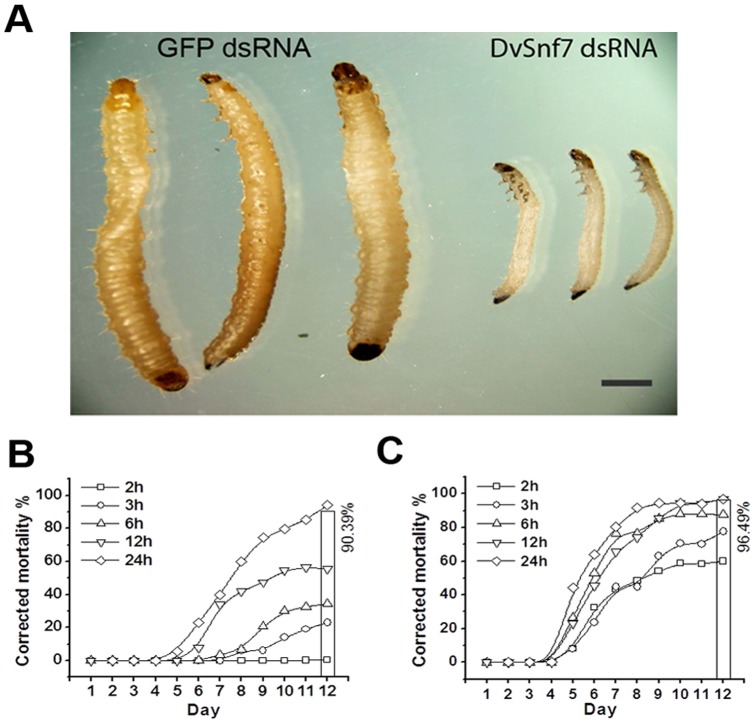
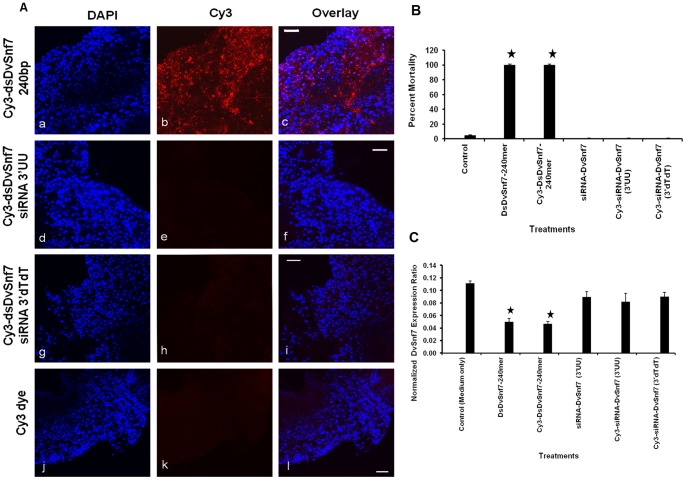
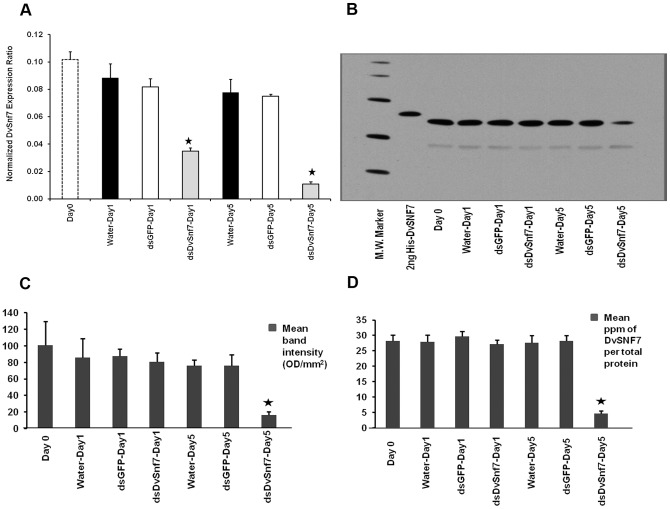
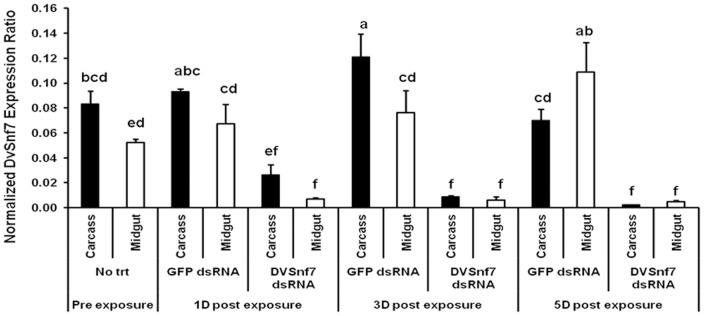
RNA interference (RNAi) has previously been shown to be effective in western corn rootworm (WCR, Diabrotica virgifera virgifera LeConte) larvae via oral delivery of synthetic double-stranded RNA (dsRNA) in an artificial diet bioassay, as well as by ingestion of transgenic corn plant tissues engineered to express dsRNA. Although the RNAi machinery components appear to be conserved in Coleopteran insects, the key steps in this process have not been reported for WCR. Here we characterized the sequence of events that result in mortality after ingestion of a dsRNA designed against WCR larvae. We selected the Snf7 ortholog (DvSnf7) as the target mRNA, which encodes an essential protein involved in intracellular trafficking. Our results showed that dsRNAs greater than or equal to approximately 60 base-pairs (bp) are required for biological activity in artificial diet bioassays. Additionally, 240 bp dsRNAs containing a single 21 bp match to the target sequence were also efficacious, whereas 21 bp short interfering (si) RNAs matching the target sequence were not. This result was further investigated in WCR midgut tissues: uptake of 240 bp dsRNA was evident in WCR midgut cells while a 21 bp siRNA was not, supporting the size-activity relationship established in diet bioassays. DvSnf7 suppression was observed in a time-dependent manner with suppression at the mRNA level preceding suppression at the protein level when a 240 bp dsRNA was fed to WCR larvae. DvSnf7 suppression was shown to spread to tissues beyond the midgut within 24 h after dsRNA ingestion. These events (dsRNA uptake, target mRNA and protein suppression, systemic spreading, growth inhibition and eventual mortality) comprise the overall mechanism of action by which DvSnf7 dsRNA affects WCR via oral delivery and provides insights as to how targeted dsRNAs in general are active against insects.
Overview
The claims and statistics of this paper haven’t been checked yet.
Run the check — free, no account needed. It reads the open-access text and checks the sources it cites.
Integrity signals
Registry
Cites
Statistics
Figures
Verification
Claims the paper makes
The claims and statistics of this paper haven’t been checked yet.
Run the check — free, no account needed. It reads the open-access text and checks the sources it cites.
Claims other papers make about this one
Each is checked against this paper’s own text: does it say what the citing paper says it does?
In the citing paper
“Suppression of Snf7 has been reported to cause increased D. v. virgifera larval mortality leading to reduced root damage (Bolognesi et al., 2012).”
From Genetically engineered crops help support conservation biological control (2019) · cites this paper as Bolognesi et al., 2012
In the citing paper
“This GE maize event (MON87411) produces a dsRNA targeting the Snf7 protein in D. v. virgifera, which is crucial for the transport of transmembrane proteins (Bachman et al., 2013;Bolognesi et al., 2012).”
From Genetically engineered crops help support conservation biological control (2019) · cites this paper as Bolognesi et al., 2012
Self-check
Percentages, sums and reported differences re-computed from the paper’s own numbers.
The self-check needs the paper’s full text.
Citations
Cites
Proceedings of the National Academy of Sciences of the United States of America
Dowling, J. E., & Wald, G. (2009) · Nutrition Reviews · doi:10.1111/j.1753-4887.1981.tb06752.x · Cited by 17,937
Potent and specific genetic interference by double-stranded RNA in Caenorhabditis elegans
Fire, A., Xu, S., Montgomery, M. K., Kostas, S. A., Driver, S. E., & Mello, C. C. (1998) · Nature · doi:10.1038/35888 · Cited by 15,429
Control of coleopteran insect pests through RNA interference
Baum, J. A., Bogaert, T., Clinton, W., Heck, G. R., Feldmann, P., Ilagan, O., Johnson, S., Plaetinck, G., Munyikwa, T., Pleau, M., et al. (2007) · Nature Biotechnology · doi:10.1038/nbt1359 · Cited by 1,789
Mao, Y.-B., Cai, W.-J., Wang, J.-W., Hong, G.-J., Tao, X.-Y., Wang, L.-J., Huang, Y.-P., & Chen, X.-Y. (2007) · Nature Biotechnology · doi:10.1038/nbt1352 · Cited by 1,358 · cited 1×
“economically important pests, including western corn rootworm (WCR, Diabrotica virgifera virgifera), southern corn rootworm (SCR, Diabrotica undecimpunctata howardii), Colorado potato beetle (Leptinotarsa decemlineata) [7], cotton bollworm (Helicoverpa armigera) [9], beet armyworm (Spodoptera exigua) [10] and brown pl…”
BackgroundMechanisms of dsRNA uptake in insects and potential of RNAi for pest control: A review
Huvenne, H., & Smagghe, G. J. (2009) · Journal of Insect Physiology · doi:10.1016/j.jinsphys.2009.10.004 · Cited by 996
Gene silencing as an adaptive defence against viruses
Waterhouse, P. M., Wang, M., & Lough, T. J. (2001) · Nature · doi:10.1038/35081168 · Cited by 985
Terenius, O., Papanicolaou, A., Garbutt, J. S., Eleftherianos, I., Huvenne, H., Kanginakudru, S., Albrechtsen, M., An, C., Aymeric, J. L., Barthel, A., et al. (2010) · Journal of Insect Physiology · doi:10.1016/j.jinsphys.2010.11.006 · Cited by 877
Palauqui, J., Elmayan, T., Pollien, J., & Vaucheret, H. (1997) · The EMBO Journal · doi:10.1093/emboj/16.15.4738 · Cited by 780
RNA Interference Directs Innate Immunity Against Viruses in Adult Drosophila
Wang, X.-H., Aliyari, R., Li, W.-X., Li, H.-W., Kim, K., Carthew, R. W., Atkinson, P. W., & Ding, S. (2006) · Science · doi:10.1126/science.1125694 · Cited by 726
Ingested double-stranded RNAs can act as species-specific insecticides
Whyard, S., Singh, A. D., & Wong, S. (2009) · Insect Biochemistry and Molecular Biology · doi:10.1016/j.ibmb.2009.09.007 · Cited by 654
Research works printed but not linked: 2
- [23]Bucher G, Scholten J, Klinger M (2002) Parental RNAi in Tribolium (Coleoptera) Current Biology. 12: R85– R86. 11839285
- [41]Ramaseshadri P, Segers G, R F, Clinton W, Oliver I, et al.. (2012) Suppression of a component of the ESCRT-III pathway (Snf7) by oral RNAi disrupts endosomal-autophagic pathway in the western corn rootworm (Diabrotica virgifera virgifera) larvae Plos One. Under review.
Cited by
Sorted by citations
Items 401–470 of 470
High-Dose/Refuge Strategy for Insect Resistance to Bt Crops
Morishita, M. (2019) · Japanese Journal of Applied Entomology and Zoology · doi:10.1303/jjaez.2019.29 · Cited by 1
Gene silencing by double stranded Ribonucleic acid (RNA)
Ahmed, H. G. M., ., A., Shaukat, S., Kousar, I., Rafiq, M., Ilyas, M., Ullah, A., & Buksh, K. (2020) · World Journal of Biology and Biotechnology · doi:10.33865/wjb.005.01.0328 · Cited by 1
RNA Interference: A Promising Molecular Tool for Insect Pest Control
Máximo, W. P. F. (2019) · Modern Concepts & Developments in Agronomy · doi:10.31031/mcda.2019.05.000614 · Cited by 1
RESISTANCE OF CITRUS PEST MITES TO ACARICIDES
da Rocha, C. M., de Castro, M. C., & de Andrade, D. J. (2022) · doi:10.22533/at.ed.4432201097 · Cited by 1
Konarev, A. V. (2023) · Plant Protection News · doi:10.31993/2308-6459-2023-106-1-15625 · Cited by 1
Matsumura, E. E., Nigg, J. C., Henry, E. M., & Falk, B. W. (2020) · bioRxiv (Cold Spring Harbor Laboratory) · doi:10.1101/2020.11.15.383588 · Cited by 1
Editorial overview: Insect genomics — shifting the focus of genomics from the lab to the field
Edwards, O. R. (2015) · Current Opinion in Insect Science · doi:10.1016/j.cois.2015.12.006
Hitchon, A. (2015) · The Atrium (University of Guelph)
Engineering Insect Resistance in Tomato by Transgenic Approaches
Rajam, M. V., & Yogindran, S. (2017) · Elsevier eBooks · doi:10.1016/b978-0-12-802441-6.00010-3
The Mechanism of RNA Interference in Arthropods
Yoon, J. (2018) · UKnowledge (University of Kentucky) · doi:10.13023/etd.2018.219
Yu Bin, J. U. N. G., Kim, J. H., Kwon, H. R., Lim, H., Yu, Y.-M., Yasunaga-Aoki, C., & Yong Man, Y. O. U. N. (2018) · Journal of the Faculty of Agriculture Kyushu University · doi:10.5109/1955397
Molecular Analysis for Characterizing Transgenic Events
Chen, W., & Wang, P. (2018) · Methods in molecular biology · doi:10.1007/978-1-4939-8778-8_24
Tuffery, J. W. (2018) · Otago University Research Archive (University of Otago)
Muzzatti, M. J. (2019) · The Atrium (University of Guelph) · doi:10.13140/rg.2.2.25038.27207
Kim, J. H., Kwon, H. R., Yu, Y.-M., Yasunaga-Aoki, C., & Youn, Y. N. (2020) · Journal of the Faculty of Agriculture Kyushu University · doi:10.5109/2558898
Targeted genome engineering for insects control
Saurabh, S., & Prasad, D. (2021) · Elsevier eBooks · doi:10.1016/b978-0-12-821910-2.00007-2
Reproducible dsRNA Microinjection and Oviposition Bioassay in Mosquitoes and House Flies
Sanscrainte, N. D., Waits, C. M., Geden, C. J., Estep, A. S., & Becnel, J. J. (2018) · Journal of Visualized Experiments · doi:10.3791/58650-v
RNA interference: Process and Application to Pest Control
Mehlhorn, S. (2020) · doi:10.53846/goediss-8110
Garg, R., Singh, B., Kargwal, R., Tiwari, S., Yadav, S. K., Jakhar, A., Kumar, D., & Sharma, B. L. (2022) · International Journal of Plant & Soil Science · doi:10.9734/ijpss/2022/v34i2231375
Motta, A. C. Q., Dias, N. P., & Polanczyk, R. A. (2022) · doi:10.22533/at.ed.44322010914
TECHNOLOGICAL INNOVATIONS APPLIED TO INSECT PEST MANAGEMENT
Fonsêca, S. S., Pinto, C. P. G., dos Santos, A. L. Z., Sousa, A. C. G., Souza, N. D. P., & Rossi, G. D. (2022) · doi:10.22533/at.ed.4432201095
LANDSCAPE STRUCTURE AND INSECT PEST MANAGEMENT
Soares, J. R. S., de Oliveira, S. J., Junqueira, T. A. S., de Castro, M. G. B., Izidro, Y. E., & Fernandes, O. A. (2022) · doi:10.22533/at.ed.4432201094
CHALLENGES IN INSECT PEST MANAGEMENT IN SUGARCANE CROP
Seleghim, A. R., Bortoli, S. A. D., & Ramalho, D. G. (2022) · doi:10.22533/at.ed.4432201098
CHALLENGES OF DIGITAL AGRICULTURE IN PEST MANAGEMENT
Rosalen, D. L. (2022) · doi:10.22533/at.ed.44322010911
Taguti, É. A., Monteiro, G. G., Souza, I. L., & Martinelli, N. M. (2022) · doi:10.22533/at.ed.4432201099
QUALITY CONTROL IN MASS REARING OF INSECTS
Pinto, M. M. D., Ramalho, D. G., da Silva, B. K. R., de Souza, J. M., Silva, M. B., de Barros, T. N., & Bortoli, S. A. D. (2022) · doi:10.22533/at.ed.4432201091
GOOD PRACTICES IN AGRICULTURAL SPRAYING FOR PEST MANAGEMENT
Peterlini, E., Spadoni, A. B. D., Pelegrini, G., Siqueira, M. T. L., Ferreira, P. H. U., & Ferreira, M. D. C. (2022) · doi:10.22533/at.ed.4432201096
CONSERVATION PRACTICES FOR MAINTENANCE OF NATURAL ENEMIES IN AGROECOSYSTEMS
dos Santos, I. L. P., Nascimento, V. F., Ramalho, D. G., de Lacerda, L. B., Melo, M. A. D., Peixoto, P. G., & Bortoli, S. A. D. (2022) · doi:10.22533/at.ed.4432201092
Plastid double-strand RNA transgenes trigger small RNA-based gene silencing of nuclear-encoded genesPreprint
Bélanger, S., Kramer, M. C., Payne, H., Slotkin, R. K., Meyers, B. C., & Staub, J. M. (2022) · bioRxiv (Cold Spring Harbor Laboratory) · doi:10.1101/2022.12.06.519219
Chloroplasts: The Future of Large-Scale Protein Production
Julian-Chávez, B., Ornelas, S. S., Rascón-Cruz, Q., Barriga, C. D. G., Arévalo‐Gallegos, S., Iglesias-Figueroa, B. F., Estrada, L. I. S., Siqueiros-Cendón, T., Sinagawa‐García, S. R., & Espinoza-Sánchez, E. A. (2023) · Physiology · doi:10.5772/intechopen.111829
Souza, L., Okumoto, N. C. D. C. S., & Marques‐Souza, H. (2023) · bioRxiv (Cold Spring Harbor Laboratory) · doi:10.1101/2023.12.05.570222
RNA vaccines in plants: Applications and future scope
Hans, A. L., & Saxena, S. (2024) · Elsevier eBooks · doi:10.1016/b978-0-443-22264-1.00020-7
REDDY, N. V., Suman, T. C., GRACY, R. G., Yadu, Y. K., Venkatesan, T., & SUSHIL, S. N. (2025) · Journal of Biological Control · doi:10.18311/jbc/2024/44991
RNAi-Based Biopesticide: A Powerful Tool for Crop Protection
Yadav, R., Chauhan, S., Sharma, H. C., Tiwari, R., & Singh, C. P. (2025) · Springer eBooks · doi:10.1007/978-981-97-7213-1_12
Konarev, A. V. (2024) · Biology Bulletin Reviews · doi:10.1134/s2079086424600954
Advancing towards the commercial application of RNAi in insect pest management
Balagalla, D. N., Wasana, H. M. S., & Jayasinghe, W. H. (2025) · CABI Reviews · doi:10.1079/cabireviews.2025.0024
Arya, R., Mohan, J., Bharti, B., Kumar, A., Negi, N., & Gautam, B. (2025) · International Journal of Advanced Biochemistry Research · doi:10.33545/26174693.2025.v9.i4c.4066
Plastid-Mediated RNA Interference for Pest Control
Li, S., Wu, M., & Zhang, J. (2025) · Springer eBooks · doi:10.1007/978-3-031-81549-2_8
RNA Insecticides and Biodiversity Conservation
Willow, J., & Smagghe, G. J. (2025) · Springer eBooks · doi:10.1007/978-3-031-81549-2_4
Arya, S. K., & Palli, S. R. (2025) · Springer eBooks · doi:10.1007/978-3-031-81549-2_15
Yeast Oral Delivery of DAF16 shRNAs Results in Effective Gene Silencing in C. elegans
Caraba, B., Montanari, A., Schifano, E., Stocchi, F., Costanzo, G., Uccelletti, D., & Mazzoni, C. (2025) · Current Issues in Molecular Biology · doi:10.3390/cimb47070570
Advances in RNAi for agricultural pest control
Molinari, M. D. C., Fuganti‐Pagliarini, R., Rosa, J. D., Arraes, F. B. M., Abbad, S. V., de Farias, M. P., Mertz-Henning, L. M., Nepomuceno, A. L., & Molinari, H. B. C. (2025) · Elsevier eBooks · doi:10.1016/b978-0-443-33341-5.00028-8
Overview of RNA Interference Methods to Hamper Phytoplasma Transmission by Phloem-Feeding Vectors
Parise, C., Galetto, L., Palmano, S., & Marzachì, C. (2025) · CABI eBooks · doi:10.1079/9781800627031.0007
CRISPR-Cas9 and its Role in Insect Pest Management
S, N. R. K., Adhikari, V., Das, A., C, A. K., Nagarjuna, T. N., Tippimath, S., & Niranjana, M. V. (2025) · Indian Journal of Entomology · doi:10.55446/ije.2025.2839
Tang, B., Han, Y., Zhong, F., Zhang, Y., Zhou, Y., Zhang, X., Zhou, M., & Jun, L. (2025) · SSRN Electronic Journal · doi:10.2139/ssrn.5639029
Kumari, A., Suhag, A., Jaiwal, R., Jaiwal, P. K., & Chaudhary, D. (2025) · Molecular Biotechnology · doi:10.1007/s12033-025-01529-y
RNA interference: Basic science to applications in pest management
Palli, S. R., Koo, J., & Moola, A. K. (2025) · Elsevier eBooks · doi:10.1016/b978-0-323-95424-2.00063-7
Corporate Influence and Intellectual Property in Transgenic Crop Development
Yavaş, C., & Arvas, Y. E. (2026) · doi:10.1002/9781394373642.ch16
Small RNA-based communication from plants to pathogenic bacterial cells
Ravet, A. (2023) · theses.fr (ABES) · doi:10.70675/8b546970z9c3fz477ez98e6z2b8a5febc404
A scalable RNAi nanoparticle approach for lethal gene targeting in the German cockroach
Wang, J., Zhang, Y., Zhao, Y. Q., Yang, T., Liu, X., Wu, C., Zhou, Y.-Y., Dewer, Y., Li, F. B., Senanayake, P. D., et al. (2026) · Pest Management Science · doi:10.1002/ps.70790
Canuto, F., Marzachi, C., Bosco, D., & Galetto, L. (2026) · Acta Horticulturae · doi:10.17660/actahortic.2026.1454.44
Neuropeptide Pathways as Next‐Generation Targets for Manipulating Insect Behaviour and Communication
Devi, D. L., Singh, J. K., & Mourya, P. K. (2026) · Entomologia Experimentalis et Applicata · doi:10.1111/eea.70175
He, C., Liao, Z., Li, Z., Zhang, H., Wu, H., Wang, M., Gao, Y., & Gao, C. (2026) · Pesticide Biochemistry and Physiology · doi:10.1016/j.pestbp.2026.107308
Luo, J., Guo, Q., Hu, R., Zhang, M., Wang, G., & Yang, B. (2026) · Frontiers in Insect Science · doi:10.3389/finsc.2026.1912427
RNAi: the next wave of green agriculture, challenges, and bridging the translational gap
Abdullah, Z. K., Ling, K., Ariffin, N., & Wong, M. (2026) · Plant Cell Reports · doi:10.1007/s00299-026-03939-x
Zhang, X., Huang, Y., Tang, X., Xiao, L., & Tan, Y. (2026) · Advanced Agrochem · doi:10.1016/j.aac.2026.08.013
Bao, W., Qiu, Y., Zhao, X., Sun, D., & Gao, F. (2026) · Insects · doi:10.3390/insects17090931
Oral RNAi in Euschistus heros: Evaluation of Gene Silencing Using Cationic Polymer-Stabilized dsRNA
Quiroga-Murcia, D. E., de Barros, D. R., Schutter, K. D., & Zotti, M. J. (2026) · Neotropical Entomology · doi:10.1007/s13744-026-01440-4
Metadata
- Authors
- Bolognesi, R., Ramaseshadri, P., Anderson, J., Bachman, P., Clinton, W., Flannagan, R., Ilagan, O., Lawrence, C., Levine, S., Moar, W., Mueller, G., Tan, J., Uffman, J., Wiggins, E., Heck, G., & Segers, G.
- Affiliations
- Monsanto (United States) (US)
- Corresponding author
- Ramaseshadri, Parthasarathy
- Venue
- PLoS ONE
- Publisher
- Public Library of Science (PLoS)
- Published
- 2012-10-11
- Volume
- 7
- Issue
- 10
- Pages
- e47534
- ISSN
- 1932-6203 (ISSN-L)
- PMC
- PMC3469495
- OpenAlex
- W2021552468
- Cited by
- 473
- References
- 42
- Citations by year
- 2026: 24 · 2025: 49 · 2024: 29 · 2023: 31 · 2022: 52 · 2021: 44 · 2020: 43 · 2019: 50 · 2018: 39 · 2017: 28 · 2016: 33 · 2015: 24 · 2014: 14 · 2013: 13
- FWCI
- 6.52
- Type
- journal article
- Language
- en
- Open access
- gold
- doi.org
- Locations
- PLoS ONE (publishedVersion, cc-by)
- PubMed Central (publishedVersion, cc-by)
- PubMed (publishedVersion)
- DOAJ (DOAJ: Directory of Open Access Journals) (submittedVersion, cc-by-sa)
- Figshare (submittedVersion, cc-by)
- Topics
- Life Sciences › Biochemistry, Genetics and Molecular Biology › Molecular Biology › Insect Resistance and Genetics
- Life Sciences › Biochemistry, Genetics and Molecular Biology › Molecular Biology › RNA Interference and Gene Delivery
- Life Sciences › Agricultural and Biological Sciences › Plant Science › Insect Pest Control Strategies
- Keywords
- western corn rootworm, RNA interference, double-stranded RNA, siRNA, oral dsRNA delivery, systemic RNAi, insect mortality, transgenic maize, insect pest control
- MeSH terms
- Analysis of Variance, Animals, Base Sequence, Coleoptera, Biological Assay, Enzyme-Linked Immunosorbent Assay, Insect Control, Larva, Lethal Dose 50, Molecular Sequence Data, RNA, Double-Stranded, Blotting, Western, Reverse Transcriptase Polymerase Chain Reaction, RNA Interference, Gastrointestinal Tract, Endosomal Sorting Complexes Required for Transport, Real-Time Polymerase Chain Reaction
About these checks
Registry, retraction, Cites and statistics results are computed, not judged, with one exception: a printed reference that no index lists is read once by a model before it counts as a citation error. Claims are extracted by a model and kept only when their quote appears verbatim in the text; each cited source is then checked, with a model’s help, for whether it says what the claim relies on. Those verdicts can be wrong — read the claim’s quote and the cited source before relying on one.
Statistics and arithmetic are recomputed, not judged.
Confidence bands are shown only for fields calibrated on our annotated test set. None is calibrated yet, so no band is shown.
What counts as a claim ›How we measure confidence ›How we check this ›
Are you an author, or do you see a problem with this page? Request a review
