

Positive Outcomes Influence the Rate and Time to Publication, but Not the Impact Factor of Publications of Clinical Trial Results
Open accessThe DOI matches its Crossref record; 37 of the 38 references it cites were found in a registry or an index.
Abstract
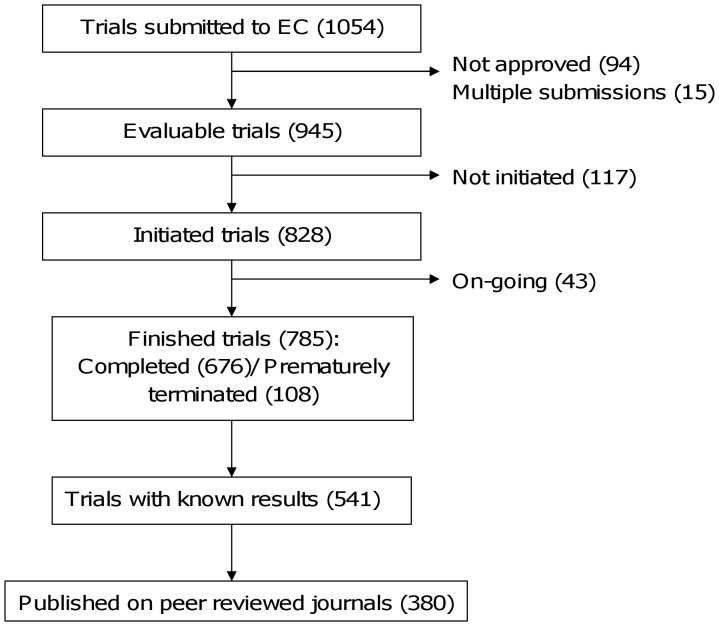
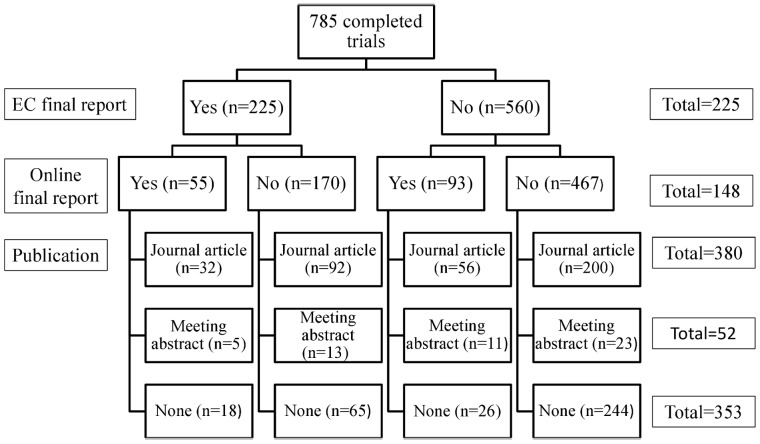
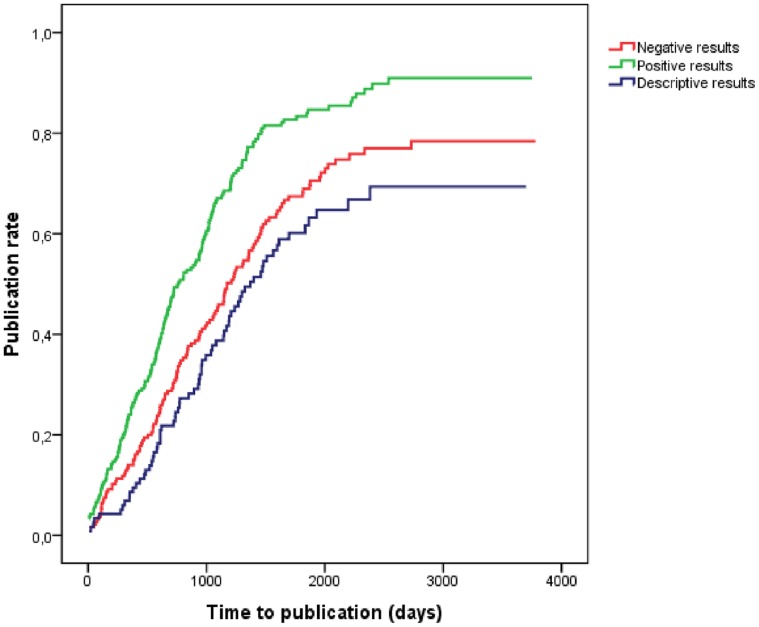
OBJECTIVES: Publication bias may affect the validity of evidence based medical decisions. The aim of this study is to assess whether research outcomes affect the dissemination of clinical trial findings, in terms of rate, time to publication, and impact factor of journal publications. METHODS AND FINDINGS: All drug-evaluating clinical trials submitted to and approved by a general hospital ethics committee between 1997 and 2004 were prospectively followed to analyze their fate and publication. Published articles were identified by searching Pubmed and other electronic databases. Clinical study final reports submitted to the ethics committee, final reports synopses available online and meeting abstracts were also considered as sources of study results. Study outcomes were classified as positive (when statistical significance favoring experimental drug was achieved), negative (when no statistical significance was achieved or it favored control drug) and descriptive (for non-controlled studies). Time to publication was defined as time from study closure to publication. A survival analysis was performed using a Cox regression model to analyze time to publication. Journal impact factors of identified publications were recorded. Publication rate was 48·4% (380/785). Study results were identified for 68·9% of all completed clinical trials (541/785). Publication rate was 84·9% (180/212) for studies with results classified as positive and 68·9% (128/186) for studies with results classified as negative (p<0·001). Median time to publication was 2·09 years (IC95 1·61-2·56) for studies with results classified as positive and 3·21 years (IC95 2·69-3·70) for studies with results classified as negative (hazard ratio 1·99 (IC95 1·55-2·55). No differences were found in publication impact factor between positive (median 6·308, interquartile range: 3·141-28·409) and negative result studies (median 8·266, interquartile range: 4·135-17·157). CONCLUSIONS: Clinical trials with positive outcomes have significantly higher rates and shorter times to publication than those with negative results. However, no differences have been found in terms of impact factor.
Overview
The claims and statistics of this paper haven’t been checked yet.
Free: it reads the open-access text and checks the first 5 claims that cite a source we can check. Create a free account to check every claim.
Integrity signals
Registry
Cites
Statistics
Figures
Verification
Claims the paper makes
The claims and statistics of this paper haven’t been checked yet.
Free: it reads the open-access text and checks the first 5 claims that cite a source we can check. Create a free account to check every claim.
Claims other papers make about this one
Each is checked against this paper’s own text: does it say what the citing paper says it does?
The cited source says what the claim attributes to it.
In the citing paper
“Compared with studies with null or negative results, studies with positive results are more likely to be published earlier (time-lag bias) [13][14][15][16][17]”
From Investigating and dealing with publication bias and other reporting biases in meta-analyses of health research: a review (2021) · cites this paper as [14]
The check wasn’t confident either way, so it gives no verdict — never disputed.
In the citing paper
“Such internet-delivered programmes provide standardised evidence-based psychological treatment at minimal cost and interference for people with chronic pain.19 31”
From Comparing the clinical-effectiveness and cost-effectiveness of an internet-delivered Acceptance and Commitment Therapy (ACT) intervention with a waiting list control among adults with chronic pain: study protocol for a randomised controlled trial (2014) · cites this paper as [31]
Experimental — accuracy not yet measuredIn the citing paper
“The J-IPV is a 4-item screening tool developed to assess IPV victimization and perpetration in patients entering substance abuse treatment 12 .”
From Intimate Partner Violence Victimization and Perpetration among U.S. Adults during COVID-19: A Brief Report (2020) · cites this paper as [12]
Self-check
Percentages, sums and reported differences re-computed from the paper’s own numbers.
The self-check needs the paper’s full text.
Citations
Cites
Pharmacological interventions for somatoform disorders in adults
Kleinstäuber, M., Witthöft, M., Steffanowski, A., van Marwijk, H., Hiller, W., & Lambert, M. J. (2014) · Cochrane Database of Systematic Reviews · doi:10.1002/14651858.cd010628.pub2 · Cited by 11,335
Improving the Quality of Reporting of Randomized Controlled Trials: The CONSORT Statement
Begg, C. (1996) · JAMA · doi:10.1001/jama.1996.03540080059030 · Cited by 3,127
Publication bias in clinical research
Easterbrook, P. J., Gopalan, R., Berlin, J. A., & Matthews, D. R. (1991) · The Lancet · doi:10.1016/0140-6736(91)90201-y · Cited by 3,109 · cited 2×
“Previous studies, performed in different areas of clinical research, including basic experimental studies, observational studies, and clinical trials, have shown the existence of a positive association between publication rates and favorable outcomes [8–12].”
ResultChan, A.-W., Hróbjartsson, A., Haahr, M. T., Gøtzsche, P. C., & Altman, D. G. (2004) · JAMA · doi:10.1001/jama.291.20.2457 · Cited by 1,845
Systematic Review of the Empirical Evidence of Study Publication Bias and Outcome Reporting Bias
Dwan, K., Altman, D. G., Arnaiz, J. A., Bloom, J., Chan, A.-W., Cronin, E., Decullier, E., Easterbrook, P. J., Von Elm, E., Gamble, C., et al. (2008) · PLoS ONE · doi:10.1371/journal.pone.0003081 · Cited by 1,546 · cited 2×
“A possibility of mismatching and even misidentification of publication exists [20–25], although we believe we have partially overcome this problem by using multiple criteria to match publications with protocols.”
MethodResultDissemination and publication of research findings: an updated review of related biases
Song, F., Parekh, Hooper, L., Loke, Y., Ryder, J., Sutton, A., Hing, C., Kwok, C., Pang, C., & Harvey, I. (2010) · Health Technology Assessment · doi:10.3310/hta14080 · Cited by 1,039 · cited 3×
“Clinical trial publication is not a clearly dichotomic process [1], [18].”
BackgroundPublication bias in clinical trials due to statistical significance or direction of trial results
Hopewell, S., Loudon, K., Clarke, M. J., Oxman, A. D., & Dickersin, K. (2009) · Cochrane Database of Systematic Reviews · doi:10.1002/14651858.mr000006.pub3 · Cited by 898 · cited 1×
“When the publication or not of a particular study is determined by its outcomes or statistical significance, the derived bias is unacceptable, since it results in an exaggeration of the positive effects of a given treatment [1], [2].”
BackgroundDickersin, K. (1992) · JAMA · doi:10.1001/jama.1992.03480030052036 · Cited by 854
Publication bias: evidence of delayed publication in a cohort study of clinical research projects
Stern, J. M., & Simes, R. J. (1997) · BMJ · doi:10.1136/bmj.315.7109.640 · Cited by 818
Publication bias: the case for an international registry of clinical trials.
Simes, R. J. (1986) · Journal of Clinical Oncology · doi:10.1200/jco.1986.4.10.1529 · Cited by 747 · cited 2×
“Efforts have been made to prevent and reduce publication bias, including prospective registration of clinical trials [3], [4], publication of results in public databases [5] or in sponsor websites [6], and journal editors’ initiatives to promote trial registration [7].”
BackgroundCha, M., Eastwaad, S., Hartan, R., Maher, D., Olkin, I., Pitkin, R., Rennie, D., Schulz, K. F., Simel, D. L., & Straup, D. F. (1996) · Cited by 737
Comparison of Registered and Published Primary Outcomes in Randomized Controlled Trials
Mathieu, S. (2009) · JAMA · doi:10.1001/jama.2009.1242 · Cited by 730 · cited 2×
“A possibility of mismatching and even misidentification of publication exists [20–25], although we believe we have partially overcome this problem by using multiple criteria to match publications with protocols.”
MethodResultIoannidis, J. P. A. (1998) · JAMA · doi:10.1001/jama.279.4.281 · Cited by 632 · cited 2×
“Previous studies, using smaller cohorts of clinical trials, have confirmed an association between study results over time to publication [9], [13].”
ResultImpact factor: a valid measure of journal quality?
(2003) · Europe PMC (PubMed Central) · Cited by 584
Clinical Trial Registration: A Statement From the International Committee of Medical Journal Editors
DeAngelis, C. D., Drazen, J. M., Frizelle, F. A., Haug, C., Hoey, J., Horton, R., Kotzin, S., Laine, C., Marusic, A., Overbeke, A. J. P. M., et al. (2004) · JAMA · doi:10.1001/jama.292.11.1363 · Cited by 579
Dickersin, K. (2003) · JAMA · doi:10.1001/jama.290.4.516 · Cited by 512
Reporting bias in medical research - a narrative review
McGauran, N., Wieseler, B., Kreis, J., Schüler, Y.-B., Kölsch, H., & Kaiser, T. (2010) · Trials · doi:10.1186/1745-6215-11-37 · Cited by 452 · cited 1×
“Clinical trial publication is not a clearly dichotomic process [1], [18].”
BackgroundPublication Bias in Editorial Decision Making
Olson, C. M. (2002) · JAMA · doi:10.1001/jama.287.21.2825 · Cited by 395 · cited 1×
“Four studies that examined manuscripts submitted to different journals concluded that manuscript acceptation was not associated with the statistical significance of the studies [30–33].”
BackgroundNIH clinical trials and publication bias.
Dickersin, K., & Min, Y. (1993) · PubMed · Cited by 300
CAWKELL, A. E. (1970) · Nature · doi:10.1038/228789b0 · Cited by 278
Unpublished Research From a Medical Specialty Meeting: Why Investigators Fail to Publish
Weber, E. J., Callaham, M. L., Wears, R. L., Barton, C., & Young, G. (1998) · JAMA · doi:10.1001/jama.280.3.257 · Cited by 262 · cited 1×
“This would seem to indicate that publication bias is set, not at the moment of selection of articles by journal editors, but previously, when the decision to submit or not manuscripts for publication is taken, as other authors have stated [12], [34].”
ResultTime to publication for results of clinical trials
Hopewell, S., Clarke, M. J., Stewart, L., & Tierney, J. (2007) · Cochrane Database of Systematic Reviews · doi:10.1002/14651858.mr000011.pub2 · Cited by 243
Krleža-Jerić, K., Chan, A.-W., Dickersin, K., Sim, I., Grimshaw, J., & Gluud, C. (2005) · BMJ · doi:10.1136/bmj.330.7497.956 · Cited by 236
Publication of Clinical Trials Supporting Successful New Drug Applications: A Literature Analysis
Lee, K., Bacchetti, P., & Sim, I. (2008) · PLoS Medicine · doi:10.1371/journal.pmed.0050191 · Cited by 215 · cited 2×
“As other authors have pointed out [28], this information will be publically available, but it is unknown whether -or how/ when- negative trials data will translate into journal article publications.”
BackgroundResultChan, A.-W., Hrobjartsson, A., Jorgensen, K. J., Gotzsche, P. C., & Altman, D. G. (2008) · BMJ · doi:10.1136/bmj.a2299 · Cited by 202 · cited 1×
“A possibility of mismatching and even misidentification of publication exists [20–25], although we believe we have partially overcome this problem by using multiple criteria to match publications with protocols.”
MethodImproving the quality of reporting of randomized controlled trials. The CONSORT statement
Begg, C., Cho, M., Eastwood, S., Horton, R., Moher, D., Olkin, I., Pitkin, R., Rennie, D., Schulz, K. F., Simel, D., et al. (1998) · Revista Española de Salud Pública · doi:10.1590/s1135-57271998000100002 · Cited by 177
Lynch, J. R., Cunningham, M. R. A., Warme, W. J., Schaad, D. C., Wolf, F. M., & Leopold, S. S. (2007) · The Journal of Bone and Joint Surgery-American Volume · doi:10.2106/00004623-200705000-00013 · Cited by 173 · cited 1×
“Four studies that examined manuscripts submitted to different journals concluded that manuscript acceptation was not associated with the statistical significance of the studies [30–33].”
BackgroundFate of biomedical research protocols and publication bias in France: retrospective cohort study
Decullier, E., Lhéritier, V., & Chapuis, F. (2005) · BMJ · doi:10.1136/bmj.38488.385995.8f · Cited by 154 · cited 1×
“This would seem to indicate that publication bias is set, not at the moment of selection of articles by journal editors, but previously, when the decision to submit or not manuscripts for publication is taken, as other authors have stated [12], [34].”
ResultThe Randomized Controlled Trial Gets a Middle-aged Checkup
Jadad, A. R., & Rennie, D. (1998) · JAMA · doi:10.1001/jama.279.4.319 · Cited by 143
Lee, K. P., Boyd, E. A., Holroyd‐Leduc, J. M., Bacchetti, P., & Bero, L. A. (2006) · Medical Journal of Australia · doi:10.5694/j.1326-5377.2006.tb00418.x · Cited by 130 · cited 1×
“Four studies that examined manuscripts submitted to different journals concluded that manuscript acceptation was not associated with the statistical significance of the studies [30–33].”
BackgroundBlümle, A., Huwiler, K., & Witschi, M. (2008) · Swiss Medical Weekly · doi:10.4414/smw.2008.12027 · Cited by 115
Okike, K., Kocher, M. S., Mehlman, C. T., Heckman, J. D., & Bhandari, M. (2008) · The Journal of Bone and Joint Surgery-American Volume · doi:10.2106/jbjs.g.00279 · Cited by 99
Hahn, S., Williamson, P. R., & Hutton, J. L. (2002) · Journal of Evaluation in Clinical Practice · doi:10.1046/j.1365-2753.2002.00314.x · Cited by 97
Negative Results and Impact Factor: A Lesson From Neonatology
Littner, Y., Mimouni, F. B., Dollberg, S., & Mandel, D. (2005) · Archives of Pediatrics & Adolescent Medicine · doi:10.1001/archpedi.159.11.1036 · Cited by 85 · cited 2×
“However, experimental cohort studies on published trials seem to indicate otherwise [3], [14], [15].”
BackgroundBlumle, A., Meerpohl, J. J., Rucker, G., Antes, G., Schumacher, M., & von Elm, E. (2011) · BMJ · doi:10.1136/bmj.d1828 · Cited by 44
Morrey, B. F. (2008) · Yearbook of Orthopedics · doi:10.1016/s0276-1092(08)79275-7 · Cited by 26
Publication biases and phase II trials investigating anticancer targeted therapies
Penel, N., & Adenis, A. (2008) · Investigational New Drugs · doi:10.1007/s10637-008-9186-4 · Cited by 9 · cited 2×
“However, experimental cohort studies on published trials seem to indicate otherwise [3], [14], [15].”
Background
Cited by
Increasing value and reducing waste: addressing inaccessible research
Chan, A.-W., Song, F., Vickers, A., Jefferson, T., Dickersin, K., Gøtzsche, P. C., Krumholz, H. M., Ghersi, D., & van der Worp, H. B. (2014) · The Lancet · doi:10.1016/s0140-6736(13)62296-5 · Cited by 887
Toward understanding the impact of artificial intelligence on labor
Frank, M. R., Autor, D., Bessen, J. E., Brynjolfsson, E., Cebrian, M., Deming, D. J., Feldman, M., Groh, M., Lobo, J., Moro, E., et al. (2019) · Proceedings of the National Academy of Sciences · doi:10.1073/pnas.1900949116 · Cited by 713
Jones, S. E., Lane, J. M., Wood, A. R., van Hees, V. T., Tyrrell, J., Beaumont, R. N., Jeffries, A. R., Dashti, H. S., Hillsdon, M., Ruth, K. S., et al. (2019) · Nature Communications · doi:10.1038/s41467-018-08259-7 · Cited by 691
Multi-omic and multi-view clustering algorithms: review and cancer benchmark
Rappoport, N., & Shamir, R. (2018) · Nucleic Acids Research · doi:10.1093/nar/gky889 · Cited by 553
Bright and photostable chemigenetic indicators for extended in vivo voltage imaging
Abdelfattah, A. S., Kawashima, T., Singh, A., Novak, O., Liu, H., Shuai, Y., Huang, Y.-C., Campagnola, L., Seeman, S. C., Yu, J., et al. (2019) · Science · doi:10.1126/science.aav6416 · Cited by 455
Metadata
- Authors
- Suñé, P., Suñé, J. M., & Montoro, J. B.
- Affiliations
- Vall d'Hebron Hospital Universitari (ES)
- Corresponding author
- Suñé, Pilar
- ORCID
- Suñé, Pilar
- Venue
- PLoS ONE
- Publisher
- Public Library of Science (PLoS)
- Published
- 2013-01-30
- Volume
- 8
- Issue
- 1
- Pages
- e54583
- ISSN
- 1932-6203 (ISSN-L)
- PMC
- PMC3559840
- OpenAlex
- W2027266940
- Cited by
- 1,687
- References
- 38
- Citations by year
- 2026: 52 · 2025: 98 · 2024: 113 · 2023: 151 · 2022: 196 · 2021: 223 · 2020: 220 · 2019: 171 · 2018: 111 · 2017: 94 · 2016: 123 · 2015: 73 · 2014: 50 · 2013: 12
- FWCI
- 93.97
- Type
- journal article
- Language
- en
- Open access
- gold
- doi.org
- Locations
- PLoS ONE (publishedVersion, cc-by)
- Europe PMC (PubMed Central) (publishedVersion, other-oa)
- PubMed Central (publishedVersion, cc-by)
- PubMed (publishedVersion)
- RECERCAT (Consorci de Serveis Universitaris de Catalunya) (publishedVersion, other-oa)
- RePEc: Research Papers in Economics (submittedVersion)
- Dipòsit Digital de la Universitat de Barcelona (Universitat de Barcelona) (submittedVersion, cc-by)
- DOAJ (DOAJ: Directory of Open Access Journals) (submittedVersion, cc-by-sa)
- Topics
- Health Sciences › Nursing › Issues, ethics and legal aspects › Pharmaceutical industry and healthcare
- Social Sciences › Decision Sciences › Statistics, Probability and Uncertainty › Meta-analysis and systematic reviews
- Social Sciences › Library and Information Sciences › Academic Publishing and Open Access
- Keywords
- publication bias, clinical trial results, positive outcomes, time to publication, journal impact factor, publication rates, ethics committees, research dissemination
- MeSH terms
- Clinical Trials as Topic, Humans, Publications, Time Factors, Treatment Outcome, Publication Bias, Evidence-Based Medicine, Journal Impact Factor
About these checks
Registry, retraction, Cites and statistics results are computed, not judged, with one exception: a printed reference that no index lists is read once by a model before it counts as a citation error. Claims are extracted by a model and kept only when their quote appears verbatim in the text; each cited source is then checked, with a model’s help, for whether it says what the claim relies on. Those verdicts can be wrong — read the claim’s quote and the cited source before relying on one.
Statistics and arithmetic are recomputed, not judged.
Confidence bands are shown only for fields calibrated on our annotated test set. None is calibrated yet, so no band is shown.
What counts as a claim ›How we measure confidence ›How we check this ›
Are you an author, or do you see a problem with this page? Request a review
Data sources
Bibliographic data: Semantic Scholar, OpenAlex, Crossref.
Contains information from the Semantic Scholar Academic Graph Datasets, made available under the ODC Attribution License (ODC-BY 1.0).
Semantic Scholar’s data is described in: Kinney, R., et al. (2023). The Semantic Scholar Open Data Platform. arXiv:2301.10140.
