

The DOI matches its Crossref record; 76 of the 76 references it cites were found in a registry or an index.
High Prevalence of Mucosa-Associated E. coli Producing Cyclomodulin and Genotoxin in Colon Cancer
Open accessAbstract
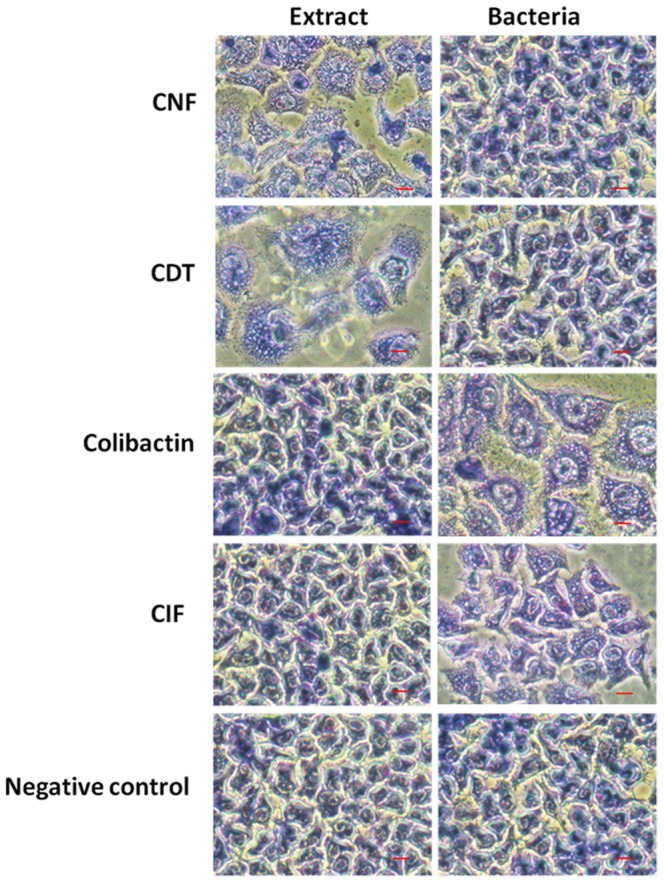
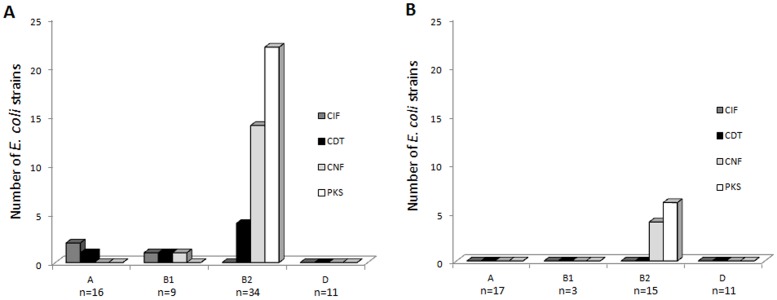
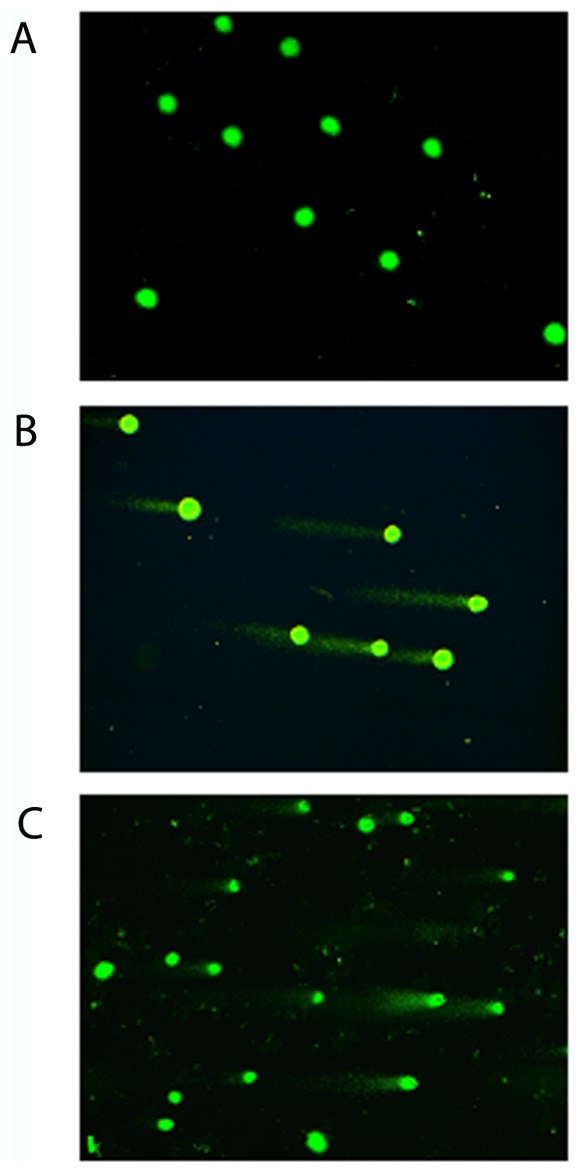
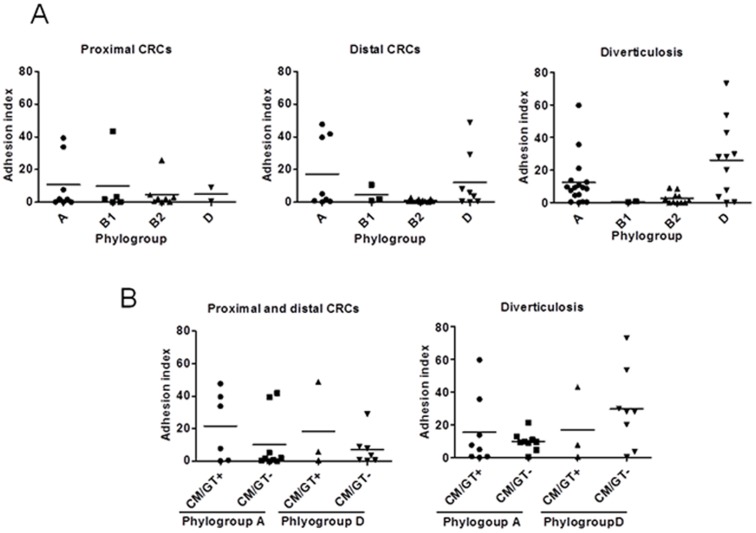
Some Escherichia coli strains produce toxins designated cyclomodulins (CMs) which interfere with the eukaryotic cell cycle of host cells, suggesting a possible link between these bacteria and cancers. There are relatively few data available concerning the colonization of colon tumors by cyclomodulin- and genotoxic-producing E. coli. We did a qualitative and phylogenetic analysis of mucosa-associated E. coli harboring cyclomodulin-encoding genes from 38 patients with colorectal cancer (CRC) and 31 with diverticulosis. The functionality of these genes was investigated on cell cultures and the genotoxic activity of strains devoid of known CM-encoding gene was investigated. Results showed a higher prevalence of B2 phylogroup E. coli harboring the colibatin-producing genes in biopsies of patients with CRC (55.3%) than in those of patients with diverticulosis (19.3%), (p<0.01). Likewise, a higher prevalence of B2 E. coli harboring the CNF1-encoding genes in biopsies of patients with CRC (39.5%) than in those of patients with diverticulosis (12.9%), (p = 0.01). Functional analysis revealed that the majority of these genes were functional. Analysis of the ability of E. coli to adhere to intestinal epithelial cells Int-407 indicated that highly adherent E. coli strains mostly belonged to A and D phylogroups, whatever the origin of the strains (CRC or diverticulosis), and that most E. coli strains belonging to B2 phylogroup displayed very low levels of adhesion. In addition, 27.6% (n = 21/76) E. coli strains devoid of known cyclomodulin-encoding genes induced DNA damage in vitro, as assessed by the comet assay. In contrast to cyclomodulin-producing E. coli, these strains mainly belonged to A or D E. coli phylogroups, and exhibited a non significant difference in the distribution of CRC and diverticulosis specimens (22% versus 32.5%, p = 0.91). In conclusion, cyclomodulin-producing E. coli belonging mostly to B2 phylogroup colonize the colonic mucosa of patients with CRC.
Overview
The claims and statistics of this paper haven’t been checked yet.
Run the check — free, no account needed. It reads the open-access text and checks the sources it cites.
Integrity signals
Registry
Cites
Statistics
Figures
Verification
Claims the paper makes
The claims and statistics of this paper haven’t been checked yet.
Run the check — free, no account needed. It reads the open-access text and checks the sources it cites.
Claims other papers make about this one
Each is checked against this paper’s own text: does it say what the citing paper says it does?
The source backs part of the claim, not all of it — or backs it for a different population, condition or comparison.
In the citing paper
“These pks-positive E. coli strains have been detected in approximately 20% of healthy individuals, 40% of patients with inflammatory bowel disease, and 60% of patients with CRC”
From Selection, Comparative Genomics, and Potential Probiotic Features of Escherichia coli 5C, a pks-Negative Strain Isolated from Healthy Infant Donor Feces (2026) · cites this paper as [153]
Experimental — accuracy not yet measured
Self-check
Percentages, sums and reported differences re-computed from the paper’s own numbers.
The self-check needs the paper’s full text.
Citations
Cites
Diversity of the Human Intestinal Microbial Flora
Eckburg, P. B., Bik, E. M., Bernstein, C. N., Purdom, E., Dethlefsen, L., Sargent, M., Gill, S. R., Nelson, K. E., & Relman, D. A. (2005) · Science · doi:10.1126/science.1110591 · Cited by 7,913
Kaper, J. B., Nataro, J. P., & Mobley, H. L. T. (2004) · Nature Reviews Microbiology · doi:10.1038/nrmicro818 · Cited by 5,583
Versalovic, J. A., Koeuth, T., & Lupski, R. L. (1991) · Nucleic Acids Research · doi:10.1093/nar/19.24.6823 · Cited by 3,249
Rapid and Simple Determination of the Escherichia coli Phylogenetic Group
Clermont, O., Bonacorsi, S., & Bingen, É. (2000) · Applied and Environmental Microbiology · doi:10.1128/aem.66.10.4555-4558.2000 · Cited by 2,647
Intestinal inflammation targets cancer-inducing activity of the microbiota
Arthur, J. C., Perez-Chanona, E., Mühlbauer, M., Tomkovich, S., Uronis, J. M., Fan, T.-J., Campbell, B. J., Abujamel, T., Dogan, B., Rogers, A. B., et al. (2012) · Science · doi:10.1126/science.1224820 · Cited by 2,263
Wu, S., Rhee, K.-J., Albesiano, E., Rabizadeh, S., Wu, X., Yen, H.-R., Huso, D. L., Brancati, F. L., Wick, E., McAllister, F., et al. (2009) · Nature Medicine · doi:10.1038/nm.2015 · Cited by 1,812
Wood, R., Mitchell, M., Sgouros, J., & Lindahl, T. (2001) · Science · doi:10.1126/science.1056154 · Cited by 1,719
Molecular mechanisms of Escherichia coli pathogenicity
Croxen, M. A., & Finlay, B. B. (2009) · Nature Reviews Microbiology · doi:10.1038/nrmicro2265 · Cited by 1,222
Escherichia coli Induces DNA Double-Strand Breaks in Eukaryotic Cells
Nougayrède, J.-P., Homburg, S., Taieb, F., Boury, M., Brzuszkiewicz, E., Gottschalk, G., Buchrieser, C., Hacker, J., Dobrindt, U., & Oswald, E. (2006) · Science · doi:10.1126/science.1127059 · Cited by 1,188
Escherichia coli induces DNA damage in vivo and triggers genomic instability in mammalian cells
Cuevas-Ramos, G., Petit, C. R., Marcq, I., Boury, M., Oswald, E., & Nougayrède, J.-P. (2010) · Proceedings of the National Academy of Sciences · doi:10.1073/pnas.1001261107 · Cited by 855
Research works printed but not linked: 3
- HM Martin, 2004, Enhanced Escherichia coli adherence and invasion in Crohn's disease and colon cancer, Gastroenterology, 127, 80
- HM Martin, 2004, Enhanced Escherichia coli adherence and invasion in Crohn's disease and colon cancer, Gastroenterology, 127, 80
- O Marchès, 2003, Enteropathogenic and enterohaemorrhagic Escherichia coli deliver a novel effector called Cif, which blocks cell cycle G2/M transition, Molecular Microbiology, 50, 1553, 10.1046/j.1365-2958.2003.03821.x · DOI
Cited by
Sorted by citations
Schwabe, R. F., & Jobin, C. (2013) · Nature Reviews Cancer · doi:10.1038/nrc3610 · Cited by 1,689
Gut microbiota in colorectal cancer: mechanisms of action and clinical applications
Wong, S. H., & Yu, J. (2019) · Nature Reviews Gastroenterology & Hepatology · doi:10.1038/s41575-019-0209-8 · Cited by 1,392
Mutational signature in colorectal cancer caused by genotoxic pks+ E. coli
Pleguezuelos-Manzano, C., Puschhof, J., Rosendahl Huber, A., van Hoeck, A., Wood, H. M., Nomburg, J., Gurjao, C., Manders, F., Dalmasso, G., Stege, P. B., et al. (2020) · Nature · doi:10.1038/s41586-020-2080-8 · Cited by 1,208
Self-citationGut microbiota imbalance and colorectal cancer
Gagnière, J. (2016) · World Journal of Gastroenterology · doi:10.3748/wjg.v22.i2.501 · Cited by 890
Microbes, Microbiota, and Colon Cancer
Sears, C. L., & Garrett, W. S. (2014) · Cell Host & Microbe · doi:10.1016/j.chom.2014.02.007 · Cited by 851
Metadata
- Authors
- Buc, E., Dubois, D., Sauvanet, P., Raisch, J., Delmas, J., Darfeuille-Michaud, A., Pezet, D., & Bonnet, R.
- Affiliations
- Inserm (FR)
- Corresponding author
- Bonnet, Richard
- Venue
- PLoS ONE
- Publisher
- Public Library of Science (PLoS)
- Published
- 2013-02-14
- Volume
- 8
- Issue
- 2
- Pages
- e56964
- ISSN
- 1932-6203 (ISSN-L)
- PMC
- PMC3572998
- OpenAlex
- W1996173530
- Cited by
- 535
- References
- 76
- Citations by year
- 2026: 20 · 2025: 42 · 2024: 62 · 2023: 44 · 2022: 62 · 2021: 83 · 2020: 49 · 2019: 49 · 2018: 31 · 2017: 21 · 2016: 25 · 2015: 17 · 2014: 20 · 2013: 8
- FWCI
- 16.57
- Type
- journal article
- Language
- en
- Open access
- gold
- doi.org
- Locations
- PLoS ONE (publishedVersion, cc-by)
- Europe PMC (PubMed Central) (publishedVersion, other-oa)
- PubMed Central (publishedVersion, cc-by)
- PubMed (publishedVersion)
- HAL (submittedVersion, other-oa)
- DOAJ (DOAJ: Directory of Open Access Journals) (submittedVersion, cc-by-sa)
- Figshare (submittedVersion, cc-by)
- Funders
- Institut National de la Santé et de la Recherche Médicale (USC-2018, U1071)
- Ligue Contre le Cancer
- Institut National de la Recherche Agronomique (U1071, USC-2018)
- Topics
- Life Sciences › Immunology and Microbiology › Microbiology › Escherichia coli research studies
- Health Sciences › Medicine › Infectious Diseases › Clostridium difficile and Clostridium perfringens research
- Life Sciences › Biochemistry, Genetics and Molecular Biology › Genetics › Bacterial Genetics and Biotechnology
- Keywords
- Escherichia coli, cytotoxic necrotizing factor 1, colorectal cancer, diverticulosis, genotoxicity, DNA damage, bacterial adhesion, host cell cycle
- MeSH terms
- Adult, Aged, Aged, 80 and over, Bacterial Adhesion, Bacterial Toxins, Colonic Neoplasms, Escherichia coli, Humans, Intestinal Mucosa, Middle Aged, Mutagens, Phenotype, Prevalence
About these checks
Registry, retraction, Cites and statistics results are computed, not judged, with one exception: a printed reference that no index lists is read once by a model before it counts as a citation error. Claims are extracted by a model and kept only when their quote appears verbatim in the text; each cited source is then checked, with a model’s help, for whether it says what the claim relies on. Those verdicts can be wrong — read the claim’s quote and the cited source before relying on one.
Statistics and arithmetic are recomputed, not judged.
Confidence bands are shown only for fields calibrated on our annotated test set. None is calibrated yet, so no band is shown.
What counts as a claim ›How we measure confidence ›How we check this ›
Are you an author, or do you see a problem with this page? Request a review
