

Investigating the Autonomic Nervous System Response to Anxiety in Children with Autism Spectrum Disorders
Open accessThe DOI matches its Crossref record; 47 of the 47 references it cites were found in a registry or an index.
Abstract
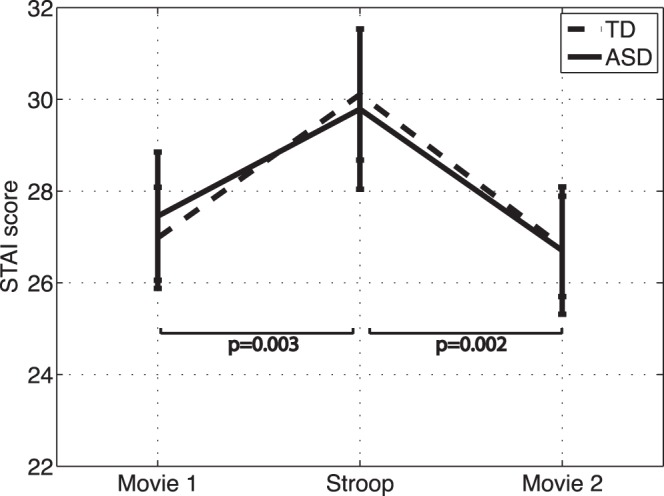
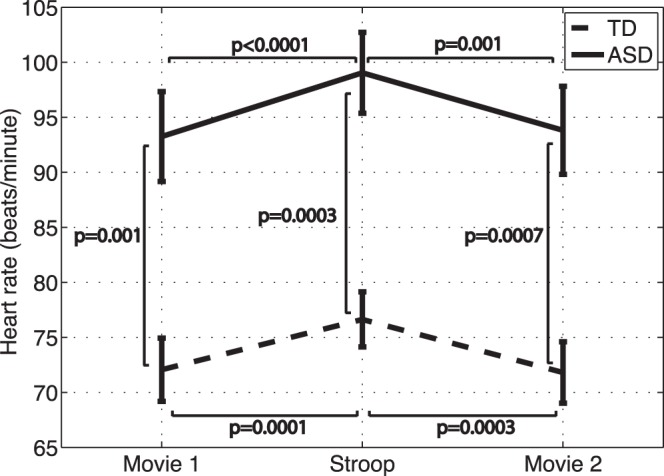
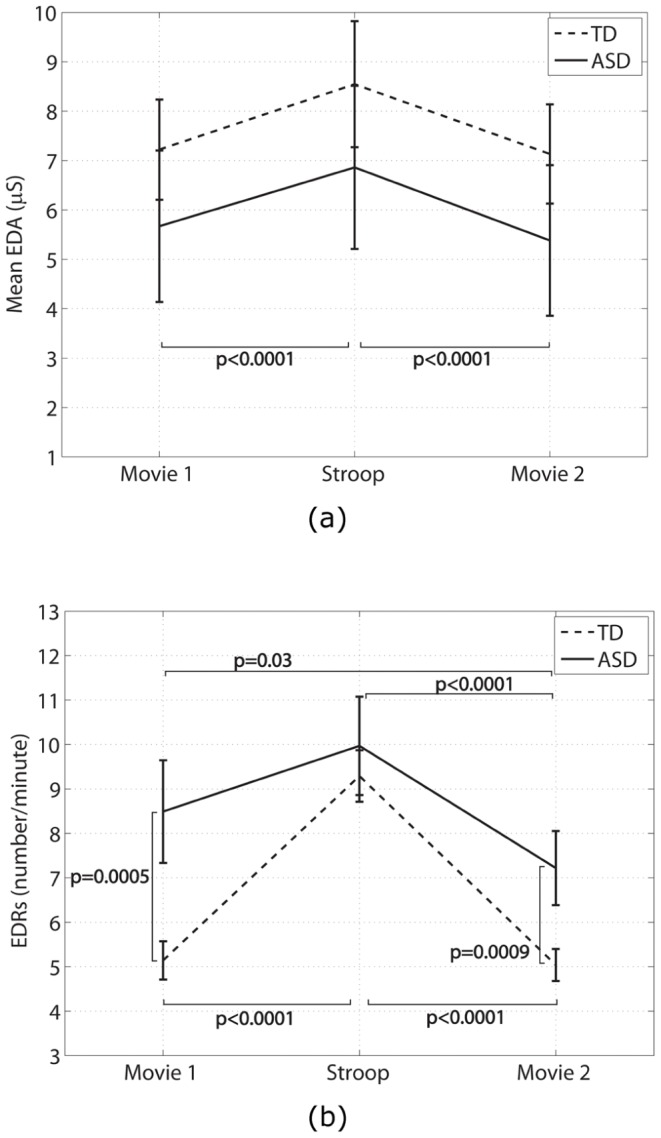
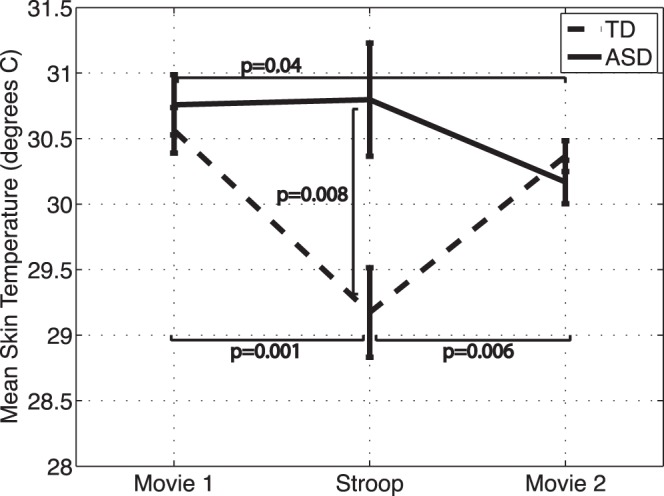
Assessment of anxiety symptoms in autism spectrum disorders (ASD) is a challenging task due to the symptom overlap between the two conditions as well as the difficulties in communication and awareness of emotions in ASD. This motivates the development of a physiological marker of anxiety in ASD that is independent of language and does not require observation of overt behaviour. In this study, we investigated the feasibility of using indicators of autonomic nervous system (ANS) activity for this purpose. Specially, the objectives of the study were to 1) examine whether or not anxiety causes significant measurable changes in indicators of ANS in an ASD population, and 2) characterize the pattern of these changes in ASD. We measured three physiological indicators of the autonomic nervous system response (heart rate, electrodermal activity, and skin temperature) during a baseline (movie watching) and anxiety condition (Stroop task) in a sample of typically developing children (n = 17) and children with ASD (n = 12). The anxiety condition caused significant changes in heart rate and electrodermal activity in both groups, however, a differential pattern of response was found between the two groups. In particular, the ASD group showed elevated heart rate during both baseline and anxiety conditions. Elevated and blunted phasic electrodermal activity were found in the ASD group during baseline and anxiety conditions, respectively. Finally, the ASD group did not show the typical decrease in skin temperature in response to anxiety. These results suggest that 1) signals of the autonomic nervous system may be used as indicators of anxiety in children with ASD, and 2) ASD may be associated with an atypical autonomic response to anxiety that is most consistent with sympathetic over-arousal and parasympathetic under-arousal.
Overview
The claims and statistics of this paper haven’t been checked yet.
Free: it reads the open-access text and checks the first 5 claims that cite a source we can check. Create a free account to check every claim.
Integrity signals
Registry
Cites
Statistics
Figures

Verification
Claims the paper makes
The claims and statistics of this paper haven’t been checked yet.
Free: it reads the open-access text and checks the first 5 claims that cite a source we can check. Create a free account to check every claim.
Claims other papers make about this one
Each is checked against this paper’s own text: does it say what the citing paper says it does?
The source backs part of the claim, not all of it — or backs it for a different population, condition or comparison.
In the citing paper
“The profile in autism is typified by high basal sympathetic (fight or flight) tone, lower parasympathetic (rest and digest) activation, and low sympathetic reactivity to certain stimuli including tests of orthostatic tolerance [105,106,107,108].”
From The Relationship between Autism and Ehlers-Danlos Syndromes/Hypermobility Spectrum Disorders (2020) · cites this paper as [105]
Experimental — accuracy not yet measured
Self-check
Percentages, sums and reported differences re-computed from the paper’s own numbers.
The self-check needs the paper’s full text.
Citations
Cites
Studies of interference in serial verbal reactions
Stroop, J. R. (1935) · Journal of Experimental Psychology · doi:10.1037/h0054651 · Cited by 18,622
Lord, C., Risi, S., Lambrecht, L., Cook, E. H., Leventhal, B. L., DiLavore, P. C., Pickles, A., & Rutter, M. (2000) · Journal of Autism and Developmental Disorders · doi:10.1023/a:1005592401947 · Cited by 7,520
Photoplethysmography and its application in clinical physiological measurement
Allen, J. (2007) · Physiological Measurement · doi:10.1088/0967-3334/28/3/r01 · Cited by 3,967 · cited 1×
“To measure BVP, a photoplethysmography [28] sensor was attached to the palmar surface of the distal phalanges of the first digit of the hand.”
MethodThe pupil as a measure of emotional arousal and autonomic activation
Bradley, M. M., Miccoli, L., Escrig, M. A., & Lang, P. J. (2008) · Psychophysiology · doi:10.1111/j.1469-8986.2008.00654.x · Cited by 1,919 · cited 2×
“In particular, pupil diameter is regulated by dilator and sphincter muscles whose activity is in turn influenced by the sympathetic and parasympathetic systems, respectively (increased sympathetic activity and/or decreased parasympathetic activity lead to pupil dilation) [44].”
BackgroundDawson, M. E., Schell, A. M., Filion, D. L., & Berntson, G. G. (2009) · Handbook of Psychophysiology · doi:10.1017/cbo9780511546396.007 · Cited by 1,720 · cited 4×
“A high correlation between the level of sympathetic activity and phasic changes in EDA has been reported [13].”
BackgroundInfluentialAnxiety in children and adolescents with autism spectrum disorders
White, S. W., Oswald, D., Ollendick, T., & Scahill, L. (2009) · Clinical Psychology Review · doi:10.1016/j.cpr.2009.01.003 · Cited by 1,427 · cited 3×
“behaviours such as aggression and self-injury [3,8,9].”
BackgroundThe Prevalence of Anxiety and Mood Problems among Children with Autism and Asperger Syndrome
Kim, J. A., Szatmari, P., Bryson, S. E., Streiner, D. L., & Wilson, F. J. (2000) · Autism · doi:10.1177/1362361300004002002 · Cited by 882 · cited 1×
“behaviours such as aggression and self-injury [3,8,9].”
The Polyvagal Theory: phylogenetic contributions to social behavior
Porges, S. W. (2003) · Physiology & Behavior · doi:10.1016/s0031-9384(03)00156-2 · Cited by 848 · cited 1×
“The vagus exerts parasympathetic control over the heart and its dysfunction has been linked to difficulties with various social engagement functions, including those associated with ASD [42].”
BackgroundBrief Report: Specific Executive Function Profiles in Three Neurodevelopmental Disorders
Ozonoff, S., & Jensen, J. (1999) · Journal of Autism and Developmental Disorders · doi:10.1023/a:1023052913110 · Cited by 724 · cited 1×
“Performance on the Stroop Task Previous literature has generally reported intact performance on the Color Stroop task for children with ASD [31–33].”
MethodBeyond Heart Rate Variability: Vagal Regulation of Allostatic Systems
THAYER, J. F., & STERNBERG, E. (2006) · Annals of the New York Academy of Sciences · doi:10.1196/annals.1366.014 · Cited by 703
Cited by
Items 201–208 of 208
Webb, L., Chatterjee, A., Holingue, C., & Jackson, D. B. (2026) · Journal of Autism and Developmental Disorders · doi:10.1007/s10803-026-07361-w
Kou, J., Yang, M., Zhang, L. Y., Le, J., Huang, L., & Lei, Y. (2026) · Autism Research · doi:10.1002/aur.70289
“In individuals with ASD, however, this regulatory balance appears to be disrupted (Kushki et al. 2013).”
Braunstein, G. K., & Braunstein, S. L. Q. R. (2026) · Revista de Geopolítica · doi:10.56238/revgeov17n7-143
Effects of Biofeedback in Children and Adolescents
Shah, A., & Aggarwal, H. (2026) · Psychiatric Clinics of North America · doi:10.1016/j.psc.2026.07.010
Pulido-Sánchez, A., Sotelo, C., Ruiz-Ramírez, J. A., Torres-Rodríguez, S. N., & Sotelo, D. (2026) · Frontiers in Education · doi:10.3389/feduc.2026.1892138
Electrodermal Activity as a Metric of Arousal in Autistic Children Prior to Dental Treatment
Isralowitz, E. B., Cermak, S. A., Sideris, J. H., Baranek, G. T., Polido, J. C., Ferrer, J. M. Y., & Duker, L. I. S. (2026) · Sensors · doi:10.3390/s26196172
“Unlike the current study, most investigations reporting significant associations between SCL and participant characteristics—including sensory over-responsiveness and expressive language—excluded individuals with disruptive behaviors and significant intellectual delays [2,3,13,14,26,48].”
Atari-Khan, R. (2014) · e-Publications@Marquette (Marquette University) · Cited by 2
Suoran katseen vaikutus autismikirjon lasten sydämen sykkeen orientaatiovasteeseen
Tiusanen, E. (2015) · Tampere University Institutional Repository (Tampere University)
Metadata
- Authors
- Kushki, A., Drumm, E., Pla Mobarak, M., Tanel, N., Dupuis, A., Chau, T., & Anagnostou, E.
- Affiliations
- Holland Bloorview Kids Rehabilitation Hospital (CA)
- Hospital for Sick Children (CA)
- University of Toronto (CA)
- Corresponding author
- Kushki, Azadeh
- Venue
- PLoS ONE
- Publisher
- Public Library of Science (PLoS)
- Published
- 2013-04-05
- Volume
- 8
- Issue
- 4
- Pages
- e59730
- ISSN
- 1932-6203 (ISSN-L)
- PMC
- PMC3618324
- OpenAlex
- W2023198468
- Cited by
- 209
- References
- 47
- Citations by year
- 2026: 15 · 2025: 16 · 2024: 15 · 2023: 13 · 2022: 13 · 2021: 21 · 2020: 26 · 2019: 18 · 2018: 12 · 2017: 14 · 2016: 13 · 2015: 19 · 2014: 12 · 2013: 2
- FWCI
- 8.41
- Type
- journal article
- Language
- en
- Open access
- gold
- doi.org
- Locations
- PLoS ONE (publishedVersion, cc-by)
- Europe PMC (PubMed Central) (publishedVersion, other-oa)
- PubMed Central (publishedVersion, cc-by)
- PubMed (publishedVersion)
- DOAJ (DOAJ: Directory of Open Access Journals) (submittedVersion, cc-by-sa)
- Funders
- Ontario Brain Institute
- Bloorview Research Institute
- Topics
- Life Sciences › Neuroscience › Cognitive Neuroscience › Autism Spectrum Disorder Research
- Health Sciences › Medicine › Cardiology and Cardiovascular Medicine › Heart Rate Variability and Autonomic Control
- Social Sciences › Psychology › Clinical Psychology › Child and Adolescent Psychosocial and Emotional Development
- Keywords
- autism spectrum disorder, anxiety, autonomic nervous system, heart rate, electrodermal activity, skin temperature, Stroop task, children
- MeSH terms
- Adolescent, Anxiety, Autonomic Nervous System, Behavior, Child, Child Development Disorders, Pervasive, Female, Galvanic Skin Response, Heart Rate, Humans, Male, Skin Temperature, Stroop Test
About these checks
Registry, retraction, Cites and statistics results are computed, not judged, with one exception: a printed reference that no index lists is read once by a model before it counts as a citation error. Claims are extracted by a model and kept only when their quote appears verbatim in the text; each cited source is then checked, with a model’s help, for whether it says what the claim relies on. Those verdicts can be wrong — read the claim’s quote and the cited source before relying on one.
Statistics and arithmetic are recomputed, not judged.
Confidence bands are shown only for fields calibrated on our annotated test set. None is calibrated yet, so no band is shown.
What counts as a claim ›How we measure confidence ›How we check this ›
Are you an author, or do you see a problem with this page? Request a review
Data sources
Bibliographic data: Semantic Scholar, OpenAlex, Crossref.
Contains information from the Semantic Scholar Academic Graph Datasets, made available under the ODC Attribution License (ODC-BY 1.0).
Semantic Scholar’s data is described in: Kinney, R., et al. (2023). The Semantic Scholar Open Data Platform. arXiv:2301.10140.
