

Inflammation and Airway Microbiota during Cystic Fibrosis Pulmonary Exacerbations
Open accessThe DOI matches its Crossref record; 55 of the 55 references it cites were found in a registry or an index.
Abstract
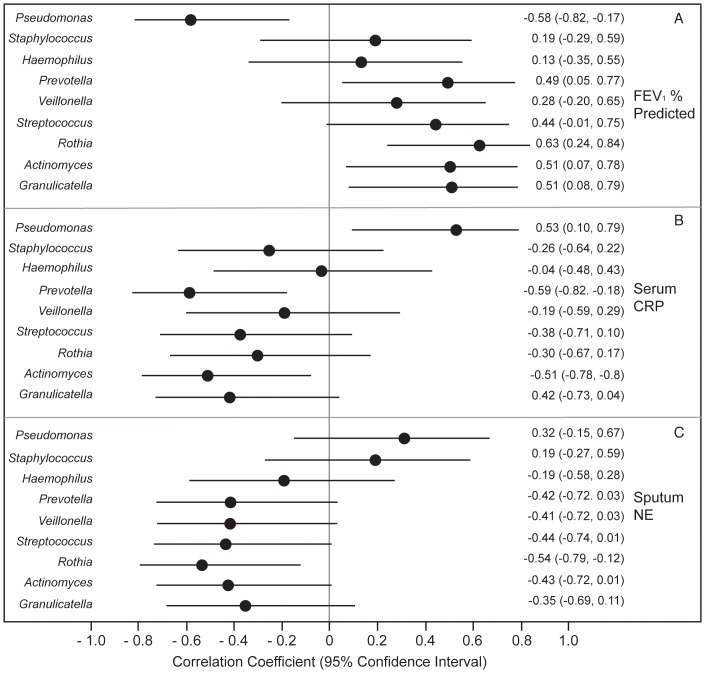
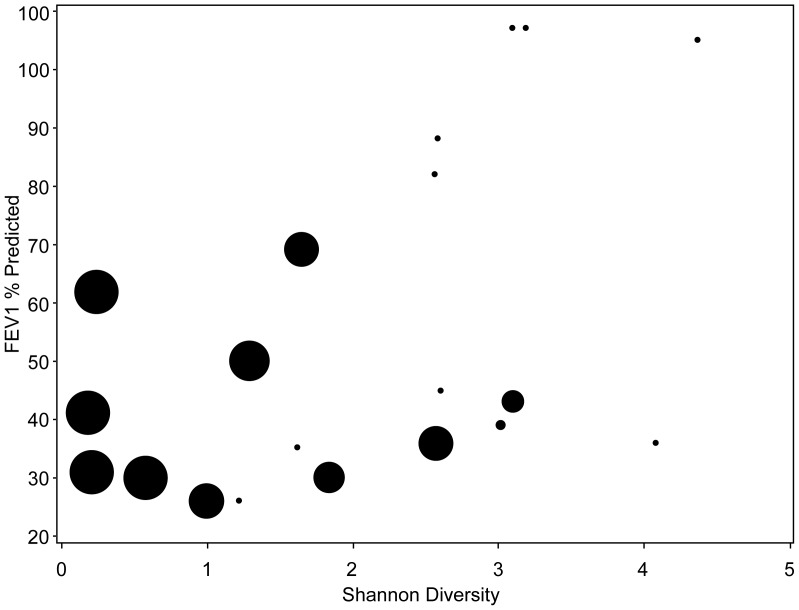
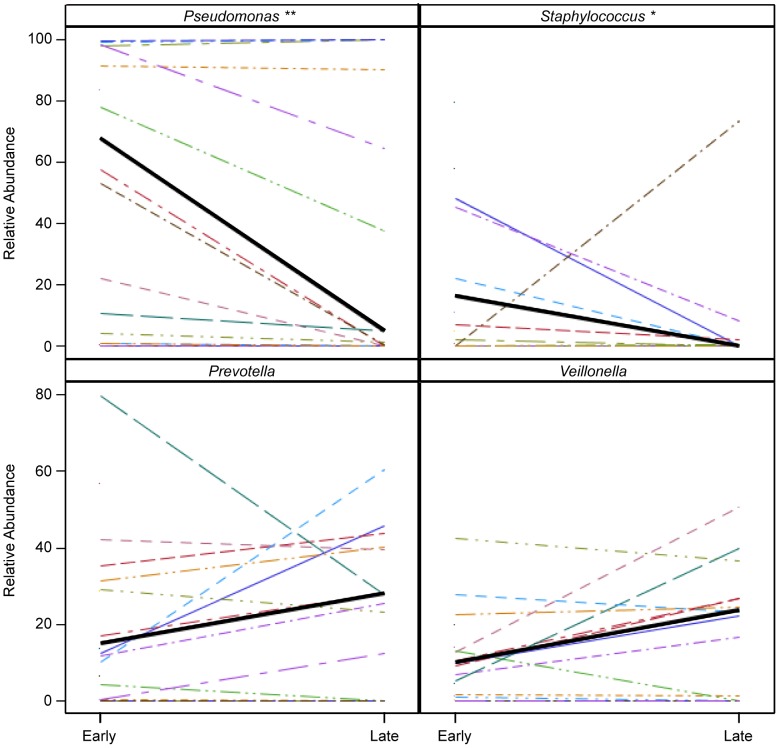
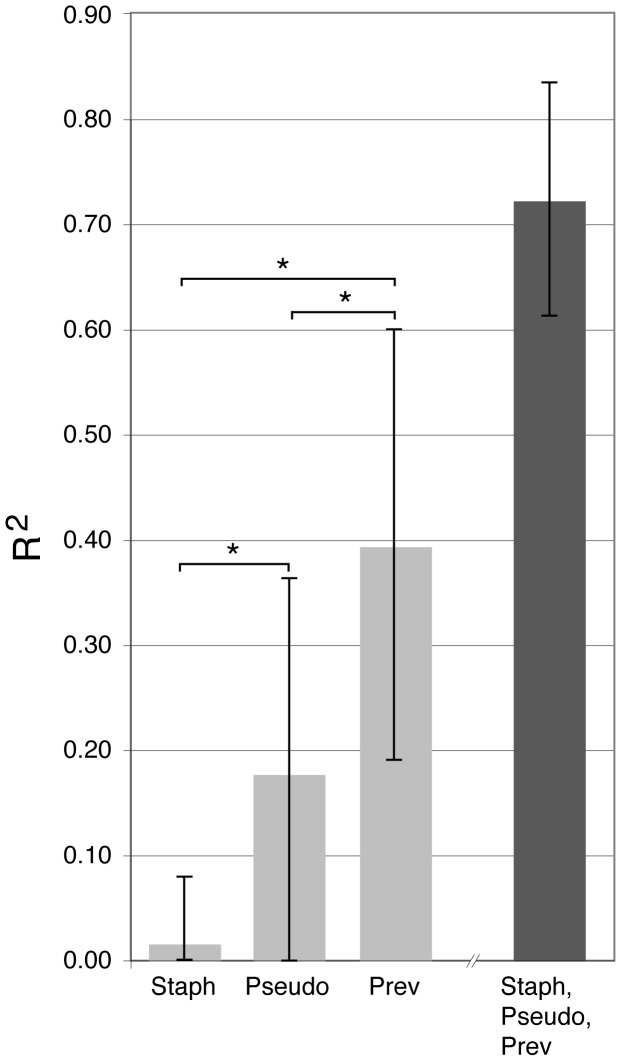
BACKGROUND: Pulmonary exacerbations (PEx), frequently associated with airway infection and inflammation, are the leading cause of morbidity in cystic fibrosis (CF). Molecular microbiologic approaches detect complex microbiota from CF airway samples taken during PEx. The relationship between airway microbiota, inflammation, and lung function during CF PEx is not well understood. OBJECTIVE: To determine the relationships between airway microbiota, inflammation, and lung function in CF subjects treated for PEx. METHODS: Expectorated sputum and blood were collected and lung function testing performed in CF subjects during early (0-3d.) and late treatment (>7d.) for PEx. Sputum was analyzed by culture, pyrosequencing of 16S rRNA amplicons, and quantitative PCR for total and specific bacteria. Sputum IL-8 and neutrophil elastase (NE); and circulating C-reactive protein (CRP) were measured. RESULTS: Thirty-seven sputum samples were collected from 21 CF subjects. At early treatment, lower diversity was associated with high relative abundance (RA) of Pseudomonas (r = -0.67, p<0.001), decreased FEV(1%) predicted (r = 0.49, p = 0.03) and increased CRP (r = -0.58, p = 0.01). In contrast to Pseudomonas, obligate and facultative anaerobic genera were associated with less inflammation and higher FEV₁. With treatment, Pseudomonas RA and P. aeruginosa by qPCR decreased while anaerobic genera showed marked variability in response. Change in RA of Prevotella was associated with more variability in FEV₁ response to treatment than Pseudomonas or Staphylococcus. CONCLUSIONS: Anaerobes identified from sputum by sequencing are associated with less inflammation and higher lung function compared to Pseudomonas at early exacerbation. CF PEx treatment results in variable changes of anaerobic genera suggesting the need for larger studies particularly of patients without traditional CF pathogens.
Overview
The claims and statistics of this paper haven’t been checked yet.
Free: it reads the open-access text and checks the first 5 claims that cite a source we can check. Create a free account to check every claim.
Integrity signals
Registry
Cites
Statistics
Figures
Verification
Claims the paper makes
The claims and statistics of this paper haven’t been checked yet.
Free: it reads the open-access text and checks the first 5 claims that cite a source we can check. Create a free account to check every claim.
Claims other papers make about this one
Each is checked against this paper’s own text: does it say what the citing paper says it does?
In the citing paper
“Cystic fibrosis infections are frequently polymicrobial, with Pseudomonas, Staphylococcus, and Burkholderia being the genera of the pathogenic species most frequently detected; the low species diversity is associated with decreased lung function and increased inflammation (554, 555).”
From Aspergillus fumigatus and Aspergillosis in 2019 (2019) · cites this paper as [554]
Self-check
Percentages, sums and reported differences re-computed from the paper’s own numbers.
The self-check needs the paper’s full text.
Citations
Cites
Basic local alignment search tool
Altschul, S. F., Gish, W., Miller, W., Myers, E. W., & Lipman, D. J. (1990) · Journal of Molecular Biology · doi:10.1006/jmbi.1990.9999 · Cited by 98,669 · cited 2×
“We also performed an ancillary analysis using BLAST to compare study sequences versus all of the isolate sequences in Silva Release 104 labeled as ‘‘isolate’’ to attempt a species level assignment for each sequence [36,37].”
MethodApplied Multiple Regression/Correlation Analysis for the Behavioral Sciences
Cohen, P., Cohen, P., West, S. G., & Aiken, L. S. (2014) · Psychology Press eBooks · doi:10.4324/9781410606266 · Cited by 20,737
Naïve Bayesian Classifier for Rapid Assignment of rRNA Sequences into the New Bacterial Taxonomy
Wang, Q., Garrity, G. M., Tiedje, J. M., & Cole, J. R. (2007) · Applied and Environmental Microbiology · doi:10.1128/aem.00062-07 · Cited by 19,885 · cited 1×
“4 with MSU training set V7 (dating from Jan 12, 2012) was used [33,34].”
MethodMiller, M. R., Hankinson, J., Brusasco, V., Burgos, F., Casaburi, R., Coates, A., Crapo, R., Enright, P., van der Grinten, C. P. M., Gustafsson, P., et al. (2005) · European Respiratory Journal · doi:10.1183/09031936.05.00034805 · Cited by 15,627 · cited 1×
“Spirometry was performed according to American Thoracic Society guidelines [24].”
MethodDatabase resources of the National Center for Biotechnology Information: update
Wheeler, D. L. (2004) · Nucleic Acids Research · doi:10.1093/nar/gkh073 · Cited by 10,641
Pruesse, E., Quast, C., Knittel, K., Fuchs, B. M., Ludwig, W., Peplies, J., & Glockner, F. O. (2007) · Nucleic Acids Research · doi:10.1093/nar/gkm864 · Cited by 6,668 · cited 1×
“We also performed an ancillary analysis using BLAST to compare study sequences versus all of the isolate sequences in Silva Release 104 labeled as ‘‘isolate’’ to attempt a species level assignment for each sequence [36,37].”
MethodThe Ribosomal Database Project: improved alignments and new tools for rRNA analysis
Cole, J. R., Wang, Q., Cardenas, E., Fish, J., Chai, B., Farris, R. J., Kulam-Syed-Mohideen, A. S., McGarrell, D. M., Marsh, T., Garrity, G. M., et al. (2009) · Nucleic Acids Research · doi:10.1093/nar/gkn879 · Cited by 4,762 · cited 1×
“4 with MSU training set V7 (dating from Jan 12, 2012) was used [33,34].”
MethodJost, L. (2006) · Oikos · doi:10.1111/j.2006.0030-1299.14714.x · Cited by 4,669
Chimeric 16S rRNA sequence formation and detection in Sanger and 454-pyrosequenced PCR amplicons
Haas, B. J., Gevers, D., Earl, A. M., Feldgarden, M., Ward, D. V., Giannoukos, G., Ciulla, D., Tabbaa, D., Highlander, S. K., Sodergren, E., et al. (2011) · Genome Research · doi:10.1101/gr.112730.110 · Cited by 3,473 · cited 2×
“Additional quality checks consisted of alignment with Infernal to confirm that the sequences conformed to the bacterial rRNA secondary structure and ChimeraSlayer to detect sequences derived from multiple templates and exclude chimeras [31,32].”
BackgroundMethodDisordered Microbial Communities in Asthmatic Airways
Hilty, M., Burke, C., Pedro, H., Cardenas, P., Bush, A., Bossley, C., Davies, J., Ervine, A., Poulter, L., Pachter, L., et al. (2010) · PLoS ONE · doi:10.1371/journal.pone.0008578 · Cited by 1,824 · cited 1×
“An alternative hypothesis for our findings is that a core microbiota including anaerobes such as Prevotella and Veillonella may be present in healthy airways with disruption of this microbiota leading to disease, as has been suggested by studies in asthma and chronic obstructive pulmonary disease [49,50].”
Background
Cited by
Aspergillus fumigatus and Aspergillosis in 2019
Latgé, J.-P., & Chamilos, G. (2019) · Clinical Microbiology Reviews · doi:10.1128/cmr.00140-18 · Cited by 1,400
Polycystic ovary syndrome (PCOS), an inflammatory, systemic, lifestyle endocrinopathy
Patel, S. (2018) · The Journal of Steroid Biochemistry and Molecular Biology · doi:10.1016/j.jsbmb.2018.04.008 · Cited by 605
Cystic Fibrosis and Pseudomonas aeruginosa: the Host-Microbe Interface
Malhotra, S., Hayes, D., & Wozniak, D. J. (2019) · Clinical Microbiology Reviews · doi:10.1128/cmr.00138-18 · Cited by 515
“aeruginosa correlated with reduced pulmonary function, increased concentrations of serum C-reactive protein (CRP) (a systemic marker of inflammation), and higher concentrations of neutrophil elastase in sputum (247).”
BackgroundRowe, S. M., Heltshe, S. L., Gonska, T., Donaldson, S. H., Borowitz, D., Gelfond, D., Sagel, S. D., Khan, U., Mayer-Hamblett, N., Van Dalfsen, J. M., et al. (2014) · American Journal of Respiratory and Critical Care Medicine · doi:10.1164/rccm.201404-0703oc · Cited by 492
“Additionally, an increased abundance of Prevotella, a bacteria associated with higher lung function in CF (24), was observed.”
BackgroundSelf-citationFilkins, L. M., Graber, J. A., Olson, D. G., Dolben, E. L., Lynd, L. R., Bhuju, S., & O'Toole, G. A. (2015) · Journal of Bacteriology · doi:10.1128/jb.00059-15 · Cited by 346
Metadata
- Authors
- Zemanick, E. T., Harris, J. K., Wagner, B. D., Robertson, C. E., Sagel, S. D., Stevens, M. J., Accurso, F. J., & Laguna, T. A.
- Affiliations
- University of Colorado Anschutz (US)
- Colorado School of Public Health (US)
- University of Colorado Boulder (US)
- University of Minnesota (US)
- Corresponding author
- Zemanick, Edith T.
- ORCID
- Venue
- PLoS ONE
- Publisher
- Public Library of Science (PLoS)
- Published
- 2013-04-30
- Volume
- 8
- Issue
- 4
- Pages
- e62917
- ISSN
- 1932-6203 (ISSN-L)
- PMC
- PMC3639911
- OpenAlex
- W2072180249
- Cited by
- 180
- References
- 55
- Citations by year
- 2026: 2 · 2025: 7 · 2024: 6 · 2023: 11 · 2022: 8 · 2021: 15 · 2020: 23 · 2019: 13 · 2018: 14 · 2017: 20 · 2016: 15 · 2015: 26 · 2014: 15 · 2013: 4
- FWCI
- 16.29
- Type
- journal article
- Language
- en
- Open access
- gold
- doi.org
- Locations
- PLoS ONE (publishedVersion, cc-by)
- Europe PMC (PubMed Central) (publishedVersion, cc-by)
- PubMed Central (publishedVersion, cc-by)
- PubMed (publishedVersion)
- DOAJ (DOAJ: Directory of Open Access Journals) (submittedVersion, cc-by-sa)
- Figshare (submittedVersion, cc-by)
- Funders
- Cystic Fibrosis Foundation (ZEMANI08A0, SAGEL07B0)
- Children's Hospital Colorado
- National Institutes of Health
- National Center for Research Resources (UL1RR025780)
- Eunice Kennedy Shriver National Institute of Child Health and Human Development (K12HD068322)
- Topics
- Health Sciences › Medicine › Pulmonary and Respiratory Medicine › Cystic Fibrosis Research Advances
- Life Sciences › Biochemistry, Genetics and Molecular Biology › Molecular Biology › Bacterial biofilms and quorum sensing
- Health Sciences › Medicine › Pulmonary and Respiratory Medicine › Chronic Obstructive Pulmonary Disease (COPD) Research
- Keywords
- cystic fibrosis, pulmonary exacerbations, airway microbiome, airway inflammation, lung function, Pseudomonas aeruginosa, anaerobic bacteria, Prevotella, Staphylococcus, C-reactive protein, neutrophil elastase, interleukin-8, sputum, 16S rRNA gene sequencing, treatment response
- MeSH terms
- Adolescent, Adult, Anti-Bacterial Agents, Bacteria, Child, Cross-Sectional Studies, Cystic Fibrosis, Female, Humans, Inflammation, Male, Respiratory Function Tests, Respiratory System, Sputum, Metagenome, Young Adult
About these checks
Registry, retraction, Cites and statistics results are computed, not judged, with one exception: a printed reference that no index lists is read once by a model before it counts as a citation error. Claims are extracted by a model and kept only when their quote appears verbatim in the text; each cited source is then checked, with a model’s help, for whether it says what the claim relies on. Those verdicts can be wrong — read the claim’s quote and the cited source before relying on one.
Statistics and arithmetic are recomputed, not judged.
Confidence bands are shown only for fields calibrated on our annotated test set. None is calibrated yet, so no band is shown.
What counts as a claim ›How we measure confidence ›How we check this ›
Are you an author, or do you see a problem with this page? Request a review
Data sources
Bibliographic data: Semantic Scholar, OpenAlex, Crossref.
Contains information from the Semantic Scholar Academic Graph Datasets, made available under the ODC Attribution License (ODC-BY 1.0).
Semantic Scholar’s data is described in: Kinney, R., et al. (2023). The Semantic Scholar Open Data Platform. arXiv:2301.10140.
