

The DOI matches its Crossref record; 42 of the 42 references it cites were found in a registry or an index.
Ancient Dispersal of the Human Fungal Pathogen Cryptococcus gattii from the Amazon Rainforest
Open accessAbstract
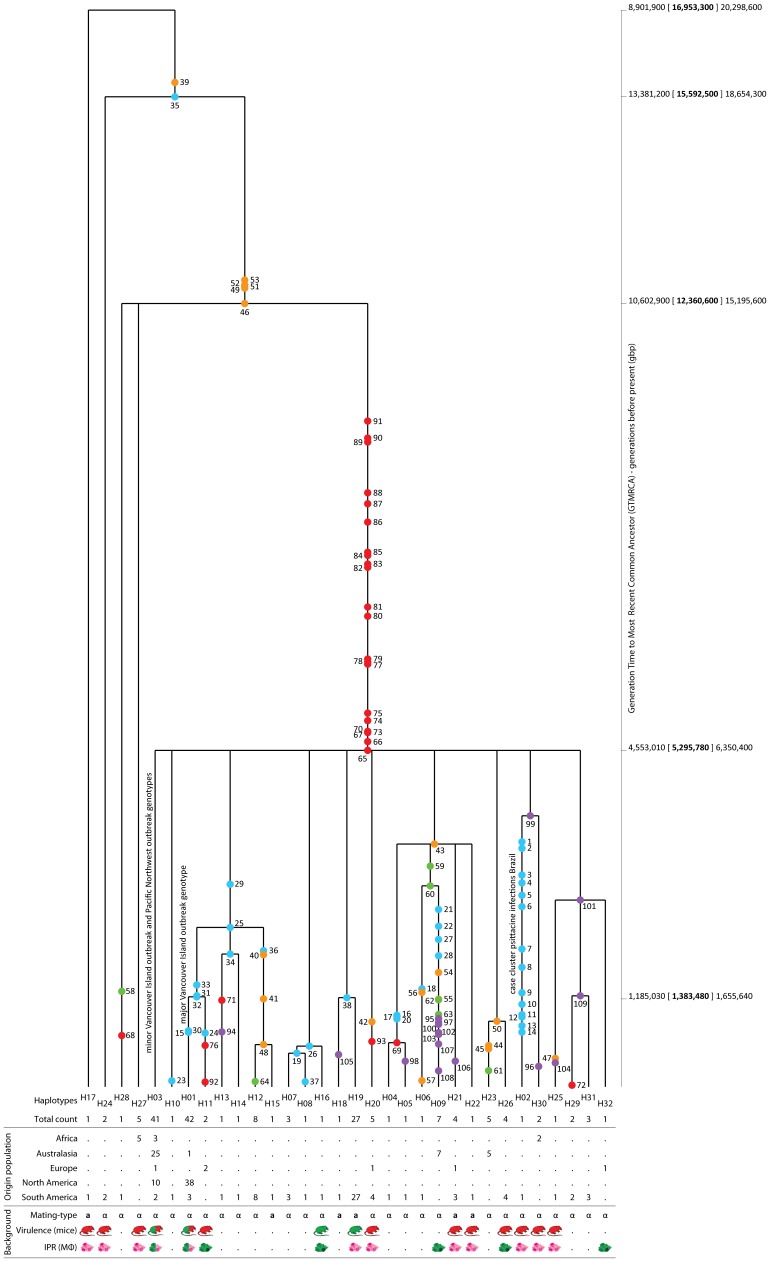
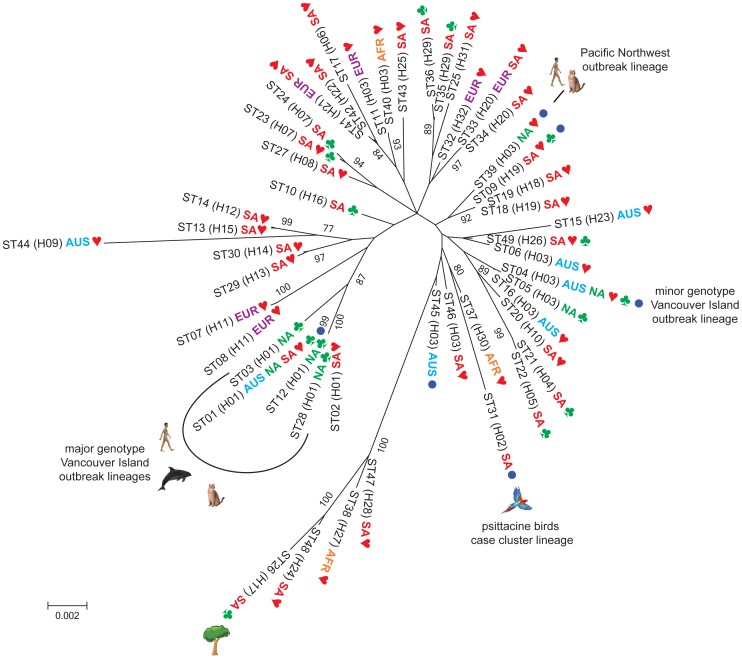
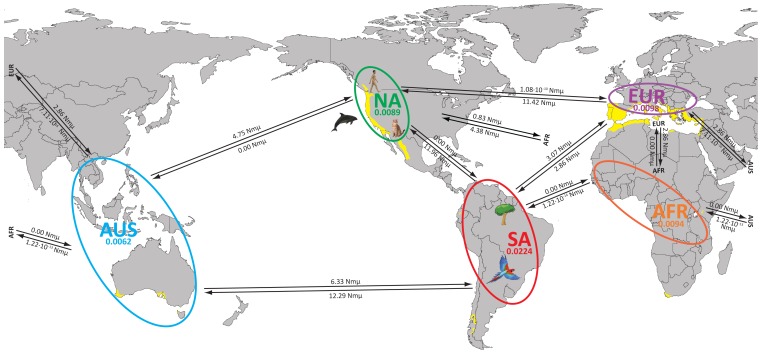
Over the past two decades, several fungal outbreaks have occurred, including the high-profile 'Vancouver Island' and 'Pacific Northwest' outbreaks, caused by Cryptococcus gattii, which has affected hundreds of otherwise healthy humans and animals. Over the same time period, C. gattii was the cause of several additional case clusters at localities outside of the tropical and subtropical climate zones where the species normally occurs. In every case, the causative agent belongs to a previously rare genotype of C. gattii called AFLP6/VGII, but the origin of the outbreak clades remains enigmatic. Here we used phylogenetic and recombination analyses, based on AFLP and multiple MLST datasets, and coalescence gene genealogy to demonstrate that these outbreaks have arisen from a highly-recombining C. gattii population in the native rainforest of Northern Brazil. Thus the modern virulent C. gattii AFLP6/VGII outbreak lineages derived from mating events in South America and then dispersed to temperate regions where they cause serious infections in humans and animals.
Overview
The claims and statistics of this paper haven’t been checked yet.
Run the check — free, no account needed. It reads the open-access text and checks the sources it cites.
Integrity signals
Registry
Cites
Statistics
Figures
Verification
Claims the paper makes
The claims and statistics of this paper haven’t been checked yet.
Run the check — free, no account needed. It reads the open-access text and checks the sources it cites.
Claims other papers make about this one
Each is checked against this paper’s own text: does it say what the citing paper says it does?
In the citing paper
“All three isolates are characterized by diminished virulence relative to the VGIIa clonal outbreak strains (Fraser et al., 2005; Byrnes et al., 2010; Hagen et al., 2013).”
From Natural mismatch repair mutations mediate phenotypic diversity and drug resistance in Cryptococcus deuterogattii (2017) · cites this paper as Hagen et al., 2013
Self-check
Percentages, sums and reported differences re-computed from the paper’s own numbers.
The self-check needs the paper’s full text.
Citations
Cites
Updated world map of the Köppen-Geiger climate classification
(2007) · doi:10.5194/hess-11-1633-2007 · Cited by 13,640
Global trends in emerging infectious diseases
Jones, K. E., Patel, N. G., Levy, M. A., Storeygard, A., Balk, D., Gittleman, J. L., & Daszak, P. (2008) · Nature · doi:10.1038/nature06536 · Cited by 8,338
Climate Warming and Disease Risks for Terrestrial and Marine Biota
Harvell, C. D., Mitchell, C. E., Ward, J. R., Altizer, S., Dobson, A. P., Ostfeld, R. S., & Samuel, M. D. (2002) · Science · doi:10.1126/science.1063699 · Cited by 2,799
The velocity of climate change
Loarie, S. R., Duffy, P. B., Hamilton, H., Asner, G. P., Field, C. B., & Ackerly, D. D. (2009) · Nature · doi:10.1038/nature08649 · Cited by 2,646
Aerial Dispersal of Pathogens on the Global and Continental Scales and Its Impact on Plant Disease
Brown, J. K. M., & Hovmøller, M. S. (2002) · Science · doi:10.1126/science.1072678 · Cited by 1,165
Bat White-Nose Syndrome: An Emerging Fungal Pathogen?
Blehert, D. S., Hicks, A. C., Behr, M. J., Meteyer, C. U., Berlowski-Zier, B. M., Buckles, E. L., Coleman, J. T. H., Darling, S. R., Gargas, A., Niver, R., et al. (2008) · Science · doi:10.1126/science.1163874 · Cited by 1,094
Atmospheric Movement of Microorganisms in Clouds of Desert Dust and Implications for Human Health
Griffin, D. W. (2007) · Clinical Microbiology Reviews · doi:10.1128/cmr.00039-06 · Cited by 824
Kidd, S. E., Hagen, F., Tscharke, R. L., Huynh, M., Bartlett, K. H., Fyfe, M. W., MacDougall, L., Boekhout, T., Kwon-Chung, K. J., & Meyer, W. (2004) · Proceedings of the National Academy of Sciences · doi:10.1073/pnas.0402981101 · Cited by 766
Self-citationNatural habitat of Cryptococcus neoformans var. gattii
Ellis, D. H., & Pfeiffer, T. (1990) · Journal of Clinical Microbiology · doi:10.1128/jcm.28.7.1642-1644.1990 · Cited by 561
Anthropogenic Warming of Earth's Climate System
Levitus, S., Antonov, J. I., Wang, J., Delworth, T. L., Dixon, K. W., & Broccoli, A. J. (2001) · Science · doi:10.1126/science.1058154 · Cited by 543
Research works printed but not linked: 1
- Griffiths A (2006) M.Sc. thesis ‘Assessing exposure to Cryptococcus gattii’, University of British Columbia, Vancouver, BC, Canada. Available: https://circle.ubc.ca/handle/2429/17839. Accessed 4 July 2013.
Cited by
Sorted by citations
Recognition of seven species in the Cryptococcus gattii/Cryptococcus neoformans species complex
Hagen, F., Khayhan, K., Theelen, B., Kolecka, A., Polacheck, I., Sionov, E., Falk, R., Parnmen, S., Lumbsch, H. T., & Boekhout, T. (2015) · Fungal Genetics and Biology · doi:10.1016/j.fgb.2015.02.009 · Cited by 723
Self-citationCryptococcus: from environmental saprophyte to global pathogen
May, R. C., Stone, N. R. H., Wiesner, D. L., Bicanic, T., & Nielsen, K. (2016) · Nature Reviews Microbiology · doi:10.1038/nrmicro.2015.6 · Cited by 541
Self-citationProbiotic Gastrointestinal Transit and Colonization After Oral Administration: A Long Journey
Han, S., Lu, Y., Xie, J., Fei, Y., Zheng, G., Wang, Z., Liu, J., Lv, L., Ling, Z., Berglund, B., et al. (2021) · Frontiers in Cellular and Infection Microbiology · doi:10.3389/fcimb.2021.609722 · Cited by 517
Calvo, B., Melo, A. S. D. A., Mena, A. J. P., Hernandez, M., Francisco, E. C., Hagen, F., Meis, J. F. G. M., & Colombo, A. L. (2016) · Journal of Infection · doi:10.1016/j.jinf.2016.07.008 · Cited by 448
Self-citation(2014) · doi:10.1128/cmr.00126-13 · Cited by 437
Self-citation
Metadata
- Authors
- Hagen, F., Ceresini, P. C., Polacheck, I., Ma, H., Nieuwerburgh, F. V., Gabaldón, T., Kagan, S., Pursall, E. R., Hoogveld, H. L., van Iersel, L. J. J., Klau, G. W., Kelk, S. M., Stougie, L., Bartlett, K. H., Voelz, K., Pryszcz, L. P., Castañeda, E., Lazera, M., Meyer, W., Deforce, D., Meis, J. F., May, R. C., Klaassen, C. H. W., & Boekhout, T.
- Affiliations
- Westerdijk Fungal Biodiversity Institute (NL)
- Universidade Estadual Paulista (Unesp) (BR)
- Hadassah Medical Center (IL)
- University of Birmingham (GB)
- Ghent University (BE)
- Centre for Genomic Regulation (ES)
- Netherlands Institute of Ecology (NL)
- Centrum Wiskunde & Informatica (NL)
- University of British Columbia (CA)
- Instituto Nacional de Salud (CO)
- The University of Sydney (AU)
- Radboud University Medical Center (NL)
- Canisius-Wilhelmina Ziekenhuis (NL)
- Second Military Medical University (CN)
- Corresponding author
- Boekhout, Teun
- ORCID
- Hagen, Ferry
- Ceresini, Paulo C.
- Polacheck, Itzhack
- Ma, Hansong
- Nieuwerburgh, Filip van
- Gabaldón, Toni
- Klau, Gunnar W.
- Kelk, Steven M.
- Stougie, Leen
- Bartlett, Karen H.
- Voelz, Kerstin
- Pryszcz, Leszek P.
- Castañeda, Elizabeth
- Meyer, Wieland
- Deforce, Dieter
- Meis, Jacques F.
- May, Robin C.
- Klaassen, Corné H. W.
- Boekhout, Teun
- Venue
- PLoS ONE
- Publisher
- Public Library of Science (PLoS)
- Published
- 2013-08-07
- Volume
- 8
- Issue
- 8
- Pages
- e71148
- ISSN
- 1932-6203 (ISSN-L)
- PMC
- PMC3737135
- OpenAlex
- W2152772772
- Cited by
- 218
- References
- 42
- Citations by year
- 2026: 1 · 2025: 5 · 2024: 4 · 2023: 6 · 2022: 4 · 2021: 28 · 2020: 18 · 2019: 14 · 2018: 19 · 2017: 33 · 2016: 21 · 2015: 27 · 2014: 30 · 2013: 4
- FWCI
- 19.92
- Type
- journal article
- Language
- en
- Open access
- gold
- doi.org
- Locations
- PLoS ONE (publishedVersion, cc-by)
- Europe PMC (PubMed Central) (publishedVersion, cc-by)
- PubMed Central (publishedVersion, cc-by)
- PubMed (publishedVersion)
- Americanae (AECID Library) (publishedVersion, other-oa)
- KNAW research portal (Royal Academy of Art and Sciences (KNAW)) (publishedVersion, cc-by)
- KNAW Research Portal (The Royal Netherlands Academy of Arts and Sciences) (publishedVersion, cc-by)
- RECERCAT (Consorci de Serveis Universitaris de Catalunya) (publishedVersion, other-oa)
- VU Research Portal (publishedVersion, other-oa)
- Ghent University Academic Bibliography (Ghent University) (submittedVersion, other-oa)
- Centrum Wiskunde & Informatica (CWI), the national research institute for mathematics and computer science in the Netherlands (submittedVersion)
- Data Archiving and Networked Services (DANS) (submittedVersion, other-oa)
- Data Archiving and Networked Services (DANS) (submittedVersion, cc-by)
- Acervo Digital da Universidade Estadual Paulista (Universidade Estadual Paulista) (submittedVersion, other-oa)
- Research Publications (Maastricht University) (submittedVersion, cc-by)
- DOAJ (DOAJ: Directory of Open Access Journals) (submittedVersion, cc-by-sa)
- Figshare (submittedVersion, cc-by)
- University of Birmingham Research Portal (University of Birmingham) (submittedVersion, other-oa)
- Repositori digital de la UPF (Universitat Pompeu Fabra) (submittedVersion, cc-by)
- LA Referencia (Red Federada de Repositorios Institucionales de Publicaciones Científicas) (submittedVersion, other-oa)
- Radboud Repository (Radboud University) (submittedVersion)
- Apollo (University of Cambridge) (submittedVersion, cc-by)
- Radboud Repository (Radboud University) (submittedVersion, other-oa)
- Research Publications (Maastricht University) (submittedVersion, other-oa)
- Apollo (cc-by)
- Funders
- Qatar Foundation
- Fonds National de la Recherche Luxembourg
- Nederlandse Organisatie voor Wetenschappelijk Onderzoek
- Qatar National Research Fund
- Topics
- Health Sciences › Medicine › Infectious Diseases › Fungal Infections and Studies
- Life Sciences › Biochemistry, Genetics and Molecular Biology › Genetics › Genetic diversity and population structure
- Life Sciences › Agricultural and Biological Sciences › Plant Science › Plant Pathogens and Fungal Diseases
- Keywords
- Cryptococcus gattii, fungal outbreak, human fungal infections, Amazon rainforest, population dispersal, recombination, phylogenetics, multilocus sequence typing, Northern Brazil, fungal genotypes
- MeSH terms
- Animals, Brazil, British Columbia, Cells, Cultured, Cryptococcosis, Disease Outbreaks, Genes, Fungal, Humans, Macrophages, Mice, Inbred BALB C, Molecular Sequence Data, Phylogeny, Polymorphism, Restriction Fragment Length, Trees, Tropical Climate, Virulence, Northwestern United States, Likelihood Functions, Mycological Typing Techniques, Mice, Cryptococcus gattii, Multilocus Sequence Typing
About these checks
Registry, retraction, Cites and statistics results are computed, not judged, with one exception: a printed reference that no index lists is read once by a model before it counts as a citation error. Claims are extracted by a model and kept only when their quote appears verbatim in the text; each cited source is then checked, with a model’s help, for whether it says what the claim relies on. Those verdicts can be wrong — read the claim’s quote and the cited source before relying on one.
Statistics and arithmetic are recomputed, not judged.
Confidence bands are shown only for fields calibrated on our annotated test set. None is calibrated yet, so no band is shown.
What counts as a claim ›How we measure confidence ›How we check this ›
Are you an author, or do you see a problem with this page? Request a review
