

The DOI matches its Crossref record; 84 of the 86 references it cites were found in a registry or an index.
A meta-analysis of randomised placebo-controlled treatment trials for depression and anxiety in Parkinson's disease
Open accessAbstract
BACKGROUND: Psychopharmacotherapy currently constitutes the first-line treatment for depression and anxiety in Parkinson's disease (PD) however the efficacy of antidepressant treatments in PD is unclear. Several alternative treatments have been suggested as potentially more viable alternatives including dopamine agonists, repetitive transcranial magnetic stimulation, and cognitive behavioural therapy (CBT). METHOD: A meta-analysis of randomised placebo-controlled trials for depression and/or anxiety in PD was conducted to systematically examine the efficacy of current treatments for depression and anxiety in PD. RESULTS: Nine trials were included. There was only sufficient data to calculate a pooled effect for antidepressant therapies. The pooled effect of antidepressants for depression in PD was moderate but non-significant (d = .71, 95% CI = -1.33 to 3.08). The secondary effect of antidepressants on anxiety in PD was large but also non-significant (d = 1.13, 95% CI = -.67 to 2.94). Two single-trials of non-pharmacological treatments for depression in PD resulted in significant large effects; Omega-3 supplementation (d = .92, 95% CI = .15 to 1.69) and CBT (d = 1.57, 95% CI = 1.06 to 2.07), and warrant further exploration. CONCLUSIONS: There remains a lack of controlled trials for both pharmacological and non-pharmacological treatments for depression and anxiety in PD which limits the conclusions which can be drawn. While the pooled effects of antidepressant therapies in PD were non-significant, the moderate to large magnitude of each pooled effect is promising. Non-pharmacological approaches show potential for depression in PD however more research is required.
Overview
The claims and statistics of this paper haven’t been checked yet.
Run the check — free, no account needed. It reads the open-access text and checks the sources it cites.
Integrity signals
Registry
Cites
Statistics
Figures
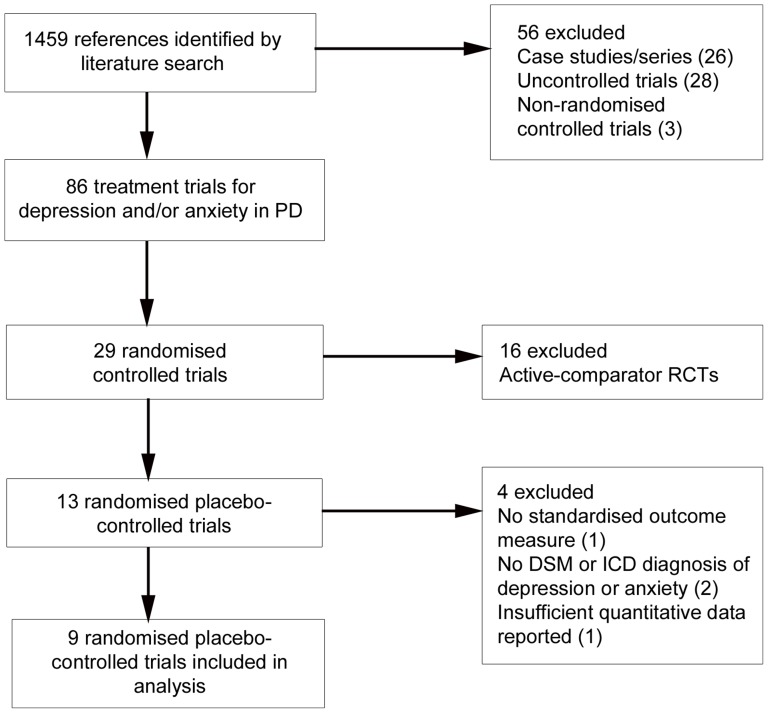
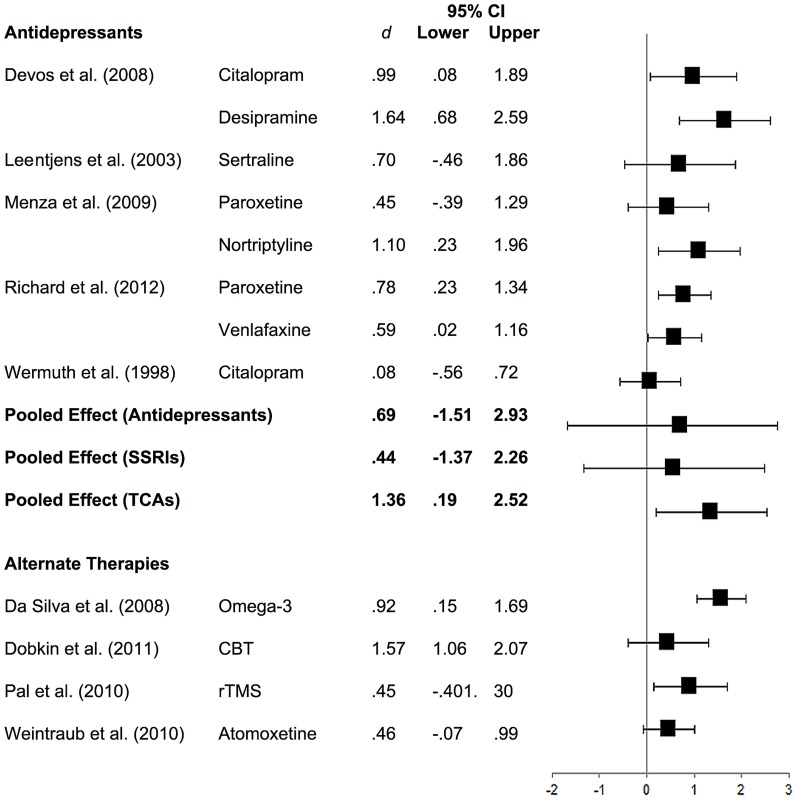
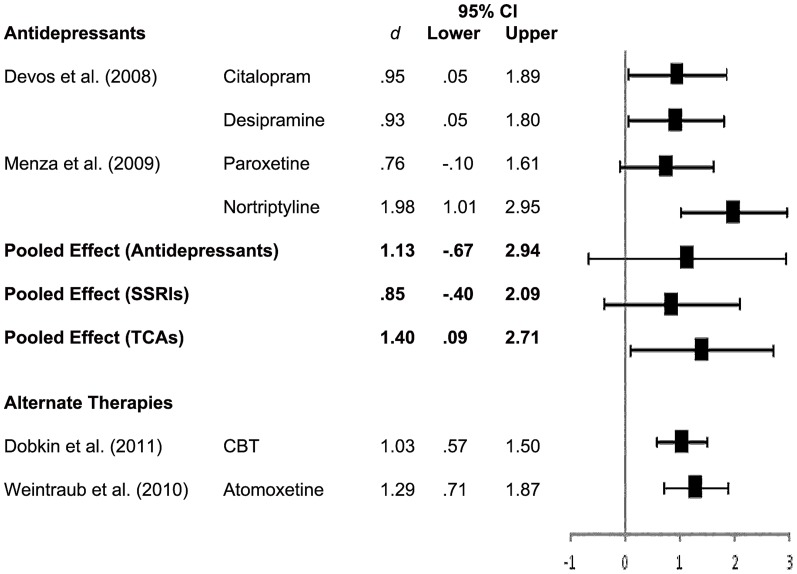
Verification
Claims the paper makes
The claims and statistics of this paper haven’t been checked yet.
Run the check — free, no account needed. It reads the open-access text and checks the sources it cites.
Claims other papers make about this one
Each is checked against this paper’s own text: does it say what the citing paper says it does?
The source backs part of the claim, not all of it — or backs it for a different population, condition or comparison.
In the citing paper
“Evidence for the effectiveness of pharmacological interventions in treating PD neuropsychiatric symptoms is mixed (Price et al., 2011”
From Remote delivery of psychological interventions for Parkinson's disease. (2018) · cites this paper as Troeung et al., 2013
Experimental — accuracy not yet measured
Self-check
Percentages, sums and reported differences re-computed from the paper’s own numbers.
The self-check needs the paper’s full text.
Citations
Cites
Preferred Reporting Items for Systematic Reviews and Meta-Analyses: the PRISMA statement
Moher, D., Liberati, A., Tetzlaff, J., Altman, D. G., & for the PRISMA Group (2009) · BMJ · doi:10.1136/bmj.b2535 · Cited by 83,823
Preferred Reporting Items for Systematic Reviews and Meta-Analyses: The PRISMA Statement
Moher, D., Liberati, A., Tetzlaff, J., Altman, D. G., & The PRISMA Group (2009) · PLoS Medicine · doi:10.1371/journal.pmed.1000097 · Cited by 64,042
Measuring inconsistency in meta-analyses
Higgins, J. P. T., Thompson, S. G., Deeks, J. J., & Altman, D. G. (2003) · BMJ · doi:10.1136/bmj.327.7414.557 · Cited by 63,139
Bias in meta-analysis detected by a simple, graphical test
Egger, M., Smith, G. D., Schneider, M., & Minder, C. (1997) · BMJ · doi:10.1136/bmj.315.7109.629 · Cited by 56,722 · cited 2×
“Publication bias in the current meta-analysis was assessed using Egger’s [69] regression asymmetry test and Rosenthal’s [70] Fail-Safe N method.”
MethodPreferred reporting items for systematic reviews and meta-analyses: the PRISMA Statement.
(2009) · PubMed Central · Cited by 44,859
Meta-analysis in clinical trials
DerSimonian, R., & Laird, N. (1986) · Controlled Clinical Trials · doi:10.1016/0197-2456(86)90046-2 · Cited by 39,552
Preferred reporting items for systematic reviews and meta-analyses: The PRISMA statement
Moher, D., Liberati, A., Tetzlaff, J., Altman, D. G., & the PRISMA Group* (2009) · Annals of Internal Medicine · doi:10.7326/0003-4819-151-4-200908180-00135 · Cited by 37,554
Quantifying heterogeneity in a meta‐analysis
Higgins, J. P. T., & Thompson, S. G. (2002) · Statistics in Medicine · doi:10.1002/sim.1186 · Cited by 36,763
Cochrane Handbook for Systematic Reviews of Interventions: Cochrane Book Series
(2008) · doi:10.1002/9780470712184 · Cited by 25,048
Wasserman, S. S., Hedges, L. V., & Olkin, I. (1988) · Journal of Educational Statistics · doi:10.2307/1164953 · Cited by 10,377
Research works printed but not linked: 3
- R Verma, 2012, Efficacy and tolerability of escitalopram for treating depression in parkinson’s disease, Delhi Psychiatry J, 15, 57
- A Alca, 2011, Comparison of sertraline and venlafaxine treatments for depression in Parkinson’s disease, Noropsikiyatri Arsivi, 48, 201
- Hedges LV, Olkin I (1985) Statistical methods for meta-analysis. Orlando, Florida, Academic Press.
Cited by
Sorted by citations
Pharmacological Treatment of Parkinson Disease
Connolly, B. S., & Lang, A. E. (2014) · JAMA · doi:10.1001/jama.2014.3654 · Cited by 1,510
Depression in neurodegenerative diseases: Common mechanisms and current treatment options
Galts, C., Bettio, L. E. B., Jewett, D. C., Yang, C. C., Brocardo, P. S., Rodrigues, A. L. S., Thacker, J. S., & Gil‐Mohapel, J. (2019) · Neuroscience & Biobehavioral Reviews · doi:10.1016/j.neubiorev.2019.04.002 · Cited by 276
Prange, S., Klinger, H., Laurencin, C., Danaila, T., & Thobois, S. (2022) · Drugs & Aging · doi:10.1007/s40266-022-00942-1 · Cited by 193
Neuroimaging of Parkinson's disease: Expanding views
Weingarten, C. P., Sundman, M. H., Hickey, P., & Chen, N. (2015) · Neuroscience & Biobehavioral Reviews · doi:10.1016/j.neubiorev.2015.09.007 · Cited by 164
Antidepressive treatments for Parkinson's disease: A systematic review and meta-analysis
Bomasang-Layno, E., Fadlon, I., Murray, A. N., & Himelhoch, S. S. (2015) · Parkinsonism & Related Disorders · doi:10.1016/j.parkreldis.2015.04.018 · Cited by 142
Metadata
- Authors
- Troeung, L., Egan, S. J., & Gasson, N.
- Affiliations
- Curtin University (AU)
- Corresponding author
- Troeung, Lakkhina
- Venue
- PLoS ONE
- Publisher
- Public Library of Science (PLoS)
- Published
- 2013-11-13
- Volume
- 8
- Issue
- 11
- Pages
- e79510
- ISSN
- 1932-6203 (ISSN-L)
- PMC
- PMC3827386
- OpenAlex
- W2022947342
- Cited by
- 132
- References
- 86
- Citations by year
- 2026: 4 · 2025: 13 · 2024: 7 · 2023: 7 · 2022: 16 · 2021: 10 · 2020: 6 · 2019: 14 · 2018: 7 · 2017: 7 · 2016: 20 · 2015: 10 · 2014: 11
- FWCI
- 1.78
- Type
- journal article
- Language
- en
- Open access
- gold
- doi.org
- Locations
- PLoS ONE (publishedVersion, cc-by)
- Europe PMC (PubMed Central) (publishedVersion, cc-by)
- PubMed Central (publishedVersion, cc-by)
- PubMed (publishedVersion)
- eSpace (Curtin University) (submittedVersion)
- UWA Profiles and Research Repository (UWA) (submittedVersion, other-oa)
- RePEc: Research Papers in Economics (submittedVersion)
- DOAJ (DOAJ: Directory of Open Access Journals) (submittedVersion, cc-by-sa)
- Topics
- Health Sciences › Medicine › Clinical Neurology › Parkinson's Disease Mechanisms and Treatments
- Health Sciences › Medicine › Pharmacology (medical) › Treatment of Major Depression
- Health Sciences › Medicine › Clinical Neurology › Deep Brain Stimulation and Movement Disorders
- Keywords
- Parkinson's disease, depression, anxiety, antidepressants, psychopharmacological treatment, dopamine agonists, repetitive transcranial magnetic stimulation, cognitive behavioral therapy, omega-3 supplementation, non-pharmacological treatment, treatment efficacy
- MeSH terms
- Antidepressive Agents, Anxiety, Depression, Humans, Parkinson Disease, Psychotherapy, Randomized Controlled Trials as Topic, Treatment Outcome
About these checks
Registry, retraction, Cites and statistics results are computed, not judged, with one exception: a printed reference that no index lists is read once by a model before it counts as a citation error. Claims are extracted by a model and kept only when their quote appears verbatim in the text; each cited source is then checked, with a model’s help, for whether it says what the claim relies on. Those verdicts can be wrong — read the claim’s quote and the cited source before relying on one.
Statistics and arithmetic are recomputed, not judged.
Confidence bands are shown only for fields calibrated on our annotated test set. None is calibrated yet, so no band is shown.
What counts as a claim ›How we measure confidence ›How we check this ›
Are you an author, or do you see a problem with this page? Request a review
