

The DOI matches its Crossref record; 71 of the 72 references it cites were found in a registry or an index.
Increased Functional Connectivity between Prefrontal Cortex and Reward System in Pathological Gambling
Open accessAbstract
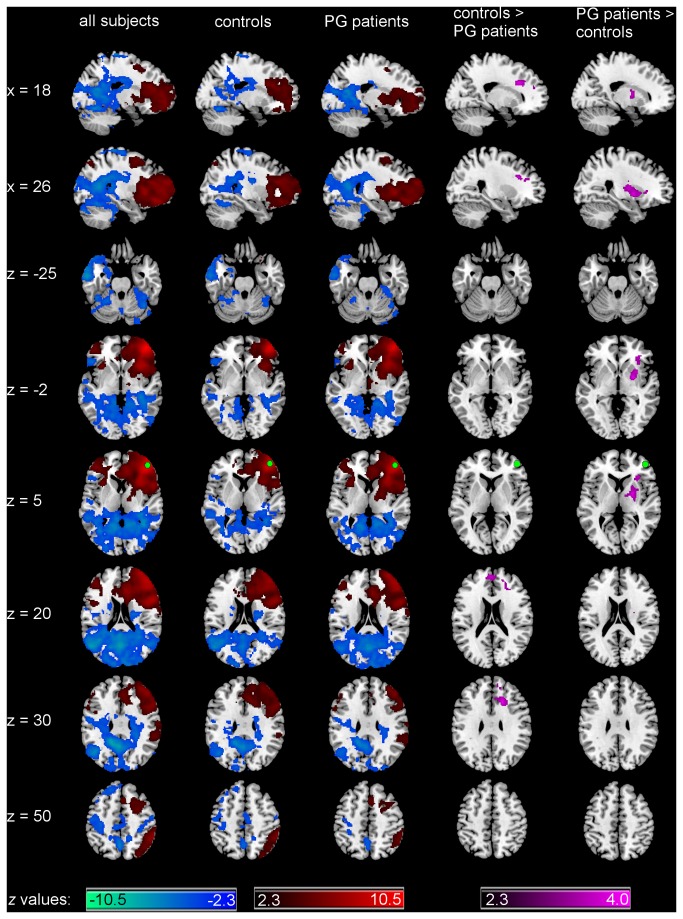
Pathological gambling (PG) shares clinical characteristics with substance-use disorders and is thus discussed as a behavioral addiction. Recent neuroimaging studies on PG report functional changes in prefrontal structures and the mesolimbic reward system. While an imbalance between these structures has been related to addictive behavior, whether their dysfunction in PG is reflected in the interaction between them remains unclear. We addressed this question using functional connectivity resting-state fMRI in male subjects with PG and controls. Seed-based functional connectivity was computed using two regions-of-interest, based on the results of a previous voxel-based morphometry study, located in the prefrontal cortex and the mesolimbic reward system (right middle frontal gyrus and right ventral striatum). PG patients demonstrated increased connectivity from the right middle frontal gyrus to the right striatum as compared to controls, which was also positively correlated with nonplanning aspect of impulsiveness, smoking and craving scores in the PG group. Moreover, PG patients demonstrated decreased connectivity from the right middle frontal gyrus to other prefrontal areas as compared to controls. The right ventral striatum demonstrated increased connectivity to the right superior and middle frontal gyrus and left cerebellum in PG patients as compared to controls. The increased connectivity to the cerebellum was positively correlated with smoking in the PG group. Our results provide further evidence for alterations in functional connectivity in PG with increased connectivity between prefrontal regions and the reward system, similar to connectivity changes reported in substance use disorder.
Overview
The claims and statistics of this paper haven’t been checked yet.
Free: it reads the open-access text and checks the first 5 claims that cite a source we can check. Create a free account to check every claim.
Integrity signals
Registry
Cites
Statistics
Figures



Verification
Claims the paper makes
The claims and statistics of this paper haven’t been checked yet.
Free: it reads the open-access text and checks the first 5 claims that cite a source we can check. Create a free account to check every claim.
Claims other papers make about this one
Each is checked against this paper’s own text: does it say what the citing paper says it does?
The source backs part of the claim, not all of it — or backs it for a different population, condition or comparison.
In the citing paper
“the abnormal functional connections may lead to some cognitive impairment, such as in reward and executive control (58–60)”
From Altered functional connectivity between the cerebellum and the cortico-striato-thalamo-cortical circuit in obsessive-compulsive disorder (2019) · cites this paper as [58]
Experimental — accuracy not yet measured
Self-check
Percentages, sums and reported differences re-computed from the paper’s own numbers.
The self-check needs the paper’s full text.
Citations
Cites
Diagnostic and Statistical Manual of Mental Disorders
Williams, J. B. W., & First, M. (2013) · Encyclopedia of Social Work · doi:10.1093/acrefore/9780199975839.013.104 · Cited by 109,519
The assessment and analysis of handedness: The Edinburgh inventory
Oldfield, R. C. (1971) · Neuropsychologia · doi:10.1016/0028-3932(71)90067-4 · Cited by 35,900
An Integrative Theory of Prefrontal Cortex Function
Miller, E. K., & Cohen, J. D. (2001) · Annual Review of Neuroscience · doi:10.1146/annurev.neuro.24.1.167 · Cited by 12,803
Diagnostic and Statistical Manual of Mental Disorders
Siegel, L. J., & Fletcher‐Janzem, E. (2008) · Encyclopedia of Special Education · doi:10.1002/9780470373699.speced0655 · Cited by 8,477
Spontaneous fluctuations in brain activity observed with functional magnetic resonance imaging
Fox, M. D., & Raichle, M. E. (2007) · Nature Reviews Neuroscience · doi:10.1038/nrn2201 · Cited by 6,700
Correspondence of the brain's functional architecture during activation and rest
Smith, S. M., Fox, P. T., Miller, K. L., Glahn, D. C., Fox, P. M., Mackay, C. E., Filippini, N., Watkins, K. E., Toro, R., Laird, A. R., et al. (2009) · Proceedings of the National Academy of Sciences · doi:10.1073/pnas.0905267106 · Cited by 5,150
Inhibition and the right inferior frontal cortex
Aron, A. R., Robbins, T. W., & Poldrack, R. A. (2004) · Trends in Cognitive Sciences · doi:10.1016/j.tics.2004.02.010 · Cited by 3,197
Separate neural systems value immediate and delayed monetary rewards
McClure, S. M., Laibson, D. I., Loewenstein, G., & Cohen, J. D. (2004) · Science · doi:10.1126/science.1100907 · Cited by 3,089 · cited 1×
“regulation [64-67].”
Dysfunction of the prefrontal cortex in addiction: neuroimaging findings and clinical implications
Goldstein, R. Z., & Volkow, N. D. (2011) · Nature Reviews Neuroscience · doi:10.1038/nrn3119 · Cited by 2,749
Decision making, impulse control and loss of willpower to resist drugs: a neurocognitive perspective
Bechara, A. (2005) · Nature Neuroscience · doi:10.1038/nn1584 · Cited by 2,149 · cited 2×
“Taking these alterations into account, an imbalance between prefrontal brain activity and mesolimbic function has been suggested to contribute to addictive behavior [18,19].”
Background
Research works printed but not linked: 1
- M First, 2001, Structured Clinical Interview for DSM-IV-TR Axis I Disorders, Research Version, Patient Edition with Psychotic Screen (SCID-I/PW/PSYSCREEN)
Cited by
Peters, S. K., Dunlop, K., & Downar, J. (2016) · Frontiers in Systems Neuroscience · doi:10.3389/fnsys.2016.00104 · Cited by 611
“Conversely, gambling addiction has displayed increased PFC connectivity to the striatum; this connectivity was associated with impulsivity, smoking frequency and craving severity (Koehler et al., 2013).”
BackgroundBargeron, A. H., & Hormes, J. M. (2017) · Computers in Human Behavior · doi:10.1016/j.chb.2016.11.029 · Cited by 204
Brand, M., Snagowski, J., Laier, C., & Maderwald, S. (2016) · NeuroImage · doi:10.1016/j.neuroimage.2016.01.033 · Cited by 198
“…Grüsser et al., 2004; Heinz, Beck, Grüsser, Grace, & Wrase, 2008; Ko, Liu, Yen, Chen, et al., 2013; Ko, Liu, Yen, Yen, et al., 2013; Ko et al., 2009; Koehler et al., 2013; Potenza, 2008; Potenza et al., 2013; Potenza et al., 2003; Romanczuk-Seiferth, Koehler, Dreesen, Wüstenberg, & Heinz, 2015).”
Disordered gambling: the evolving concept of behavioral addiction
Clark, L. (2014) · Annals of the New York Academy of Sciences · doi:10.1111/nyas.12558 · Cited by 193
Neuroimaging of reward mechanisms in Gambling disorder: an integrative review
Clark, L., Boileau, I., & Zack, M. H. (2018) · Molecular Psychiatry · doi:10.1038/s41380-018-0230-2 · Cited by 175
Metadata
- Authors
- Koehler, S., Ovadia-Caro, S., van der Meer, E., Villringer, A., Heinz, A., Romanczuk-Seiferth, N., & Margulies, D. S.
- Affiliations
- Humboldt-Universität zu Berlin (DE)
- Max Planck Society (DE)
- Corresponding author
- Koehler, Saskia
- Venue
- PLoS ONE
- Publisher
- Public Library of Science (PLoS)
- Published
- 2013-12-19
- Volume
- 8
- Issue
- 12
- Pages
- e84565
- ISSN
- 1932-6203 (ISSN-L)
- PMC
- PMC3868704
- OpenAlex
- W1968016381
- Cited by
- 86
- References
- 72
- Citations by year
- 2025: 7 · 2024: 7 · 2023: 10 · 2022: 6 · 2021: 3 · 2020: 6 · 2019: 8 · 2018: 9 · 2017: 7 · 2016: 8 · 2015: 9 · 2014: 6
- FWCI
- 8.52
- Type
- journal article
- Language
- en
- Update notices
- correction (2015-07-21)
- Open access
- gold
- doi.org
- Licence
- Locations
- PLoS ONE (publishedVersion, cc-by)
- Europe PMC (PubMed Central) (publishedVersion, cc-by)
- PubMed Central (publishedVersion, cc-by)
- PubMed (publishedVersion)
- DOAJ (DOAJ: Directory of Open Access Journals) (submittedVersion, cc-by-sa)
- Max Planck Digital Library (submittedVersion, other-oa)
- Figshare (submittedVersion, cc-by)
- MPG.PuRe (Max Planck Society) (submittedVersion, other-oa)
- Funders
- Bristol-Myers Squibb
- Eli Lilly and Company
- Minerva Foundation
- Deutsche Forschungsgemeinschaft (HE 2597/4, HE 2597/4-3, EXC257, 01QG87164, 01GQ0411, STE 1430/2-1)
- Bundesministerium für Bildung und Forschung (01QG87164, 01GQ0411, 01GS08152)
- Cilag
- Topics
- Social Sciences › Psychology › Clinical Psychology › Gambling Behavior and Treatments
- Life Sciences › Neuroscience › Cognitive Neuroscience › Functional Brain Connectivity Studies
- Life Sciences › Neuroscience › Cognitive Neuroscience › Neural and Behavioral Psychology Studies
- Keywords
- gambling addiction, functional connectivity, prefrontal cortex, mesolimbic reward system, ventral striatum, middle frontal gyrus, cerebellum, impulsivity, smoking, craving, behavioral addiction, substance use disorders
- MeSH terms
- Adult, Basal Ganglia, Brain Mapping, Gambling, Humans, Magnetic Resonance Imaging, Male, Nerve Net, Psychometrics, Reward, Behavior, Addictive, Prefrontal Cortex, Self Report
About these checks
Registry, retraction, Cites and statistics results are computed, not judged, with one exception: a printed reference that no index lists is read once by a model before it counts as a citation error. Claims are extracted by a model and kept only when their quote appears verbatim in the text; each cited source is then checked, with a model’s help, for whether it says what the claim relies on. Those verdicts can be wrong — read the claim’s quote and the cited source before relying on one.
Statistics and arithmetic are recomputed, not judged.
Confidence bands are shown only for fields calibrated on our annotated test set. None is calibrated yet, so no band is shown.
What counts as a claim ›How we measure confidence ›How we check this ›
Are you an author, or do you see a problem with this page? Request a review
How to cite
Cite CoChat for the checks on this page, and the paper for its own findings.
- This page
- CoChat. (2026). Citation check: Increased Functional Connectivity between Prefrontal Cortex and Reward System in Pathological Gambling. https://app.cochat.ai/papers/10.1371/journal.pone.0084565
- The paper
- Koehler, S., Ovadia-Caro, S., van der Meer, E., Villringer, A., Heinz, A., Romanczuk-Seiferth, N., & Margulies, D. S. (2013). Increased Functional Connectivity between Prefrontal Cortex and Reward System in Pathological Gambling. PLoS ONE. https://doi.org/10.1371/journal.pone.0084565
Data sources
Bibliographic data: Semantic Scholar, OpenAlex, Crossref.
Contains information from the Semantic Scholar Academic Graph Datasets, made available under the ODC Attribution License (ODC-BY 1.0).
Semantic Scholar’s data is described in: Kinney, R., et al. (2023). The Semantic Scholar Open Data Platform. arXiv:2301.10140.
