

The Vigilance Decrement in Executive Function Is Attenuated When Individual Chronotypes Perform at Their Optimal Time of Day
Open accessThe DOI matches its Crossref record; 64 of the 64 references it cites were found in a registry or an index.
Abstract
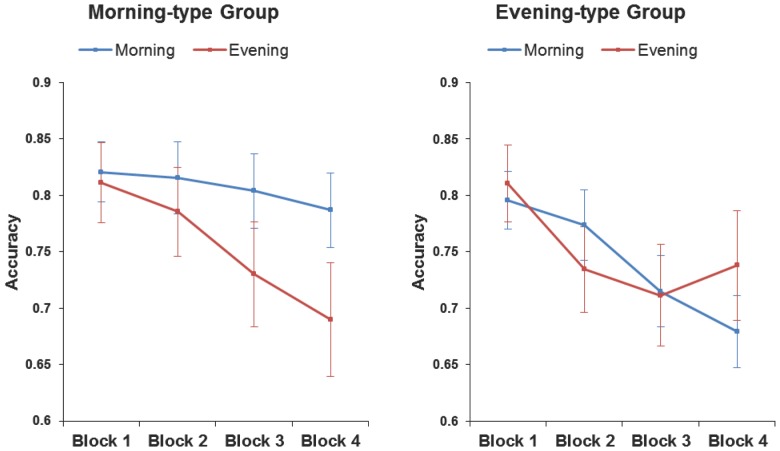
Time of day modulates our cognitive functions, especially those related to executive control, such as the ability to inhibit inappropriate responses. However, the impact of individual differences in time of day preferences (i.e. morning vs. evening chronotype) had not been considered by most studies. It was also unclear whether the vigilance decrement (impaired performance with time on task) depends on both time of day and chronotype. In this study, morning-type and evening-type participants performed a task measuring vigilance and response inhibition (the Sustained Attention to Response Task, SART) in morning and evening sessions. The results showed that the vigilance decrement in inhibitory performance was accentuated at non-optimal as compared to optimal times of day. In the morning-type group, inhibition performance decreased linearly with time on task only in the evening session, whereas in the morning session it remained more accurate and stable over time. In contrast, inhibition performance in the evening-type group showed a linear vigilance decrement in the morning session, whereas in the evening session the vigilance decrement was attenuated, following a quadratic trend. Our findings imply that the negative effects of time on task in executive control can be prevented by scheduling cognitive tasks at the optimal time of day according to specific circadian profiles of individuals. Therefore, time of day and chronotype influences should be considered in research and clinical studies as well as real-word situations demanding executive control for response inhibition.
Overview
The claims and statistics of this paper haven’t been checked yet.
Free: it reads the open-access text and checks the first 5 claims that cite a source we can check. Create a free account to check every claim.
Integrity signals
Registry
Cites
Statistics
Figures
Verification
Claims the paper makes
The claims and statistics of this paper haven’t been checked yet.
Free: it reads the open-access text and checks the first 5 claims that cite a source we can check. Create a free account to check every claim.
Claims other papers make about this one
Each is checked against this paper’s own text: does it say what the citing paper says it does?
The check wasn’t confident either way, so it gives no verdict — never disputed.
In the citing paper
“The current literature indicates a substantial problem with task impurity and emphasizes the need for viable solutions.109,165”
From Executive function deficits in attention-deficit/hyperactivity disorder and autism spectrum disorder (2024) · cites this paper as [165]
Experimental — accuracy not yet measured
Self-check
Percentages, sums and reported differences re-computed from the paper’s own numbers.
The self-check needs the paper’s full text.
Citations
Cites
The benefits of being present: Mindfulness and its role in psychological well-being
Brown, K. W., & Ryan, R. M. (2003) · Journal of Personality and Social Psychology · doi:10.1037/0022-3514.84.4.822 · Cited by 13,448
Beaton, A. E., & Keppel, G. (1975) · American Educational Research Journal · doi:10.3102/00028312012001101 · Cited by 5,855
Design and Analysis: A Researcher's Handbook
Beaton, A. E., & Keppel, G. (1975) · American Educational Research Journal · doi:10.2307/1162588 · Cited by 5,822
A self-assessment questionnaire to determine morningness- eveningness in human circadian rhythms
Home, J. K. (1976) · Medical Entomology and Zoology · Cited by 4,783
(2005) · Choice Reviews Online · doi:10.5860/choice.43-0626 · Cited by 4,674
Attention to Action: Willed and Automatic Control of Behavior
Norman, D. A., & Shallice, T. (1986) · Consciousness and Self-Regulation · doi:10.1007/978-1-4757-0629-1_1 · Cited by 4,455
(1976) · PubMed · Cited by 3,979
Life between Clocks: Daily Temporal Patterns of Human Chronotypes
Roenneberg, T., Wirz-Justice, A., & Merrow, M. (2003) · Journal of Biological Rhythms · doi:10.1177/0748730402239679 · Cited by 2,662
Robertson, I. H., Manly, T., Andrade, J., Baddeley, B. T., & Yiend, J. (1997) · Neuropsychologia · doi:10.1016/s0028-3932(97)00015-8 · Cited by 2,059
Dinges, D. F., & Powell, J. W. (1985) · Behavior Research Methods, Instruments, & Computers · doi:10.3758/bf03200977 · Cited by 1,744
Cited by
Sleep timing, chronotype and social jetlag: Impact on cognitive abilities and psychiatric disorders
Taillard, J., Sagaspe, P., Philip, P., & Bioulac, S. (2021) · Biochemical Pharmacology · doi:10.1016/j.bcp.2021.114438 · Cited by 288
Interplay of chronotype and school timing predicts school performance
Goldin, A. P., Sigman, M., Braier, G., Golombek, D. A., & Leone, M. J. (2020) · Nature Human Behaviour · doi:10.1038/s41562-020-0820-2 · Cited by 142
Cognitive enhancement by transcranial laser stimulation and acute aerobic exercise
Hwang, J., Castelli, D. M., & Gonzalez-Lima, F. (2016) · Lasers in Medical Science · doi:10.1007/s10103-016-1962-3 · Cited by 134
Transcranial direct current stimulation versus caffeine as a fatigue countermeasure
McIntire, L. K., McKinley, R. A., Nelson, J. M., & Goodyear, C. (2017) · Brain stimulation · doi:10.1016/j.brs.2017.08.005 · Cited by 91
Evening types have social jet lag and metabolic alterations in school-age children
Martínez-Lozano, N., Barraco, G. M., Ríos, R., Ruiz, M. J., Tvarijonaviciute, A., Fardy, P. S., Madrid, J. A., & Garaulet, M. (2020) · Scientific Reports · doi:10.1038/s41598-020-73297-5 · Cited by 74
Self-citationLower school performance in late chronotypes: underlying factors and mechanisms
Zerbini, G., van der Vinne, V., Otto, L. K. M., Kantermann, T., Krijnen, W. P., Roenneberg, T., & Merrow, M. (2017) · Scientific Reports · doi:10.1038/s41598-017-04076-y · Cited by 69
Effects of chronotype and time of day on the vigilance decrement during simulated driving
Correa, Á., Molina, E., & Sanabria, D. (2014) · Accident Analysis & Prevention · doi:10.1016/j.aap.2014.02.020 · Cited by 66
Self-citationSharaan, S., Fletcher‐Watson, S., & MacPherson, S. E. (2020) · Autism Research · doi:10.1002/aur.2439 · Cited by 66
Circadian rhythms and decision-making: a review and new evidence from electroencephalography
Correa, Á., Alguacil, S., Ciria, L. F., Jiménez-García, A., & Ruz, M. (2020) · Chronobiology International · doi:10.1080/07420528.2020.1715421 · Cited by 52
Self-citationExecutive function deficits in attention-deficit/hyperactivity disorder and autism spectrum disorder
Kofler, M. J., Soto, E. F., Singh, L. J., Harmon, S. L., Jaisle, E. M., Smith, J. N., Feeney, K. E., & Musser, E. D. (2024) · Nature Reviews Psychology · doi:10.1038/s44159-024-00350-9 · Cited by 51
“…and performance should be assessed across multiple sessions on separate testing days — ideally at different times of day — to increase the specificity and reliability of executive function scores, to reduce participant fatigue and to account for random and time-of-day effects 131,164,165 .”
Wrist temperature and cortisol awakening response in humans with social jetlag in the North
Polugrudov, A. S., Panev, A. S., Смирнов, В. В., Михайлович, П. Н., Borisenkov, M. F., & Popov, S. V. (2016) · Chronobiology International · doi:10.3109/07420528.2016.1168829 · Cited by 49
Time-of-day effects on prospective memory
Barner, C., Schmid, S. R., & Diekelmann, S. (2019) · Behavioural Brain Research · doi:10.1016/j.bbr.2019.112179 · Cited by 48
The State of Cognitive Control in Language Processing
Ness, T., Langlois, V. J., Kim, A. E., & Novick, J. M. (2023) · Perspectives on Psychological Science · doi:10.1177/17456916231197122 · Cited by 46
Effect of chronotype on emotional processing and risk taking
Berdynaj, D., Boudissa, S. N., Grieg, M. S., Hope, C., Mahamed, S. H., & Norbury, R. (2016) · Chronobiology International · doi:10.3109/07420528.2016.1146739 · Cited by 45
Circadian Phenotype Composition is a Major Predictor of Diurnal Physical Performance in Teams
Facer‐Childs, E. R., & Brandstätter, R. (2015) · Frontiers in Neurology · doi:10.3389/fneur.2015.00208 · Cited by 47
Ferrante, G. R., Goldin, A. P., Sigman, M., & Leone, M. J. (2023) · npj Science of Learning · doi:10.1038/s41539-023-00171-0 · Cited by 44
Chronotype regulates the neural basis of response inhibition during the daytime
Song, J., Feng, P., Zhao, X., Xu, W., Xiao, L., Zhou, J., & Zheng, Y. (2018) · Chronobiology International · doi:10.1080/07420528.2017.1392550 · Cited by 40
“© 2017 Taylor & Francis Group, LLC incongruent items but not for neutral items in a Stroop paradigm (Schmidt et al., 2012a), and for precision strategy conditions (controlled processing) but not for speed strategy conditions (automatic processing) in the Sustained Attention to Response Task (Lara et al., 2014).”
MethodResultInfluentialFor Whom (and When) the Time Bell Tolls: Chronotypes and the Synchrony Effect
May, C. P., Hasher, L., & Healey, K. (2023) · Perspectives on Psychological Science · doi:10.1177/17456916231178553 · Cited by 40
The role of chronotype in the interaction between the alerting and the executive control networks
Martínez‐Pérez, V., Palmero, L. B., Campoy, G., & Fuentes, L. J. (2020) · Scientific Reports · doi:10.1038/s41598-020-68755-z · Cited by 40
Bartolacci, C., Scarpelli, S., D’Atri, A., Gorgoni, M., Annarumma, L., Cloos, C., Giannini, A. M., & Gennaro, L. D. (2020) · Brain Sciences · doi:10.3390/brainsci10060327 · Cited by 38
Rodríguez-Morilla, B., Madrid, J. A., Molina, E., Pérez‐Navarro, J., & Correa, Á. (2018) · Frontiers in Psychology · doi:10.3389/fpsyg.2018.00688 · Cited by 37
Self-citationStellingwerff, T., Burke, L. M., Caldwell, H. G., Gathercole, R. J., McNeil, C. J., Napier, C., Purcell, S. A., Boegman, S., Johnson, E. A., Hoar, S., et al. (2025) · Sports Medicine · doi:10.1007/s40279-025-02227-0 · Cited by 38
Light Effects on Behavioural Performance Depend on the Individual State of Vigilance
Correa, Á., Barba, A., & Padilla, F. M. (2016) · PLoS ONE · doi:10.1371/journal.pone.0164945 · Cited by 36
Self-citationSalig, L. K., Kroff, J. R. V., Slevc, L. R., & Novick, J. M. (2021) · Neurobiology of Language · doi:10.1162/nol_a_00046 · Cited by 32
Vigilance decrement and mind-wandering in sustained attention tasks: Two sides of the same coin?
Martínez‐Pérez, V., Andreu, A., Sandoval‐Lentisco, A., Tortajada, M., Palmero, L. B., Castillo, A., Campoy, G., & Fuentes, L. J. (2023) · Frontiers in Neuroscience · doi:10.3389/fnins.2023.1122406 · Cited by 32
Richardson, C. E., Micic, G., Cain, N., Bartel, K., Maddock, B., & Gradisar, M. (2018) · Journal of Adolescence · doi:10.1016/j.adolescence.2018.03.002 · Cited by 30
Martínez‐Pérez, V., Tortajada, M., Palmero, L. B., Campoy, G., & Fuentes, L. J. (2022) · Scientific Reports · doi:10.1038/s41598-021-04607-8 · Cited by 30
Jubera-García, E., Gevers, W., & Opstal, F. V. (2021) · Biochemical Pharmacology · doi:10.1016/j.bcp.2021.114478 · Cited by 29
Cognitive control states influence real-time sentence processing as reflected in the P600 ERP
Ovans, Z., Hsu, N. S., Bell-Souder, D., Gilley, P. M., Novick, J. M., & Kim, A. E. (2022) · Language Cognition and Neuroscience · doi:10.1080/23273798.2022.2026422 · Cited by 29
Chan, W. S. (2016) · Journal of Sleep Research · doi:10.1111/jsr.12437 · Cited by 29
Circadian preference and physical and cognitive performance in adolescence: A scoping review
Vidueira, V. F., Booth, J. N., Saunders, D. H., Sproule, J., & Turner, A. P. (2023) · Chronobiology International · doi:10.1080/07420528.2023.2256901 · Cited by 28
The Role of Morningness and Endurance in Mood and Attention During Morning and Evening Hours
Jankowski, K. S., & Zajenkowski, M. (2016) · Journal of Individual Differences · doi:10.1027/1614-0001/a000189 · Cited by 28
Cásedas, L., Cebolla, A., & Lupiáñez, J. (2022) · Mindfulness · doi:10.1007/s12671-022-01850-6 · Cited by 28
Examining the effects of time of day and sleep on generalization
Tandoc, M. C., Bayda, M., Poskanzer, C., Cho, E., Cox, R., Stickgold, R., & Schapiro, A. C. (2021) · PLoS ONE · doi:10.1371/journal.pone.0255423 · Cited by 28
Augmenting Visual Search Performance With Transcranial Direct Current Stimulation (tDCS)
Nelson, J. M., McKinley, R. A., McIntire, L. K., Goodyear, C., & Walters, C. M. (2015) · Military Psychology · doi:10.1037/mil0000085 · Cited by 28
Economic decision-making in morning/evening-type people as a function of time of day
Correa, Á., Herrera, N. R., Ruz, M., Tonetti, L., Martoni, M., Fabbri, M., & Natale, V. (2016) · Chronobiology International · doi:10.1080/07420528.2016.1246455 · Cited by 27
Self-citationLucifora, C., Grasso, G. M., Nitsche, M. A., D'Italia, G., Sortino, M., Salehinejad, M. A., Falzone, A., Avenanti, A., & Vicario, C. M. (2022) · Journal of Affective Disorders · doi:10.1016/j.jad.2022.05.033 · Cited by 27
Too Jittery to Sleep? Temporal Associations of Actigraphic Sleep and Caffeine in Adolescents
Mathew, G. M., Reichenberger, D., Master, L., Buxton, O. M., Chang, A., & Hale, L. E. (2021) · Nutrients · doi:10.3390/nu14010031 · Cited by 26
Bellicoso, D., Trudeau, M., Fitch, M. I., & Ralph, M. R. (2017) · Chronobiology International · doi:10.1080/07420528.2017.1314301 · Cited by 26
Time-restricted eating, the clock ticking behind the scenes
Ribas‐Latre, A., Fernández‐Veledo, S., & Vendrell, J. J. (2024) · Frontiers in Pharmacology · doi:10.3389/fphar.2024.1428601 · Cited by 22
Hafiz, P., & Bardram, J. E. (2020) · JMIR mhealth and uhealth · doi:10.2196/17506 · Cited by 21
Chronotype, sleep quality and academic performances among Mizo students
Jongte, L., & Trivedi, A. K. (2021) · Chronobiology International · doi:10.1080/07420528.2021.2002350 · Cited by 21
A relational structure of voluntary visual-attention abilities.
Skogsberg, K., Grabowecky, M., Wilt, J. A., Revelle, W., Iordanescu, L., & Suzuki, S. (2015) · Journal of Experimental Psychology Human Perception & Performance · doi:10.1037/a0039000 · Cited by 21
Naftalovich, H., Anholt, G. E., Keren, R., Ben Arush, O., & Kalanthroff, E. (2021) · Journal of Psychiatric Research · doi:10.1016/j.jpsychires.2021.08.032 · Cited by 18
Chronotype and synchrony effects in human cognitive performance: A systematic review
Chauhan, S., Vanova, M., Tailor, U., Asad, M., Faßbender, K., Norbury, R., Ettinger, U., & Kumari, V. (2025) · Chronobiology International · doi:10.1080/07420528.2025.2490495 · Cited by 18
The Acute Readiness Monitoring Scale: Assessing Predictive and Concurrent Validation
Summers, S. J., Keegan, R. J., Flood, A. P., Martin, K., McKune, A. J., & Rattray, B. (2021) · Frontiers in Psychology · doi:10.3389/fpsyg.2021.738519 · Cited by 16
Grady, C. L., Rieck, J. R., Baracchini, G., & DeSouza, B. (2023) · Social Cognitive and Affective Neuroscience · doi:10.1093/scan/nsad044 · Cited by 15
Solheim, B., Olsen, A., Kallestad, H., Langsrud, K., Bjorvatn, B., Gradisar, M., & Sand, T. (2018) · Journal of Sleep Research · doi:10.1111/jsr.12730 · Cited by 15
Rosa, D. E., Marot, L. P., de Mello, M. T., Narciso, F. V., Gonçalves, B. D. S. B., Marqueze, E. C., & Crispim, C. A. (2019) · Scientific Reports · doi:10.1038/s41598-019-55114-w · Cited by 15
Electroencephalographic and skin temperature indices of vigilance and inhibitory control
Lara, T., Molina, E., Madrid, J. A., & Correa, Á. (2018) · Psicologica · doi:10.2478/psicolj-2018-0010 · Cited by 14
Self-citationKorman, M., Levy, I., Maaravi-Hesseg, R., Eshed-Mantel, A., & Karni, A. (2019) · Frontiers in Psychology · doi:10.3389/fpsyg.2019.01397 · Cited by 14
Do early birds share their worms? How prosocial behaviour and empathy vary across the day
Francis, Z. L., Depow, G. J., & Inzlicht, M. (2020) · Journal of Research in Personality · doi:10.1016/j.jrp.2020.104055 · Cited by 14
Probing sustained attention and fatigue across the lifespan
Hanzal, S., Learmonth, G., Thut, G., & Harvey, M. (2024) · PLoS ONE · doi:10.1371/journal.pone.0292695 · Cited by 13
Response Complexity Reduces Errors on a Response Inhibition Task
Head, J. R., Tenan, M. S., Tweedell, A. J., Wilson, K., & Helton, W. S. (2019) · Human Factors The Journal of the Human Factors and Ergonomics Society · doi:10.1177/0018720819852801 · Cited by 13
Rulleau, T., Robin, N., Abou-Dest, A., Chesnet, D., & Toussaint, L. (2018) · Experimental Aging Research · doi:10.1080/0361073x.2018.1521496 · Cited by 13
Time of day effects on the use of distraction to minimise forgetting
Ngo, K. W. J., Biss, R. K., & Hasher, L. (2018) · Quarterly Journal of Experimental Psychology · doi:10.1177/1747021817740808 · Cited by 12
Target bottom-up strength determines the extent of attentional modulations on conscious perception
Botta, F., Ródenas, E., & Chica, A. B. (2017) · Experimental Brain Research · doi:10.1007/s00221-017-4954-z · Cited by 12
Academic performance depends on chronotype: Myth or reality?
Indla, Y. R., & Nagothu, R. S. (2019) · Indian Journal of Clinical Anatomy and Physiology · doi:10.18231/j.ijcap.2019.103 · Cited by 12
Chronotype, general health and quality of sleep in a population of Spanish nurses
Debbia, F., Medina-Valverde, M. J., García‐Arcos, A., Garrido-Gutiérrez, A., Rodríguez‐Borrego, M. A., & López‐Soto, P. J. (2021) · Revista da Escola de Enfermagem da USP · doi:10.1590/s1980-220x2020010903752 · Cited by 12
Opstal, F. V., Aslanov, V., & Schnelzer, S. (2022) · Collabra Psychology · doi:10.1525/collabra.57536 · Cited by 11
Levitan, R. D., Klein, R., Bakshi, N., Laposa, J. M., Hill, S., Kloiber, S. M., & Daskalakis, Z. J. (2019) · Chronobiology International · doi:10.1080/07420528.2019.1661851 · Cited by 11
Richards, A. L., Kanady, J. C., Huie, J. R., Straus, L. D., Inslicht, S. S., Levihn‐Coon, A., Metzler, T. J., & Neylan, T. C. (2019) · Journal of Sleep Research · doi:10.1111/jsr.12919 · Cited by 11
Auditory spatial attention gradients and cognitive control as a function of vigilance
Golob, E. J., Nelson, J. T., Scheuerman, J., Venable, K. B., & Mock, J. R. (2021) · Psychophysiology · doi:10.1111/psyp.13903 · Cited by 9
Mid-luteal phase progesterone effects on vigilance tasks are modulated by women’s chronotype
Palmero, L. B., Martínez‐Pérez, V., Tortajada, M., Campoy, G., & Fuentes, L. J. (2022) · Psychoneuroendocrinology · doi:10.1016/j.psyneuen.2022.105722 · Cited by 9
The Interplay of Time-of-day and Chronotype Results in No General and Robust Cognitive Boost
Rey-Mermet, A., & Rothen, N. (2023) · Collabra Psychology · doi:10.1525/collabra.88337 · Cited by 7
Yang, H.-J., Cheng, W., Hsiao, M.-C., Huang, S.-C., Kubo, T., Hang, L., & Lee, C. W. (2023) · Frontiers in Psychiatry · doi:10.3389/fpsyt.2023.1214143 · Cited by 7
Altay, G., & YAVUZ, A. Y. (2024) · Chronobiology International · doi:10.1080/07420528.2024.2419865 · Cited by 7
Mental rotation performance and circadian chronotype in university students: a preliminary study
Nishida, M., Hiroki, A. N. D. O., Murata, Y., & Shioda, K. (2021) · Biological Rhythm Research · doi:10.1080/09291016.2021.1890366 · Cited by 7
Hanzal, S., Learmonth, G., Thut, G., & Harvey, M. (2024) · bioRxiv (Cold Spring Harbor Laboratory) · doi:10.1101/2024.10.16.618638 · Cited by 6
Fatigue Leads to Dynamic Shift in Fronto-parietal Sustained Attention Network
Borghetti, L., Rhodes, L. J., & Morris, M. B. (2022) · Proceedings of the Human Factors and Ergonomics Society Annual Meeting · doi:10.1177/1071181322661056 · Cited by 6
Sarvandani, M. N., Garmabi, B., Asadi, M., Ghazvini, H., Rafaiee, R., & Moghaddam, H. K. (2025) · Basic and Clinical Neuroscience Journal · doi:10.32598/bcn.2022.1425.6 · Cited by 6
Gobbo, M., & Falciati, L. (2014) · Frontiers in Psychiatry · doi:10.3389/fpsyt.2014.00150 · Cited by 6
Age differences in motivation drive performance during the sustained attention to response task
Hanzal, S., Learmonth, G., Thut, G., & Harvey, M. (2025) · PLoS ONE · doi:10.1371/journal.pone.0324694 · Cited by 5
Sindiani, M., Korman, M., & Karni, A. (2022) · Learning and Instruction · doi:10.1016/j.learninstruc.2022.101630 · Cited by 5
Influence of time-of-day on joint Navon effect
Fabbri, M., Frisoni, M., Martoni, M., Tonetti, L., & Natale, V. (2017) · Cognitive Processing · doi:10.1007/s10339-017-0849-y · Cited by 5
Tseng, H., & Damian, M. F. (2023) · Chronobiology International · doi:10.1080/07420528.2023.2256843 · Cited by 5
Budiawan, W., Prastawa, H., Merdeka, G. F. P., Zahra, Z. A., & Gitowardojo, R. J. (2024) · Multidisciplinary Science Journal · doi:10.31893/multiscience.2025204 · Cited by 5
Palmero, L. B., Martínez‐Pérez, V., Tortajada, M., Campoy, G., & Fuentes, L. J. (2024) · Consciousness and Cognition · doi:10.1016/j.concog.2023.103633 · Cited by 4
Pahan, M. K., & Singh, M. K. (2022) · Physical Education Theory and Methodology · doi:10.17309/tmfv.2022.2.18 · Cited by 4
Circadian modulation of the time course of automatic and controlled semantic processing
Palmero, L. B., Tortajada, M., Martínez‐Pérez, V., Sandoval‐Lentisco, A., Campoy, G., & Fuentes, L. J. (2024) · Chronobiology International · doi:10.1080/07420528.2024.2312806 · Cited by 4
Crisp, C., Mooney, E., Howlader, M., Stoddard, J., & Penton‐Voak, I. S. (2024) · BMJ Mental Health · doi:10.1136/bmjment-2024-301045 · Cited by 4
Sleep and Infantry Battle Drill Performance in Special Operations Soldiers
Mantua, J., Shevchik, J. D., Chaudhury, S., Eldringhoff, H. P., Mickelson, C. A., & McKeon, A. B. (2022) · Aerospace Medicine and Human Performance · doi:10.3357/amhp.6040.2022 · Cited by 4
Linkovski, O., Naftalovich, H., David, M., Seror, Y., & Kalanthroff, E. (2023) · Journal of Clinical Medicine · doi:10.3390/jcm12124075 · Cited by 3
Hausen, J. E., Møller, J., Greiff, S., & Niepel, C. (2023) · Contemporary Educational Psychology · doi:10.1016/j.cedpsych.2023.102199 · Cited by 3
Sato, T. G., Takahashi, M., & Nishida, M. (2025) · Journal of Sleep Research · doi:10.1111/jsr.70223 · Cited by 3
Normed Images for X-ray Screening Vigilance Tasks
Merritt, S. M., Shirase, L., & Foster, G. C. (2020) · Journal of Open Psychology Data · doi:10.5334/jopd.48 · Cited by 3
Figueiredo, S. (2024) · Center for Educational Policy Studies Journal · doi:10.26529/cepsj.1454 · Cited by 3
Hanzal, S., Learmonth, G., Thut, G., & Harvey, M. (2026) · European Journal of Neuroscience · doi:10.1111/ejn.70402 · Cited by 3
Toward sustainable interventions for enhancing vigilance: A scoping review
Prendez, D. M., Li, J., Higgins, E. A., & Kim, J.-E. (2025) · Applied Ergonomics · doi:10.1016/j.apergo.2025.104628 · Cited by 3
Kalanthroff, E., Seror, Y., Sagi, N., Hochman, S., Linkovski, O., Naftalovich, H., & Simpson, H. B. (2025) · Journal of Mood & Anxiety Disorders · doi:10.1016/j.xjmad.2025.100113 · Cited by 2
An examination of sustained attention during complex multitasking scenarios
Rann, J. C., & Almor, A. (2025) · Cognitive Research Principles and Implications · doi:10.1186/s41235-025-00674-x · Cited by 2
Light Exposure on Alertness after Wake-Up in Healthy Men: Comparing Dim, Bright, Red, and Blue Light
Mekschrat, L., Straßer, T., Ghassabei, S., Schmalbach, B., Niedling, M., & Petrowski, K. (2024) · Neuropsychobiology · doi:10.1159/000541230 · Cited by 2
Gobbo, M., de Resende, M. S., Santos, I. M., de Moura, E. C., & Pedro, R. D. A. (2025) · BMJ Open · doi:10.1136/bmjopen-2025-102783 · Cited by 2
Plueckebaum, H., Czernochowski, D., Lachmann, T., & Beck, A. (2025) · Biological Psychology · doi:10.1016/j.biopsycho.2025.109042 · Cited by 1
Molina, E., Fernández‐Prieto, I., Andrés, P., & Parmentier, F. B. R. (2020) · PsyArXiv (OSF Preprints) · doi:10.31234/osf.io/8ynca · Cited by 1
Time-of-day related fluctuations of self-belief formationPreprint
Mayer, A. V., Schröder, A., Czekalla, N., Müller‐Pinzler, L., Rosenbusch, L., Paulus, F. M., Oster, H., Sayk, C., Kammerer, M. K., Wilhelm, I., et al. (2024) · bioRxiv (Cold Spring Harbor Laboratory) · doi:10.1101/2024.12.05.627011 · Cited by 1
Nelson, J. M. (2016) · CORE Scholar (Wright State University) · Cited by 1
Sharaan, S. (2021) · ERA · doi:10.7488/era/1078 · Cited by 1
Chidharom, M. (2021) · theses.fr (ABES) · doi:10.70675/86b202ecz4a60z4cf6z88baz443d18d8680a · Cited by 1
Nutrition at the Interface of Sleep and Circadian Rhythms: Implications for Health
Scoditti, E., & Garbarino, S. (2023) · MDPI eBooks · doi:10.3390/books978-3-0365-6709-9 · Cited by 1
Metadata
- Authors
- Lara, T., Madrid, J. A., & Correa, Á.
- Affiliations
- Universidad de Granada (ES)
- Universidad de Murcia (ES)
- Corresponding author
- Correa, Ángel
- Venue
- PLoS ONE
- Publisher
- Public Library of Science (PLoS)
- Published
- 2014-02-19
- Volume
- 9
- Issue
- 2
- Pages
- e88820
- ISSN
- 1932-6203 (ISSN-L)
- PMC
- PMC3929366
- OpenAlex
- W2031715874
- Cited by
- 109
- References
- 63
- Citations by year
- 2026: 5 · 2025: 12 · 2024: 10 · 2023: 13 · 2022: 10 · 2021: 13 · 2020: 12 · 2019: 8 · 2018: 6 · 2017: 7 · 2016: 8 · 2015: 3 · 2014: 2
- FWCI
- 9.26
- Type
- journal article
- Language
- en
- Open access
- gold
- doi.org
- Locations
- PLoS ONE (publishedVersion, cc-by)
- Europe PMC (PubMed Central) (publishedVersion, cc-by)
- PubMed Central (publishedVersion, cc-by)
- PubMed (publishedVersion)
- LA Referencia (Red Federada de Repositorios Institucionales de Publicaciones Científicas) (submittedVersion, other-oa)
- Institutional Repository of the University of Granada (University of Granada) (submittedVersion, other-oa)
- DOAJ (DOAJ: Directory of Open Access Journals) (submittedVersion, cc-by-sa)
- Topics
- Social Sciences › Psychology › Experimental and Cognitive Psychology › Sleep and Work-Related Fatigue
- Life Sciences › Neuroscience › Cognitive Neuroscience › Mind wandering and attention
- Life Sciences › Neuroscience › Endocrine and Autonomic Systems › Circadian rhythm and melatonin
- Keywords
- vigilance decrement, chronotype, executive function, response inhibition, sustained attention, time of day, circadian rhythm, time on task, Sustained Attention to Response Task, individual differences
- MeSH terms
- Adolescent, Adult, Arousal, Attention, Awareness, Chronobiology Phenomena, Circadian Rhythm, Humans, Individuality, Inhibition, Psychological, Male, Neuropsychological Tests, Reaction Time, Task Performance and Analysis, Time Factors, Young Adult, Executive Function
About these checks
Registry, retraction, Cites and statistics results are computed, not judged, with one exception: a printed reference that no index lists is read once by a model before it counts as a citation error. Claims are extracted by a model and kept only when their quote appears verbatim in the text; each cited source is then checked, with a model’s help, for whether it says what the claim relies on. Those verdicts can be wrong — read the claim’s quote and the cited source before relying on one.
Statistics and arithmetic are recomputed, not judged.
Confidence bands are shown only for fields calibrated on our annotated test set. None is calibrated yet, so no band is shown.
What counts as a claim ›How we measure confidence ›How we check this ›
Are you an author, or do you see a problem with this page? Request a review
Data sources
Bibliographic data: Semantic Scholar, OpenAlex, Crossref.
Contains information from the Semantic Scholar Academic Graph Datasets, made available under the ODC Attribution License (ODC-BY 1.0).
Semantic Scholar’s data is described in: Kinney, R., et al. (2023). The Semantic Scholar Open Data Platform. arXiv:2301.10140.
