

The Vigilance Decrement in Executive Function Is Attenuated When Individual Chronotypes Perform at Their Optimal Time of Day
Open accessThe DOI matches its Crossref record; 64 of the 64 references it cites were found in a registry or an index.
Abstract
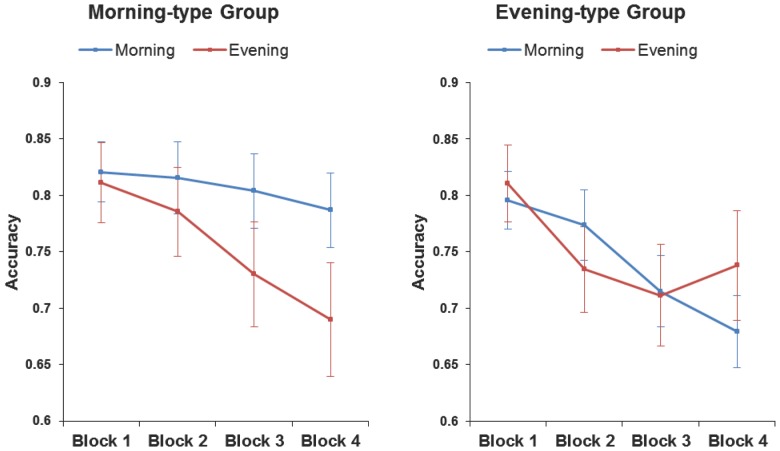
Time of day modulates our cognitive functions, especially those related to executive control, such as the ability to inhibit inappropriate responses. However, the impact of individual differences in time of day preferences (i.e. morning vs. evening chronotype) had not been considered by most studies. It was also unclear whether the vigilance decrement (impaired performance with time on task) depends on both time of day and chronotype. In this study, morning-type and evening-type participants performed a task measuring vigilance and response inhibition (the Sustained Attention to Response Task, SART) in morning and evening sessions. The results showed that the vigilance decrement in inhibitory performance was accentuated at non-optimal as compared to optimal times of day. In the morning-type group, inhibition performance decreased linearly with time on task only in the evening session, whereas in the morning session it remained more accurate and stable over time. In contrast, inhibition performance in the evening-type group showed a linear vigilance decrement in the morning session, whereas in the evening session the vigilance decrement was attenuated, following a quadratic trend. Our findings imply that the negative effects of time on task in executive control can be prevented by scheduling cognitive tasks at the optimal time of day according to specific circadian profiles of individuals. Therefore, time of day and chronotype influences should be considered in research and clinical studies as well as real-word situations demanding executive control for response inhibition.
Overview
The claims and statistics of this paper haven’t been checked yet.
Free: it reads the open-access text and checks the first 5 claims that cite a source we can check. Create a free account to check every claim.
Integrity signals
Registry
Cites
Statistics
Figures
Verification
Claims the paper makes
The claims and statistics of this paper haven’t been checked yet.
Free: it reads the open-access text and checks the first 5 claims that cite a source we can check. Create a free account to check every claim.
Claims other papers make about this one
Each is checked against this paper’s own text: does it say what the citing paper says it does?
The check wasn’t confident either way, so it gives no verdict — never disputed.
In the citing paper
“The current literature indicates a substantial problem with task impurity and emphasizes the need for viable solutions.109,165”
From Executive function deficits in attention-deficit/hyperactivity disorder and autism spectrum disorder (2024) · cites this paper as [165]
Experimental — accuracy not yet measured
Self-check
Percentages, sums and reported differences re-computed from the paper’s own numbers.
The self-check needs the paper’s full text.
Citations
Cites
The benefits of being present: Mindfulness and its role in psychological well-being
Brown, K. W., & Ryan, R. M. (2003) · Journal of Personality and Social Psychology · doi:10.1037/0022-3514.84.4.822 · Cited by 13,448
Beaton, A. E., & Keppel, G. (1975) · American Educational Research Journal · doi:10.3102/00028312012001101 · Cited by 5,855
Design and Analysis: A Researcher's Handbook
Beaton, A. E., & Keppel, G. (1975) · American Educational Research Journal · doi:10.2307/1162588 · Cited by 5,822
A self-assessment questionnaire to determine morningness- eveningness in human circadian rhythms
Home, J. K. (1976) · Medical Entomology and Zoology · Cited by 4,783
(2005) · Choice Reviews Online · doi:10.5860/choice.43-0626 · Cited by 4,674
Attention to Action: Willed and Automatic Control of Behavior
Norman, D. A., & Shallice, T. (1986) · Consciousness and Self-Regulation · doi:10.1007/978-1-4757-0629-1_1 · Cited by 4,455
(1976) · PubMed · Cited by 3,979
Life between Clocks: Daily Temporal Patterns of Human Chronotypes
Roenneberg, T., Wirz-Justice, A., & Merrow, M. (2003) · Journal of Biological Rhythms · doi:10.1177/0748730402239679 · Cited by 2,662
Robertson, I. H., Manly, T., Andrade, J., Baddeley, B. T., & Yiend, J. (1997) · Neuropsychologia · doi:10.1016/s0028-3932(97)00015-8 · Cited by 2,059
Dinges, D. F., & Powell, J. W. (1985) · Behavior Research Methods, Instruments, & Computers · doi:10.3758/bf03200977 · Cited by 1,744
Cited by
Items 101–139 of 139
Kahl, S. (2024) · University Libraries (University of Maryland) · doi:10.13016/om5k-5jwr · Cited by 1
Preferencias circadianas, hábitos de sueño y desempeño académico en adolescentes
Estevan Debat, I. M. (2018) · LA Referencia (Red Federada de Repositorios Institucionales de Publicaciones Científicas) · Cited by 1
Serio, G., Pacelli, C., Piccoli, C., Capitanio, N., Cibelli, G., Valenzano, A. A., Landini, F., Carlucci, L., & Palladino, P. (2026) · PLoS ONE · doi:10.1371/journal.pone.0338877
Circadian Factors in Coping with Chronic Stress
Bellicoso, D. (2017) · TSpace (University of Toronto)
Wüst, L. N., Cajochen, C., & Lasauskaite, R. (2025) · Neurobiology of Sleep and Circadian Rhythms · doi:10.1016/j.nbscr.2025.100125
The modulatory effect of sleep on transcranial direct current stimulation-enhanced learning
Ebajemito, J. K. (2018) · University of Surrey Open Research repository
Tavares, P. D. S., Weydmann, G. J., Morais, R. S. D. O., Buchmann, S., Schmidt, E. B., Alves, P., Eckhardt, J., Friedman, R., & Bizarro, L. (2026) · Sleep Medicine · doi:10.1016/j.sleep.2026.109245
Do early birds share their worms? How empathy and prosociality vary across the course of the dayPreprint
Francis, Z. L., Depow, G. J., & Inzlicht, M. (2020) · PsyArXiv (OSF Preprints) · doi:10.31234/osf.io/yfch6
Daily dynamics of the temporal orientations of mind wandering: chronotype matters!
Likar, M., Becz, B., Tomacsek, V., & Simor, P. (2025) · Neuroscience of Consciousness · doi:10.1093/nc/niaf036
Aguirre, M. J., Barttfeld, P., Martín‐Arévalo, E., Lupiáñez, J., & Luna, F. G. (2025) · Behavior Research Methods · doi:10.3758/s13428-025-02808-x
黄辰晔, Wang, X., & Xie, D. (2026) · Brain Imaging and Behavior · doi:10.1007/s11682-026-01147-5
Application clinique de l'imagerie motrice en rééducation
Rulleau, T. (2017) · theses.fr (ABES) · doi:10.70675/0fbe5fd6z7d44z4b33za9f9z1fc64af04a52
AVERY, M. (2022) · Durham e-Theses (Durham University)
Regulation of Energy through Music Listening and the Influence of Diurnal Energy LevelsPreprint
Randall, W., Mavrolampados, A., Saarikallio, S. H., Kirk, R., MacKerron, G., & Toiviainen, P. (2026) · Research Square · doi:10.21203/rs.3.rs-10894216/v1
Chauhan, S., Ettinger, U., Faßbender, K., Norbury, R., & Kumari, V. (2025) · Journal of Psychopharmacology · doi:10.1177/02698811251337397
Darby, S. (2015) · Research Explorer (The University of Manchester)
Influencia de la luz sobre procesos neurocomportamentales implicados en vigilancia
Barba Herrera, A. (2018) · Institutional Repository of the University of Granada (University of Granada)
Influencia de la luz y los ritmos circadianos en las tareas de vigilancia
Rodríguez Morilla, B. (2017) · Institutional Repository of the University of Granada (University of Granada)
Likar, M. (2024) · Repository of the University of Ljubljana (University of Ljubljana)
Gilsoul, J. (2020) · ORBi (University of Liège)
Salviviani, R. (2026) · BCU Open Access Repository (Birmingham City University)
Tomás, C. (2018) · Repositório Institucional da Universidade Autónoma de Lisboa (Universidade Autónoma de Lisboa)
A influência do cronótipo no desempenho da memória de testemunhas oculares
Oliveira, A. C. (2022) · Portuguese National Funding Agency for Science, Research and Technology (RCAAP Project by FCT) · doi:10.34626/7r3c-2b29
Jobi, S. (2024) · MACAU: Open Access Repository of Kiel University
Carvalho, L. V. B., Pato, M. V., & Pinto, N. (2026) · Biological Rhythm Research · doi:10.1080/09291016.2026.2755850
Age differences in selective covert attention and associative memory
Parimoo, S. (2018) · TSpace (University of Toronto)
Efeitos do Cronótipo e da Alexitimia no Reconhecimento de Identidade
Vasconcelos, J. D. J. (2020) · Portuguese National Funding Agency for Science, Research and Technology (RCAAP Project by FCT)
McGowan, N. M. (2017) · Arrow@dit (Dublin Institute of Technology)
A Multimodal Investigation of Age Differences in Inhibitory Control
Parimoo, S. (2023) · TSpace (University of Toronto)
Efectos del ejercicio físico sobre el rendimiento de vigilancia
Fernández, G., & Tomás, F. (2017) · Institutional Repository of the University of Granada (University of Granada)
Cruz, H. (2018) · Lusophone University Repository
Scheduled at the margins: antecedents and consequences of nonstandard work schedules
Taiji, R. (2018) · Oxford University Research Archive (ORA) (University of Oxford) · doi:10.5287/ora-vg8qv4ybd
The effects of total sleep deprivation on decision making
Latini, E. (2026) · Warwick Research Archive Portal (University of Warwick) · doi:10.82444/warw.33883186
(Poster presentation and Conference Abstract)
Gomes, A. A., Leitao, J., Pires, L. M. D. C. P. D. S., Marques, D. R., Vilar, M., Silva, C. F., & de Azevedo, M. H. P. (2019) · Portuguese National Funding Agency for Science, Research and Technology (RCAAP Project by FCT)
Oliveira, I. B. D. (2025) · Portuguese National Funding Agency for Science, Research and Technology (RCAAP Project by FCT)
Metadata
- Authors
- Lara, T., Madrid, J. A., & Correa, Á.
- Affiliations
- Universidad de Granada (ES)
- Universidad de Murcia (ES)
- Corresponding author
- Correa, Ángel
- Venue
- PLoS ONE
- Publisher
- Public Library of Science (PLoS)
- Published
- 2014-02-19
- Volume
- 9
- Issue
- 2
- Pages
- e88820
- ISSN
- 1932-6203 (ISSN-L)
- PMC
- PMC3929366
- OpenAlex
- W2031715874
- Cited by
- 109
- References
- 63
- Citations by year
- 2026: 5 · 2025: 12 · 2024: 10 · 2023: 13 · 2022: 10 · 2021: 13 · 2020: 12 · 2019: 8 · 2018: 6 · 2017: 7 · 2016: 8 · 2015: 3 · 2014: 2
- FWCI
- 9.26
- Type
- journal article
- Language
- en
- Open access
- gold
- doi.org
- Locations
- PLoS ONE (publishedVersion, cc-by)
- Europe PMC (PubMed Central) (publishedVersion, cc-by)
- PubMed Central (publishedVersion, cc-by)
- PubMed (publishedVersion)
- LA Referencia (Red Federada de Repositorios Institucionales de Publicaciones Científicas) (submittedVersion, other-oa)
- Institutional Repository of the University of Granada (University of Granada) (submittedVersion, other-oa)
- DOAJ (DOAJ: Directory of Open Access Journals) (submittedVersion, cc-by-sa)
- Topics
- Social Sciences › Psychology › Experimental and Cognitive Psychology › Sleep and Work-Related Fatigue
- Life Sciences › Neuroscience › Cognitive Neuroscience › Mind wandering and attention
- Life Sciences › Neuroscience › Endocrine and Autonomic Systems › Circadian rhythm and melatonin
- Keywords
- vigilance decrement, chronotype, executive function, response inhibition, sustained attention, time of day, circadian rhythm, time on task, Sustained Attention to Response Task, individual differences
- MeSH terms
- Adolescent, Adult, Arousal, Attention, Awareness, Chronobiology Phenomena, Circadian Rhythm, Humans, Individuality, Inhibition, Psychological, Male, Neuropsychological Tests, Reaction Time, Task Performance and Analysis, Time Factors, Young Adult, Executive Function
About these checks
Registry, retraction, Cites and statistics results are computed, not judged, with one exception: a printed reference that no index lists is read once by a model before it counts as a citation error. Claims are extracted by a model and kept only when their quote appears verbatim in the text; each cited source is then checked, with a model’s help, for whether it says what the claim relies on. Those verdicts can be wrong — read the claim’s quote and the cited source before relying on one.
Statistics and arithmetic are recomputed, not judged.
Confidence bands are shown only for fields calibrated on our annotated test set. None is calibrated yet, so no band is shown.
What counts as a claim ›How we measure confidence ›How we check this ›
Are you an author, or do you see a problem with this page? Request a review
Data sources
Bibliographic data: Semantic Scholar, OpenAlex, Crossref.
Contains information from the Semantic Scholar Academic Graph Datasets, made available under the ODC Attribution License (ODC-BY 1.0).
Semantic Scholar’s data is described in: Kinney, R., et al. (2023). The Semantic Scholar Open Data Platform. arXiv:2301.10140.
