

Association between Drug Insurance Cost Sharing Strategies and Outcomes in Patients with Chronic Diseases: A Systematic Review
Open accessThe DOI matches its Crossref record; 41 of the 43 references it cites were found in a registry or an index.
Abstract
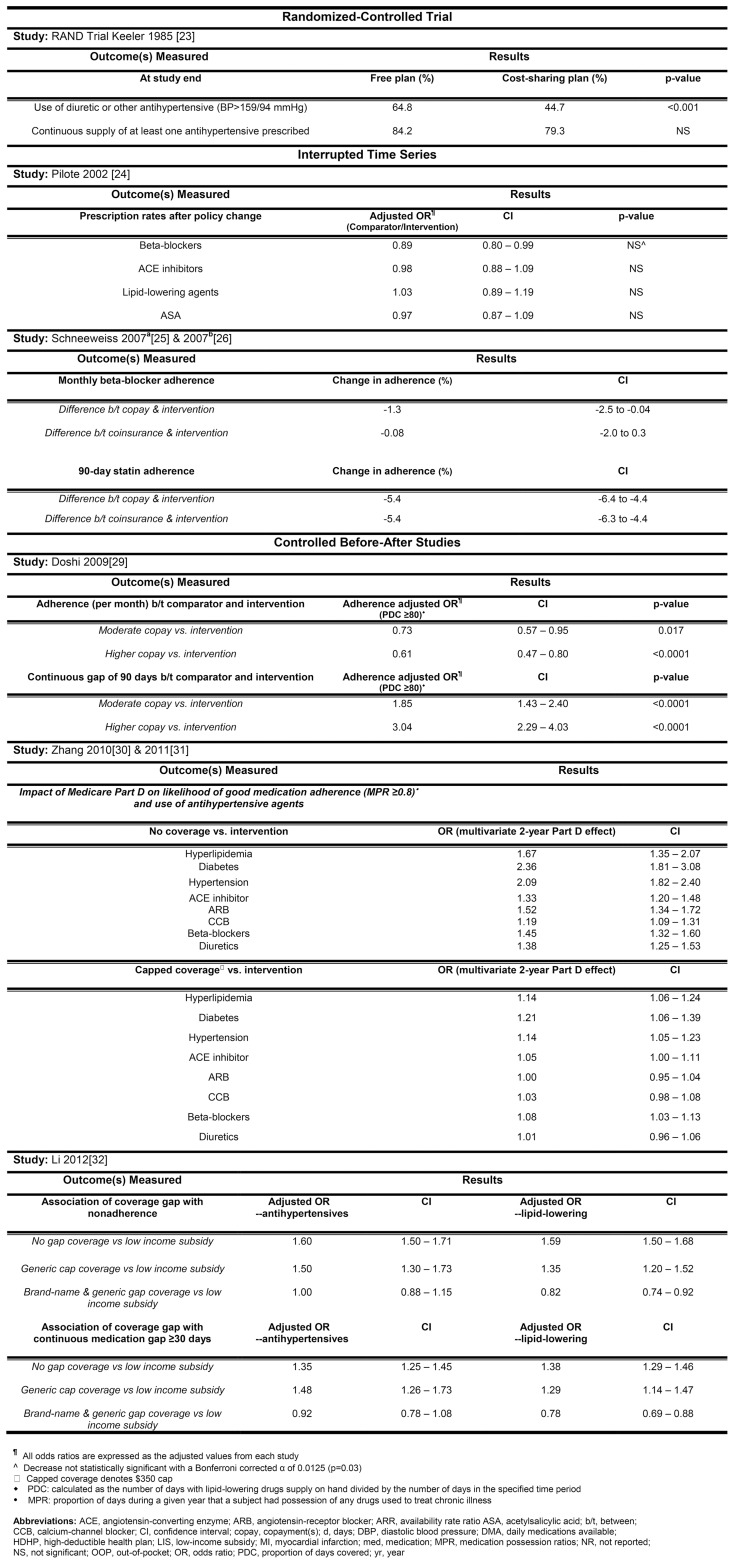
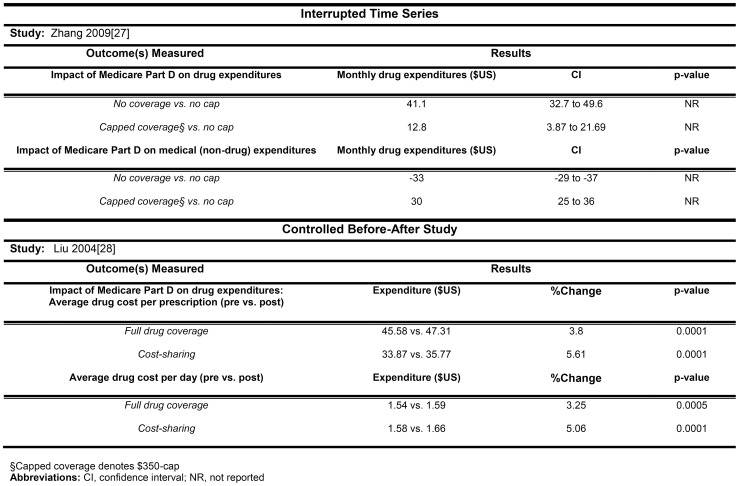
BACKGROUND: Prescription drugs are used in people with hypertension, diabetes, and cardiovascular disease to manage their illness. Patient cost sharing strategies such as copayments and deductibles are often employed to lower expenditures for prescription drug insurance plans, but the impact on health outcomes in these patients is unclear. OBJECTIVE: To determine the association between drug insurance and patient cost sharing strategies on medication adherence, clinical and economic outcomes in those with chronic diseases (defined herein as diabetes, hypertension, hypercholesterolemia, coronary artery disease, and cerebrovascular disease). METHODS: Studies were included if they examined various cost sharing strategies including copayments, coinsurance, fixed copayments, deductibles and maximum out-of-pocket expenditures. Value-based insurance design and reference based pricing studies were excluded. Two reviewers independently identified original intervention studies (randomized controlled trials, interrupted time series, and controlled before-after designs). MEDLINE, EMBASE, Cochrane Library, CINAHL, and relevant reference lists were searched until March 2013. Two reviewers independently assessed studies for inclusion, quality, and extracted data. Eleven studies, assessing the impact of seven policy changes, were included: 2 separate reports of one randomized controlled trial, 4 interrupted time series, and 5 controlled before-after studies. FINDINGS: Outcomes included medication adherence, clinical events (myocardial infarction, stroke, death), quality of life, healthcare utilization, or cost. The heterogeneity among the studies precluded meta-analysis. Few studies reported the impact of cost sharing strategies on mortality, clinical and economic outcomes. The association between patient copayments and medication adherence varied across studies, ranging from no difference to significantly lower adherence, depending on the amount of the copayment. CONCLUSION: Lowering cost sharing in patients with chronic diseases may improve adherence, but the impact on clinical and economic outcomes is uncertain.
Overview
The claims and statistics of this paper haven’t been checked yet.
Free: it reads the open-access text and checks the first 5 claims that cite a source we can check. Create a free account to check every claim.
Integrity signals
Registry
Cites
Statistics
Figures
Verification
Claims the paper makes
The claims and statistics of this paper haven’t been checked yet.
Free: it reads the open-access text and checks the first 5 claims that cite a source we can check. Create a free account to check every claim.
Claims other papers make about this one
Each is checked against this paper’s own text: does it say what the citing paper says it does?
The source backs part of the claim, not all of it — or backs it for a different population, condition or comparison.
In the citing paper
“In contrast, 2/3 of all included SRs were at high risk of bias in two or three domains [20, 21, 23, 24, 26, 30, 33, 35, 37–39].”
From Medication adherence influencing factors—an (updated) overview of systematic reviews (2019) · cites this paper as [26]
Experimental — accuracy not yet measuredThe cited source says what the claim attributes to it.
In the citing paper
“Finally, 21 SRs were included in this overview [20–40].”
From Medication adherence influencing factors—an (updated) overview of systematic reviews (2019) · cites this paper as [26]
The cited source says what the claim attributes to it.
In the citing paper
“Some evidence for a negative impact of co-payments on adherence in inflammatory arthritis, chronic diseases and cardiovascular conditions exists [20, 22, 23, 25, 26, 38].”
From Medication adherence influencing factors—an (updated) overview of systematic reviews (2019) · cites this paper as [26]
The cited source says what the claim attributes to it.
In the citing paper
“In cardiovascular conditions, there was some evidence that patients not paying any co-payments are more adherent than those patients paying (any) co-payments [25, 26].”
From Medication adherence influencing factors—an (updated) overview of systematic reviews (2019) · cites this paper as [26]
Self-check
Percentages, sums and reported differences re-computed from the paper’s own numbers.
The self-check needs the paper’s full text.
Citations
Cites
The Cochrane Collaboration's tool for assessing risk of bias in randomised trials
Higgins, J. P. T., Altman, D. G., Gotzsche, P. C., Juni, P., Moher, D., Oxman, A. D., Savovic, J., Schulz, K. F., Weeks, L., Sterne, J. A. C., et al. (2011) · BMJ · doi:10.1136/bmj.d5928 · Cited by 33,817
Grundy, S. M., Bilheimer, D. W., Chait, A., Clark, L. T., Denke, M. A., Havel, R. J., Hazzard, W. R., Hulley, S. B., Hunninghake, D. B., Kreisberg, R. A., et al. (1993) · JAMA · doi:10.1001/jama.269.23.3015 · Cited by 27,947
Dermyshi, E., Wang, Y., Yan, C., Hong, W., Qiu, G., Gong, X., & Zhang, T. (2017) · Neonatology · doi:10.1159/000454668 · Cited by 24,451
Ahmed, A., Jorna, T., & Bhandari, S. (2016) · Nephron · doi:10.1159/000447068 · Cited by 11,717
The ALLHAT Officers and Coordinators for the ALLHAT Collaborative Research Group (2002) · JAMA: The Journal of the American Medical Association · doi:10.1001/jama.288.23.2981 · Cited by 5,664
Standards of medical care in diabetes—2013
American Diabetes Association (2013) · Diabetes Care · doi:10.2337/dc13-s011 · Cited by 4,369
Collaborators, C. T. T. (. (2012) · The Lancet · doi:10.1016/s0140-6736(12)60367-5 · Cited by 2,833
Fihn, S. D., Gardin, J. M., Abrams, J., Berra, K., Blankenship, J. C., Dallas, A. P., Douglas, P. S., Foody, J. M., Gerber, T. C., Hinderliter, A. L., et al. (2012) · Circulation · doi:10.1161/cir.0b013e3182776f83 · Cited by 2,410
Benazepril plus amlodipine or hydrochlorothiazide for hypertension in high-risk patients
Jamerson, K., Weber, M. A., Bakris, G. L., Dahlöf, B., Pitt, B., Shi, V., Hester, A., Gupte, J., Gatlin, M., & Velazquez, E. J. (2008) · New England Journal of Medicine · doi:10.1056/nejmoa0806182 · Cited by 2,065 · cited 1×
“antihypertensive agents, statins, and anti-diabetic drugs) are effective in reducing morbidity and mortality [16–19].”
BackgroundFihn, S. D., Gardin, J. M., Abrams, J., Berra, K., Blankenship, J. C., Dallas, A. P., Douglas, P. S., Foody, J. M., Gerber, T. C., Hinderliter, A. L., et al. (2012) · Journal of the American College of Cardiology · doi:10.1016/j.jacc.2012.07.013 · Cited by 1,555
Goldman, D. P., Joyce, G. F., & Zheng, Y. (2007) · JAMA · doi:10.1001/jama.298.1.61 · Cited by 874 · cited 1×
“Many patients lack drug insurance or make some form of direct payment for a portion of their prescriptions, which may constitute a financial barrier to drug access [8,9] – especially since patients with lower socioeconomic status are at higher risk of chronic diseases [10–12].”
BackgroundFihn, S. D., Gardin, J. M., Abrams, J., Berra, K., Blankenship, J. C., Dallas, A. P., Douglas, P. S., Foody, J. M., Gerber, T. C., Hinderliter, A. L., et al. (2012) · Circulation · doi:10.1161/cir.0b013e318277d6a0 · Cited by 845
Does Free Care Improve Adults' Health?: Results from a Randomized Controlled Trial
Brook, R. H., Ware, J. E., Rogers, W. H., Keeler, E. B., Davies, A. R., Donald, C. A., Goldberg, G. A., Lohr, K. N., Masthay, P. C., & Newhouse, J. P. (1983) · New England Journal of Medicine · doi:10.1056/nejm198312083092305 · Cited by 666
Socioeconomic status and cardiovascular disease: risks and implications for care
Clark, A. M., DesMeules, M., Luo, W., Duncan, A. S., & Wielgosz, A. (2009) · Nature Reviews Cardiology · doi:10.1038/nrcardio.2009.163 · Cited by 533
Pharmacy Benefits and the Use of Drugs by the Chronically Ill
Goldman, D. P. (2004) · JAMA · doi:10.1001/jama.291.19.2344 · Cited by 530 · cited 1×
“Many patients lack drug insurance or make some form of direct payment for a portion of their prescriptions, which may constitute a financial barrier to drug access [8,9] – especially since patients with lower socioeconomic status are at higher risk of chronic diseases [10–12].”
BackgroundGuidelines for the management of chronic kidney disease
Levin, A., Hemmelgarn, B., Culleton, B., Tobe, S., McFarlane, P., Ruzicka, M., Burns, K., Manns, B., White, C., Madore, F., et al. (2008) · Canadian Medical Association Journal · doi:10.1503/cmaj.080351 · Cited by 420 · cited 1×
“Access and adherence to medications is important in the management of many chronic diseases, including cardiovascular conditions [1–5].”
BackgroundSelf-citationPiette, J. D., Heisler, M., & Wagner, T. H. (2004) · American Journal of Public Health · doi:10.2105/ajph.94.10.1782 · Cited by 349 · cited 1×
“This shift of financial responsibility may lead to underuse of potentially important medications in people with chronic conditions [37,38].”
BackgroundThe effects of prescription drug cost sharing: a review of the evidence.
Gibson, T. B., Ozminkowski, R. J., & Goetzel, R. Z. (2005) · PubMed · Cited by 295
Haas, J. S., Phillips, K. A., Gerstenberger, E. P., & Seger, A. C. (2005) · Annals of Internal Medicine · doi:10.7326/0003-4819-142-11-200506070-00006 · Cited by 271
Hypertension and socioeconomic status
Grotto, I., Huerta, M., & Sharabi, Y. (2008) · Current Opinion in Cardiology · doi:10.1097/hco.0b013e3283021c70 · Cited by 269 · cited 1×
“Many patients lack drug insurance or make some form of direct payment for a portion of their prescriptions, which may constitute a financial barrier to drug access [8,9] – especially since patients with lower socioeconomic status are at higher risk of chronic diseases [10–12].”
BackgroundRabi, D. M., Edwards, A. L., Southern, D. A., Svenson, L. W., Sargious, P. M., Norton, P., Larsen, E. T., & Ghali, W. A. (2006) · BMC Health Services Research · doi:10.1186/1472-6963-6-124 · Cited by 262
Chobanian, A. V., Bakris, G. L., & Black, H. R. (2003) · ACC Current Journal Review · doi:10.1016/s1062-1458(03)00270-8 · Cited by 239
Freeman, J. D., Kadiyala, S., Bell, J. F., & Martin, D. P. (2008) · Medical Care · doi:10.1097/mlr.0b013e318185c913 · Cited by 229 · cited 1×
“Previous reviews have examined the relationship between drug insurance and health care utilization [39] or various policies regarding direct payment of drugs [14].”
BackgroundA Successful and Sustainable Health System — How to Get There from Here
Fineberg, H. V. (2012) · New England Journal of Medicine · doi:10.1056/nejmsa1114777 · Cited by 226
Impact of a prescription copayment increase on lipid-lowering medication adherence in veterans
Doshi, J. A., Zhu, J., Lee, B. Y., Kimmel, S. E., & Volpp, K. G. (2009) · Circulation · doi:10.1161/circulationaha.108.783944 · Cited by 184
Pharmaceutical policies: effects of cap and co-payment on rational drug use
Austvoll-Dahlgren, A., Aaserud, M., Vist, G. E., Ramsay, C., Oxman, A. D., Sturm, H., Kösters, J. P., & Vernby, Å. (2008) · Cochrane Database of Systematic Reviews · doi:10.1002/14651858.cd007017 · Cited by 164 · cited 3×
“Previous reviews have examined the relationship between drug insurance and health care utilization [39] or various policies regarding direct payment of drugs [14].”
BackgroundResultHow Free Care Reduced Hypertension in the Health Insurance Experiment
Keeler, E. B. (1985) · JAMA: The Journal of the American Medical Association · doi:10.1001/jama.1985.03360140084030 · Cited by 155
The Effect of Medicare Part D on Drug and Medical Spending
Zhang, Y., Donohue, J. M., Lave, J. R., O'Donnell, G., & Newhouse, J. P. (2009) · New England Journal of Medicine · doi:10.1056/nejmsa0807998 · Cited by 152 · cited 3×
“Like others, we found that the addition of drug insurance for those without previous drug insurance appears to consistently increase adherence to medications, and that increased costs on drug expenditures may be offset by decreased costs in non-drug expenditures [27,30,31].”
BackgroundResultSchneeweiss, S., Patrick, A. R., Maclure, M., Dormuth, C. R., & Glynn, R. J. (2007) · Circulation · doi:10.1161/circulationaha.106.665992 · Cited by 130
Manns, B. J., Tonelli, M., Zhang, J., Campbell, D. J. T., Sargious, P., Ayyalasomayajula, B., Clement, F., Johnson, J. A., Laupacis, A., Lewanczuk, R., et al. (2012) · Canadian Medical Association Journal · doi:10.1503/cmaj.110755 · Cited by 100 · cited 1×
“financial barrier to accessing drugs, and those with barriers were 50% less likely to receive statins than those without barriers [13].”
BackgroundSelf-citationKeehan, S. P., Cuckler, G. A., Sisko, A. M., Madison, A. J., Smith, S. D., Lizonitz, J. M., Poisal, J. A., & Wolfe, C. J. (2012) · Health Affairs · doi:10.1377/hlthaff.2012.0404 · Cited by 99 · cited 1×
“Prescription drugs constitute a significant proportion of overall healthcare costs, with current annual spending for prescription drugs in the US at $259 billion, projected to double over the next decade [34].”
BackgroundProjecting future drug expenditures—2012
Hoffman, J. M., Li, E., Doloresco, F., Matusiak, L. M., Hunkler, R. J., Shah, N. D., Vermeulen, L. C., & Schumock, G. T. (2012) · American Journal of Health-System Pharmacy · doi:10.2146/ajhp110697 · Cited by 87
Pilote, L., Beck, C. A., Richard, H., & Eisenberg, M. J. (2002) · Europe PMC (PubMed Central) · Cited by 70
Zhang, Y., Lave, J. R., Donohue, J. M., Fischer, M. A., Chernew, M. E., & Newhouse, J. P. (2010) · Medical Care · doi:10.1097/mlr.0b013e3181d68978 · Cited by 68 · cited 3×
“Like others, we found that the addition of drug insurance for those without previous drug insurance appears to consistently increase adherence to medications, and that increased costs on drug expenditures may be offset by decreased costs in non-drug expenditures [27,30,31].”
BackgroundResultLi, P., McElligott, S., Bergquist, H., Schwartz, J. S., & Doshi, J. A. (2012) · Annals of Internal Medicine · doi:10.7326/0003-4819-156-11-201206050-00004 · Cited by 65
Schneeweiß, S., Patrick, A. R., Maclure, M., Dormuth, C. R., & Glynn, R. J. (2007) · PubMed · Cited by 39
The use of prescription charges
Huttin, C. C. (1994) · Health Policy · doi:10.1016/0168-8510(94)90157-0 · Cited by 38 · cited 1×
“This shift of financial responsibility may lead to underuse of potentially important medications in people with chronic conditions [37,38].”
BackgroundImpact of Consumer Fees on Drug Utilisation
Smith, D. G., & Kirking, D. M. (1992) · PharmacoEconomics · doi:10.2165/00019053-199202040-00008 · Cited by 36 · cited 1×
“One mechanism that has been devised to reduce the financial burden to insurance plans is to shift the burden from the insurer to patients [35,36].”
BackgroundLiu, S.-Z., & Romeis, J. C. (2004) · Health Policy · doi:10.1016/j.healthpol.2003.12.013 · Cited by 33 · cited 1×
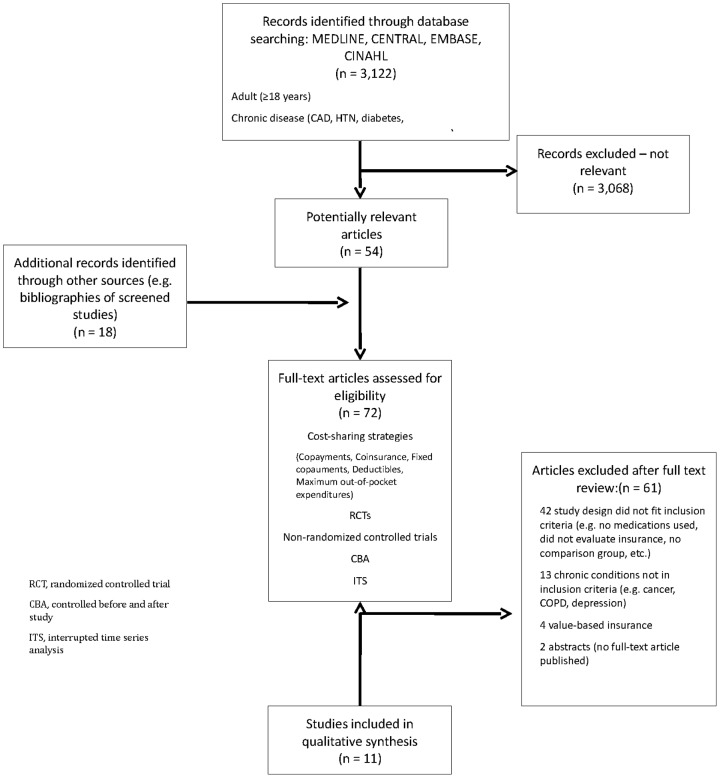
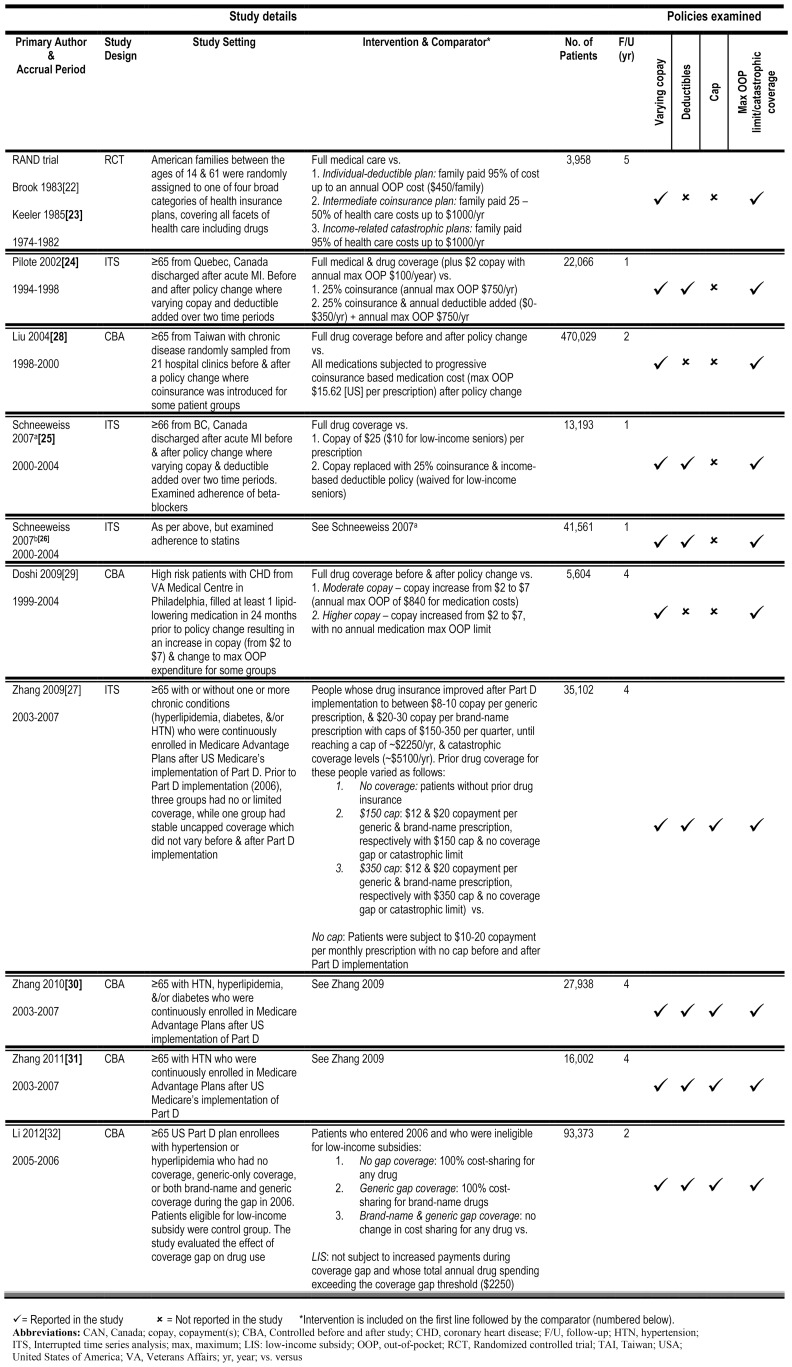
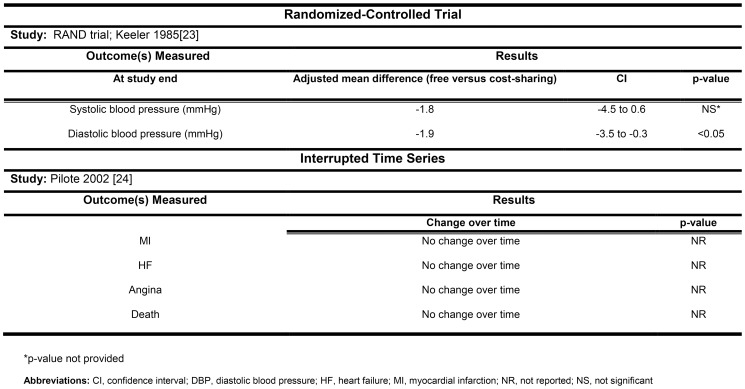
“Of these, 11 studies evaluating 7 different drug insurance policy changes met our inclusion criteria (Figure 1): 2 separate reports of one randomized controlled trial (RCT), the RAND trial [22,23]; 4 interrupted time series (ITS) assessing three drug policy changes [24–27]; and 5 controlled before-after (CBA) studies…”
BackgroundThe Impact of Medicare Part D on Medication Treatment of Hypertension
Zhang, Y., Donohue, J. M., Lave, J. R., & Gellad, W. F. (2010) · Health Services Research · doi:10.1111/j.1475-6773.2010.01183.x · Cited by 27 · cited 3×
“Like others, we found that the addition of drug insurance for those without previous drug insurance appears to consistently increase adherence to medications, and that increased costs on drug expenditures may be offset by decreased costs in non-drug expenditures [27,30,31].”
BackgroundResultEconomic Impact of Cost-Containment Strategies in Third Party Programmes in the US (Part I)1
Reeder, C. E., Lingle, E. W., Schulz, R., Mauch, R. P., Nightengale, B. S., Pedersen, C. A., Watrous, M. L., & Zetzl, S. E. (1993) · PharmacoEconomics · doi:10.2165/00019053-199304020-00004 · Cited by 20
Cited by
Medication adherence influencing factors—an (updated) overview of systematic reviews
Gast, A., & Mathes, T. (2019) · Systematic Reviews · doi:10.1186/s13643-019-1014-8 · Cited by 560
“…outcome of interest Different study types including controlled trials, cohort studies and cross-sectional studies Published in every language Mann 2014 Not limited to March 2013 Adult patients with cardiovascular-related chronic conditions (coronary artery disease, hypertension,…”
BackgroundAdherence to cardiovascular medication: a review of systematic reviews
Leslie, K., McCowan, C., & Pell, J. P. (2018) · Journal of Public Health · doi:10.1093/pubmed/fdy088 · Cited by 136
Reasons for Nonadherence to Statins – A Systematic Review of Reviews
Ingersgaard, M. V., Andersen, T. H., Norgaard, O., Grabowski, D., & Olesen, K. (2020) · Patient Preference and Adherence · doi:10.2147/ppa.s245365 · Cited by 95
Qin, V. M., Hone, T., Millett, C. J., Moreno‐Serra, R., McPake, B., Atun, R. A., & Lee, J. T. (2019) · BMJ Global Health · doi:10.1136/bmjgh-2018-001087 · Cited by 96
Karter, A. J., Parker, M. M., Solomon, M. D., Lyles, C. R., Adams, A. S., Moffet, H. H., & Reed, M. E. (2018) · Health Services Research · doi:10.1111/1475-6773.12700 · Cited by 80
“As a strategy to control expenditures and excessive use of services, insurers and health care delivery systems typically require patients to bear an out-ofpocket (OOP) cost (in the form of copayments, coinsurance, or deductibles) for prescribed medications (Goldman et al. 2007; Eaddy et al. 2012; Mann et al. 2014).”
BackgroundInfluential
Metadata
- Authors
- Mann, B. S., Barnieh, L., Tang, K., Campbell, D. J. T., Clement, F., Hemmelgarn, B., Tonelli, M., Lorenzetti, D., & Manns, B. J.
- Affiliations
- University of Calgary (CA)
- University of Alberta (CA)
- Corresponding author
- Manns, Braden J.
- ORCID
- Venue
- PLoS ONE
- Publisher
- Public Library of Science (PLoS)
- Published
- 2014-03-25
- Volume
- 9
- Issue
- 3
- Pages
- e89168
- ISSN
- 1932-6203 (ISSN-L)
- PMC
- PMC3965394
- OpenAlex
- W2140725189
- Semantic Scholar
- 04e4e675230b940c20947ca40f5f7fd3e30af549
- Cited by
- 66
- References
- 41
- Citations by year
- 2026: 2 · 2025: 4 · 2024: 4 · 2023: 3 · 2022: 6 · 2021: 10 · 2020: 4 · 2019: 7 · 2018: 7 · 2017: 7 · 2016: 5 · 2015: 7
- FWCI
- 1.86
- Type
- journal article
- Language
- en
- Open access
- gold
- doi.org
- Locations
- PLoS ONE (publishedVersion, cc-by)
- Europe PMC (PubMed Central) (publishedVersion, other-oa)
- PubMed Central (publishedVersion, cc-by)
- PubMed (publishedVersion)
- RePEc: Research Papers in Economics (submittedVersion)
- DOAJ (DOAJ: Directory of Open Access Journals) (submittedVersion, cc-by-sa)
- Figshare (submittedVersion, cc-by)
- Funders
- Government of Alberta
- Government of Canada
- Alberta Innovates
- Topics
- Social Sciences › Economics, Econometrics and Finance › Economics and Econometrics › Healthcare Policy and Management
- Health Sciences › Medicine › Family Practice › Medication Adherence and Compliance
- Social Sciences › Economics, Econometrics and Finance › Economics and Econometrics › Pharmaceutical Economics and Policy
- Keywords
- prescription drug coverage, patient cost sharing, copayments, deductibles, medication adherence, chronic disease, diabetes mellitus, hypertension, cardiovascular disease, hypercholesterolemia, cerebrovascular disease, health care utilization, health outcomes, cost-sharing policy
- MeSH terms
- Chronic Disease, Health Expenditures, Humans, Insurance, Pharmaceutical Services, Quality of Life, Cost Sharing, Outcome Assessment, Health Care, Medication Adherence
About these checks
Registry, retraction, Cites and statistics results are computed, not judged, with one exception: a printed reference that no index lists is read once by a model before it counts as a citation error. Claims are extracted by a model and kept only when their quote appears verbatim in the text; each cited source is then checked, with a model’s help, for whether it says what the claim relies on. Those verdicts can be wrong — read the claim’s quote and the cited source before relying on one.
Statistics and arithmetic are recomputed, not judged.
Confidence bands are shown only for fields calibrated on our annotated test set. None is calibrated yet, so no band is shown.
What counts as a claim ›How we measure confidence ›How we check this ›
Are you an author, or do you see a problem with this page? Request a review
Data sources
Bibliographic data: Semantic Scholar, OpenAlex, Crossref.
Contains information from the Semantic Scholar Academic Graph Datasets, made available under the ODC Attribution License (ODC-BY 1.0).
Semantic Scholar’s data is described in: Kinney, R., et al. (2023). The Semantic Scholar Open Data Platform. arXiv:2301.10140.
