

Human Adipose Tissue-Derived Stromal/Stem Cells Promote Migration and Early Metastasis of Triple Negative Breast Cancer Xenografts
Open accessThe DOI matches its Crossref record; 61 of the 62 references it cites were found in a registry or an index.
Abstract
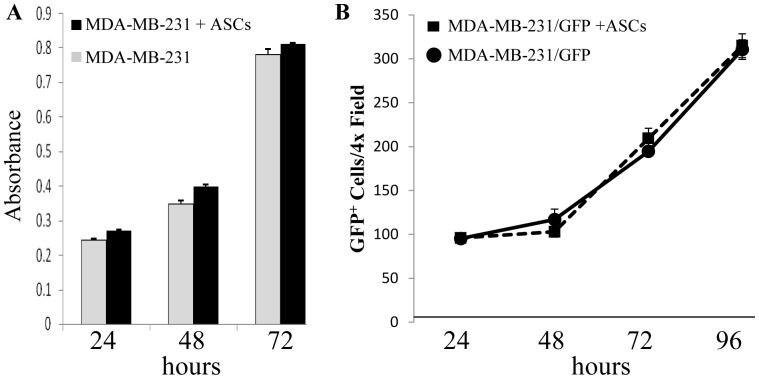
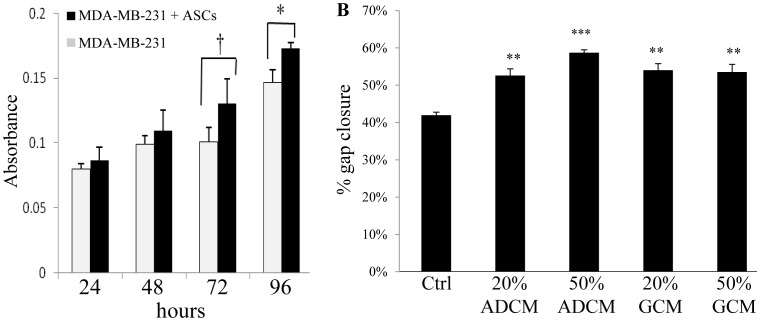
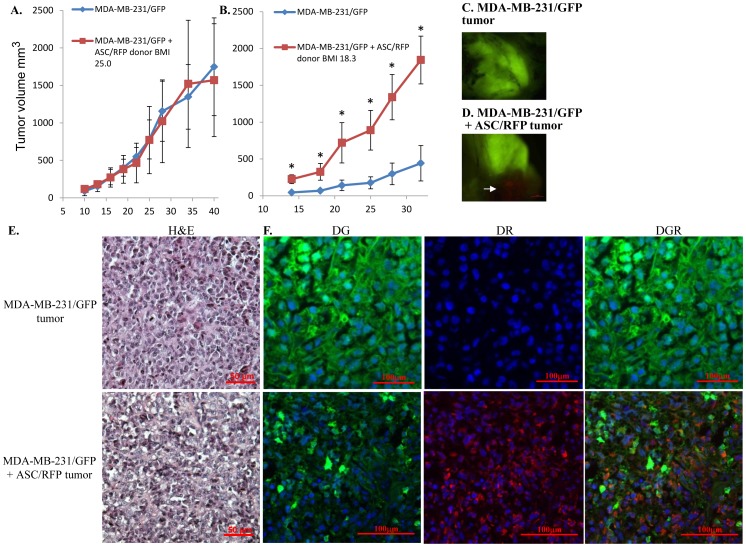
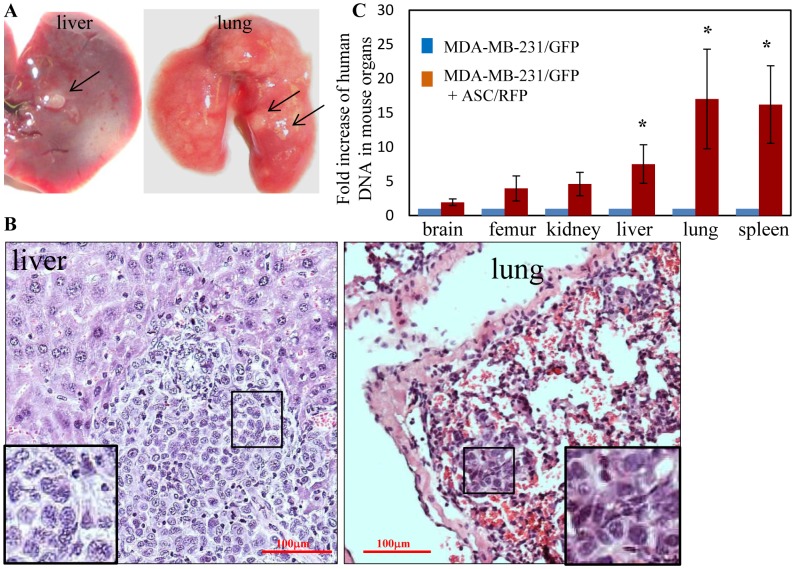
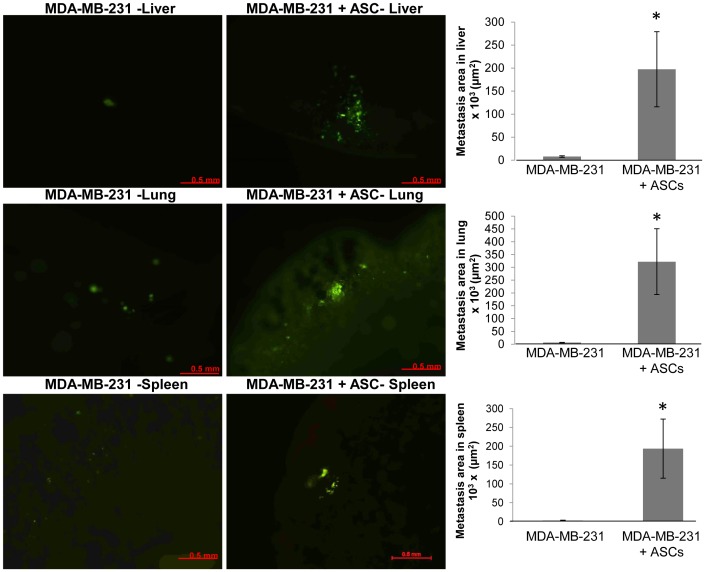
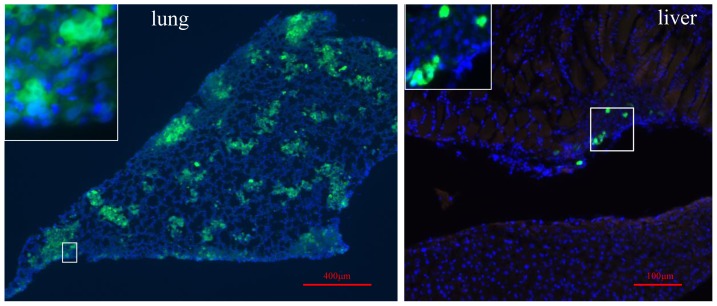
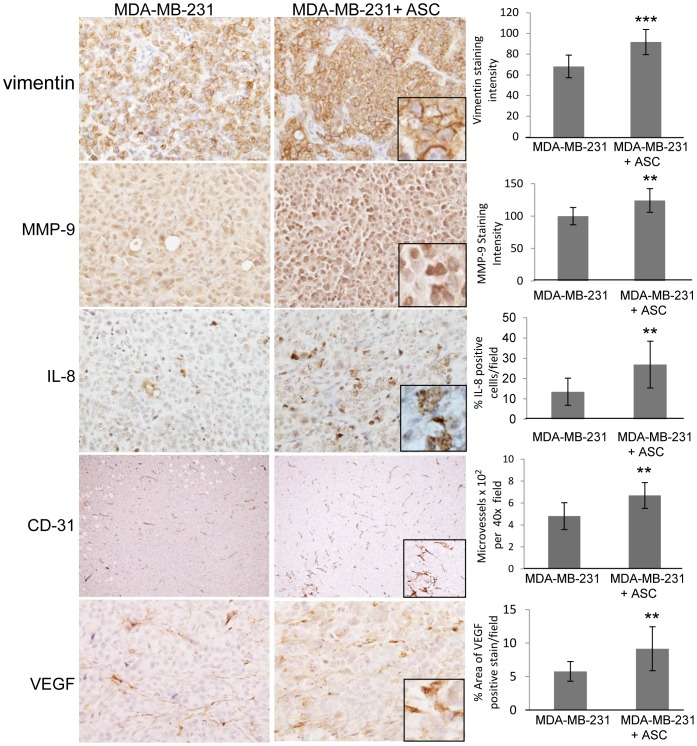
BACKGROUND: Fat grafting is used to restore breast defects after surgical resection of breast tumors. Supplementing fat grafts with adipose tissue-derived stromal/stem cells (ASCs) is proposed to improve the regenerative/restorative ability of the graft and retention. However, long term safety for ASC grafting in proximity of residual breast cancer cells is unknown. The objective of this study was to determine the impact of human ASCs derived from abdominal lipoaspirates of three donors, on a human breast cancer model that exhibits early metastasis. METHODOLOGY/PRINCIPAL FINDINGS: Human MDA-MB-231 breast cancer cells represents "triple negative" breast cancer that exhibits early micrometastasis to multiple mouse organs [1]. Human ASCs were derived from abdominal adipose tissue from three healthy female donors. Indirect co-culture of MDA-MB-231 cells with ASCs, as well as direct co-culture demonstrated that ASCs had no effect on MDA-MB-231 growth. Indirect co-culture, and ASC conditioned medium (CM) stimulated migration of MDA-MB-231 cells. ASC/RFP cells from two donors co-injected with MDA-MB-231/GFP cells exhibited a donor effect for stimulation of primary tumor xenografts. Both ASC donors stimulated metastasis. ASC/RFP cells were viable, and integrated with MDA-MB-231/GFP cells in the tumor. Tumors from the co-injection group of one ASC donor exhibited elevated vimentin, matrix metalloproteinase-9 (MMP-9), IL-8, VEGF and microvessel density. The co-injection group exhibited visible metastases to the lung/liver and enlarged spleen not evident in mice injected with MDA-MB-231/GFP alone. Quantitation of the total area of GFP fluorescence and human chromosome 17 DNA in mouse organs, H&E stained paraffin sections and fluorescent microscopy confirmed multi-focal metastases to lung/liver/spleen in the co-injection group without evidence of ASC/RFP cells. CONCLUSIONS: Human ASCs derived from abdominal lipoaspirates of two donors stimulated metastasis of MDA-MB-231 breast tumor xenografts to multiple mouse organs. MDA-MB-231 tumors co-injected with ASCs from one donor exhibited partial EMT, expression of MMP-9, and increased angiogenesis.
Overview
The claims and statistics of this paper haven’t been checked yet.
Free: it reads the open-access text and checks the first 5 claims that cite a source we can check. Create a free account to check every claim.
Integrity signals
Registry
Cites
Statistics
Figures
Verification
Claims the paper makes
The claims and statistics of this paper haven’t been checked yet.
Free: it reads the open-access text and checks the first 5 claims that cite a source we can check. Create a free account to check every claim.
Claims other papers make about this one
Each is checked against this paper’s own text: does it say what the citing paper says it does?
The source backs part of the claim, not all of it — or backs it for a different population, condition or comparison.
In the citing paper
“However, as referred to earlier, there were safety concerns about human adipose-tissue stromal cells (ASC) included in fat grafts that increased migration and metastases of breast tumour and osteosarcoma animal models [74], [101].”
From Mesenchymal stromal cells for bone sarcoma treatment: Roadmap to clinical practice (2019) · cites this paper as [74]
Experimental — accuracy not yet measuredThe source backs part of the claim, not all of it — or backs it for a different population, condition or comparison.
In the citing paper
“There were some safety concerns about human ADSC included in fat grafts, however, that were found to increase migration and metastases in a breast tumour and osteosarcoma models [74], [101].”
From Mesenchymal stromal cells for bone sarcoma treatment: Roadmap to clinical practice (2019) · cites this paper as [74]
Experimental — accuracy not yet measuredThe cited source says what the claim attributes to it.
In the citing paper
“The application of human ADSCs in proximity to breast cancer raised concerns as it was associated with an increase in the migration and metastasis of cancer cells [74].”
From Mesenchymal stromal cells for bone sarcoma treatment: Roadmap to clinical practice (2019) · cites this paper as [74]
Self-check
Percentages, sums and reported differences re-computed from the paper’s own numbers.
The self-check needs the paper’s full text.
Citations
Cites
Mesenchymal stem cells within tumour stroma promote breast cancer metastasis
Karnoub, A. E., Dash, A. B., Vo, A. P., Sullivan, A., Brooks, M. W., Bell, G. W., Richardson, A. L., Polyak, K., Tubo, R., & Weinberg, R. A. (2007) · Nature · doi:10.1038/nature06188 · Cited by 3,206
Adipose-derived stem cells for regenerative medicine
Gimble, J. M., Katz, A. J., & Bunnell, B. A. (2007) · Circulation Research · doi:10.1161/01.res.0000265074.83288.09 · Cited by 2,332
Self-citationAdipose-derived stem cells: Isolation, expansion and differentiation☆
BUNNELL, B., FLAAT, M., GAGLIARDI, C., PATEL, B., & RIPOLL, C. (2008) · Methods · doi:10.1016/j.ymeth.2008.03.006 · Cited by 1,067
Facial Recontouring with Lipostructure
Coleman, S. R. (1997) · Clinics in Plastic Surgery · doi:10.1016/s0094-1298(20)31069-5 · Cited by 1,046
Yoshimura, K., Sato, K., Aoi, N., Kurita, M., Hirohi, T., & Harii, K. (2008) · Aesthetic Plastic Surgery · doi:10.1007/s00266-007-9019-4 · Cited by 881
Allred, D. C., Clark, G. M., Elledge, R., Fuqua, S. A. W., Brown, R. W., Chamness, G. C., Osborne, C. K., & McGuire, W. L. (1993) · JNCI Journal of the National Cancer Institute · doi:10.1093/jnci/85.3.200 · Cited by 772
Production, concentration and titration of pseudotyped HIV-1-based lentiviral vectors
Kutner, R. H., Zhang, X.-Y., & Reiser, J. (2009) · Nature Protocols · doi:10.1038/nprot.2009.22 · Cited by 668
Self-citationDelay, E., Garson, S., Tousson, G., & Sinna, R. (2009) · Aesthetic Surgery Journal · doi:10.1016/j.asj.2009.08.010 · Cited by 536
YOSHIMURA, K., SATO, K., AOI, N., KURITA, M., INOUE, K., SUGA, H., ETO, H., KATO, H., HIROHI, T., & HARII, K. (2008) · Dermatologic Surgery · doi:10.1111/j.1524-4725.2008.34256.x · Cited by 429
Finn, R. S., Dering, J., Ginther, C., Wilson, C. A., Glaspy, P., Tchekmedyian, N., & Slamon, D. J. (2007) · Breast Cancer Research and Treatment · doi:10.1007/s10549-006-9463-x · Cited by 409
Cited by
Role of tumor microenvironment in tumorigenesis
Wang, M., Zhao, J., Zhang, L., Wei, F., Lian, Y., Wu, Y., Gong, Z., Zhang, S., Zhou, J., Cao, K., et al. (2017) · Journal of Cancer · doi:10.7150/jca.17648 · Cited by 1,404
Balaban, S., Shearer, R. F., Lee, L. S., van Geldermalsen, M., Schreuder, M., Shtein, H. C., Cairns, R., Thomas, K. C., Fazakerley, D. J., Grewal, T., et al. (2017) · Cancer & Metabolism · doi:10.1186/s40170-016-0163-7 · Cited by 416
Adipose-derived stem cells: Sources, potency, and implications for regenerative therapies
Si, Z., Wang, X., Sun, C., Kang, Y., Xu, J., Wang, X., & Hui, Y. (2019) · Biomedicine & Pharmacotherapy · doi:10.1016/j.biopha.2019.108765 · Cited by 423
Cancer as a Matter of Fat: The Crosstalk between Adipose Tissue and Tumors
Lengyel, E., Makowski, L., DiGiovanni, J., & Kolonin, M. G. (2018) · Trends in Cancer · doi:10.1016/j.trecan.2018.03.004 · Cited by 424
“In addition, roles for ASC in therapy resistance [59] and metastasis [60, 61] have also surfaced.”
BackgroundHossain, A., Gumin, J., Gao, F., Figueroa, J., Shinojima, N., Takezaki, T., Priebe, W., Villarreal, D., Kang, S.-G., Joyce, C., et al. (2015) · Stem Cells · doi:10.1002/stem.2053 · Cited by 224
Metadata
- Authors
- Rowan, B. G., Gimble, J. M., Sheng, M., Anbalagan, M., Jones, R. K., Frazier, T. P., Asher, M., Lacayo, E. A., Friedlander, P. L., Kutner, R., & Chiu, E. S.
- Affiliations
- Tulane University (US)
- Pennington Biomedical Research Center (US)
- Louisiana State University Health Sciences Center New Orleans (US)
- NYU Langone Health (US)
- Corresponding author
- Rowan, Brian G.
- Chiu, Ernest S.
- ORCID
- Venue
- PLoS ONE
- Publisher
- Public Library of Science (PLoS)
- Published
- 2014-02-28
- Volume
- 9
- Issue
- 2
- Pages
- e89595
- ISSN
- 1932-6203 (ISSN-L)
- PMC
- PMC3938488
- OpenAlex
- W1984075943
- Cited by
- 174
- References
- 62
- Citations by year
- 2026: 4 · 2025: 3 · 2024: 7 · 2023: 11 · 2022: 10 · 2021: 17 · 2020: 15 · 2019: 14 · 2018: 17 · 2017: 24 · 2016: 20 · 2015: 20 · 2014: 12
- FWCI
- 12.71
- Type
- journal article
- Language
- en
- Open access
- gold
- doi.org
- Locations
- PLoS ONE (publishedVersion, cc-by)
- Europe PMC (PubMed Central) (publishedVersion, other-oa)
- PubMed Central (publishedVersion, cc-by)
- PubMed (publishedVersion)
- DOAJ (DOAJ: Directory of Open Access Journals) (submittedVersion, cc-by-sa)
- Figshare (submittedVersion, cc-by)
- Funders
- Aesthetic Surgery Education and Research Foundation
- Pennington Biomedical Research Foundation
- Tulane University
- National Institute of Diabetes and Digestive and Kidney Diseases (P30DK072476)
- Topics
- Life Sciences › Biochemistry, Genetics and Molecular Biology › Cell Biology › Mesenchymal stem cell research
- Health Sciences › Medicine › Oncology › Cancer Cells and Metastasis
- Life Sciences › Immunology and Microbiology › Immunology › Immune cells in cancer
- Keywords
- triple-negative breast cancer, early metastasis, micrometastases, MDA-MB-231 cells, fat grafting, breast reconstruction, tumor cell migration, epithelial-mesenchymal transition, MMP-9, angiogenesis, interleukin-8, vascular endothelial growth factor, microvessel density
- MeSH terms
- Adipose Tissue, Animals, Female, Humans, Stem Cells, Interleukin-8, Culture Media, Conditioned, Stromal Cells, Matrix Metalloproteinase 9, Vascular Endothelial Growth Factor A, Mice, Triple Negative Breast Neoplasms
About these checks
Registry, retraction, Cites and statistics results are computed, not judged, with one exception: a printed reference that no index lists is read once by a model before it counts as a citation error. Claims are extracted by a model and kept only when their quote appears verbatim in the text; each cited source is then checked, with a model’s help, for whether it says what the claim relies on. Those verdicts can be wrong — read the claim’s quote and the cited source before relying on one.
Statistics and arithmetic are recomputed, not judged.
Confidence bands are shown only for fields calibrated on our annotated test set. None is calibrated yet, so no band is shown.
What counts as a claim ›How we measure confidence ›How we check this ›
Are you an author, or do you see a problem with this page? Request a review
How to cite
Cite CoChat for the checks on this page, and the paper for its own findings.
- This page
- CoChat. (2026). Citation check: Human Adipose Tissue-Derived Stromal/Stem Cells Promote Migration and Early Metastasis of Triple Negative Breast Cancer Xenografts. https://app.cochat.ai/papers/10.1371/journal.pone.0089595
- The paper
- Rowan, B. G., Gimble, J. M., Sheng, M., Anbalagan, M., Jones, R. K., Frazier, T. P., Asher, M., Lacayo, E. A., Friedlander, P. L., Kutner, R., & Chiu, E. S. (2014). Human Adipose Tissue-Derived Stromal/Stem Cells Promote Migration and Early Metastasis of Triple Negative Breast Cancer Xenografts. PLoS ONE. https://doi.org/10.1371/journal.pone.0089595
Data sources
Bibliographic data: Semantic Scholar, OpenAlex, Crossref.
Contains information from the Semantic Scholar Academic Graph Datasets, made available under the ODC Attribution License (ODC-BY 1.0).
Semantic Scholar’s data is described in: Kinney, R., et al. (2023). The Semantic Scholar Open Data Platform. arXiv:2301.10140.
