

Personality and Healthy Sleep: The Importance of Conscientiousness and Neuroticism
Open accessThe DOI matches its Crossref record; 67 of the 68 references it cites were found in a registry or an index.
Abstract
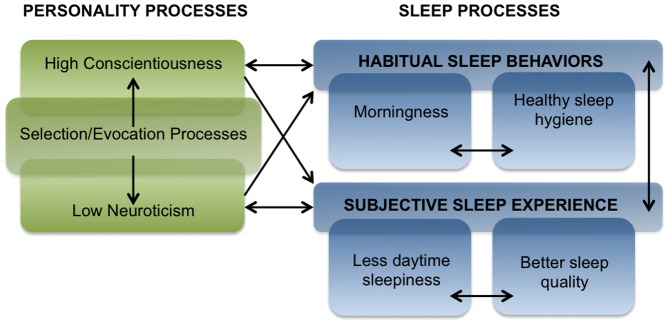
Although previous research has shown personality and sleep are each substantial predictors of health throughout the lifespan, little is known about links between personality and healthy sleep patterns. This study examined Big Five personality traits and a range of factors related to sleep health in 436 university students (M(age) = 19.88, SD = 1.50, 50% Male). Valid self-report measures of personality, chronotype, sleep hygiene, sleep quality, and sleepiness were analyzed. To remove multicollinearity between personality factors, each sleep domain was regressed on relevant demographic and principal component-derived personality factors in multiple linear regressions. Results showed that low conscientiousness and high neuroticism were the best predictors of poor sleep (poor sleep hygiene, low sleep quality, and increased sleepiness), consistent with other research on predictors of poor health and mortality risk. In this first comprehensive study of the topic, the findings suggest that personality has a significant association with sleep health, and researchers could profitably examine both personality and sleep in models of health and well-being.
Overview
The claims and statistics of this paper haven’t been checked yet.
Free: it reads the open-access text and checks the first 5 claims that cite a source we can check. Create a free account to check every claim.
Integrity signals
Registry
Cites
Statistics
Figures
Verification
Claims the paper makes
The claims and statistics of this paper haven’t been checked yet.
Free: it reads the open-access text and checks the first 5 claims that cite a source we can check. Create a free account to check every claim.
Claims other papers make about this one
Each is checked against this paper’s own text: does it say what the citing paper says it does?
The source backs part of the claim, not all of it — or backs it for a different population, condition or comparison.
In the citing paper
“There is clear evidence to support the relationships between the transdiagnostic factors and chronic insomnia (18, 19, 21); however, the extent to which each of these factors can affect insomnia remains unclear.”
From The contribution of transdiagnostic vulnerability factors in patients with chronic insomnia (2023) · cites this paper as [18]
Experimental — accuracy not yet measured
Self-check
Percentages, sums and reported differences re-computed from the paper’s own numbers.
The self-check needs the paper’s full text.
Citations
Cites
The Pittsburgh Sleep Quality Index: a new instrument for psychiatric practice and research
Buysse, D. J., Reynolds, C. F., Monk, T. H., Berman, S. R., & Kupfer, D. J. (1989) · Psychiatry Research · doi:10.1016/0165-1781(89)90047-4 · Cited by 35,234 · cited 4×
“Sleep quality was measured using the Pittsburgh Sleep Quality Index (PSQI; [22]).”
BackgroundMethodInfluential(1992) · PubMed · Cited by 33,716
The MOS 36-ltem Short-Form Health Survey (SF-36): I. Conceptual Framework and Item Selection
Ware, J. E., & Sherbourne, C. D. (1992) · Medical Care · doi:10.1097/00005650-199206000-00002 · Cited by 30,033
Applied Multiple Regression/Correlation Analysis for the Behavioral Sciences
Cohen, P., Cohen, P., West, S. G., & Aiken, L. S. (2014) · Psychology Press eBooks · doi:10.4324/9781410606266 · Cited by 20,737
A New Method for Measuring Daytime Sleepiness: The Epworth Sleepiness Scale
Johns, M. W. (1991) · Sleep · doi:10.1093/sleep/14.6.540 · Cited by 17,364 · cited 4×
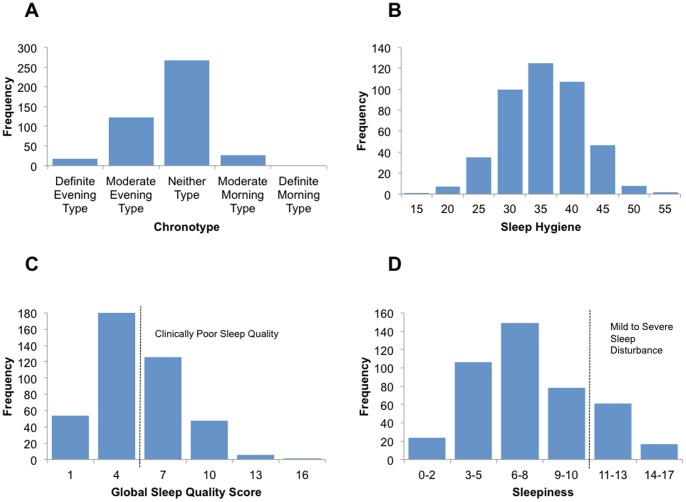
“Higher scores on the Epworth Sleepiness Scale indicate higher trait sleepiness, and scores above 10 indicate a mild to severe sleep disturbance may be contributing to daytime sleepiness.”
BackgroundMethodInfluentialAmazon's Mechanical Turk: A New Source of Inexpensive, Yet High-Quality, Data?
Buhrmester, M., Kwang, T., & Gosling, S. D. (2011) · Perspectives on Psychological Science · doi:10.1177/1745691610393980 · Cited by 9,996
(1999) · Cited by 7,995
Adler, N. E., Epel, E. S., Castellazzo, G., & Ickovics, J. R. (2000) · Health Psychology · doi:10.1037/0278-6133.19.6.586 · Cited by 5,080 · cited 2×
“Perceived socioeconomic status (SES) was assessed using a question that asked participants to rate their status from a 1 (low) to 10 (high) on a modified ladder scale similar to Adler, Epel, Castellazzo, and Ickovics [34].”
BackgroundMethodA self-assessment questionnaire to determine morningness- eveningness in human circadian rhythms
Home, J. K. (1976) · Medical Entomology and Zoology · Cited by 4,783
Handbook of Personality : Theory and Research
Pervin, L. A. (1992) · Cited by 4,543
Cited by
Items 201–211 of 211
Scherz, W. D., Gaiduk, M., Ávila-Campos, J., Seepold, R., Madrid, N. M., Herrera, P., & Echeverry, J. D. (2025) · Procedia Computer Science · doi:10.1016/j.procs.2025.10.040 · Cited by 1
Wang, D., Fan, Y., Li, Y., Zhai, S., Zhang, X., Li, H., Ma, Z., & Fan, F. (2025) · BMC Psychiatry · doi:10.1186/s12888-025-07590-w
“Neuroticism has been linked to difficulty in regulating emotions (such as depression and anxiety) and behavior (such as sleep hygiene) [53].”
Shah, A., Almourad, M. B., Ali, S., Alam, A., & Rahman, T. U. (2025) · Human Behavior and Emerging Technologies · doi:10.1155/hbe2/4428860 · Cited by 1
Yiğit, B., Türkdoğan, E. N., Ergin, K. F., & Satıcı, S. A. (2025) · Behavioral Sleep Medicine · doi:10.1080/15402002.2025.2609553
“Personality, as a fundamental structure that determines differences between individuals, predicts both sleep-related behavior patterns and levels of well-being and psychological distress (Anglim et al., 2020; Duggan et al., 2014).”
Wang, C., Yi, S., Tian, T., Zhao, Z., Wang, L., Zhang, X., Zeng, M., Liu, T., & Wang, L. (2026) · European journal of medical research · doi:10.1186/s40001-025-03821-8
“For example, research has found that neuroticism was associated with depressive disorders among healthcare workers during the COVID-19 pandemic [9].”
Increased p‐Tau181 Levels After Overnight Wakefulness Are Associated With Neuroticism in Young Women
Nôga, D. A., Meth, E. M. S., Almajni, A., Rossi, V., Zetterlund, C., Noory, S. F. M., Danek, M., Al-Grety, A., Pacheco, A. P., Wu, M., et al. (2026) · Journal of Sleep Research · doi:10.1111/jsr.70278 · Cited by 1
“Supporting this view, higher levels of neuroticism have been associated with greater mood disturbance, increased sleepiness and poorer attentional performance under conditions of acute sleep deprivation (Duggan et al. 2014; Mastin et al. 2005).”
Deters, F. G., Reiter, T., & Schoedel, R. (2026) · Computers in Human Behavior Reports · doi:10.1016/j.chbr.2026.101114
Self-critical perfectionism and sleep disturbance: The moderating role of anxiety
Lee, J. H., & Suh, H. (2026) · Current Psychology · doi:10.1007/s12144-026-09458-y
“…generally agree that sleep disturbance involves an assessment of subjective sleep quality as well as objective metrics such as sleep latency, sleep duration, as well as daytime and nighttime time interferences and dysfunctions (Cellini, 2017; Duggan et al., 2014; Williams & Moroz, 2009).”
Kokkinos, C. M., & Koutsospyros, A. (2026) · Psychological Reports · doi:10.1177/00332941261464092
Personality traits and self-reported bruxism in university students: A cross-sectional study
Galińska, W., Owczarczyk, D., Kukla, W., Jakimow, J., & Baron, S. (2026) · Annales Academiae Medicae Silesiensis · doi:10.18794/aams/225619
Sun, C., Zhang, Q., Wang, L., Li, D., & Tsai, C. (2026) · Frontiers in Psychology · doi:10.3389/fpsyg.2026.1933055
“Duggan et al. (2014) found that lower conscientiousness and higher neuroticism were among the strongest personality correlates of poorer sleep, and Stephan et al. (2018) further showed longitudinal links between personality traits and sleep quality across four prospective samples.”
Metadata
- Authors
- Duggan, K. A., Friedman, H. S., McDevitt, E. A., & Mednick, S. C.
- Affiliations
- University of California, Riverside (US)
- Corresponding author
- Mednick, Sara C.
- Venue
- PLoS ONE
- Publisher
- Public Library of Science (PLoS)
- Published
- 2014-03-20
- Volume
- 9
- Issue
- 3
- Pages
- e90628
- ISSN
- 1932-6203 (ISSN-L)
- PMC
- PMC3961248
- OpenAlex
- W1973489838
- Cited by
- 211
- References
- 68
- Citations by year
- 2026: 8 · 2025: 16 · 2024: 21 · 2023: 26 · 2022: 17 · 2021: 31 · 2020: 16 · 2019: 25 · 2018: 16 · 2017: 17 · 2016: 12 · 2015: 6
- FWCI
- 16.23
- Type
- journal article
- Language
- en
- Open access
- gold
- doi.org
- Locations
- PLoS ONE (publishedVersion, cc-by)
- Europe PMC (PubMed Central) (publishedVersion, other-oa)
- PubMed Central (publishedVersion, cc-by)
- PubMed (publishedVersion)
- RePEc: Research Papers in Economics (submittedVersion)
- DOAJ (DOAJ: Directory of Open Access Journals) (submittedVersion, cc-by-sa)
- eScholarship (California Digital Library) (submittedVersion, cc-by)
- Funders
- National Institute of Mental Health (K01MH080992)
- Topics
- Social Sciences › Psychology › Experimental and Cognitive Psychology › Sleep and related disorders
- Social Sciences › Psychology › Clinical Psychology › Personality Traits and Psychology
- Life Sciences › Neuroscience › Cognitive Neuroscience › Sleep and Wakefulness Research
- Keywords
- personality, sleep health, conscientiousness, neuroticism, Big Five personality traits, sleep hygiene, sleep quality, sleepiness, chronotype, university students, well-being
- MeSH terms
- Neuroticism, Anxiety Disorders, Demography, Female, Humans, Male, Personality, Personality Inventory, Regression Analysis, Sleep, Principal Component Analysis, Young Adult
About these checks
Registry, retraction, Cites and statistics results are computed, not judged, with one exception: a printed reference that no index lists is read once by a model before it counts as a citation error. Claims are extracted by a model and kept only when their quote appears verbatim in the text; each cited source is then checked, with a model’s help, for whether it says what the claim relies on. Those verdicts can be wrong — read the claim’s quote and the cited source before relying on one.
Statistics and arithmetic are recomputed, not judged.
Confidence bands are shown only for fields calibrated on our annotated test set. None is calibrated yet, so no band is shown.
What counts as a claim ›How we measure confidence ›How we check this ›
Are you an author, or do you see a problem with this page? Request a review
Data sources
Bibliographic data: Semantic Scholar, OpenAlex, Crossref.
Contains information from the Semantic Scholar Academic Graph Datasets, made available under the ODC Attribution License (ODC-BY 1.0).
Semantic Scholar’s data is described in: Kinney, R., et al. (2023). The Semantic Scholar Open Data Platform. arXiv:2301.10140.
