

The DOI matches its Crossref record; 32 of the 34 references it cites were found in a registry or an index.
Detusking Fence-Breaker Elephants as an Approach in Human-Elephant Conflict Mitigation
Open accessAbstract
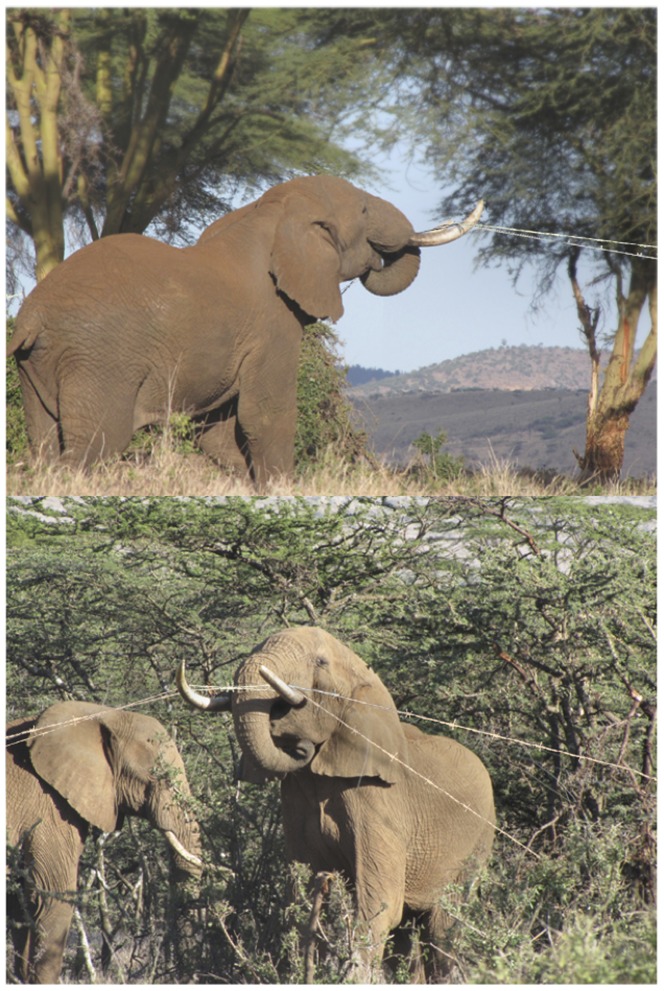
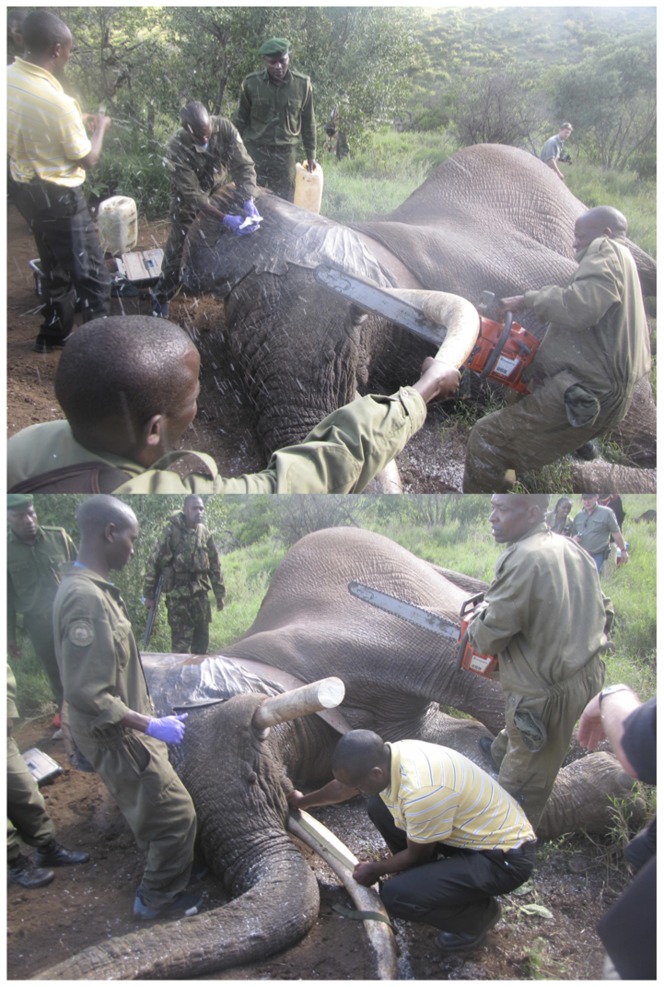
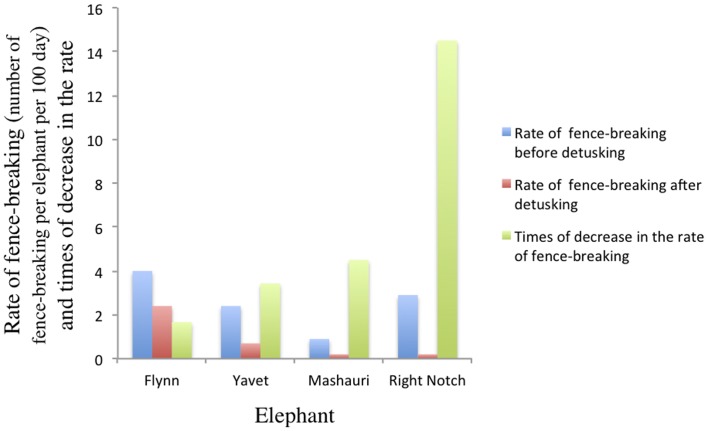
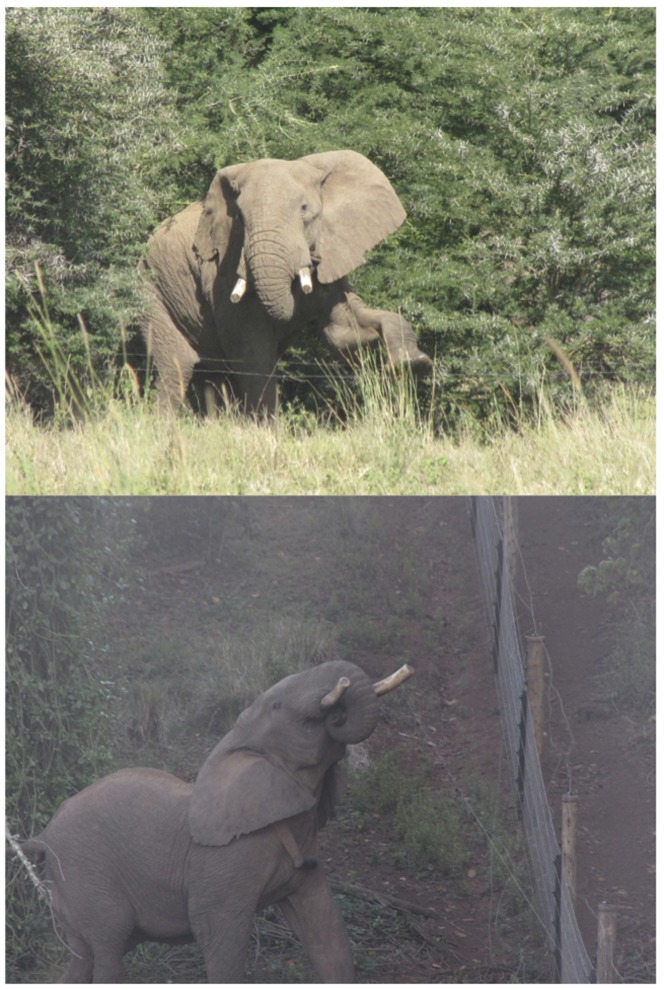
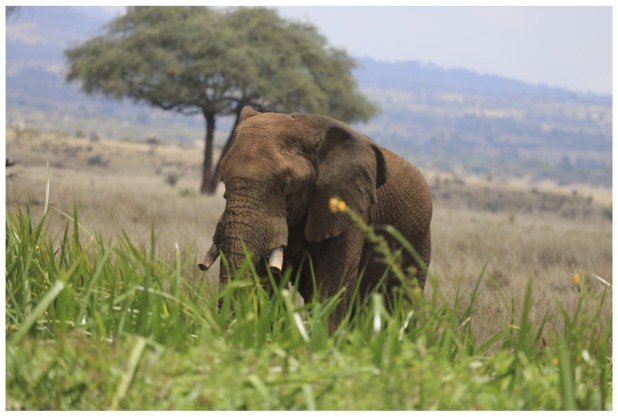
BACKGROUND: Human-elephant conflict (HEC) is a recurring problem that appears wherever the range of elephants and humans overlap. Different methods including the use of electric fences are used worldwide to mitigate this conflict. Nonetheless, elephants learn quickly that their tusks do not conduct electricity and use them to break down fences (fence-breakers). METHODOLOGY/PRINCIPAL FINDINGS: In Lewa Wildlife Conservancy, Kenya, destructive elephants (Loxodonta africana) were monitored between 2010 and 2013. The fence-breaking rate reached four incidents (fence-breaking) per elephant per 100 days. Ten bull males and 57 females were identified as fence-breakers. The bulls were involved in 85.07% and the females in 14.93% of incidents. The Kenya Wildlife Service approved detusking (partial cutting of tusks) in four of the 10 fence-breakers as a way of preventing them from breaking down fences, thereby mitigating HEC in the Conservancy. The result of the detusking was a drastic six-fold reduction in damage to fences (range: 1.67 to 14.5 times less fence-breaking) by the four worst fence-breaker elephants, because with trimmed tusks elephants lack the tools to break down fences. Detusking could not totally eliminate fence destruction because, despite lacking their tools, elephants can still destroy fences using their heads, bodies and trunks, albeit less effectively. On the other hand, apart from inherent aesthetic considerations, the detusking of elephants may have certain negative effects on factors such as elephants' social hierarchies, breeding, mate selection and their access to essential minerals and food. CONCLUSIONS: Elephant detusking seems to be effective in drastically reducing fence-breaking incidents, nonetheless its negative effects on behaviour, access to food and its aesthetical consequences still need to be further studied and investigated.
Overview
The claims and statistics of this paper haven’t been checked yet.
Run the check — free, no account needed. It reads the open-access text and checks the sources it cites.
Integrity signals
Registry
Cites
Statistics
Figures
Verification
Claims the paper makes
The claims and statistics of this paper haven’t been checked yet.
Run the check — free, no account needed. It reads the open-access text and checks the sources it cites.
Claims other papers make about this one
Each is checked against this paper’s own text: does it say what the citing paper says it does?
The cited source says what the claim attributes to it.
In the citing paper
“some elephants learn to use their tusks, which do not conduct electricity, as a way to manipulate and break electric fences (Mutinda et al., 2014)”
From Do elephants really never forget? What we know about elephant memory and a call for further investigation (2025) · cites this paper as Mutinda et al., 2014
The cited source says what the claim attributes to it.
In the citing paper
“elephants have been observed overcoming barriers to access and forage on crop fields (Fernando et al., 2008; Kioko et al., 2008; Mutinda et al., 2014)”
From Do elephants really never forget? What we know about elephant memory and a call for further investigation (2025) · cites this paper as Mutinda et al., 2014
The cited source says what the claim attributes to it.
In the citing paper
“To access crops, elephants have learned to overcome barriers, such as electric fences, that are meant to deter them from entering crop fields (Kioko et al., 2008; Mutinda et al., 2014).”
From Do elephants really never forget? What we know about elephant memory and a call for further investigation (2025) · cites this paper as Mutinda et al., 2014
The cited source says what the claim attributes to it.
In the citing paper
“In the wild, elephants have demonstrated their ability to find solutions to novel problems when they determine how to overcome barriers, such as electric fences, to enter crop fields to forage (Fernando et al., 2008; Kioko et al., 2008; Mutinda et al., 2014).”
From Do elephants really never forget? What we know about elephant memory and a call for further investigation (2025) · cites this paper as Mutinda et al., 2014
Self-check
Percentages, sums and reported differences re-computed from the paper’s own numbers.
The self-check needs the paper’s full text.
Citations
Cites
R: A Language and Environment for Statistical Computing
R Core Team (2000) · doi:10.32614/r.manuals · Cited by 355,893
Dickman, A. J. (2010) · Animal Conservation · doi:10.1111/j.1469-1795.2010.00368.x · Cited by 1,590
Human-induced evolution caused by unnatural selection through harvest of wild animals
Allendorf, F. W., & Hard, J. J. (2009) · Proceedings of the National Academy of Sciences · doi:10.1073/pnas.0901069106 · Cited by 629
Mate choice and sexual selection: What have we learned since Darwin?
Jones, A. G., & Ratterman, N. L. (2009) · Proceedings of the National Academy of Sciences · doi:10.1073/pnas.0901129106 · Cited by 383
Fences and artificial water affect African savannah elephant movement patterns
Loarie, S. R., van Aarde, R. J., & Pimm, S. L. (2009) · Biological Conservation · doi:10.1016/j.biocon.2009.08.008 · Cited by 256
Newmark, W. D., Manyanza, D. N., Gamassa, D.-G. M., & Sariko, H. I. (1994) · Conservation Biology · doi:10.1046/j.1523-1739.1994.08010249.x · Cited by 250
Mate guarding, reproductive success and female choice in African elephants
Poole, J. H. (1989) · Animal Behaviour · doi:10.1016/0003-3472(89)90068-7 · Cited by 242
Beehive fences as effective deterrents for crop-raiding elephants: field trials in northern Kenya
King, L. E., Douglas‐Hamilton, I., & Vollrath, F. W. (2011) · African Journal of Ecology · doi:10.1111/j.1365-2028.2011.01275.x · Cited by 154
Shocking elephants: Fences and crop raiders in Laikipia District, Kenya
Thouless, C. R., & Sakwa, J. (1995) · Biological Conservation · doi:10.1016/0006-3207(94)00071-w · Cited by 153
Osborn, F. V., & Parker, G. E. (2003) · Oryx · doi:10.1017/s0030605303000152 · Cited by 148
Research works printed but not linked: 3
- Ngene S (2010) Why elephants roam? PHD Thesis University of Twente. The Netherlands; accessed on 03/20/2013.
- J Beringer, 2002, Efficacy of translocation to control urban deer in Missouri: costs, efficiency, and outcome, Wildl Soc B, 30, 767
- Nelson A, Bidwell P, Sillero-Zubiri C (2003) A review of human-elephant conflict management strategies. People & Wildlife, A Wildlife Conservation Research Unit, Born Free Foundation Partnership.
Cited by
Sorted by citations
Human-Elephant Conflict: A Review of Current Management Strategies and Future Directions
Shaffer, L. J., Khadka, K. K., Hoek, J. V. D., & Naithani, K. J. (2019) · Frontiers in Ecology and Evolution · doi:10.3389/fevo.2018.00235 · Cited by 416
Managing diagnostic uncertainty in primary care: a systematic critical review
Alam, R., Cheraghi‐Sohi, S., Panagioti, M., Esmail, A., Campbell, S., & Panagopoulou, E. P. (2017) · BMC Family Practice · doi:10.1186/s12875-017-0650-0 · Cited by 209
Proteomics: a powerful tool to study plant responses to biotic stress
Liu, Y., Lu, S., Liu, K., Wang, S., Huang, L., & Guo, L. (2019) · Plant Methods · doi:10.1186/s13007-019-0515-8 · Cited by 214
Merkes, C. M., McCalla, S. G., Jensen, N. R., Gaikowski, M. P., & Amberg, J. J. (2014) · PLoS ONE · doi:10.1371/journal.pone.0113346 · Cited by 176
The cognition of ‘nuisance’ species
Barrett, L. P., Stanton, L. A., & Benson-Amram, S. (2019) · Animal Behaviour · doi:10.1016/j.anbehav.2018.05.005 · Cited by 166
Calycosin: a Review of its Pharmacological Effects and Application Prospects
Deng, M., Chen, H., Long, J., Song, J., Xie, L., & Li, X. (2020) · Expert Review of Anti-infective Therapy · doi:10.1080/14787210.2021.1863145 · Cited by 139
Ecology of Problem Individuals and the Efficacy of Selective Wildlife Management
Swan, G. J. F., Redpath, S. M., Bearhop, S., & McDonald, R. A. (2017) · Trends in Ecology & Evolution · doi:10.1016/j.tree.2017.03.011 · Cited by 127
Coral reef restoration efforts in Latin American countries and territories
Bayraktarov, E., Banaszak, A. T., Montoya-Maya, P., Kleypas, J. A., Arias‐González, J. E., Blanco‐Pimentel, M., Calle‐Triviño, J., Charuvi, N., Cortés‐Useche, C., Galván, V., et al. (2020) · PLoS ONE · doi:10.1371/journal.pone.0228477 · Cited by 112
Mao, C., Wang, X., Xi, J., Feng, Y., & Ren, G. (2017) · Energy · doi:10.1016/j.energy.2017.06.050 · Cited by 110
Argument for a non‐linear relationship between severity of human obesity and dopaminergic tone
Horstmann, A., Fenske, W. K., & Hankir, M. K. (2015) · Obesity Reviews · doi:10.1111/obr.12303 · Cited by 109
Recent Strategies in Tissue Engineering for Guided Peripheral Nerve Regeneration
Belanger, K., Dinis, T., Taourirt, S., Vidal, G., Kaplan, D. L., & Egles, C. (2016) · Macromolecular Bioscience · doi:10.1002/mabi.201500367 · Cited by 97
IUCN SSC guidelines on human-wildlife conflict and coexistence
IUCN SSC Human-Wildlife Conflict and Coexistence Specialist Group (2023) · doi:10.2305/ygik2927 · Cited by 115
Gyarmati, P., Kjellander, C., Aust, C., Song, Y., Öhrmalm, L., & Giske, C. G. (2016) · Scientific Reports · doi:10.1038/srep23532 · Cited by 92
Matseketsa, G., Muboko, N., Gandiwa, E., Kombora, D. M., & Chibememe, G. (2019) · Global Ecology and Conservation · doi:10.1016/j.gecco.2019.e00737 · Cited by 86
CRISPR/Cas9-Mediated Genome Editing and Mutagenesis of EcChi4 in Exopalaemon carinicauda
Gui, T., Zhang, J., Song, F., Sun, Y., Xie, S., Yu, K., & Xiang, J. (2016) · G3 Genes Genomes Genetics · doi:10.1534/g3.116.034082 · Cited by 79
RNAseq Transcriptional Profiling following Whip Development in Sugarcane Smut Disease
Schaker, P. D. C., Palhares, A., Taniguti, L. M., Peters, L. P., Creste, S., Aitken, K. S., Sluys, M. V., Kitajima, J. P., Vieira, M. L. C., & Monteiro-Vitorello, C. B. (2016) · PLoS ONE · doi:10.1371/journal.pone.0162237 · Cited by 78
Gravina, B., Bachellerie, F., Caux, S., Discamps, E., Faivre, J.-P., Galland, A., Michel, A., Teyssandier, N., & Bordes, J. (2018) · Scientific Reports · doi:10.1038/s41598-018-33084-9 · Cited by 72
Rethinking assessment of success of mitigation strategies for elephant‐induced crop damage
Snyder, K. D., & Rentsch, D. (2020) · Conservation Biology · doi:10.1111/cobi.13433 · Cited by 67
Sedentary behavior patterns and adiposity in children: a study based on compositional data analysis
Gába, A., Pedišić, Ž., Štefelová, N., Dygrýn, J., Hron, K., Dumuid, D., & Tremblay, M. S. (2020) · BMC Pediatrics · doi:10.1186/s12887-020-02036-6 · Cited by 65
Yang, H., Zhang, D., Li, H., Li, H., Zhang, D., Lan, H., Wood, A. J., & Wang, J. (2016) · Molecular Breeding · doi:10.1007/s11032-015-0422-2 · Cited by 56
Retrieval of brain MRI with tumor using contrastive loss based similarity on GoogLeNet encodings
Deepak, S., & Ameer, P. M. (2020) · Computers in Biology and Medicine · doi:10.1016/j.compbiomed.2020.103993 · Cited by 54
Trends of spinal tuberculosis research (1994–2015)
Wang, Y., Wang, Q., Zhu, R., Yang, C., Chen, K., Bai, Y., Ming, L., & Zhai, X. (2016) · Medicine · doi:10.1097/md.0000000000004923 · Cited by 54
Yin, I. X., Zhao, I. S., Mei, M. L., Lo, E. C. M., Tang, J., Li, Q., So, L. Y., & Chu, C. H. (2020) · International Journal of Nanomedicine · doi:10.2147/ijn.s243202 · Cited by 54
Alam, M. Z., Carpenter‐Boggs, L., Rahman, A., Haque, M. M., Miah, M. R. U., Moniruzzaman, M., Qayum, M. A., & Abdullah, H. M. (2017) · Sustainability of water quality and ecology · doi:10.1016/j.swaqe.2017.03.002 · Cited by 53
Erramilli, S., & Genzer, J. (2019) · Soft Matter · doi:10.1039/c9sm00527g · Cited by 48
Horgan, F. G., & Kudavidanage, E. P. (2019) · Crop Protection · doi:10.1016/j.cropro.2019.104981 · Cited by 49
Lüeders, I., Young, D., Maree, L., van der Horst, G., Luther, I., Botha, S., Tindall, B., Fosgate, G. T., Ganswindt, A., & Bertschinger, H. J. (2017) · PLoS ONE · doi:10.1371/journal.pone.0178270 · Cited by 41
Cohn, A., Morse, M. A., O’Neil, B., Whiting, S., Coeshott, C., Ferraro, J., Bellgrau, D., Apelian, D., & Rodell, T. C. (2018) · Journal of Immunotherapy · doi:10.1097/cji.0000000000000219 · Cited by 41
The Conservation Costs of Game Ranching
Pitman, R. T., Fattebert, J., Williams, S. T., Williams, K. S., Hill, R. A., Hunter, L., Slotow, R., & Balme, G. A. (2016) · Conservation Letters · doi:10.1111/conl.12276 · Cited by 42
Nguyen, V. V., Phan, T. T. T., & Lee, C. (2022) · Global Ecology and Conservation · doi:10.1016/j.gecco.2022.e02285 · Cited by 39
Feuerbacher, A., Lippert, C., Kuenzang, J., & Subedi, K. (2021) · Biological Conservation · doi:10.1016/j.biocon.2020.108919 · Cited by 38
A conceptual framework for the emerging discipline of conservation physiology
Coristine, L. E., Robillard, C. M., Kerr, J. T., O’Connor, C. M., Lapointe, D., & Cooke, S. J. (2014) · Conservation Physiology · doi:10.1093/conphys/cou033 · Cited by 40
Hess, M. K., Hess, A. S., & Garrick, D. J. (2016) · PLoS ONE · doi:10.1371/journal.pone.0151236 · Cited by 33
Elucidating rhizosphere processes by mass spectrometry – A review
Rugova, A., Puschenreiter, M., Koellensperger, G., & Hann, S. (2017) · Analytica Chimica Acta · doi:10.1016/j.aca.2016.12.044 · Cited by 32
Ngama, S., Bindelle, J., Poulsen, J. R., Hornick, J.-L., Linden, A. S., Körte, L., Doucet, J., & Vermeulen, C. (2019) · PLoS ONE · doi:10.1371/journal.pone.0213971 · Cited by 30
Li, D., Yu, H., Guo, Z., Li, S., Li, Y., Guo, Y., Zhong, H., Xiong, H., & Liu, Z. (2020) · Nanoscale · doi:10.1039/c9nr08754k · Cited by 30
Jacobson, S. L., Puitiza, A., Snyder, R. J., Sheppard, A., & Plotnik, J. M. (2022) · Animal Cognition · doi:10.1007/s10071-021-01576-3 · Cited by 30
Using ecological stoichiometry to understand and predict infectious diseases
Sanders, A. J., & Taylor, B. W. (2018) · Oikos · doi:10.1111/oik.05418 · Cited by 27
Naidoo, R., Beytell, P. C., Brennan, A., Kilian, W., McCulloch, G. P., Stronza, A. L., Taylor, R., Tsholofelo, C., & Songhurst, A. (2022) · Frontiers in Conservation Science · doi:10.3389/fcosc.2022.788133 · Cited by 27
Radiation and Immunotherapy in High-grade Gliomas
Reznik, E., Smith, A. W., Taube, S., Mann, J. M., Yondorf, M. Z., Parashar, B., & Wernicke, A. G. (2017) · American Journal of Clinical Oncology · doi:10.1097/coc.0000000000000406 · Cited by 27
Mortality and risk of tuberculosis among people living with HIV in whom TB was initially ruled out
García, J. I., Mambuque, E., Nguenha, D., Vilanculo, F. C., Sacoor, C. N., Sequera, G., Fernández-Quevedo, M., Pierre, M. L.-L., Chiconela, H., Faife, L. A., et al. (2020) · Scientific Reports · doi:10.1038/s41598-020-71784-3 · Cited by 24
Meng, F., Yang, M., Li, Y., Li, T., Liu, X., Wang, G., Wang, Z., Jin, X., & Li, W. (2018) · Frontiers in Physiology · doi:10.3389/fphys.2018.00383 · Cited by 23
Geoarchaeological evolution of Tel Akko's ancient harbour (Israel)
Morhange, C., Giaime, M., Marriner, N., Hamid, A. A., Bruneton, H., Honnorat, A., Kaniewski, D., Magnin, F., Porotov, A., Wante, J., et al. (2016) · Journal of Archaeological Science Reports · doi:10.1016/j.jasrep.2016.03.046 · Cited by 22
Balancing African Elephant Conservation with Human Well-Being in Rombo Area, Tanzania
Mmbaga, N. E., Munishi, L. K., & Treydte, A. C. (2017) · Advances in Ecology · doi:10.1155/2017/4184261 · Cited by 22
Agrawal, M., Bento-Miranda, M., Walsh, S., Narula, N., Colombel, J., & Ungaro, R. C. (2021) · Journal of Crohn s and Colitis · doi:10.1093/ecco-jcc/jjab030 · Cited by 23
Matata, M. T., Kegamba, J. J., Mremi, R. F., & Eustace, A. (2022) · Journal for Nature Conservation · doi:10.1016/j.jnc.2022.126271 · Cited by 21
Sargeant, J. M., Deb, B., Bergevin, M. D., Churchill, K. J., Dawkins, K., Dunn, J. N., Hu, D., Moody, C. M., O'Connor, A. M. C., O’Sullivan, T. L., et al. (2019) · Animal Health Research Reviews · doi:10.1017/s1466252319000173 · Cited by 21
Giaime, M., Morhange, C., Marriner, N., López-Cadavid, G. I., & Artzy, M. (2018) · Geoarchaeology · doi:10.1002/gea.21683 · Cited by 21
Berezowska‐Cnota, T., Konopiński, M. K., Bartoń, K. A., Bautista, C., Revilla, E., Naves, J., Biedrzycka, A., Fedyń, H., Fernández, N., Jastrzębski, T., et al. (2023) · Journal of Applied Ecology · doi:10.1111/1365-2664.14388 · Cited by 20
Dupuis‐Désormeaux, M., Davidson, Z., Pratt, L., Mwololo, M., & MacDonald, S. E. (2016) · PeerJ · doi:10.7717/peerj.1681 · Cited by 22
Zoo elephant research: contributions to conservation of captive and free‐ranging species
Bechert, U. S., Brown, J. L., Dierenfeld, E. S., Ling, P. D., Molter, C. M., & Schulte, B. A. (2019) · International Zoo Yearbook · doi:10.1111/izy.12211 · Cited by 21
Gába, A., Pelclová, J., Štefelová, N., Přidalová, M., Zając-Gawlak, I., Tlučáková, L., Pechová, J., & Svozilová, Z. (2020) · Clinical Nutrition · doi:10.1016/j.clnu.2020.10.020 · Cited by 20
Shaher, F., Wang, S., Qiu, H., Hu, Y., Zhang, Y., Wang, W., Al-Ward, H., Abdulghani, M. A. M., Baldi, S., & Zhou, S. (2020) · Diabetes Metabolic Syndrome and Obesity · doi:10.2147/dmso.s281527 · Cited by 20
A ghost fence-gap: surprising wildlife usage of an obsolete fence crossing
Dupuis‐Désormeaux, M., Kaaria, T. N., Mwololo, M., Davidson, Z., & MacDonald, S. E. (2018) · PeerJ · doi:10.7717/peerj.5950 · Cited by 18
IoT-Enabled Smart Elephant Detection System for Combating Human Elephant Conflict
Fazil, M., & Firdhous, M. (2018) · International Conference on Information Technology Research (ICITR) · doi:10.1109/icitr.2018.8736149 · Cited by 17
Effects of fences and fence gaps on the movement behavior of three southern African antelope species
Hering, R., Hauptfleisch, M., Kramer‐Schadt, S., Stiegler, J., & Blaum, N. (2022) · Frontiers in Conservation Science · doi:10.3389/fcosc.2022.959423 · Cited by 16
Association of VEGFA and IL1β gene polymorphisms with preeclampsia in Sudanese women
Hamid, H. M., Abdalla, S. E., Sidig, M., Adam, I., & Hamdan, H. Z. (2020) · Molecular Genetics & Genomic Medicine · doi:10.1002/mgg3.1119 · Cited by 16
Strategies for Multiplexed Biosensor Imaging to Study Intracellular Signaling Networks
Keyes, J. D., Mehta, S., & Zhang, J. (2021) · Methods in molecular biology · doi:10.1007/978-1-0716-1593-5_1 · Cited by 15
Innovating to solve a novel puzzle: wild Asian elephants vary in their ability to problem solve
Jacobson, S. L., Dechanupong, J., Horpiencharoen, W., Yindee, M., & Plotnik, J. M. (2023) · Animal Behaviour · doi:10.1016/j.anbehav.2023.08.019 · Cited by 14
Nguyen, V. V., Nguyen, H. T. T., Phan, T. T. T., & Lee, C. (2023) · Trees Forests and People · doi:10.1016/j.tfp.2023.100435 · Cited by 14
Hagman, C. H. C., Rohrlack, T., & Riise, G. (2020) · Limnologica · doi:10.1016/j.limno.2020.125818 · Cited by 14
Testing the Prey-Trap Hypothesis at Two Wildlife Conservancies in Kenya
Dupuis‐Désormeaux, M., Davidson, Z., Mwololo, M., Kisio, E., Taylor, S., & MacDonald, S. E. (2015) · PLoS ONE · doi:10.1371/journal.pone.0139537 · Cited by 14
Tiller, L. N., Oniba, E., Opira, G., Brennan, E., King, L. E., Ndombi, V., Wanjala, D. K., & Robertson, M. R. (2022) · Diversity · doi:10.3390/d14070509 · Cited by 13
In Silico Studies Applied to Natural Products with Potential Activity Against Alzheimer’s Disease
Scotti, L., & Scotti, L. (2017) · Neuromethods · doi:10.1007/978-1-4939-7404-7_18 · Cited by 13
Wildlife Fences to Mitigate Human–Wildlife Conflicts in Africa: A Literature Analysis
Burudi, J. W., Kovács, E., & Katona, K. (2025) · Diversity · doi:10.3390/d17020087 · Cited by 12
Fernández-Vargas, J., Tremmel, C., Valeriani, D., Bhattacharyya, S., Cinel, C., Citi, L., & Poli, R. (2021) · Journal of Neural Engineering · doi:10.1088/1741-2552/abf2e4 · Cited by 13
Human‐wildlife conflicts in communities bordering a Savannah‐Fenced wildlife conservancy
Dupuis‐Désormeaux, M., Kaaria, T. N., Kinoti, J., Paul, A., Gilisho, S., Kobia, F., Onyango, R., Chege, G., Kimiti, D. W., Mwololo, M., et al. (2023) · African Journal of Ecology · doi:10.1111/aje.13151 · Cited by 11
von Essen, E., Drenthen, M., & Bhardwaj, M. (2023) · Wildlife Biology · doi:10.1002/wlb3.01146 · Cited by 10
Counting Kmers for Biological Sequences at Large Scale
Ge, J.-Q., Meng, J.-T., Guo, N., Wei, Y.-J., Balaji, P., & Feng, S.-Z. (2019) · Interdisciplinary Sciences Computational Life Sciences · doi:10.1007/s12539-019-00348-5 · Cited by 9
Hope, S. F., Willgohs, K. R., Dittakul, S., & Plotnik, J. M. (2025) · Learning & Behavior · doi:10.3758/s13420-024-00655-y · Cited by 8
Distribution of clones among hosts for the lizard malaria parasite Plasmodium mexicanum
Neal, A. T. (2021) · PeerJ · doi:10.7717/peerj.12448 · Cited by 8
Adekanmbi, A. O., Oluwaseyi, T. A., & Oyelade, A. A. (2021) · Meta Gene · doi:10.1016/j.mgene.2021.100853 · Cited by 8
O'Connell‐Rodwell, C. E., Sandri, M. N., Berezin, J. L., Munevar, J. M., Kinzley, C., WOOD, J. D., Wiśniewska, M., & Kilian, J. W. (2022) · Animals · doi:10.3390/ani12091162 · Cited by 8
Human-hippos (Hippopotamus amphibius) interactions in villages adjacent to Lake Babati, Tanzania
Mmbaga, N. E. (2022) · Global Ecology and Conservation · doi:10.1016/j.gecco.2022.e02316 · Cited by 8
Bhaskarjyoti, B., & Kar, B. K. (2018) · Space and Culture India · doi:10.20896/saci.v6i3.391 · Cited by 7
Nasoori, A. (2020) · Archives of Oral Biology · doi:10.1016/j.archoralbio.2020.104835 · Cited by 9
Mbamy, W., Beirne, C., Froese, G., Ebanéga, M. O., & Poulsen, J. R. (2023) · Oryx · doi:10.1017/s0030605323000704 · Cited by 7
Sinha, S., Das, T. K., Bezbaruah, A. N., & Fortuna, A. (2018) · NanoImpact · doi:10.1016/j.impact.2018.08.009 · Cited by 7
Redox changes in the brains of reproductive female rats during aging
Heemann, F. M., da Silva, A. C. A., Salomon, T. B., Putti, J. S., Engers, V. K., Hackenhaar, F. S., & Benfato, M. S. (2016) · Experimental Gerontology · doi:10.1016/j.exger.2016.11.005 · Cited by 6
Knowledge acquisition after Helping Babies Survive training in rural Tanzania
Dol, J., Campbell-Yeo, M. L., Bulemela, J., McMillan, D., Abel, Z., Nyamtema, A., & LeBlanc, J. C. (2018) · International Health · doi:10.1093/inthealth/ihy068 · Cited by 5
Robertson, M. R., Olivier, L., Roberts, J., Yonthantham, L., Banda, C., Ng'ombwa, I. B., Dale, R., & Tiller, L. N. (2023) · Animals · doi:10.3390/ani13213334 · Cited by 5
Measures for brain connectivity analysis: nodes centrality and their invariant patterns
da Silva, L. M. U., Baltazar, C. A., Silva, C. A., Ribeiro, M. W., Aratanha, M. A., Deolindo, C. S., Rodrigues, A. C., & Machado, B. S. (2017) · The European Physical Journal Special Topics · doi:10.1140/epjst/e2016-60400-2 · Cited by 5
Management of Dental Disease in Elephants
Steenkamp, G. (2018) · Elsevier eBooks · doi:10.1016/b978-0-323-55228-8.00093-x · Cited by 5
How did the elephant cross the fence? Electric fence crossing by elephants in Udawalawe, Sri Lanka
Ranjeewa, A. D. G., Thomas, R. J., Weerakoon, D. K., Sandanayake, G. H. N. A., & Fernando, P. (2024) · Animal Conservation · doi:10.1111/acv.12982 · Cited by 4
Mitigating Human-Elephant Conflict in Southeast Asia
Kochprapa, P., Savini, C., Ngoprasert, D., Savini, T., & Gale, G. A. (2024) · Tropical Natural History · doi:10.58837/tnh.24.1.262158 · Cited by 4
Guarín, M. R., Rueda, J. G., Muñoz, V. P., & Salazar, O. R. (2017) · Revista Mexicana de Trastornos Alimentarios/Mexican Journal of Eating Disorders · doi:10.1016/j.rmta.2016.12.003 · Cited by 4
Shrestha, U. B., Shrestha, S., Khanal, S., Baral, N., Dhungel, U., Shrestha, A., Neupane, D., Dahal, B. R., & Thapa, S. K. (2025) · Journal of Environmental Management · doi:10.1016/j.jenvman.2025.127944 · Cited by 3
Prototype Solution for Human-Elephant Conflict using Secondary Data
Thilakarathne, C., Samarawickrama, D., Serasinghe, H., Kuruwitaarachchi, N., & Samaratunga, U. (2022) · IEEE International Conference for Convergence in Technology (I2CT) · doi:10.1109/i2ct54291.2022.9825396 · Cited by 3
Do we measure or compute polygenic risk scores? Why language matters
Penders, B., & Janssens, A. C. J. W. (2021) · Human Genetics · doi:10.1007/s00439-021-02262-7 · Cited by 3
Canadian Fisheries and Aquaculture: Prospects under a Changing Climate
Rice, J. C., Beamish, R. J., Duplisea, D. E., Reid, G. K., & Gurney‐Smith, H. (2017) · doi:10.1002/9781119154051.ch13 · Cited by 3
Chapter 4. The implications of being a “problem” elephant
Evans, L. A., & Nduguta, R. N. (2023) · IRD Éditions eBooks · doi:10.4000/books.irdeditions.47275 · Cited by 2
Reactivity of the CH-bonds of 2-butanol in liquid-phase oxidation
Puchkov, S. V., & Nepomnyashchikh, Y. V. (2017) · Russian Journal of Physical Chemistry A · doi:10.1134/s003602441712024x · Cited by 2
A Pressing Need for Pharmacotherapy Development to Treat Drug Addiction
Andraka‐Christou, B. (2016) · International review of neurobiology · doi:10.1016/bs.irn.2016.02.003 · Cited by 2
Emily, P. P., & AB, E. R. E. (2021) · Wiley eBooks · doi:10.1002/9781119545804.ch23 · Cited by 2
Han, Z., Cong, R., & Li, Q. (2021) · Journal of Ocean University of China · doi:10.1007/s11802-021-4768-2 · Cited by 1
The expansion of agriculture in Kenya and its effect on the African elephant
Öhman, C. (2015) · Cited by 1
Oxytocin in Feeding and Eating Disorders, Role of
Leslie, M. R., & Treasure, J. L. (2017) · Springer eBooks · doi:10.1007/978-981-287-104-6_202
Causes of Higher-Order Aberrations Induction in Excimer Laser Surgery
Katsanevaki, V. J., Vargas, V., & ALIO, J. L. (2017) · Springer eBooks · doi:10.1007/978-3-319-60561-6_20
(2017) · Advances in Ecology · doi:10.1155/6253
Metadata
- Authors
- Mutinda, M., Chenge, G., Gakuya, F., Otiende, M., Omondi, P., Kasiki, S., Soriguer, R. C., & Alasaad, S.
- Affiliations
- Kenya Wildlife Service (KE)
- Consejo Superior de Investigaciones Científicas (ES)
- Corresponding author
- Alasaad, Samer
- Venue
- PLoS ONE
- Publisher
- Public Library of Science (PLoS)
- Published
- 2014-03-10
- Volume
- 9
- Issue
- 3
- Pages
- e91749
- ISSN
- 1932-6203 (ISSN-L)
- PMC
- PMC3948880
- OpenAlex
- W2054351282
- Cited by
- 111
- References
- 34
- Citations by year
- 2026: 4 · 2025: 4 · 2024: 6 · 2023: 11 · 2022: 8 · 2021: 10 · 2020: 13 · 2019: 9 · 2018: 12 · 2017: 16 · 2016: 13 · 2015: 3 · 2014: 2
- FWCI
- 9.84
- Type
- journal article
- Language
- en
- Open access
- gold
- doi.org
- Locations
- PLoS ONE (publishedVersion, cc-by)
- Europe PMC (PubMed Central) (publishedVersion, other-oa)
- PubMed Central (publishedVersion, cc-by)
- PubMed (publishedVersion)
- DIGITAL.CSIC (Spanish National Research Council (CSIC)) (submittedVersion)
- DOAJ (DOAJ: Directory of Open Access Journals) (submittedVersion, cc-by-sa)
- Greater South Information System
- Topics
- Physical Sciences › Environmental Science › Ecology › Wildlife Ecology and Conservation
- Physical Sciences › Environmental Science › Ecology › Rangeland and Wildlife Management
- Physical Sciences › Environmental Science › Ecology › Wildlife-Road Interactions and Conservation
- Keywords
- human-elephant conflict, elephant tusks, electric fences, Loxodonta africana, social hierarchy
- MeSH terms
- Animals, Animal Structures, Conflict, Psychological, Conservation of Natural Resources, Elephants, Female, Humans, Kenya, Male, Time Factors
About these checks
Registry, retraction, Cites and statistics results are computed, not judged, with one exception: a printed reference that no index lists is read once by a model before it counts as a citation error. Claims are extracted by a model and kept only when their quote appears verbatim in the text; each cited source is then checked, with a model’s help, for whether it says what the claim relies on. Those verdicts can be wrong — read the claim’s quote and the cited source before relying on one.
Statistics and arithmetic are recomputed, not judged.
Confidence bands are shown only for fields calibrated on our annotated test set. None is calibrated yet, so no band is shown.
What counts as a claim ›How we measure confidence ›How we check this ›
Are you an author, or do you see a problem with this page? Request a review
