

Prolonged Calcitonin Receptor Signaling by Salmon, but Not Human Calcitonin, Reveals Ligand Bias
Open accessThe DOI matches its Crossref record; 36 of the 36 references it cites were found in a registry or an index.
Abstract
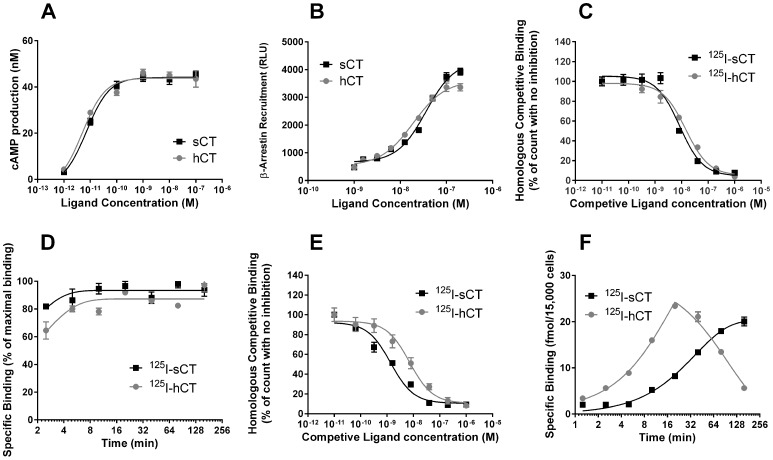
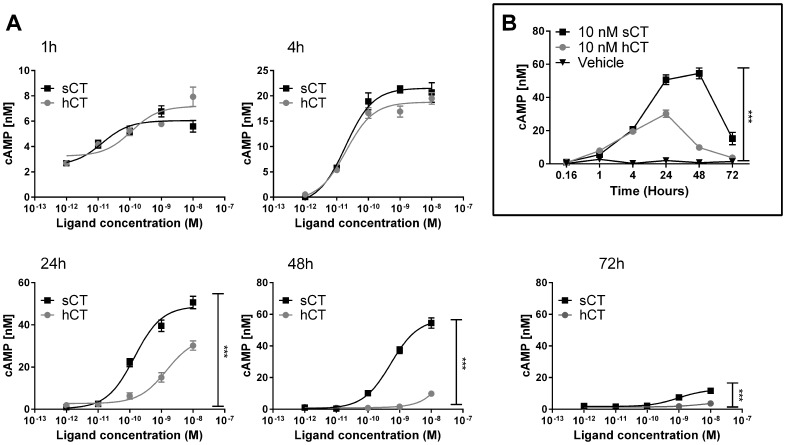
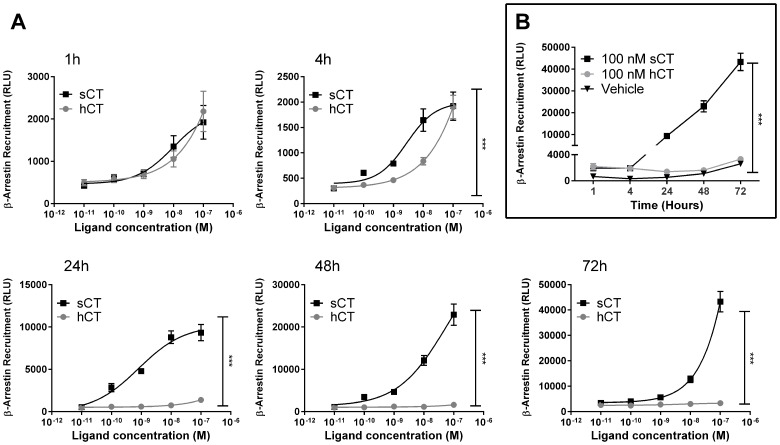
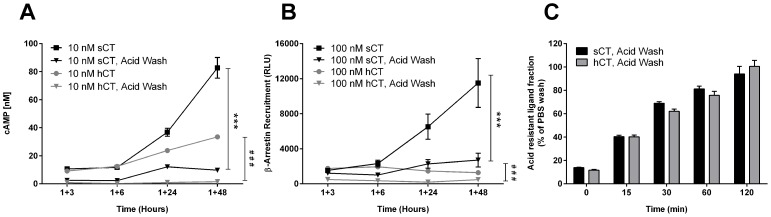
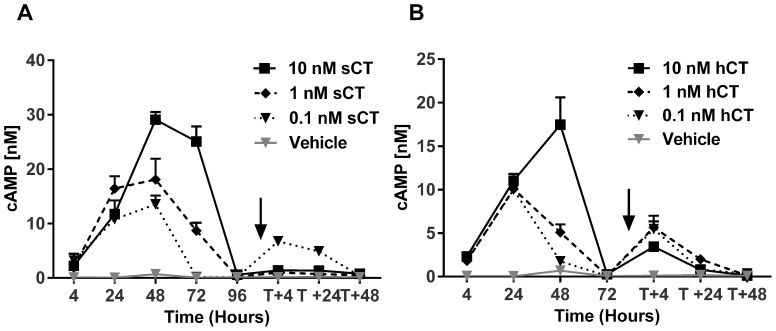
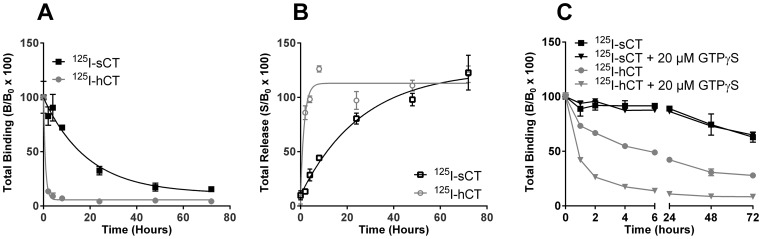
Salmon calcitonin (sCT) and human calcitonin (hCT) are pharmacologically distinct. However, the reason for the differences is unclear. Here we analyze the differences between sCT and hCT on the human calcitonin receptor (CT(a)R) with respect to activation of cAMP signaling, β-arrestin recruitment, ligand binding kinetics and internalization. The study was conducted using mammalian cell lines heterologously expressing the human CT(a) receptor. CT(a)R downstream signaling was investigated with dose response profiles for cAMP production and β-arrestin recruitment for sCT and hCT during short term (<2 hours) and prolonged (up to 72 hours) stimulation. CT(a)R kinetics and internalization was investigated with radio-labeled sCT and hCT ligands on cultured cells and isolated membrane preparations from the same cell line. We found that sCT and hCT are equipotent during short-term stimulations with differences manifesting themselves only during long-term stimulation with sCT inducing a prolonged activation up to 72 hours, while hCT loses activity markedly earlier. The prolonged sCT stimulation of both cAMP accumulation and β-arrestin recruitment was attenuated, but not abrogated by acid wash, suggesting a role for sCT activated internalized receptors. We have demonstrated a novel phenomenon, namely that two distinct CT(a)R downstream signaling activation patterns are activated by two related ligands, thereby highlighting qualitatively different signaling responses in vitro that could have implications for sCT use in vivo.
Overview
The claims and statistics of this paper haven’t been checked yet.
Free: it reads the open-access text and checks the first 5 claims that cite a source we can check. Create a free account to check every claim.
Integrity signals
Registry
Cites
Statistics
Figures
Verification
Claims the paper makes
The claims and statistics of this paper haven’t been checked yet.
Free: it reads the open-access text and checks the first 5 claims that cite a source we can check. Create a free account to check every claim.
Claims other papers make about this one
Each is checked against this paper’s own text: does it say what the citing paper says it does?
The source backs part of the claim, not all of it — or backs it for a different population, condition or comparison.
In the citing paper
“Recently, studies that compared the binding of sCT and hCT to the CTR have found that the different ligands not only affect receptor conformation, but also modulate the bound G protein and the kinetics of downstream signaling (9,75).”
From The Activity of Peptides of the Calcitonin Family in Bone (2019) · cites this paper as [9]
Experimental — accuracy not yet measuredThe cited source says what the claim attributes to it.
In the citing paper
“A recent study demonstrated that these ligands are equipotent during short-term stimulation.However, long-term stimulation with sCT results in sustained activation of CTR, whereas hCT loses its activity much earlier (9).”
From The Activity of Peptides of the Calcitonin Family in Bone (2019) · cites this paper as [9]
Self-check
Percentages, sums and reported differences re-computed from the paper’s own numbers.
The self-check needs the paper’s full text.
Citations
Cites
Poyner, D. R., Sexton, P. M., Marshall, I., Smith, D. M., Quirion, R., Born, W., Muff, R., Fischer, J. A., & Foord, S. M. (2002) · Pharmacological Reviews · doi:10.1124/pr.54.2.233 · Cited by 804 · cited 4×
“The CT(a) and CT(b) receptors are the two major alternatively spliced isoforms expressed in humans and have different properties with respect to activation of downstream signaling pathways for each isoform and in their tissue distribution, with the CT(a) receptor being the most abundant [3,4].”
BackgroundResultInfluentialSelf-citationβ-arrestin-mediated receptor trafficking and signal transduction
Shenoy, S. K., & Lefkowitz, R. J. (2011) · Trends in Pharmacological Sciences · doi:10.1016/j.tips.2011.05.002 · Cited by 712
Sustained cyclic AMP production by parathyroid hormone receptor endocytosis
Ferrandon, S., Feinstein, T. N., Castro, M., Wang, B., Bouley, R., Potts, J. T., Gardella, T. J., & Vilardaga, J.-P. (2009) · Nature Chemical Biology · doi:10.1038/nchembio.206 · Cited by 572 · cited 1×
“An example of ligand differentiation in class B GPCR activation and regulation has been published [33].”
BackgroundDegorce, F. (2009) · Current Chemical Genomics · doi:10.2174/1875397300903010022 · Cited by 501 · cited 1×
“Quantification of the intracellular cAMP was measured directly in the wells using the cAMP FEMTO TB KIT [23] (62AM7PEB, Cisbio Bioassays) according to the manufacturer’s instructions.”
MethodHobbs, S., Jitrapakdee, S., & Wallace, J. C. (1998) · Biochemical and Biophysical Research Communications · doi:10.1006/bbrc.1998.9646 · Cited by 254 · cited 1×
“Cos-7 CT(a)R cell line: parental Cos-7 cell line (CRL-1651, ATCC) with a stable transfection of a pEF-IRESpuro6 expression vector [21] containing a cDNA insert for a cMyc-hCT(a)(Leu variant) receptor construct (The stable transfected Cos-7 cell line was provided by Monash Institute of Pharmaceutical Sciences, DBB numb…”
MethodFischer, J. A., Tobler, P. H., Kaufmann, M., Born, W., Henke, H., Cooper, P. E., Sagar, S. M., & Martin, J. B. (1981) · Proceedings of the National Academy of Sciences · doi:10.1073/pnas.78.12.7801 · Cited by 201 · cited 1×
“However, this clear cut difference is somewhat blurred as this is not always reflected in comparable in vitro studies [3,12–14,18–20].”
ResultThe structure and mechanism of formation of human calcitonin fibrils.
Arvinte, T., Cudd, A., & Drake, A. F. (1993) · Journal of Biological Chemistry · doi:10.1016/s0021-9258(18)53268-3 · Cited by 172 · cited 1×
“There are several known issues with hCT in vitro, such as lower potency due to an increased rate of fibrillation compared to sCT [31,32], however, despite these differences hCT still has the same acute functional responses as sCT in our in vitro studies and hCT do generate a cAMP signaling that persists beyond the ini…”
BackgroundSexton, P. M., Findlay, D. M., & Martin, T. J. (1999) · Current Medicinal Chemistry · doi:10.2174/092986730611220401164504 · Cited by 163
Self-citationForty years of calcitonin—where are we now? A tribute to the work of Iain Macintyre, FRS
Zaidi, M., Inzerillo, A. M., Moonga, B. S., Bevis, P. J. R., & Huang, C. L.-H. (2002) · Bone · doi:10.1016/s8756-3282(02)00688-9 · Cited by 151 · cited 1×
“In general, any increased homology with sCT increases the biological activity of the agonists [10].”
BackgroundCloning and characterization of an abundant subtype of the human calcitonin receptor.
Kuestner, R. E., Elrod, R. D., Grant, F. J., Hagen, F. S., Kuijper, J. L., Matthewes, S. L., O'Hara, P. J., Sheppard, P. O., Stroop, S. D., & Thompson, D. L. (1994) · Molecular Pharmacology · doi:10.1016/s0026-895x(25)09678-6 · Cited by 149 · cited 2×
“Our findings that hCT and sCT are close to equipotent during short-term stimulation are in line with previous work on hCT and sCT activated cAMP production; two-fold difference in an overexpressing CT(a) receptor cell line [12], equipotency in CT(a) receptor-transfected cell lines [19] and a six-fold difference in T47…”
BackgroundResult
Research works printed but not linked: 1
- 1. Azria M (1989) The calcitonins. Karger.
Cited by
Biased signalling: from simple switches to allosteric microprocessors
Smith, J. S., Lefkowitz, R. J., & Rajagopal, S. (2018) · Nature Reviews Drug Discovery · doi:10.1038/nrd.2017.229 · Cited by 738
Amylin: Pharmacology, Physiology, and Clinical Potential
Hay, D. L., Chen, S., Lutz, T. A., Parkes, D. G., & Roth, J. D. (2015) · Pharmacological Reviews · doi:10.1124/pr.115.010629 · Cited by 400
“There has been no specific investigation of whether amylin-induced ERK activation is G protein dependent or arrestin mediated; however, the calcitonin receptor can recruit arrestin in response to human and salmon calcitonin (Andreassen et al., 2014).”
BackgroundUpdate on the pharmacology of calcitonin/CGRP family of peptides: IUPHAR Review 25
Hay, D. L., Garelja, M. L., Poyner, D. R., & Walker, C. S. (2018) · British Journal of Pharmacology · doi:10.1111/bph.14075 · Cited by 370
“Interestingly, the KBP compounds maintain the long-acting ability of salmon CT to stimulate signalling in cell culture models (Andreassen et al., 2014a; Gydesen et al., 2016).”
BackgroundInfluentialThe role of kinetic context in apparent biased agonism at GPCRs
Klein Herenbrink, C., Sykes, D. A., Donthamsetti, P., Canals, M., Coudrat, T., Shonberg, J., Scammells, P. J., Capuano, B., Sexton, P. M., Charlton, S. J., et al. (2016) · Nature Communications · doi:10.1038/ncomms10842 · Cited by 328
Self-citationPTH receptor-1 signalling—mechanistic insights and therapeutic prospects
Cheloha, R. W., Gellman, S. H., Vilardaga, J.-P., & Gardella, T. J. (2015) · Nature Reviews Endocrinology · doi:10.1038/nrendo.2015.139 · Cited by 265
Metadata
- Authors
- Andreassen, K. V., Hjuler, S. T., Furness, S. G., Sexton, P. M., Christopoulos, A., Nosjean, O., Karsdal, M. A., & Henriksen, K.
- Affiliations
- Nordic Bioscience (Denmark) (DK)
- Monash University (AU)
- Servier (France) (FR)
- Corresponding author
- Andreassen, Kim Vietz
- ORCID
- Venue
- PLoS ONE
- Publisher
- Public Library of Science (PLoS)
- Published
- 2014-03-18
- Volume
- 9
- Issue
- 3
- Pages
- e92042
- ISSN
- 1932-6203 (ISSN-L)
- PMC
- PMC3958426
- OpenAlex
- W1986267285
- Cited by
- 89
- References
- 36
- Citations by year
- 2026: 1 · 2025: 12 · 2024: 5 · 2023: 1 · 2022: 8 · 2021: 13 · 2020: 11 · 2019: 9 · 2018: 7 · 2017: 11 · 2016: 5 · 2015: 5 · 2014: 1
- FWCI
- 3.01
- Type
- journal article
- Language
- en
- Open access
- gold
- doi.org
- Locations
- PLoS ONE (publishedVersion, cc-by)
- Europe PMC (PubMed Central) (publishedVersion, cc-by)
- PubMed Central (publishedVersion, cc-by)
- PubMed (publishedVersion)
- Monash University Research Portal (Monash University) (submittedVersion, cc-by)
- DOAJ (DOAJ: Directory of Open Access Journals) (submittedVersion, cc-by-sa)
- Figshare (submittedVersion, cc-by)
- Topics
- Life Sciences › Biochemistry, Genetics and Molecular Biology › Molecular Biology › Receptor Mechanisms and Signaling
- Life Sciences › Neuroscience › Cellular and Molecular Neuroscience › Neuropeptides and Animal Physiology
- Life Sciences › Biochemistry, Genetics and Molecular Biology › Molecular Biology › Ion channel regulation and function
- Keywords
- salmon calcitonin, human calcitonin, calcitonin receptor, ligand bias, receptor internalization, cAMP signaling, β-arrestin recruitment, receptor desensitization, acid washing
- MeSH terms
- beta-Arrestins, Cyclic AMP, Animals, Calcitonin, Cell Line, Gene Expression Regulation, Humans, Ligands, Salmon, Species Specificity, Time Factors, Signal Transduction, Receptors, Calcitonin, Transgenes, Arrestins, Protein Transport
About these checks
Registry, retraction, Cites and statistics results are computed, not judged, with one exception: a printed reference that no index lists is read once by a model before it counts as a citation error. Claims are extracted by a model and kept only when their quote appears verbatim in the text; each cited source is then checked, with a model’s help, for whether it says what the claim relies on. Those verdicts can be wrong — read the claim’s quote and the cited source before relying on one.
Statistics and arithmetic are recomputed, not judged.
Confidence bands are shown only for fields calibrated on our annotated test set. None is calibrated yet, so no band is shown.
What counts as a claim ›How we measure confidence ›How we check this ›
Are you an author, or do you see a problem with this page? Request a review
Data sources
Bibliographic data: Semantic Scholar, OpenAlex, Crossref.
Contains information from the Semantic Scholar Academic Graph Datasets, made available under the ODC Attribution License (ODC-BY 1.0).
Semantic Scholar’s data is described in: Kinney, R., et al. (2023). The Semantic Scholar Open Data Platform. arXiv:2301.10140.
