

Everything Is Permitted? People Intuitively Judge Immorality as Representative of Atheists
Open accessThe DOI matches its Crossref record; 44 of the 44 references it cites were found in a registry or an index.
Abstract
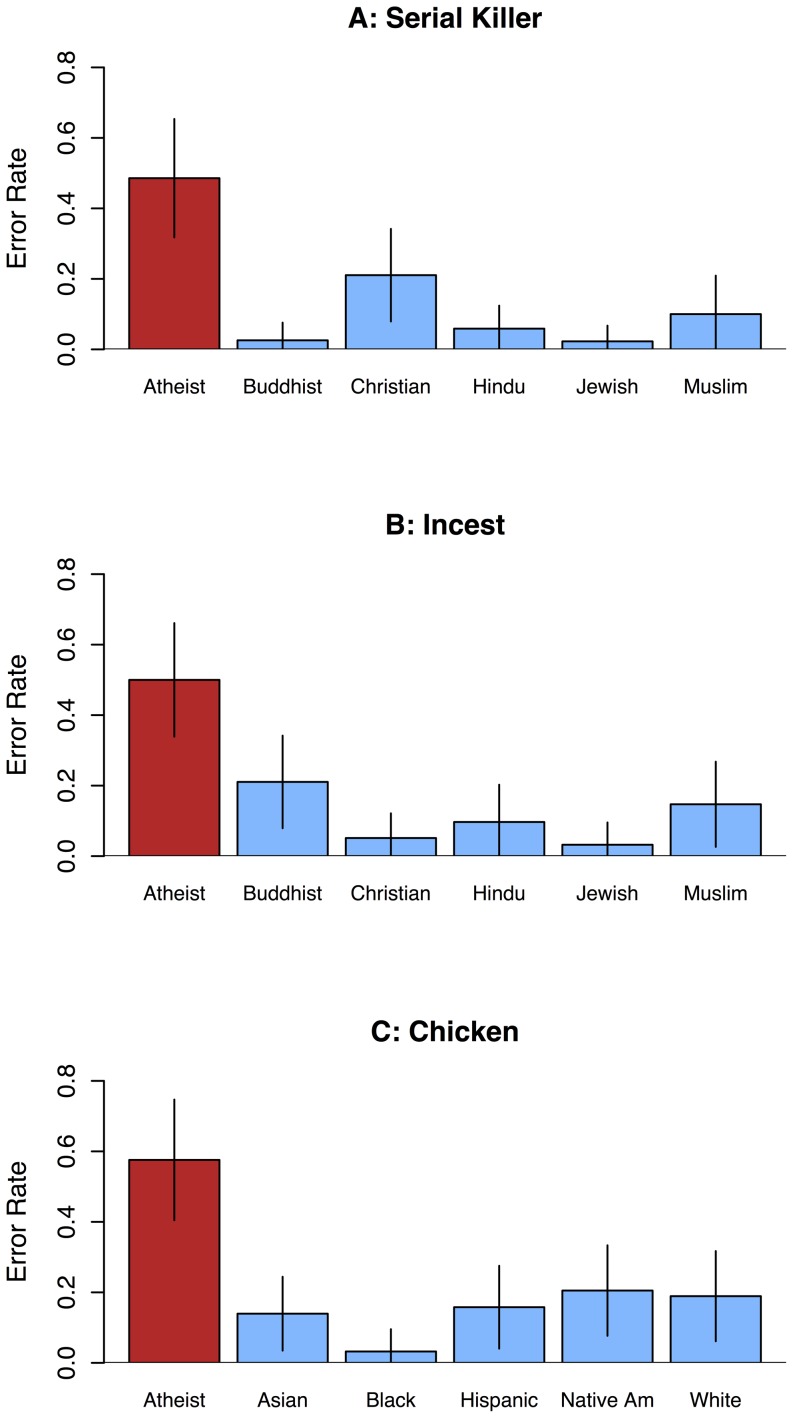
Scientific research yields inconsistent and contradictory evidence relating religion to moral judgments and outcomes, yet most people on earth nonetheless view belief in God (or gods) as central to morality, and many view atheists with suspicion and scorn. To evaluate intuitions regarding a causal link between religion and morality, this paper tested intuitive moral judgments of atheists and other groups. Across five experiments (N = 1,152), American participants intuitively judged a wide variety of immoral acts (e.g., serial murder, consensual incest, necrobestiality, cannibalism) as representative of atheists, but not of eleven other religious, ethnic, and cultural groups. Even atheist participants judged immoral acts as more representative of atheists than of other groups. These findings demonstrate a prevalent intuition that belief in God serves a necessary function in inhibiting immoral conduct, and may help explain persistent negative perceptions of atheists.
Overview
The claims and statistics of this paper haven’t been checked yet.
Free: it reads the open-access text and checks the first 5 claims that cite a source we can check. Create a free account to check every claim.
Integrity signals
Registry
Cites
Statistics
Figures
Verification
Claims the paper makes
The claims and statistics of this paper haven’t been checked yet.
Free: it reads the open-access text and checks the first 5 claims that cite a source we can check. Create a free account to check every claim.
Claims other papers make about this one
Each is checked against this paper’s own text: does it say what the citing paper says it does?
The source backs part of the claim, not all of it — or backs it for a different population, condition or comparison.
In the citing paper
“Religions underpin large-scale intragroup cooperation 3 , but also promote distrust of nonbelievers 13,19 who are excluded from such religious moral communities 3,25 .”
From Global evidence of extreme intuitive moral prejudice against atheists (2017) · cites this paper as [19]
Experimental — accuracy not yet measuredThe cited source says what the claim attributes to it.
In the citing paper
“Modern investigations reflect this perceived link between belief in gods and morality, as recent small sample studies in North America suggest deep moral suspicion of individuals who do not believe in gods 13,19 .”
From Global evidence of extreme intuitive moral prejudice against atheists (2017) · cites this paper as [19]
The cited source says what the claim attributes to it.
In the citing paper
“Higher conjunction fallacy rates (picking option B) in the atheist condition indicate that people intuitively view serial murder as more representative of atheists than of religious believers 19 .”
From Global evidence of extreme intuitive moral prejudice against atheists (2017) · cites this paper as [19]
The cited source says what the claim attributes to it.
In the citing paper
“Psychologists have recently started to examine why people have such antipathy toward atheists, and the findings strongly suggest that prejudice against atheists is driven by distrust [4–8].”
From The amoral atheist? A cross-national examination of cultural, motivational, and cognitive antecedents of disbelief, and their implications for morality (2021) · cites this paper as [6]
The cited source says what the claim attributes to it.
In the citing paper
“There is a widespread cross-cultural stereotype suggesting that atheists are untrustworthy and lack a moral compass.”
From The amoral atheist? A cross-national examination of cultural, motivational, and cognitive antecedents of disbelief, and their implications for morality (2021) · cites this paper as [6]
Self-check
Percentages, sums and reported differences re-computed from the paper’s own numbers.
The self-check needs the paper’s full text.
Citations
Cites
R: A Language and Environment for Statistical Computing
R Core Team (2025) · doi:10.32614/r.manuals · Cited by 352,181
Amazon's Mechanical Turk: A New Source of Inexpensive, Yet High-Quality, Data?
Buhrmester, M., Kwang, T., & Gosling, S. D. (2011) · Perspectives on Psychological Science · doi:10.1177/1745691610393980 · Cited by 9,996
Adler, N. E., Epel, E. S., Castellazzo, G., & Ickovics, J. R. (2000) · Health Psychology · doi:10.1037/0278-6133.19.6.586 · Cited by 5,080
An fMRI Investigation of Emotional Engagement in Moral Judgment
Greene, J. D., Sommerville, R. B., Nystrom, L. E., Darley, J. M., & Cohen, J. D. (2001) · Science · doi:10.1126/science.1062872 · Cited by 4,561 · cited 2×
“Coda Recently, successful lines of research have emerged, independently investigating the evolutionary and cognitive origins and consequences of both religion [1–2,41–43] and morality [11– 13,29,34–35].”
BackgroundLiberals and conservatives rely on different sets of moral foundations.
Graham, J., Haidt, J., & Nosek, B. A. (2009) · Journal of Personality and Social Psychology · doi:10.1037/a0015141 · Cited by 4,560
Extensional versus intuitive reasoning: The conjunction fallacy in probability judgment.
Tversky, A., & Kahneman, D. (1983) · Psychological Review · doi:10.1037/0033-295x.90.4.293 · Cited by 3,991
Instructional manipulation checks: Detecting satisficing to increase statistical power
Oppenheimer, D. M., Meyvis, T., & Davidenko, N. (2009) · Journal of Experimental Social Psychology · doi:10.1016/j.jesp.2009.03.009 · Cited by 3,493 · cited 5×
“Following the conjunction task, participants completed an Instrumental Manipulation Check [31], as in other studies.”
BackgroundMethodInfluentialThe Dishonesty of Honest People: A Theory of Self-Concept Maintenance
Mazar, N., Amir, O., & Ariely, D. (2008) · Journal of Marketing Research · doi:10.1509/jmkr.45.6.633 · Cited by 2,875 · cited 1×
“Is religion the bedrock of morality? On the one hand, religion is linked to a variety of positive outcomes, including prosocial behavior [1–4], volunteerism [5], honesty [6–7], and an ability to resist temptation [8–9].”
BackgroundThe New Synthesis in Moral Psychology
Haidt, J. (2007) · Science · doi:10.1126/science.1137651 · Cited by 2,382
Social evaluation by preverbal infants
Hamlin, J. K., Wynn, K., & Bloom, P. (2007) · Nature · doi:10.1038/nature06288 · Cited by 1,566 · cited 3×
“If true, then exposure to scientific arguments regarding the developmental [11], phylogenetic [12], or neural [35–36] underpinnings of common moral intuitions might alleviate morality-driven antipathy towards atheists.”
Background
Research works printed but not linked: 1
- 19. Pew Research Global Attitudes Project (2007) Chapter 3: Views of religion and morality. Available: http://www.pewglobal.org/2007/10/04/chapter-3-views- of-religion-and-morality/. Accessed 23 January 2014
Cited by
Items 101–164 of 164
How Nonreligious Parents Approach the (Non)Religious Socialization of Their Children
Kelley, H. H., Marks, L. D., Dollahite, D. C., & Aller, T. B. (2025) · Journal of Family Issues · doi:10.1177/0192513x251370700 · Cited by 1
“Research has documented that negative attitudes towards nonreligious individuals and groups (atheists in particular) are pervasive in the United States (Cheng et al., 2018; Edgell et al., 2016; Gervais, 2014).”
Cragun, R. T. (2026) · International Journal for the Psychology of Religion · doi:10.1080/10508619.2026.2675189 · Cited by 1
“A well-established body of research has shown that Americans hold negative views of atheists (Edgell et al., 2006, 2016; Gervais, 2014), as do people in many countries around the world (Gervais et al., 2017).”
Religion, Crime, and Prosocial Behaviour
Durrant, R., & Poppelwell, Z. (2017) · Springer eBooks · doi:10.1007/978-3-319-64428-8_3 · Cited by 2
The Zarathustra: Exploring the Interplay of Marriage, Faith, and Social Life
Khatun, M., & Islam, M. A. (2024) · Community Jurnal Hasil Penelitian dan Pengabdian Masyarakat · doi:10.61166/community.v3i1.75 · Cited by 1
A Faith-Based Spiritual Theory
Yair, Y. B., & Ronel, N. (2024) · Springer eBooks · doi:10.1007/978-3-031-63172-6_2 · Cited by 1
Intuitive moral bias favors the religiously faithful
Dayer, A., Aswamenakul, C., Turner, M. A., Nicolay, S., Wang, E., Shurik, K., & Holbrook, C. (2024) · Scientific Reports · doi:10.1038/s41598-024-67960-4 · Cited by 2
“…acts (serial murder, incest, necrobestiality, and cannibalism) as more representative of atheists compared to other social and religious groups 14 , and convergent research indicates that distrust of atheists is mediated by the belief that supernatural surveillance encourages moral behavior…”
BackgroundThe Moral Motivations of Negative Attitudes Toward Transgender People
Hatch, H. (2018) · UNI ScholarWorks (University of Northern Iowa) · Cited by 5
We Do Not Think It Means What They Think It Means: A Response to Thunström et al
Cragun, R. T., & Speed, D. (2021) · Journal for the Scientific Study of Religion · doi:10.1111/jssr.12713 · Cited by 1
“Their conclusion that they have evidence that atheists are less trustworthy—paired with the already widespread prejudice and discrimination against nonbelievers in the United States (Edgell, Gerteis, and Hartmann 2006; Gervais 2014)—is akin to kicking a hornet’s nest.”
BackgroundGranger, A. M. (2021) · PDXScholar (Portland State University) · doi:10.15760/etd.7640 · Cited by 2
Religious Nonbelievers’ Psychological Distress
Weber, S. R., Lomax, J. W., & Pargäment, K. I. (2022) · Springer eBooks · doi:10.1007/978-3-319-69909-7_4135-2 · Cited by 1
ON A(PE)THEISM: RELIGIOUS DEHUMANIZATION OF ATHEISTS AND OTHER OUTGROUPS
Ng, B. K. L. (2015) · UKnowledge (University of Kentucky)
Granger, A. M. (2017) · DigitalCommons (California Polytechnic State University)
Durrant, R., & Poppelwell, Z. (2017) · Springer eBooks · doi:10.1007/978-3-319-64428-8_1
The Moral Motivations of Negative Attitudes toward Transgender PersonsPreprint
Hatch, H., & Harton, H. C. (2017) · OSF Preprints (OSF Preprints) · doi:10.17605/osf.io/q5ngc
Esche, A. (2017) · Cardinal Scholar (Ball State University)
Religiousness and Spirituality: How Are They Related to Moral Orientations?
Gabhart, E. A. (2017) · University of North Texas Digital Library (University of North Texas) · doi:10.12794/metadc1011767
In the presence of god : does acceptance by god increase prosocial behavior?
Woo, Y. T. (2019) · DR-NTU (Nanyang Technological University) · doi:10.32657/10356/87256
Mickey, Yahweh, and Zeus: Why Cultural Learning Is Essential for the Evolutionary Study of Religion
Gervais, W. M. (2020) · Oxford University Press eBooks · doi:10.1093/oxfordhb/9780199397747.013.3 · Cited by 1
Self-citationBias against Atheists and Religious Persons in Sweden
Hallin, N., Västfjäll, D., & Andersson, G. (2020) · Journal for the Cognitive Science of Religion · doi:10.1558/jcsr.41002 · Cited by 1
How Atheist Scientists Approach Meaning and Morality
Ecklund, E. H., & Johnson, D. R. (2021) · Oxford University Press eBooks · doi:10.1093/oso/9780197539163.003.0007
Why Study Atheism among Scientists?
Ecklund, E. H., & Johnson, D. R. (2021) · Oxford University Press eBooks · doi:10.1093/oso/9780197539163.003.0001
“Tried and Found Wanting”: How Atheist Scientists Explain Religious Transitions
Ecklund, E. H., & Johnson, D. R. (2021) · Oxford University Press eBooks · doi:10.1093/oso/9780197539163.003.0002
“I Am Not Like Richard”: Modernist Atheist Scientists
Ecklund, E. H., & Johnson, D. R. (2021) · Oxford University Press eBooks · doi:10.1093/oso/9780197539163.003.0003
From Rhetoric to Reality: Why Religious Believers Should Give Atheist Scientists a Chance
Ecklund, E. H., & Johnson, D. R. (2021) · Oxford University Press eBooks · doi:10.1093/oso/9780197539163.003.0008
Ties That Bind: Culturally Religious Atheists
Ecklund, E. H., & Johnson, D. R. (2021) · Oxford University Press eBooks · doi:10.1093/oso/9780197539163.003.0004
Ecklund, E. H., & Johnson, D. R. (2021) · Oxford University Press eBooks · doi:10.1093/oso/9780197539163.003.0005
What Atheist Scientists Think about Science
Ecklund, E. H., & Johnson, D. R. (2021) · Oxford University Press eBooks · doi:10.1093/oso/9780197539163.003.0006
(2019) · International Journal for the Psychology of Religion · doi:10.1080/10508619.2019.1640006
McCaffree, K. J. (2017) · Springer eBooks · doi:10.1007/978-3-319-50262-5_5
Steinhart, E. C. (2022) · Palgrave frontiers in philosophy of religion · doi:10.1007/978-3-031-17752-1_1
Benevolent God Concepts and Past Kind Behaviors Induce Generosity Toward Outgroups
Lee, Y.-E., Payir, A., & Heiphetz, L. (2023) · Social Cognition · doi:10.1521/soco.2023.41.4.321
Religious Nonbelievers’ Psychological Distress
Weber, S. R., Lomax, J. W., & Pargäment, K. I. (2023) · Springer eBooks · doi:10.1007/978-3-031-17299-1_4135
Ecklund, E. H., & Johnson, D. R. (2021) · Oxford University Press eBooks · doi:10.1093/oso/9780197539163.005.0001
Ecklund, E. H., & Johnson, D. R. (2021) · Oxford University Press eBooks · doi:10.1093/oso/9780197539163.002.0006
Ecklund, E. H., & Johnson, D. R. (2021) · Oxford University Press eBooks · doi:10.1093/oso/9780197539163.002.0003
Atheists and Christians can be Discerned from their Faces
Pitts, G. S., & Rule, N. O. (2024) · Journal of Nonverbal Behavior · doi:10.1007/s10919-024-00467-8
“Furthermore, people judge atheists as more likely to commit a range of immoral behaviors compared to members from a wide variety of other social and religious groups (Gervais, 2014).”
Snell, A., & Burt, M. (2024) · Springer eBooks · doi:10.1007/978-3-031-38971-9_934-1 · Cited by 1
Religion: Evolutionary Foundation for
Ko, N. F., & Li, N. P. (2025) · Springer eBooks · doi:10.1007/978-3-031-38971-9_1747-1
Demczuk, A., & Chammas, E. (2025) · Springer eBooks · doi:10.1007/978-3-031-38971-9_858-1
AtheistsPreprint
Schiavone, S. R., & Gervais, W. M. (2017) · PsyArXiv (OSF Preprints) · doi:10.31234/osf.io/ryp6g_v1
Self-citationMorality: Religious and Nonreligious
Stiehl, M. M., Rowatt, W. C., & Tsang, J.-A. C. (2025) · Springer eBooks · doi:10.1007/978-3-031-38971-9_376-1
Zuckerman, P., & Myers, S. (2025) · Secularism and Nonreligion · doi:10.5334/snr.221
Dutta, G., Misra, G., & Gupta, S. (2025) · Springer eBooks · doi:10.1007/978-981-96-4210-6_1
Religious Beliefs, Cooperation, and Evolutionary Mechanisms
Ko, N. F., & Li, N. P. (2025) · Springer eBooks · doi:10.1007/978-3-031-38971-9_1778-1
Christians Have More Self-Compassion Than Atheists—But Also More Grandiose (Not Fragile) Narcissism
Magee, M. W. (2025) · Pastoral Psychology · doi:10.1007/s11089-025-01239-x
Scheitle, C. P., & Corcoran, K. E. (2024) · The Conversation · doi:10.64628/aai.hj7dwqdk7
Why is it so hard for atheists to get voted in to Congress?
Zuckerman, P. (2020) · The Conversation · doi:10.64628/aai.da46n6crr
Zuckerman, P. (2022) · The Conversation · doi:10.64628/aai.3drp95fud
Religion: Evolutionary Foundation for
Ko, N. F., & Li, N. P. (2025) · Springer eBooks · doi:10.1007/978-3-031-38971-9_1747-2
Hallin, N., Västfjäll, D., & Andersson, G. (2022) · Figshare · doi:10.6084/m9.figshare.21162828
Hallin, N., Västfjäll, D., & Andersson, G. (2022) · Figshare · doi:10.6084/m9.figshare.21162825
Positive Perceptions of Atheists
(2018) · Arizona State University Library Digital Repository (Arizona State University)
Galgali, M. S. (2020) · EngagedScholarship @ Cleveland State University (Cleveland State University) · Cited by 1
Bradley, D. F. (2018) · OhioLink ETD Center (Ohio Library and Information Network)
Religious envy: investigating the nonreligious experience
Underill, B., Steger, M., Dik, B., Hastings, P., & Tompkins, S. A. (2022) · Digital Collections of Colorado (Colorado State University) · doi:10.25675/3.04105
Workineh, D. (2021) · ETHIOINQUIRY Journal of Humanities and Social Sciences · doi:10.20372/0wamjz20
The Utility of Social Identity Interventions for Reducing Interfaith Prejudice in the United States
Bergstrom, V. N. Z. (2023) · TSpace (University of Toronto)
The cognitive anthropology of moralistic culture
Fitouchi, L. (2023) · theses.fr (ABES) · doi:10.70675/eb504fd4z1da1z41daz901bz26acc5197a48
Formas de identificación de los “no creyentes”: una etnografía sobre agnósticos y ateos en Lima
Delgado, R. D. R. (2026) · Communities in DSpace (Pontifical Catholic University of Peru)
Catena‐Fernández, C. (2025) · UNED repository
Halstead, I. N., Major‐Smith, D., Heron, J. E., Golding, J., Iles-Caven, Y., Svob, C., & Joinson, C. J. (2026) · Religion Brain & Behavior · doi:10.1080/2153599x.2026.2684682
Underill, B. D., Dik, B. J., Knight-Baughman, R., Chavez, E., & Hastings, O. ". (2026) · doi:10.25675/3.027414
Partisanship and openness to nonreligious candidates for elective office in the United States
Golebiowska, E. A. (2026) · Politics and Religion · doi:10.1017/s1755048326100522
Moral Grounds Without God: Moral Reasoning, Meaning, and the Social Life of Nonbelievers in Pakistan
., S., & Rasool, D. F. (2023) · International Journal of Research in Social Sciences and Humanities · doi:10.37648/ijrssh.v13i03.036
Metadata
- Authors
- Gervais, W. M.
- Affiliations
- University of Kentucky (US)
- Corresponding author
- Gervais, Will M.
- ORCID
- Gervais, Will M.
- Venue
- PLoS ONE
- Publisher
- Public Library of Science (PLoS)
- Published
- 2014-04-09
- Volume
- 9
- Issue
- 4
- Pages
- e92302
- ISSN
- 1932-6203 (ISSN-L)
- PMC
- PMC3981659
- OpenAlex
- W2007906398
- Semantic Scholar
- 207f15047fd97b124f2218eae1f1212234410346
- Cited by
- 151
- References
- 44
- Citations by year
- 2026: 3 · 2025: 18 · 2024: 13 · 2023: 8 · 2022: 11 · 2021: 26 · 2020: 13 · 2019: 10 · 2018: 6 · 2017: 23 · 2016: 10 · 2015: 6 · 2014: 2
- FWCI
- 7.62
- Type
- journal article
- Language
- en
- Open access
- gold
- doi.org
- Locations
- PLoS ONE (publishedVersion, cc-by)
- Europe PMC (PubMed Central) (publishedVersion, other-oa)
- PubMed Central (publishedVersion, cc-by)
- PubMed (publishedVersion)
- UKnowledge (University of Kentucky) (submittedVersion, cc-by)
- DOAJ (DOAJ: Directory of Open Access Journals) (submittedVersion, cc-by-sa)
- Funders
- University of Kentucky
- Topics
- Life Sciences › Neuroscience › Cognitive Neuroscience › Psychology of Moral and Emotional Judgment
- Social Sciences › Sociology and Political Science › Social and Intergroup Psychology
- Social Sciences › Sociology and Political Science › Religion and Society Interactions
- Keywords
- religion and morality, atheism, moral judgment, intuitive judgment, stereotypes, belief in God, unethical behavior, intergroup perception
- MeSH terms
- Adult, Humans, Judgment, Morals, Religion, Logistic Models, Intuition
About these checks
Registry, retraction, Cites and statistics results are computed, not judged, with one exception: a printed reference that no index lists is read once by a model before it counts as a citation error. Claims are extracted by a model and kept only when their quote appears verbatim in the text; each cited source is then checked, with a model’s help, for whether it says what the claim relies on. Those verdicts can be wrong — read the claim’s quote and the cited source before relying on one.
Statistics and arithmetic are recomputed, not judged.
Confidence bands are shown only for fields calibrated on our annotated test set. None is calibrated yet, so no band is shown.
What counts as a claim ›How we measure confidence ›How we check this ›
Are you an author, or do you see a problem with this page? Request a review
Data sources
Bibliographic data: Semantic Scholar, OpenAlex, Crossref.
Contains information from the Semantic Scholar Academic Graph Datasets, made available under the ODC Attribution License (ODC-BY 1.0).
Semantic Scholar’s data is described in: Kinney, R., et al. (2023). The Semantic Scholar Open Data Platform. arXiv:2301.10140.
