

The DOI matches its Crossref record; 37 of the 37 references it cites were found in a registry or an index.
Circulating Exosomal microRNAs as Biomarkers of Colon Cancer
Open accessAbstract
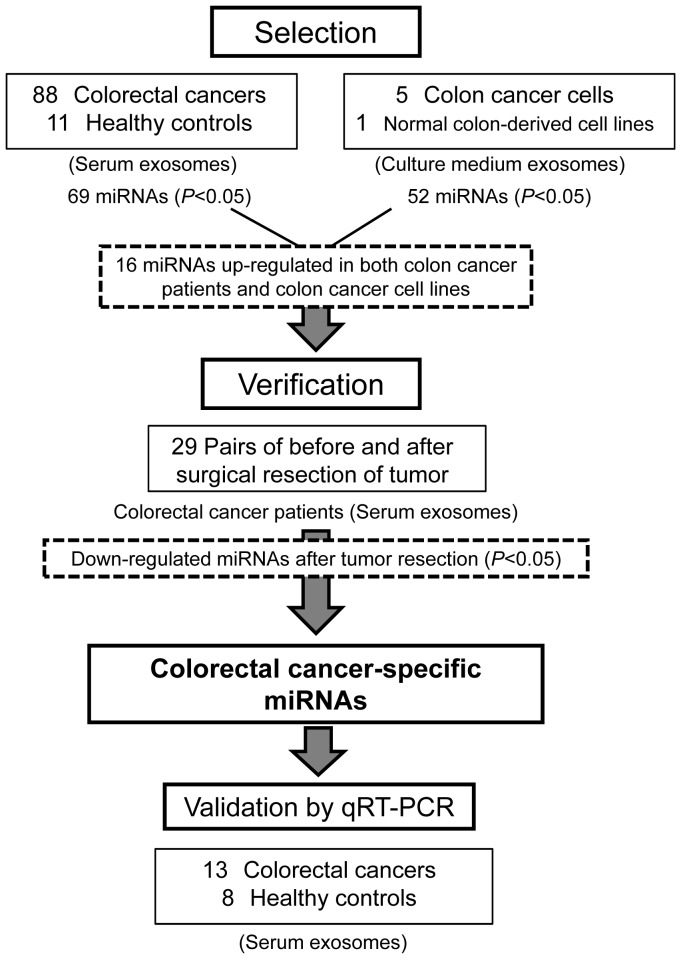
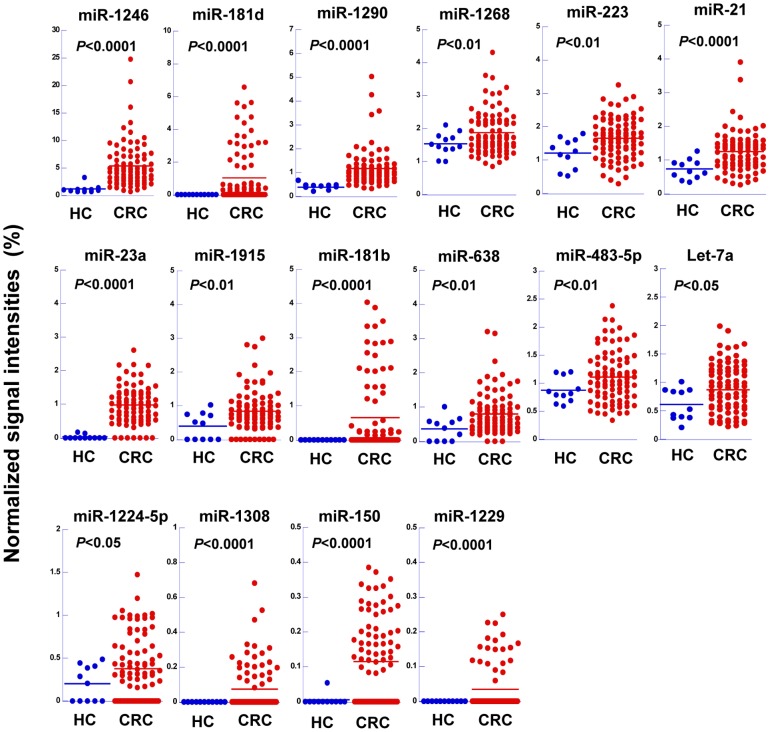
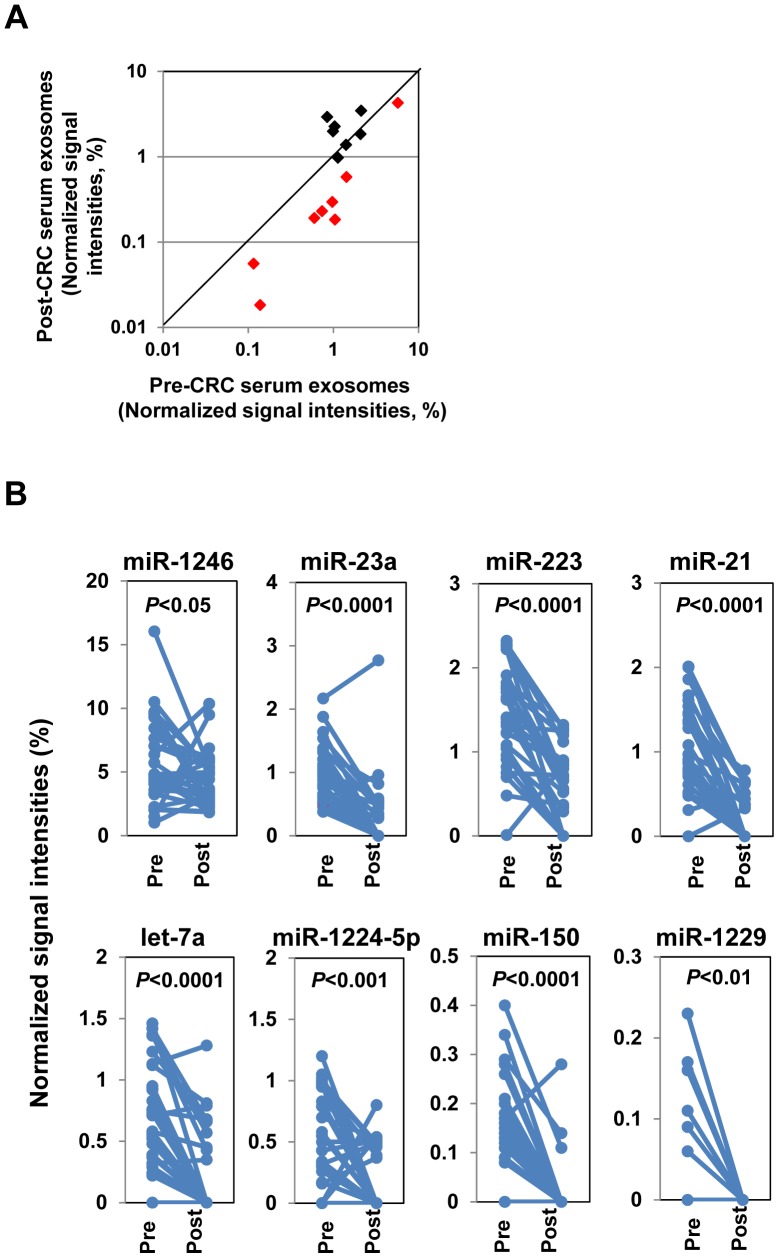
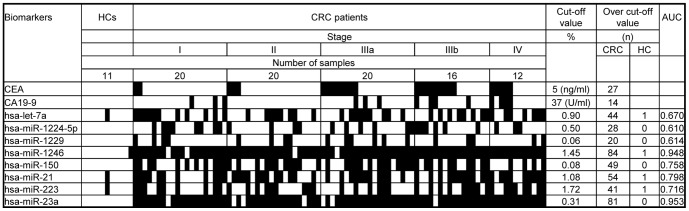
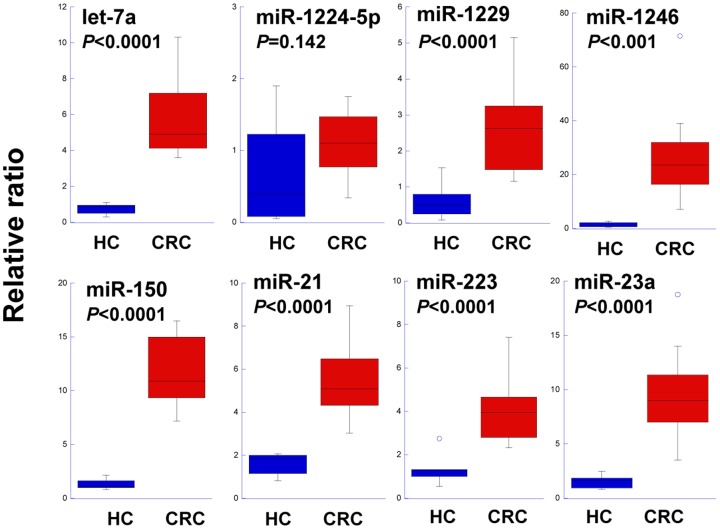
PURPOSE: Exosomal microRNAs (miRNAs) have been attracting major interest as potential diagnostic biomarkers of cancer. The aim of this study was to characterize the miRNA profiles of serum exosomes and to identify those that are altered in colorectal cancer (CRC). To evaluate their use as diagnostic biomarkers, the relationship between specific exosomal miRNA levels and pathological changes of patients, including disease stage and tumor resection, was examined. EXPERIMENTAL DESIGN: Microarray analyses of miRNAs in exosome-enriched fractions of serum samples from 88 primary CRC patients and 11 healthy controls were performed. The expression levels of miRNAs in the culture medium of five colon cancer cell lines were also compared with those in the culture medium of a normal colon-derived cell line. The expression profiles of miRNAs that were differentially expressed between CRC and control sample sets were verified using 29 paired samples from post-tumor resection patients. The sensitivities of selected miRNAs as biomarkers of CRC were evaluated and compared with those of known tumor markers (CA19-9 and CEA) using a receiver operating characteristic analysis. The expression levels of selected miRNAs were also validated by quantitative real-time RT-PCR analyses of an independent set of 13 CRC patients. RESULTS: The serum exosomal levels of seven miRNAs (let-7a, miR-1229, miR-1246, miR-150, miR-21, miR-223, and miR-23a) were significantly higher in primary CRC patients, even those with early stage disease, than in healthy controls, and were significantly down-regulated after surgical resection of tumors. These miRNAs were also secreted at significantly higher levels by colon cancer cell lines than by a normal colon-derived cell line. The high sensitivities of the seven selected exosomal miRNAs were confirmed by a receiver operating characteristic analysis. CONCLUSION: Exosomal miRNA signatures appear to mirror pathological changes of CRC patients and several miRNAs are promising biomarkers for non-invasive diagnosis of the disease.
Overview
The claims and statistics of this paper haven’t been checked yet.
Run the check — free, no account needed. It reads the open-access text and checks the sources it cites.
Integrity signals
Registry
Cites
Statistics
Figures
Verification
Claims the paper makes
The claims and statistics of this paper haven’t been checked yet.
Run the check — free, no account needed. It reads the open-access text and checks the sources it cites.
Claims other papers make about this one
Each is checked against this paper’s own text: does it say what the citing paper says it does?
The cited source says what the claim attributes to it.
In the citing paper
“microRNA's presence in exosomes have been already reported in different cells and cancer types (44–50).”
From Potential Therapeutic Effects of Exosomes Packed With a miR-21-Sponge Construct in a Rat Model of Glioblastoma (2019) · cites this paper as [48]
Self-check
Percentages, sums and reported differences re-computed from the paper’s own numbers.
The self-check needs the paper’s full text.
Citations
Cites
1 retracted
RETRACTED: MicroRNA signatures of tumor-derived exosomes as diagnostic biomarkers of ovarian cancer
Taylor, D. D., & Gerçel-Taylor, Ç. (2008) · Gynecologic Oncology · doi:10.1016/j.ygyno.2008.04.033 · Cited by 2,333
RetractedAnalysis of Relative Gene Expression Data Using Real-Time Quantitative PCR and the 2−ΔΔCT Method
Livak, K. J., & Schmittgen, T. D. (2001) · Methods · doi:10.1006/meth.2001.1262 · Cited by 180,860
Jemal, A., Bray, F., Ferlay, J., Ward, E., & Forman, D. (2011) · CA A Cancer Journal for Clinicians · doi:10.3322/caac.20107 · Cited by 55,077
Valadi, H., Ekström, K., Bossios, A., Sjöstrand, M., Lee, J. J., & Lötvall, J. O. (2007) · Nature Cell Biology · doi:10.1038/ncb1596 · Cited by 12,834
MicroRNA expression profiles classify human cancers
Lü, J., Getz, G. A., Miska, E. A., Alvarez-Saavedra, E., Lamb, J., Peck, D., Sweet-Cordero, A., Ebert, B. L., Mak, R. H., Ferrando, A. A., et al. (2005) · Nature · doi:10.1038/nature03702 · Cited by 9,637
Oncomirs—MicroRNAs with a role in cancer
Esquela-Kerscher, A., & Slack, F. J. (2006) · Nature Reviews Cancer · doi:10.1038/nrc1840 · Cited by 5,884
Skog, J., Würdinger, T., van Rijn, S., Meijer, D. H., Gainche, L., Curry, W. T., Carter, B. S., Krichevsky, A. M., & Breakefield, X. O. (2008) · Nature Cell Biology · doi:10.1038/ncb1800 · Cited by 5,001
Causes and consequences of microRNA dysregulation in cancer
Croce, C. M. (2009) · Nature Reviews Genetics · doi:10.1038/nrg2634 · Cited by 3,039
MicroRNA dysregulation in cancer: diagnostics, monitoring and therapeutics. A comprehensive review
Iorio, M. V., & Croce, C. M. (2012) · EMBO Molecular Medicine · doi:10.1002/emmm.201100209 · Cited by 1,778
Atkin, W. S., Edwards, R., Kralj‐Hans, I., Wooldrage, K., Hart, A. R., Northover, J. M. A., Parkin, D. M., Wardle, J., Duffy, S. W., & Cuzick, J. M. (2010) · The Lancet · doi:10.1016/s0140-6736(10)60551-x · Cited by 1,618
Cited by
Sorted by citations
Items 801–810 of 810
Litwiniuk, A., Kalisz, M., Stępień, D., Sławkowska, N., Roszkowski, R., Remyzovska, O., Grala, B., Bik, W., & Kwiatkowski, A. (2026) · Critical Reviews in Oncology/Hematology · doi:10.1016/j.critrevonc.2026.105491
Li, D.-M., Pei, K., Yu, X., Li, M.-Z., Yuan, M., Qie, M., & Hou, M. (2026) · European Journal of Obstetrics & Gynecology and Reproductive Biology · doi:10.1016/j.ejogrb.2026.115323
Corral-San-Miguel, R., González-Gil, A., Tomás‐Loba, A., Rodríguez‐Vita, J., Gil‐Gómez, E., Olivares-Ripoll, V., Martínez, J., Guijarro‐Campillo, A. R., & Cáscales-Campos, P. A. (2026) · European Journal of Surgical Oncology · doi:10.1016/j.ejso.2026.112044
Liquid biopsies in colorectal cancer screening and diagnosis
Bai, X.-Z., Bao, S.-C. L., Zhang, X.-Q., & Yang, Z.-N. (2026) · World Journal of Gastrointestinal Oncology · doi:10.4251/wjgo.120332
Exosomes in Colorectal Cancer: From Tumor Biology to Diagnostic and Therapeutic Applications
Topal, U., & Zamur, C. (2026) · Medicina · doi:10.3390/medicina62081538
Exosomes—nano-messengers in tumors: capturing techniques, birth codes, and functional deciphering
Li, Y., Gao, Y., Wang, Y.-H., Zhou, K.-F., Zhao, Y., & Zhao, L. (2026) · Frontiers in Cell and Developmental Biology · doi:10.3389/fcell.2026.1825151 · Cited by 1
Grivachev, Е. A., Tryakin, A. A., Vinokurova, S., Sapozhnikov, K. V., Obarevich, E., Fedorova, M. D., Sableva, N. A., Козлов, Н. А., Bolotova, M. E., Elkina, N. V., et al. (2026) · Surgery and Oncology · doi:10.17650/2949-5857-2026-16-2-11-43
Exosomes: The Elixir or the Trojan Horse
Khosravipour, A., Mansoori, M., Aboutalebi, H., Hashemi, F., & Vafaei, S. (2026) · Biomedicine & Pharmacotherapy · doi:10.1016/j.biopha.2026.119957
Zhang, X., 潘洁贞, Lin, Y., Lin, Z., Zhu, Y., Yang, C., Zhang, Y., Yan, L., Li, Z., & Yan, X. (2026) · Talanta · doi:10.1016/j.talanta.2026.130751
Onat, S., Kayım, Z. Y., Karaman, Ş., Özgür, İ., Pasin, Ö., Çelik, B., Kılıç, S., Erdoğan, Ö. Ş., & Tunçer, Ş. B. (2026) · Turkish Journal of Biochemistry · doi:10.1515/tjb-2026-0142
Metadata
- Authors
- Ogata-Kawata, H., Izumiya, M., Kurioka, D., Honma, Y., Yamada, Y., Furuta, K., Gunji, T., Ohta, H., Okamoto, H., Sonoda, H., Watanabe, M., Nakagama, H., Yokota, J., Kohno, T., & Tsuchiya, N.
- Affiliations
- University of Tokyo Hospital (JP)
- Yokohama National University (JP)
- National Cancer Center Hospital (JP)
- NTT Medical Center (JP)
- Shionogi (Japan) (JP)
- National Cancer Center Research Institute (JP)
- Institute of Predictive and Personalized Medicine of Cancer (ES)
- Corresponding author
- Tsuchiya, Naoto
- ORCID
- Venue
- PLoS ONE
- Publisher
- Public Library of Science (PLoS)
- Published
- 2014-04-04
- Volume
- 9
- Issue
- 4
- Pages
- e92921
- ISSN
- 1932-6203 (ISSN-L)
- PMC
- PMC3976275
- OpenAlex
- W1992970284
- Cited by
- 809
- References
- 37
- Citations by year
- 2026: 28 · 2025: 37 · 2024: 51 · 2023: 45 · 2022: 76 · 2021: 96 · 2020: 89 · 2019: 81 · 2018: 76 · 2017: 76 · 2016: 78 · 2015: 60 · 2014: 15
- FWCI
- 31.32
- Type
- journal article
- Language
- en
- Open access
- gold
- doi.org
- Locations
- PLoS ONE (publishedVersion, cc-by)
- Europe PMC (PubMed Central) (publishedVersion, cc-by)
- PubMed Central (publishedVersion, cc-by)
- PubMed (publishedVersion)
- DOAJ (DOAJ: Directory of Open Access Journals) (submittedVersion)
- Figshare (submittedVersion, cc-by)
- Funders
- National Institute of Biomedical Innovation
- Japan Society for the Promotion of Science (23300359, 24790683)
- Topics
- Life Sciences › Biochemistry, Genetics and Molecular Biology › Molecular Biology › Extracellular vesicles in disease
- Life Sciences › Biochemistry, Genetics and Molecular Biology › Cancer Research › MicroRNA in disease regulation
- Life Sciences › Biochemistry, Genetics and Molecular Biology › Cancer Research › Cancer-related molecular mechanisms research
- Keywords
- exosomal microRNAs, colorectal cancer, serum exosomes, diagnostic biomarkers, non-invasive diagnosis, miR-21, miR-223, miR-23a, miR-150, miR-1246, let-7a, tumor resection, CA19-9, carcinoembryonic antigen
- MeSH terms
- Adult, Aged, Colonic Neoplasms, Female, Humans, Male, Middle Aged, Tumor Cells, Cultured, Biomarkers, Tumor, Gene Expression Regulation, Neoplastic, Case-Control Studies, HT29 Cells, Gene Expression Profiling, MicroRNAs, HCT116 Cells, Cell Line, Tumor, Microarray Analysis, Exosomes
About these checks
Registry, retraction, Cites and statistics results are computed, not judged, with one exception: a printed reference that no index lists is read once by a model before it counts as a citation error. Claims are extracted by a model and kept only when their quote appears verbatim in the text; each cited source is then checked, with a model’s help, for whether it says what the claim relies on. Those verdicts can be wrong — read the claim’s quote and the cited source before relying on one.
Statistics and arithmetic are recomputed, not judged.
Confidence bands are shown only for fields calibrated on our annotated test set. None is calibrated yet, so no band is shown.
What counts as a claim ›How we measure confidence ›How we check this ›
Are you an author, or do you see a problem with this page? Request a review
