

The DOI matches its Crossref record; 363 of the 363 references it cites were found in a registry or an index.
Almost All Antipsychotics Result in Weight Gain: A Meta-Analysis
Open accessAbstract
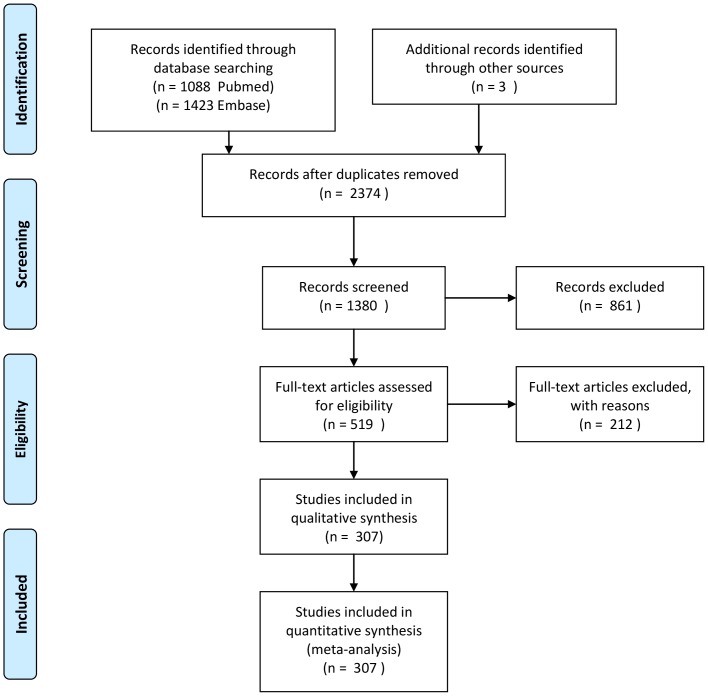
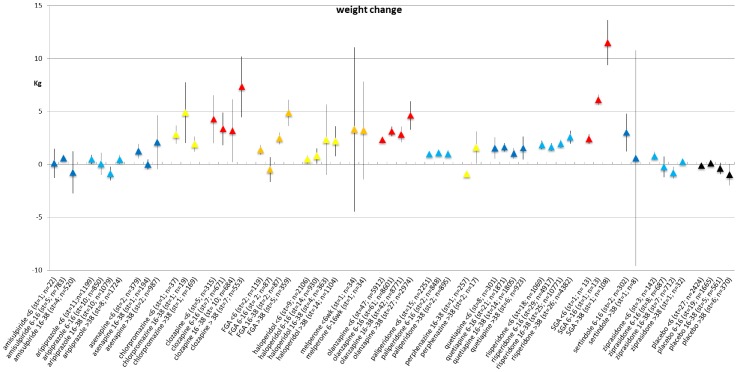
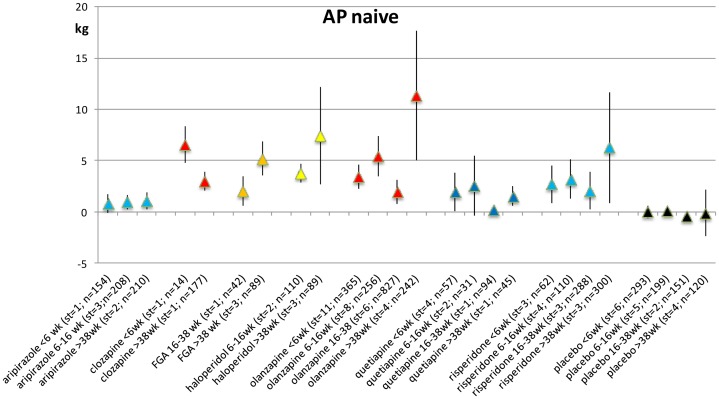
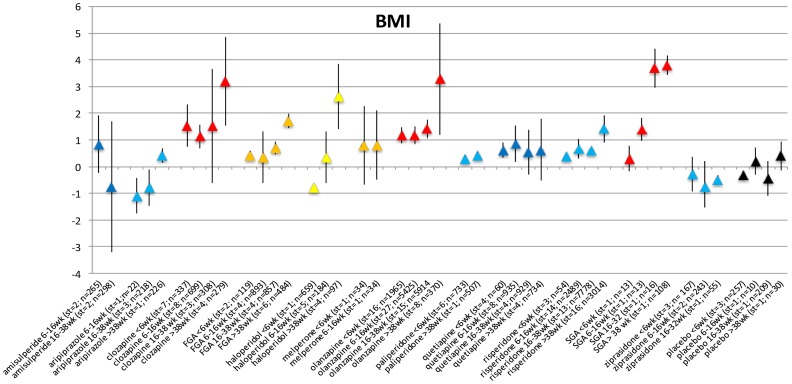
INTRODUCTION: Antipsychotics (AP) induce weight gain. However, reviews and meta-analyses generally are restricted to second generation antipsychotics (SGA) and do not stratify for duration of AP use. It is hypothesised that patients gain more weight if duration of AP use is longer. METHOD: A meta-analysis was conducted of clinical trials of AP that reported weight change. Outcome measures were body weight change, change in BMI and clinically relevant weight change (7% weight gain or loss). Duration of AP-use was stratified as follows: ≤6 weeks, 6-16 weeks, 16-38 weeks and >38 weeks. Forest plots stratified by AP as well as by duration of use were generated and results were summarised in figures. RESULTS: 307 articles met inclusion criteria. The majority were AP switch studies. Almost all AP showed a degree of weight gain after prolonged use, except for amisulpride, aripiprazole and ziprasidone, for which prolonged exposure resulted in negligible weight change. The level of weight gain per AP varied from discrete to severe. Contrary to expectations, switch of AP did not result in weight loss for amisulpride, aripiprazole or ziprasidone. In AP-naive patients, weight gain was much more pronounced for all AP. CONCLUSION: Given prolonged exposure, virtually all AP are associated with weight gain. The rational of switching AP to achieve weight reduction may be overrated. In AP-naive patients, weight gain is more pronounced.
Overview
The claims and statistics of this paper haven’t been checked yet.
Run the check — free, no account needed. It reads the open-access text and checks the sources it cites.
Integrity signals
Registry
Cites
Statistics
Figures
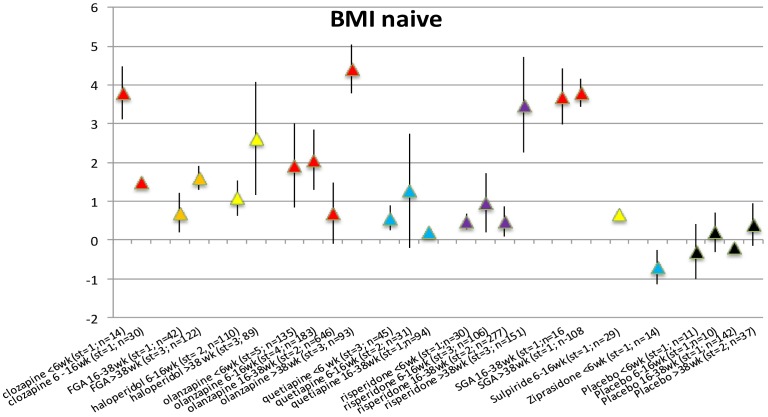
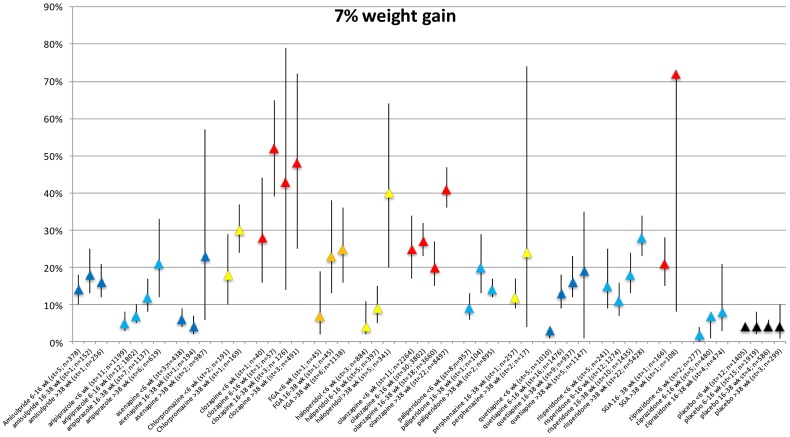
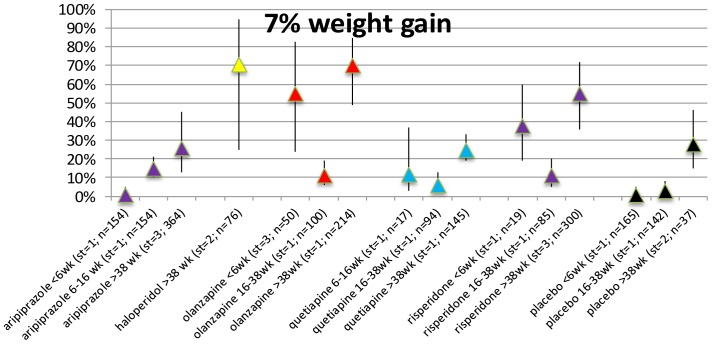
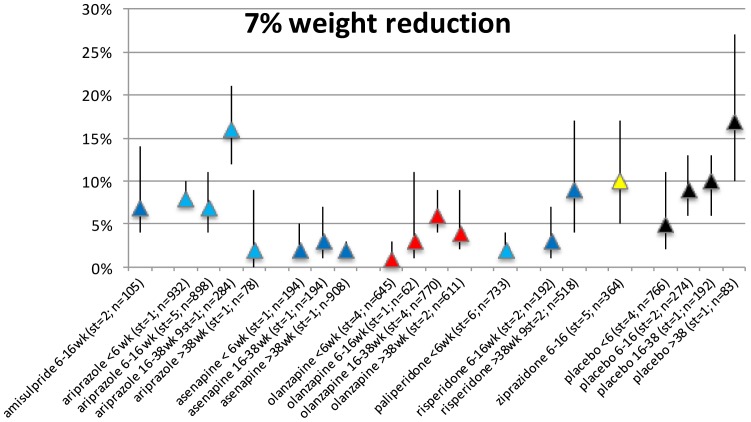
Verification
Claims the paper makes
The claims and statistics of this paper haven’t been checked yet.
Run the check — free, no account needed. It reads the open-access text and checks the sources it cites.
Claims other papers make about this one
Each is checked against this paper’s own text: does it say what the citing paper says it does?
The cited source says what the claim attributes to it.
In the citing paper
“lower BMI has been associated with higher risk of weight gain due to antipsychotics in meta-analyses20 and pooled analyses of brexpiprazole clinical studies.21”
From Brexpiprazole for the maintenance treatment of adults with schizophrenia: an evidence-based review and place in therapy (2019) · cites this paper as [20]
In the citing paper
“Of these risk factors, medication with antipsychotic drugs can be considered partly modifiable, as reducing doses or switching prescriptions only leads to moderate improvement of metabolic risk factors 10,11 .”
Self-check
Percentages, sums and reported differences re-computed from the paper’s own numbers.
The self-check needs the paper’s full text.
Citations
Cites
R: A Language and Environment for Statistical Computing
R Core Team (2000) · doi:10.32614/r.manuals · Cited by 355,893
Meta-analysis of Observational Studies in Epidemiology<SUBTITLE>A Proposal for Reporting</SUBTITLE>
Stroup, D. F. (2000) · JAMA · doi:10.1001/jama.283.15.2008 · Cited by 20,623
Effectiveness of Antipsychotic Drugs in Patients with Chronic Schizophrenia
Lieberman, J. A., Stroup, T. S., McEvoy, J. P., Swartz, M. S., Rosenheck, R. A., Perkins, D. O., Keefe, R. S. E., Davis, S. M., Davis, C. E., Lebowitz, B. D., et al. (2005) · New England Journal of Medicine · doi:10.1056/nejmoa051688 · Cited by 5,892 · cited 1×
“1999 [62–68]; 2000 [69–73]; 2001 [74–90]; 2002 [37,91–106]; 2003 [107–132]; 2004 [133–157]; 2005 [158–191]; 2006 [46,192– 218]; 2007 [219–254]; 2008 [45,49,255–286]; 2009 [287–317]; 2010 [43,318–338]; 2011 [50,339–359]”
Leucht, S., Cipriani, A., Spineli, L., Mavridis, D., Örey, D., Richter, F., Samara, M., Barbui, C., Engel, R. R., Geddes, J. R., et al. (2013) · The Lancet · doi:10.1016/s0140-6736(13)60733-3 · Cited by 2,561
Antipsychotic-induced weight gain: a comprehensive research synthesis
Allison, D. B., Mentore, J. L., Heo, M., Chandler, L. P., Cappelleri, J. C., Infante, M. C., & Weiden, P. J. (1999) · American Journal of Psychiatry · doi:10.1176/ajp.156.11.1686 · Cited by 2,382 · cited 6×
“In addition, Allison [19] suggested to study clinically significant weight gain and weight loss and provided a definition.”
BackgroundMethodResultInfluentialSaha, S., Chant, D., & McGrath, J. (2007) · Archives of General Psychiatry · doi:10.1001/archpsyc.64.10.1123 · Cited by 2,065 · cited 1×
“Compared to the general population, the risk of developing cardiovascular illness is doubled and more than five times higher for endocrine disease [12,14].”
BackgroundTiihonen, J., Lönnqvist, J., Wahlbeck, K., Klaukka, T., Niskanen, L., Tanskanen, A., & Haukka, J. (2009) · The Lancet · doi:10.1016/s0140-6736(09)60742-x · Cited by 1,354
Effectiveness of Atypical Antipsychotic Drugs in Patients with Alzheimer's Disease
Schneider, L. S., Tariot, P. N., Dagerman, K. S., Davis, S. M., Hsiao, J. K., Ismail, M. S., Lebowitz, B. D., Lyketsos, C. G., Ryan, J. M., Stroup, T. S., et al. (2006) · New England Journal of Medicine · doi:10.1056/nejmoa061240 · Cited by 1,206
Metabolic and cardiovascular adverse effects associated with antipsychotic drugs.
De Hert, M., Detraux, J., van Winkel, R., Yu, W., & Correll, C. U. (2012) · Nature Reviews Endocrinology · doi:10.1038/nrendo.2011.156 · Cited by 1,145 · cited 1×
“Indeed some reviews address this issue although restricted to only schizophrenia and bipolar disorder [27,61].”
BackgroundExcess Mortality in Bipolar and Unipolar Disorder in Sweden
Ösby, U., Brandt, L., Correia, N., Ekbom, A., & Sparén, P. (2001) · Archives of General Psychiatry · doi:10.1001/archpsyc.58.9.844 · Cited by 1,120 · cited 1×
“6 in women [15].”
Research works printed but not linked: 1
- P Chue, 2005, Study of long-term quetiapine treatment, The journal of applied research, 5, 246
Cited by
Sorted by citations
Items 401–490 of 490
Zeleke, T. K., Teshome, A. H., Assefa, M. T., Chanie, G. S., & Abebe, R. B. (2024) · BMC Psychiatry · doi:10.1186/s12888-024-06266-1 · Cited by 1
“Certain antipsychotics, such as clozapine and olan-zapine, have been shown to cause the highest rates of metabolic side effects, including elevated cholesterol and triglycerides levels [62, 63].”
BackgroundPrevalence of Metabolic Syndrome among Bahraini Patients with Schizophrenia
Jahrami, H., & Ali, M. K. (2018) · Journal of the Bahrain Medical Society · doi:10.26715/jbms.2_29052018 · Cited by 1
Currie, O., Williman, J. A., Mangin, D. A., McKinnon-Gee, B., & Bridgford, P. (2019) · BMJ Open · doi:10.1136/bmjopen-2018-022984 · Cited by 1
Antipsychotics: Nonmotor Side Effects
Freudenreich, O. (2019) · Current clinical psychiatry · doi:10.1007/978-3-030-29450-2_15 · Cited by 1
Examining sense of self and identity in schizophrenia: A modified grounded theory study
Wang, Y. (2020) · Summit (Simon Fraser University) · Cited by 1
The use of melatonin to mitigate the adverse metabolic side effects of antipsychotics
Romo‐Nava, F., Buijs, R. M., & McElroy, S. L. (2021) · Handbook of clinical neurology · doi:10.1016/b978-0-12-819975-6.00024-8 · Cited by 1
Diagnostik und Ätiologie der Adipositas
Wirth, A. G. (2022) · Springer eBooks · doi:10.1007/978-3-662-63544-5_55 · Cited by 1
Quality of life after bariatric surgery is about weight loss…and more
Varban, O. A. (2020) · Surgery for Obesity and Related Diseases · doi:10.1016/j.soard.2020.06.042 · Cited by 2
Ablordeppey, S. Y., & Ofori, E. (2021) · Wiley eBooks · doi:10.1002/0471266949.bmc103.pub3 · Cited by 1
Schizophrenia and Related Psychoses
(2025) · Wiley eBooks · doi:10.1002/9781119870203.mpg001.pub2 · Cited by 2
Hüppi, R. M., Bautista, L., Cecere, G., Just, S. A., Koops, S., Hussain, M., Tedeschi, E., Benke-Bruderer, S., Bora, E., Lyne, J., et al. (2025) · medRxiv · doi:10.1101/2025.11.14.25339774 · Cited by 1
6 – Effets indésirables des antipsychotiques
Nicolas Franck, B., Fromager, F., & Thibaut, F. (2015) · doi:10.1016/b978-2-294-74633-8.00006-4
Surveillance d'un traitement par antipsychotique
Nicolas Franck, B., Fromager, F., & Thibaut, F. (2015)
Effects of aripiprazole vs. haloperidol on brain activity in healthy volunteers
Bolstad, I. (2016) · NORA - Norwegian Open Research Archives
Uduehi, E., Gallagher, L., & Alugo, T. (2016) · Irish Journal of Psychological Medicine · doi:10.1017/ipm.2016.14
Substanzspezifische Betrachtung und therapeutische Möglichkeiten
Zeiss, R., Connemann, B., & Gahr, M. (2017) · DNP - Der Neurologe & Psychiater · doi:10.1007/s15202-017-1495-z
Gates, M. L., Webb, N. C., Stone, R. B., Ballance, D., & Yoo, W. (2016) · Journal of the Georgia Public Health Association · doi:10.20429/jgpha.2016.050307
Nutrition for Persons Coping With Serious Mental Illnesses
Suarez, C. A., Annunziata, A.-R. I., & Dwyer, J. T. (2017) · Nutrition Today · doi:10.1097/nt.0000000000000223
Chapter 6 - Antipsychotic Drugs
Chue, P., & Baker, G. (2015) · Side effects of drugs annual · doi:10.1016/bs.seda.2015.07.002
Managing urinary incontinence in an acute mental health ward: A case study
McWilliams, C., Goddard, K., & Pegram, A. M. (2018) · British Journal of Mental Health Nursing · doi:10.12968/bjmh.2018.7.2.85
de Jong, P. J. (2018) · Research Publications (Maastricht University) · doi:10.26481/dis.20180518mj
Fairbairn, J., Munshi, T. A., Naeem, F., Baldock, J., & Feakins, M. (2018) · Clinical Audit · doi:10.2147/ca.s156596
“The second-generation antipsychotics associated with a favorable metabolic profile include aripiprazole, ziprasidone, asenapine, and lurasidone.(6,18)”
BackgroundTwenty years of adverse drug reactions: a look back – part 2
Ferner, R. E., & Anton, C. (2018) · Adverse Drug Reaction Bulletin · doi:10.1097/fad.0000000000000034
Effectiveness of interventions to support weight loss in adults taking antipsychotics: a review
Ayodele, D., & Oates, J. (2019) · British Journal of Mental Health Nursing · doi:10.12968/bjmh.2019.8.2.88
Зелінська, Н. Б. (2021) · The Scientific Issues of Ternopil Volodymyr Hnatiuk National Pedagogical University Series pedagogy
Influencia del sexo en el tratamiento con olanzapina: una revisión sistemática
Alberich, S., Martínez‐Cengotitabengoa, M., González–Ortega, I., Fernández-Sevillano, J., Usall, J., & González-Pinto, A. M. (2019) · Psiquiatría Biológica · doi:10.1016/j.psiq.2019.06.001
Safety of psychopharmacotherapy: a clinical and pharmacological approach
Kirilochev, O. O., & Умерова, А. Р. (2019) · S S Korsakov Journal of Neurology and Psychiatry · doi:10.17116/jnevro2019119101127
Balõtšev, R. (2020) · DSpace repository (University of Tartu)
Cardiovascular Manifestations in Schizophrenia
Calorio, F., Catania, C. G., & Rocchetti, M. (2020) · Springer eBooks · doi:10.1007/978-3-030-28008-6_24
Obesity and schizophrenia: New drugs, new hopes
Miljević, Č., & Vuković, O. (2020) · Psihijatrija danas · doi:10.5937/psihdan2001113m
Investigating Antipsychotic Drug-induced Impairment of Central Energy Homeostasis
Kowalchuk, C. (2019) · TSpace (University of Toronto)
Management of Drug-induced Weight Gain in Persons Receiving Psychotropic Drugs
Menon, V., & Praharaj, S. K. (2021) · Indian Journal of Private Psychiatry · doi:10.5005/jp-journals-10067-0071
Heart murmurs in low birth weight infants.
Rankova, S., Apostolova, S., Arnaudov, N., & Velkovski, I. G. (1989) · PubMed
OBESITY AND ITS RELATIONSHIP WITH CANCER: PART I OBESITY
Agarwal, S. K. (2021) · American International Journal of Cancer Studies · doi:10.46545/aijcs.v3i1.214
“Psychotropic drugs especially clozapine and olanzapine are notorious in this regard (Bak et al., 2014; Zhang et al., 2016).”
Pharmacological interventions for reduction of weight gain in people with schizophrenia
Hahn, M., Agarwal, S. M., Ahsan, Z. A., Lockwood, J., Duncan, M. J., Takeuchi, H., Cohn, T. A., Taylor, V. H., Remington, G. J., & Faulkner, G. (2019) · Cochrane Database of Systematic Reviews · doi:10.1002/14651858.cd013338
Cardiovascular Manifestations in Schizophrenia
Calorio, F., Catania, C. G., & Rocchetti, M. (2020) · Springer eBooks · doi:10.1007/978-3-319-90305-7_24-1
Connecting needs and care in psychosis
Roebroek, L. O. (2022) · doi:10.33612/diss.207593828
Chen, Y.-L., Chiu, C., Chen, K., Tai, M., & Lung, F. (2019) · doi:10.21203/rs.2.12759/v1
Hoq, R. (2021) · Springer eBooks · doi:10.1007/978-3-030-58663-8_28
Metabolic disturbances in mental illness
Suat, K. (2020) · Research Publications (Maastricht University) · doi:10.26481/dis.20201214sk
Skin-Gut-Breast Microbiota Axes
Drago, L. (2021) · MDPI eBooks · doi:10.3390/books978-3-0365-0899-3
Vassilopoulou, Ε., Efthymiou, D., Papatriantafyllou, E., Markopoulou, M., Sakellariou, E.-M., & Popescu, A.-C. (2022) · Public Health Toxicology · doi:10.18332/pht/149655
Does Chronic Risperidone Administration Affect Food Reinforcement in Adulthood in Mice?
Torres, F., & Soto, P. (2022) · doi:10.31390/gradschool_theses.5563
Targeting Metabolic Abnormalities in Mental Health Prevention Strategies
Schimmenti, S., Maselli, F. M. C., & Tosato, S. (2022) · Springer eBooks · doi:10.1007/978-3-030-97906-5_13
PHARMACOLOGICAL ADD-ON TREATMENTS IN MANAGING ANTIPSYCHOTIC-INDUCED WEIGHT GAIN
Rădulescu, I.-D., Dobri, M. L., Moraru, C., Nechita, P., Vlad, C., & Bichescu, C. I. (2023) · European Conference of Psychiatry and Mental Health "Galatia" · doi:10.35630/2022/12/psy.ro.24
Greene, C., Ward-Penny, H., Ioannou, M. F., Wild, S. H., Wu, H., Smıth, D. J., & Jackson, C. (2023) · medRxiv · doi:10.1101/2023.01.27.23285097
Dickman, A. R. (2023) · doi:10.1093/med/9780198746409.003.0016
Motivation and pleasure deficits undermine the benefits of social affiliation in psychosisPreprint
Blanchard, J. J., Smith, J. F., Bennett, M. E., Orth, R. D., Savage, C. L. G., McCarthy, J., Coan, J. A., & Shackman, A. J. (2023) · doi:10.31234/osf.io/2y3rz
Nandhini, L. P., Kamalanathan, S., & Sahoo, J. (2023) · Springer eBooks · doi:10.1007/978-3-031-25519-9_6
Hosokawa, T., Miyaji, C., Yoshimura, Y., Washida, K., Yada, Y., Sakamoto, S., Okahisa, Y., Takao, S., Nomura, A., Kishi, Y., et al. (2023) · Psychopharmacology · doi:10.1007/s00213-023-06407-6
“2006), and the risk increased over time from the start of OLZ (Bak et al. 2014).”
Ravan, J. R., Panda, U. K., Pattnaik, J. I., Chaudhuri, T., & Jacob, R. (2022) · Odisha Journal of Psychiatry · doi:10.4103/ojp.ojp_11_23
Reilly, J. (2023) · Queensland University of Technology · doi:10.5204/thesis.eprints.242770
Antipsychotic Adherence and Weight ChangePreprint
Glick, H. A., KENT, J. M., Fleming, S. P., & Khandker, R. K. (2023) · SSRN Electronic Journal · doi:10.2139/ssrn.4563264
Einsatzmöglichkeiten körperlicher Aktivität in der Behandlung psychischer Erkrankungen
Bendau, A., Petzold, M. B., & Ströhle, A. (2023) · Springer eBooks · doi:10.1007/978-3-662-66208-3_11
Cirurgia bariátrica em pessoas com esquizofrenia
Ferreira, A. C. (2020) · doi:10.47749/t/unicamp.2020.1162032
Livsstilen til norske pasienter med en alvorlig psykisk lidelse
Angelsen, M. E., Johannessen, E. N., Retterstøl, K., & Peleikis, D. E. (2024) · Norsk tidsskrift for ernæring · doi:10.18261/ntfe.22.1.2
Diagnosis and Etiology of Obesity
Wirth, A. G. (2024) · Springer eBooks · doi:10.1007/978-3-662-67662-2_55
Propane, shattered glass, and parasites
Welch, C. (2024) · Cambridge University Press eBooks · doi:10.1017/9781108623872.003
Vaqué-Crusellas, C., Ribot, B., Corominas, A., Prat, G., Vila‐Martí, A., Torres‐Moreno, M., Serra, M., & Boreu, Q. F. (2024) · Cureus · doi:10.7759/cureus.64691
“…being associated with first-and second-generation antipsychotic medication, which induces appetite and cravings for sweet foods and drinks and causes several metabolic abnormalities such as obesity, type 2 diabetes, hyperglycemia and dyslipidemia, is also linked with poor lifestyle choices [9].”
BackgroundDoane, M. J., Jauregui, A., & Panchmatia, H. R. (2024) · Advances in Therapy · doi:10.1007/s12325-024-02953-3
“Phar-macotherapies may also contribute to obesity in this population, because many agents used for controlling the symptoms of BD-I, including antipsychotic medications, antidepressants, and mood stabilizers, are associated with weight gain [8, 9].”
BackgroundBrand, B. A. (2024) · University of Groningen research database (University of Groningen / Centre for Information Technology) · doi:10.33612/diss.1087705066
Psychische Gesundheit und körperliche Aktivität
Bendau, A., Petzold, M. B., & Ströhle, A. (2024) · Elsevier eBooks · doi:10.1016/b978-3-437-15091-3.00003-1
Study of factors associated with obesity in patients using antipsychotics in schizophrenia
Patnam, V., Keerthi, P. R., Kiran, P. R., & Panati, D. (2024) · Telangana Journal of Psychiatry · doi:10.4103/tjp.tjp_22_24
Digital Psychiatry for the Treatment of Comorbid Disorders
Orsolini, L., Fiorani, M., Longo, G., & Volpe, U. (2025) · Springer eBooks · doi:10.1007/978-3-031-81802-8_20
Uncoupling overeating and fat storage by modulation of different serotonergic receptorsPreprint
Clark, C., Zapata, R. C., Newman, I. A., Osborn, O., & Petrascheck, M. (2025) · bioRxiv (Cold Spring Harbor Laboratory) · doi:10.1101/2025.03.18.644037
Agorinya, J., Asem-Ahiablee, E. E. A., Dzordzorme, E. A., Ayambila, J. N., Amaning, E. A., Ohakpougwu, C. E., Arhin, A., Obeng, K. M., & Lennox, B. (2025) · BJPsych International · doi:10.1192/bji.2025.7
“17,18,38 However, this could also be a type II error, with a lack of power to detect differences between medications.”
Attala, A., Lake, A. A., & Giles, E. L. (2025) · Nutrition Bulletin · doi:10.1111/nbu.70013
“There was also concern that some healthcare professionals pressure people with SMI/learning disability to lose weight, which may not be realistic, due to the impact of many antipsychotics (Bak et al. 2014); an issue highlighted by other authors (Teasdale et al. 2023).”
Jannatabadi, N. A., Emadzadeh, M., Bordbar, M. R. F., Mohajeri, S. A., & Nahidi, M. (2025) · Journal of Psychopharmacology · doi:10.1177/02698811251346696
“…antipsychotics) are the first-line treatment for schizophrenia; however, their use is often associated with adverse effects such as antipsychotic-induced weight gain (AIWG) and related metabolic disorders (Bak et al., 2014; Dayabandara et al., 2017a; Huhn et al., 2019; Pillinger et al., 2020).”
Berdot, S., Perrin, G., Disse, E., Arnoux, A., Bertin, É., Borel, A., Brindisi, M., Luca, A. D., Laforgue, E., Lalau, J., et al. (2025) · Obesity Reviews · doi:10.1111/obr.13977
Bipolar disorder isn’t the same for everyone. So people should have more say in how they’re treated
Parker, G. B., & Spoelma, M. J. (2023) · doi:10.64628/aa.u7nxnjwsu
Tran, N. M. H., Nguyen, V. T. D., Nguyen, Q. N., & Nguyễn, V. Q. H. (2025) · Diabetes Metabolic Syndrome and Obesity · doi:10.2147/dmso.s546206
Lutova, N. B., Makarevich, O. V., Khobeysh, M. A., Sushkova, V. Y., Шаманина, М. В., Yakovleva, Y. V., Yakovleva, Y. A., Сергеевна, Г. Е., & Sorokin, M. Y. (2025) · V M BEKHTEREV REVIEW OF PSYCHIATRY AND MEDICAL PSYCHOLOGY · doi:10.31363/2313-7053-2025-4-1121
Lin, C., & Her, Y. (2025) · American Journal of Therapeutics · doi:10.1097/mjt.0000000000001977
Darehbagh, R. R., Ghanizadeh, A. J., & Seyedoshohadaei, S. A. (2025) · BMC Psychiatry · doi:10.1186/s12888-025-07496-7
“Furthermore, our inclusion of appetite monitoring complements prior studies that emphasized BMI alone [25, 26].”
Wang, X., Huang, J., Lu, J., Li, X., Tang, H., & Shao, P. (2024) · Figshare · doi:10.6084/m9.figshare.24979599
Dhar, M., Pattnaik, J. I., Ravan, J. R., Panda, U. K., Preetinanda, P., & Das, S. K. (2026) · Industrial Psychiatry Journal · doi:10.4103/ipj.ipj_213_25
Leighton, S., Leong, I. L., Machlanski, D., Perry, B. I., Tsaftaris, S., Deligianni, F., Lawrie, S., & Krishnadas, R. (2026) · The British Journal of Psychiatry · doi:10.1192/bjp.2026.10561
Dar, M. M., Gulzar, W., Paray, A. A., & Javid, M. S. (2026) · International Journal of Research in Medical Sciences · doi:10.18203/2320-6012.ijrms20260997
Rôle du pharmacien d’officine auprès du patient en situation d’obésité
Vincent, T. (2026) · Actualités Pharmaceutiques · doi:10.1016/j.actpha.2026.03.008
de Boer, N., Hanskamp, I., Lin, B. D., Boonstra, L., van der Horst, M. Z., van Eijk, K. R., Boks, M. P., Peyrot, W. J., Twisk, J. W. R., Goldschmidt, T., et al. (2026) · Nature Mental Health · doi:10.1038/s44220-026-00620-w
“Notably, studies of the effects of mood stabilizers on BMI are limited in number and statistical power 6,9,11,14,15 .”
González, J. L. S., Sánchez-Gil, A., Gonzalo, Ó., Polo-Ferrero, L., Martín-Vallejo, J., & Perez, J. (2026) · American Journal of Geriatric Psychiatry · doi:10.1016/j.jagp.2026.06.004
Cortés-Fernández, J. A., Flor-Gómez, M. C., Gómez-Ruíz, E., Cordero‐Andrés, P., Fuentes-Pérez, P., Ovejas-Catalán, C., Vázquez-Bourgón, J., Pérez‐Iglesias, R., & Suárez‐Pinilla, P. (2026) · The European Journal of Psychiatry · doi:10.1016/j.ejpsy.2026.100372
Cheung, N., Cheung, H. K., Yu, Y.-W., & Tsang, Y. C. Y. (2026) · Cureus · doi:10.7759/cureus.114952
Wang, J., Brekke, R., & Høydal, M. A. (2026) · Psychiatry Research · doi:10.1016/j.psychres.2026.117453
Neuropsychiatry genetics in Africa
Iyegbe, C. O., Chaouch, M., Isewon, I., Majara, L., Ayinde, O. O., O’Hare, M. A., Mufford, M. S., Okoh, C. O. A., Larnaout, A., Grobler, A.-L., et al. (2026) · Nature Communications · doi:10.1038/s41467-026-78057-z
“For example, the sustained use of antipsychotic medications is known to result in weight gain, which in turn increases the risk of several NCDs 13 ; depression worsens adherence to diabetes medication; cardiovascular risk factors predict cognitive decline, and Human Immunode fi ciency Virus (HIV) doubles the prevalence…”
InfluentialHall, E., Ratnayake, N., Waldmann, J., Daglish, M. R. C., Scott, J. G., Connor, J. P., & Parker, S. (2026) · Australian & New Zealand Journal of Psychiatry · doi:10.1177/00048674261490027
Effects of antipsychotic drugs on the occurrence of metabolic syndrome
Wysokiński, A. (2014) · Psychiatria i Psychologia Kliniczna · doi:10.15557/pipk.2014.0039
Metadata
- Authors
- Bak, M., Fransen, A., Janssen, J., van Os, J., & Drukker, M.
- Affiliations
- Maastricht University Medical Centre (NL)
- Máxima Medisch Centrum (NL)
- Corresponding author
- Bak, Maarten
- Venue
- PLoS ONE
- Publisher
- Public Library of Science (PLoS)
- Published
- 2014-04-24
- Volume
- 9
- Issue
- 4
- Pages
- e94112
- ISSN
- 1932-6203 (ISSN-L)
- PMC
- PMC3998960
- OpenAlex
- W2089001223
- Cited by
- 490
- References
- 362
- Citations by year
- 2026: 17 · 2025: 31 · 2024: 39 · 2023: 42 · 2022: 47 · 2021: 48 · 2020: 45 · 2019: 55 · 2018: 50 · 2017: 43 · 2016: 39 · 2015: 28 · 2014: 5
- FWCI
- 5.28
- Type
- journal article
- Language
- en
- Open access
- gold
- doi.org
- Locations
- PLoS ONE (publishedVersion, cc-by)
- Europe PMC (PubMed Central) (publishedVersion, other-oa)
- PubMed Central (publishedVersion, cc-by)
- PubMed (publishedVersion)
- Research Publications (Maastricht University) (publishedVersion, cc-by)
- RePEc: Research Papers in Economics (submittedVersion)
- DOAJ (DOAJ: Directory of Open Access Journals) (submittedVersion, cc-by-sa)
- Figshare (submittedVersion, cc-by)
- NORA - Norwegian Open Research Archives (submittedVersion, cc-by)
- Research Publications (Maastricht University) (submittedVersion, other-oa)
- Topics
- Health Sciences › Medicine › Psychiatry and Mental health › Schizophrenia research and treatment
- Health Sciences › Medicine › Pharmacology (medical) › Pharmacology and Obesity Treatment
- Social Sciences › Psychology › Clinical Psychology › Eating Disorders and Behaviors
- Keywords
- antipsychotic drugs, weight gain, body mass index, antipsychotic switching, amisulpride, aripiprazole, ziprasidone, antipsychotic-naive patients, weight loss
- MeSH terms
- Bipolar Disorder, Humans, Schizophrenia, Antipsychotic Agents, Weight Gain, Body Mass Index, Overweight
About these checks
Registry, retraction, Cites and statistics results are computed, not judged, with one exception: a printed reference that no index lists is read once by a model before it counts as a citation error. Claims are extracted by a model and kept only when their quote appears verbatim in the text; each cited source is then checked, with a model’s help, for whether it says what the claim relies on. Those verdicts can be wrong — read the claim’s quote and the cited source before relying on one.
Statistics and arithmetic are recomputed, not judged.
Confidence bands are shown only for fields calibrated on our annotated test set. None is calibrated yet, so no band is shown.
What counts as a claim ›How we measure confidence ›How we check this ›
Are you an author, or do you see a problem with this page? Request a review
