

The DOI matches its Crossref record; 61 of the 61 references it cites were found in a registry or an index.
Intrinsic Functional Brain Architecture Derived from Graph Theoretical Analysis in the Human Fetus
Open accessAbstract
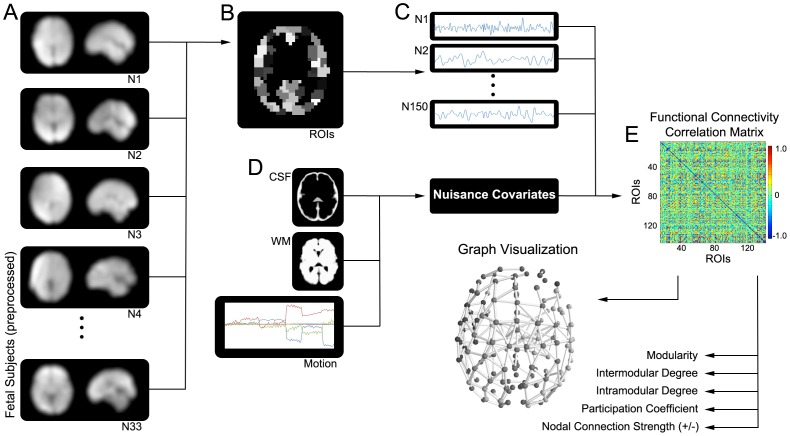
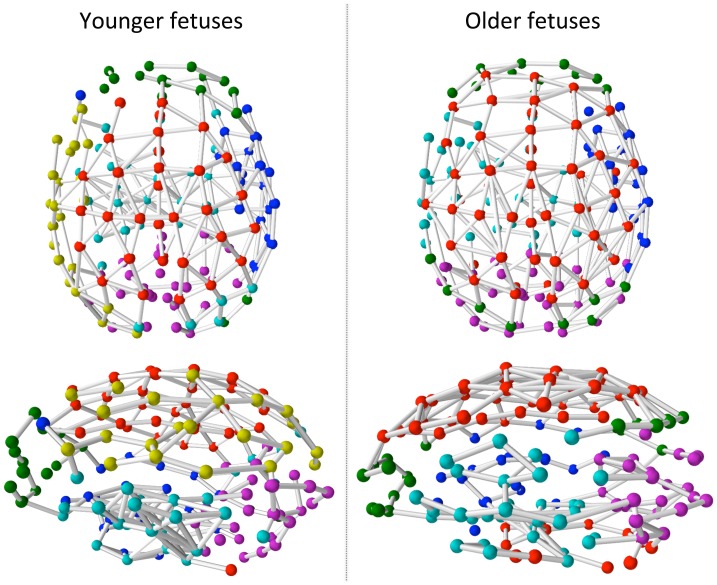
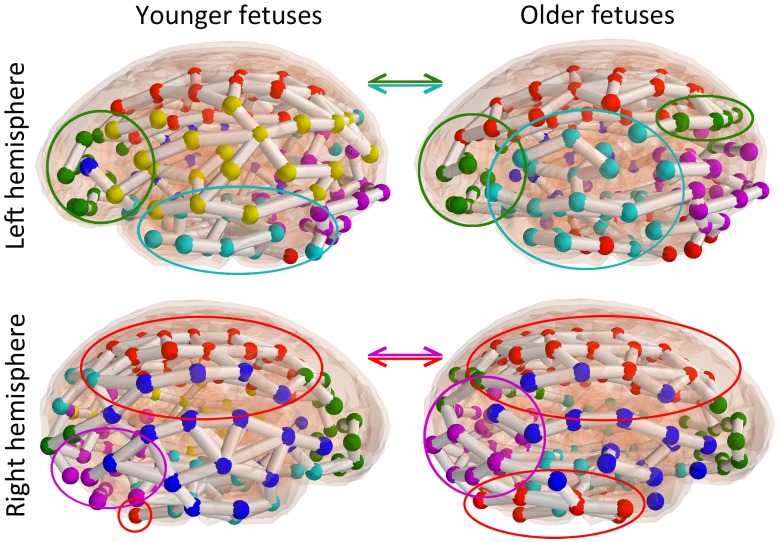
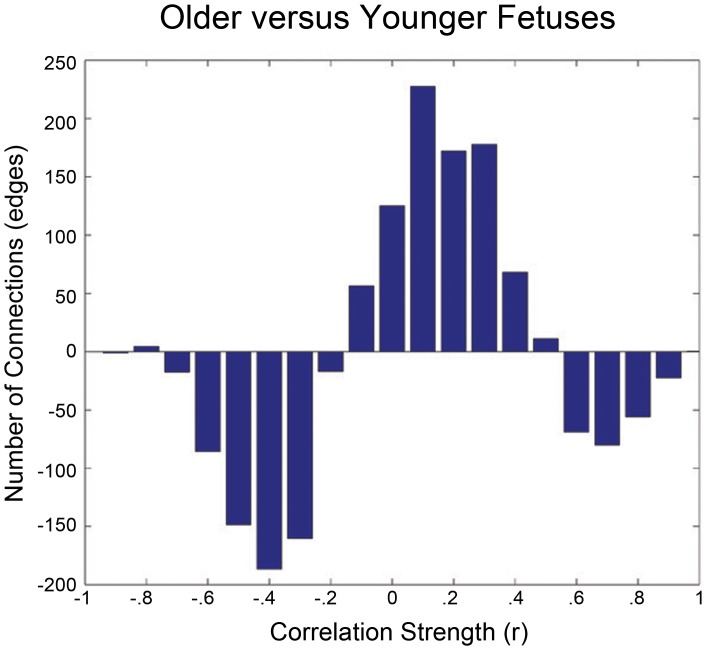
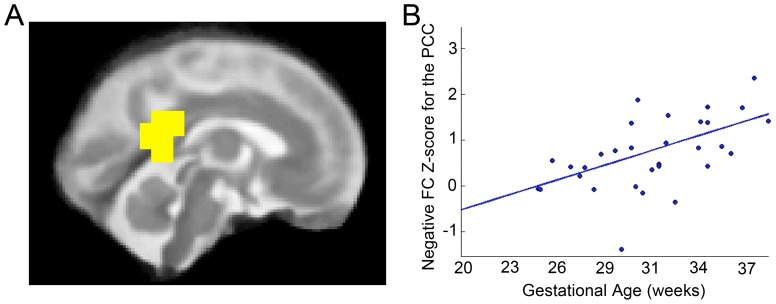
The human brain undergoes dramatic maturational changes during late stages of fetal and early postnatal life. The importance of this period to the establishment of healthy neural connectivity is apparent in the high incidence of neural injury in preterm infants, in whom untimely exposure to ex-uterine factors interrupts neural connectivity. Though the relevance of this period to human neuroscience is apparent, little is known about functional neural networks in human fetal life. Here, we apply graph theoretical analysis to examine human fetal brain connectivity. Utilizing resting state functional magnetic resonance imaging (fMRI) data from 33 healthy human fetuses, 19 to 39 weeks gestational age (GA), our analyses reveal that the human fetal brain has modular organization and modules overlap functional systems observed postnatally. Age-related differences between younger (GA <31 weeks) and older (GA≥31 weeks) fetuses demonstrate that brain modularity decreases, and connectivity of the posterior cingulate to other brain networks becomes more negative, with advancing GA. By mimicking functional principles observed postnatally, these results support early emerging capacity for information processing in the human fetal brain. Current technical limitations, as well as the potential for fetal fMRI to one day produce major discoveries about fetal origins or antecedents of neural injury or disease are discussed.
Overview
The claims and statistics of this paper haven’t been checked yet.
Run the check — free, no account needed. It reads the open-access text and checks the sources it cites.
Integrity signals
Registry
Cites
Statistics
Figures
Verification
Claims the paper makes
The claims and statistics of this paper haven’t been checked yet.
Run the check — free, no account needed. It reads the open-access text and checks the sources it cites.
Claims other papers make about this one
Each is checked against this paper’s own text: does it say what the citing paper says it does?
The source backs part of the claim, not all of it — or backs it for a different population, condition or comparison.
In the citing paper
“Posterior cingulate connectivity to the rest of the brain, for example, weakens with increasing gestational age [64].”
From Brain structural and functional outcomes in the offspring of women experiencing psychological distress during pregnancy (2024) · cites this paper as [64]
Experimental — accuracy not yet measured
Self-check
Percentages, sums and reported differences re-computed from the paper’s own numbers.
The self-check needs the paper’s full text.
Citations
Cites
Controlling the False Discovery Rate: A Practical and Powerful Approach to Multiple Testing
Benjamini, Y., & Hochberg, Y. (1995) · Journal of the Royal Statistical Society Series B: Statistical Methodology · doi:10.1111/j.2517-6161.1995.tb02031.x · Cited by 109,482
A default mode of brain function
Raichle, M. E., MacLeod, A. M., Snyder, A. Z., Powers, W. J., Gusnard, D. A., & Shulman, G. L. (2001) · Proceedings of the National Academy of Sciences · doi:10.1073/pnas.98.2.676 · Cited by 12,190
The organization of the human cerebral cortex estimated by intrinsic functional connectivity
Thomas Yeo, B. T., Krienen, F. M., Sepulcre, J., Sabuncu, M. R., Lashkari, D., Hollinshead, M., Roffman, J. L., Smoller, J. W., Zöllei, L., Polimeni, J. R., et al. (2011) · Journal of Neurophysiology · doi:10.1152/jn.00338.2011 · Cited by 9,182
The human brain is intrinsically organized into dynamic, anticorrelated functional networks
Fox, M. D., Snyder, A. Z., Vincent, J. L., Corbetta, M., Van Essen, D. C., & Raichle, M. E. (2005) · Proceedings of the National Academy of Sciences · doi:10.1073/pnas.0504136102 · Cited by 8,553
Power, J. D., Barnes, K. A., Snyder, A. Z., Schlaggar, B. L., & Petersen, S. E. (2012) · NeuroImage · doi:10.1016/j.neuroimage.2011.10.018 · Cited by 7,429
The organization of the human cerebellum estimated by intrinsic functional connectivity
Buckner, R. L., Krienen, F. M., Castellanos, A., Diaz, J. C., & Yeo, B. T. T. (2011) · Journal of Neurophysiology · doi:10.1152/jn.00339.2011 · Cited by 7,304
The relation of strength of stimulus to rapidity of habit formation
Yerkes, R. M., & Dodson, J. D. (1908) · Journal of Comparative Neurology and Psychology · doi:10.1002/cne.920180503 · Cited by 6,911
Conn : A Functional Connectivity Toolbox for Correlated and Anticorrelated Brain Networks
Whitfield-Gabrieli, S., & Nieto-Castanon, A. (2012) · Brain Connectivity · doi:10.1089/brain.2012.0073 · Cited by 4,885
A component based noise correction method (CompCor) for BOLD and perfusion based fMRI
Behzadi, Y., Restom, K., Liau, J., & Liu, T. T. (2007) · NeuroImage · doi:10.1016/j.neuroimage.2007.04.042 · Cited by 4,502
Mapping the structural core of human cerebral cortex
Hagmann, P., Cammoun, L., Gigandet, X., Meuli, R., Honey, C. J., Wedeen, V. J., & Sporns, O. (2008) · PLoS Biology · doi:10.1371/journal.pbio.0060159 · Cited by 4,173
Cited by
Sorted by citations
Environmental influences on the pace of brain development
Tooley, U. A., Bassett, D. S., & Mackey, A. P. (2021) · Nature reviews. Neuroscience · doi:10.1038/s41583-021-00457-5 · Cited by 488
Unraveling the Miswired Connectome: A Developmental Perspective
Martino, A. D., Fair, D. A., Kelly, C. A. M., Satterthwaite, T. D., Castellanos, F. X., Thomason, M. E., Craddock, R. C., Luna, B., LEVENTHAL, B. L., Zuo, X., et al. (2014) · Neuron · doi:10.1016/j.neuron.2014.08.050 · Cited by 357
Self-citationDevelopmental connectomics from infancy through early childhood
Cao, M., Huang, H., & He, Y. (2017) · Trends in Neurosciences · doi:10.1016/j.tins.2017.06.003 · Cited by 284
Delineation of early brain development from fetuses to infants with diffusion MRI and beyond
Ouyang, M., Dubois, J., Yu, Q., Mukherjee, P., & Huang, H. (2018) · NeuroImage · doi:10.1016/j.neuroimage.2018.04.017 · Cited by 257
Neural histology and neurogenesis of the human fetal and infant brain
Kostović, I., Sedmak, G., & Judáš, M. (2018) · NeuroImage · doi:10.1016/j.neuroimage.2018.12.043 · Cited by 272
Metadata
- Authors
- Thomason, M. E., Brown, J. A., Dassanayake, M. T., Shastri, R., Marusak, H. A., Hernandez-Andrade, E., Yeo, L., Mody, S., Berman, S., Hassan, S. S., & Romero, R.
- Affiliations
- United States Department of Health and Human Services (US)
- University of California, San Francisco (US)
- Wayne State University (US)
- Corresponding author
- Thomason, Moriah E.
- ORCID
- Venue
- PLoS ONE
- Publisher
- Public Library of Science (PLoS)
- Published
- 2014-05-01
- Volume
- 9
- Issue
- 5
- Pages
- e94423
- ISSN
- 1932-6203 (ISSN-L)
- PMC
- PMC4006774
- OpenAlex
- W2030993584
- Cited by
- 130
- References
- 61
- Citations by year
- 2026: 7 · 2025: 13 · 2024: 12 · 2023: 9 · 2022: 13 · 2021: 19 · 2020: 9 · 2019: 12 · 2018: 9 · 2017: 6 · 2016: 9 · 2015: 7 · 2014: 5
- FWCI
- 5.02
- Type
- journal article
- Language
- en
- Open access
- gold
- doi.org
- Locations
- PLoS ONE (publishedVersion, cc-by)
- Europe PMC (PubMed Central) (publishedVersion, cc-by)
- PubMed Central (publishedVersion, cc-by)
- PubMed (publishedVersion)
- DOAJ (DOAJ: Directory of Open Access Journals) (submittedVersion)
- Funders
- U.S. Department of Health and Human Services
- Wayne State University
- W.K. Kellogg Foundation (P3018205)
- National Institutes of Health (P3018205)
- National Institute of Mental Health (R01MH110793)
- National Institute of Environmental Health Sciences (R21ES026022)
- National Institute of Child Health and Human Development
- Eunice Kennedy Shriver National Institute of Child Health and Human Development (HD-2-3342, N01 HD23342, N01-HD-)
- Topics
- Life Sciences › Neuroscience › Cognitive Neuroscience › Functional Brain Connectivity Studies
- Health Sciences › Medicine › Radiology, Nuclear Medicine and Imaging › Advanced Neuroimaging Techniques and Applications
- Health Sciences › Medicine › Pediatrics, Perinatology and Child Health › Neonatal and fetal brain pathology
- Keywords
- fetal brain, functional brain networks, brain modularity, resting-state functional connectivity, posterior cingulate cortex, gestational age, brain maturation, preterm infants, nerve injury, graph theory
- MeSH terms
- Adolescent, Adult, Brain, Brain Mapping, Female, Fetus, Gestational Age, Gyrus Cinguli, Humans, Magnetic Resonance Imaging, Pregnancy, Young Adult, Connectome
About these checks
Registry, retraction, Cites and statistics results are computed, not judged, with one exception: a printed reference that no index lists is read once by a model before it counts as a citation error. Claims are extracted by a model and kept only when their quote appears verbatim in the text; each cited source is then checked, with a model’s help, for whether it says what the claim relies on. Those verdicts can be wrong — read the claim’s quote and the cited source before relying on one.
Statistics and arithmetic are recomputed, not judged.
Confidence bands are shown only for fields calibrated on our annotated test set. None is calibrated yet, so no band is shown.
What counts as a claim ›How we measure confidence ›How we check this ›
Are you an author, or do you see a problem with this page? Request a review
