

The DOI matches its Crossref record; 54 of the 54 references it cites were found in a registry or an index.
Evaluation of Finnish Diabetes Risk Score in Screening Undiagnosed Diabetes and Prediabetes among U.S. Adults by Gender and Race: NHANES 1999-2010
Open accessAbstract
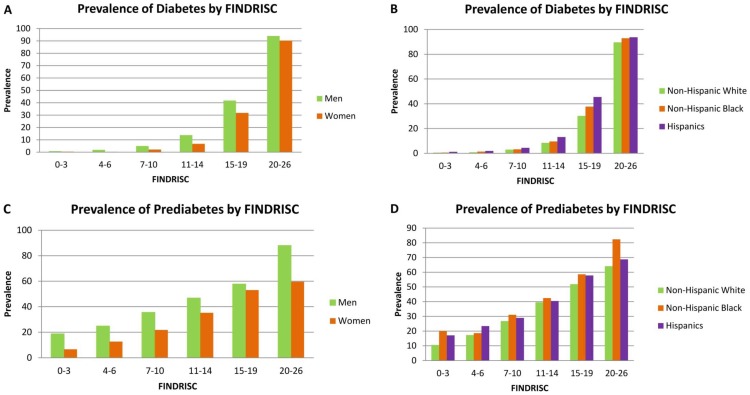
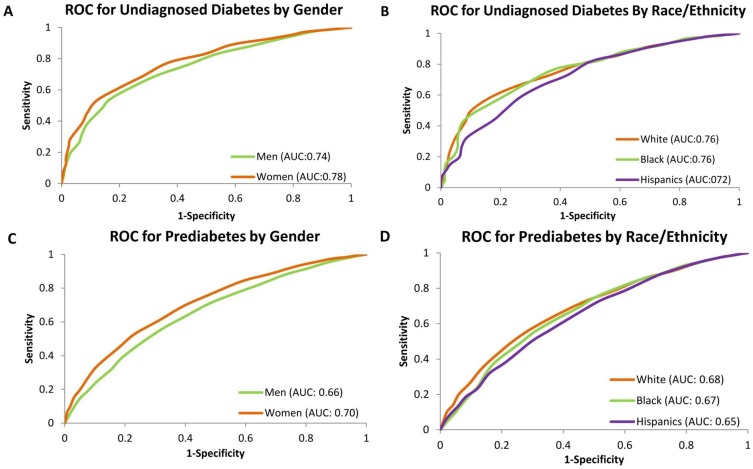
OBJECTIVE: To evaluate the performance of Finnish Diabetes Risk Score (FINDRISC) in detecting undiagnosed diabetes and prediabetes among U.S. adults by gender and race. METHODS: This cross-sectional analysis included participants (aged ≥20 years) from the National Health and Nutrition Examination Survey (NHANES) 1999-2010. Sensitivity, specificity, area under the receiver operating characteristic (ROC) curve and the optimal cutoff points for identifying undiagnosed diabetes and prediabetes were calculated for FINDRISC by gender and race/ethnicity. RESULTS: Among the 20,633 adults (≥20 years), 49.8% were women and 53.0% were non-Hispanic White. The prevalence of undiagnosed diabetes and prediabetes was 4.1% and 35.6%, respectively. FINDRISC was positively associated with the prevalence of diabetes (OR = 1.48 for 1 unit increase, p<0.001) and prediabetes (OR = 1.15 for 1 unit increase, p<0.001). The area under ROC for detecting undiagnosed diabetes was 0.75 for total population, 0.74 for men and 0.78 for women (p = 0.04); 0.76 for White, 0.76 for Black and 0.72 for Hispanics (p = 0.03 for White vs. Hispanics). The area under ROC for detecting prediabetes was 0.67 for total population, 0.66 for men and 0.70 for women (p<0.001); 0.68 for White, 0.67 for Black and 0.65 for Hispanics (p<0.001 for White vs. Hispanics). The optimal cutoff point was 10 (sensitivity = 0.75) for men and 12 (sensitivity = 0.72) for women for detecting undiagnosed diabetes; 9 (sensitivity = 0.61) for men and 10 (sensitivity = 0.69) for women for detecting prediabetes. CONCLUSIONS: FINDRISC is a simple and non-invasive screening tool to identify individuals at high risk for diabetes in the U.S. adults.
Overview
The claims and statistics of this paper haven’t been checked yet.
Run the check — free, no account needed. It reads the open-access text and checks the sources it cites.
Integrity signals
Registry
Cites
Statistics
Figures
Verification
Claims the paper makes
The claims and statistics of this paper haven’t been checked yet.
Run the check — free, no account needed. It reads the open-access text and checks the sources it cites.
Claims other papers make about this one
Each is checked against this paper’s own text: does it say what the citing paper says it does?
The cited source says what the claim attributes to it.
In the citing paper
“In addition, our previous study has indicated that FINDRISC score is a valid tool in detecting both undiagnosed diabetes and pre-diabetes in U.S. men and women with different race/ethnicities [26].”
From A Novel Testing Model for Opportunistic Screening of Pre-Diabetes and Diabetes among U.S. Adults (2015) · cites this paper as [26]
The cited source says what the claim attributes to it.
In the citing paper
“In addition, our group recently evaluated the validity of FINDRISC in the general U.S. population and found it is a valid and reliable tool to identify undiagnosed diabetes and pre-diabetes in both men and women with different races/ethnicities [26].”
From A Novel Testing Model for Opportunistic Screening of Pre-Diabetes and Diabetes among U.S. Adults (2015) · cites this paper as [26]
Self-check
Percentages, sums and reported differences re-computed from the paper’s own numbers.
The self-check needs the paper’s full text.
Citations
Cites
1 retracted
Barengo, N. C., Acosta, T., Arrieta, A., Ricaurte, C., Mayor, D., Tuomilehto, J. O., & the DEMOJUAN study group (2013) · Diabetes/Metabolism Research and Reviews · doi:10.1002/dmrr.2462 · Cited by 26
RetractedReduction in the incidence of type 2 diabetes with lifestyle intervention or metformin
(2002) · New England Journal of Medicine · doi:10.1056/nejmoa012512 · Cited by 19,011
Diagnosis and Classification of Diabetes Mellitus
American Diabetes Association (2010) · Diabetes Care · doi:10.2337/dc11-s062 · Cited by 14,094
Tuomilehto, J., Lindström, J., Eriksson, J. G., Valle, T. T., Hämäläinen, H., Ilanne-Parikka, P., Keinänen-Kiukaanniemi, S., Laakso, M., Louheranta, A., Rastas, M., et al. (2001) · New England Journal of Medicine · doi:10.1056/nejm200105033441801 · Cited by 10,873 · cited 1×
“Emerging evidence from both observational studies and randomized controlled trials (RCTs) has clearly shown that people with high risk for type 2 diabetes or people at prediabetes stage will be benefited by early identification followed by the intensive lifestyle intervention and pharmacological treatment [5–9].”
BackgroundStandards of Medical Care in Diabetes
Power, D. V. (2006) · Diabetes Care · doi:10.2337/diacare.29.02.06.dc05-1593 · Cited by 8,676
Standards of medical care in diabetes—2013
American Diabetes Association (2013) · Diabetes Care · doi:10.2337/dc13-s011 · Cited by 4,369
Economic Costs of Diabetes in the U.S. in 2002
American Diabetes Association (2003) · Diabetes Care · doi:10.2337/diacare.26.3.917 · Cited by 4,147
Basevi, V., Mario, S. D., Morciano, C., Nonino, F., & Magrini, N. (2011) · Diabetes Care · doi:10.2337/dc11-0174 · Cited by 3,058
Prediabetes: a high-risk state for diabetes development
Tabák, A. G., Herder, C., Rathmann, W., Brunner, E. J., & Kivimäki, M. (2012) · The Lancet · doi:10.1016/s0140-6736(12)60283-9 · Cited by 2,958
Diagnosis and classification of diabetes mellitus
American Diabetes Association (2013) · Diabetes Care · doi:10.2337/dc13-s067 · Cited by 2,245
Cited by
Sorted by citations
Bernabé‐Ortiz, A., Perel, P., Miranda, J. J., & Smeeth, L. L. (2018) · Primary care diabetes · doi:10.1016/j.pcd.2018.07.015 · Cited by 117
Pretorius, E., Bester, J., Vermeulen, N., Alummoottil, S., Soma, P., Buys, A. V., & Kell, D. B. (2015) · Cardiovascular Diabetology · doi:10.1186/s12933-015-0192-5 · Cited by 89
Comparison of screening scores for diabetes and prediabetes
Poltavskiy, E. A., Kim, D. J., & Bang, H. (2016) · Diabetes Research and Clinical Practice · doi:10.1016/j.diabres.2016.06.022 · Cited by 71
Salinero-Fort, M. Á., de Burgos‐Lunar, C., Lahoz, C., Mostaza, J. M., Abánades-Herranz, J. C., Cuesta, F. L., Cabo, E. E.-D., García-Iglesias, F., González-Alegre, T., Fernández-Puntero, B., et al. (2016) · PLoS ONE · doi:10.1371/journal.pone.0158489 · Cited by 65
Masconi, K. L., Matsha, T. E., Echouffo-Tcheugui, J. B., Erasmus, R. T., & Kengne, A. P. (2015) · The EPMA Journal · doi:10.1186/s13167-015-0028-0 · Cited by 57
Metadata
- Authors
- Zhang, L., Zhang, Z., Zhang, Y., Hu, G., & Chen, L.
- Affiliations
- Louisiana State University Health Sciences Center New Orleans (US)
- Michigan State University (US)
- First Affiliated Hospital of Xi'an Jiaotong University (CN)
- Pennington Biomedical Research Center (US)
- Clemson University (US)
- Corresponding author
- Chen, Liwei
- Venue
- PLoS ONE
- Publisher
- Public Library of Science (PLoS)
- Published
- 2014-05-22
- Volume
- 9
- Issue
- 5
- Pages
- e97865
- ISSN
- 1932-6203 (ISSN-L)
- PMC
- PMC4031122
- OpenAlex
- W1966075779
- Cited by
- 130
- References
- 54
- Citations by year
- 2026: 3 · 2025: 8 · 2024: 8 · 2023: 11 · 2022: 11 · 2021: 14 · 2020: 18 · 2019: 10 · 2018: 13 · 2017: 8 · 2016: 16 · 2015: 9 · 2014: 1
- FWCI
- 9.12
- Type
- journal article
- Language
- en
- Open access
- gold
- doi.org
- Locations
- PLoS ONE (publishedVersion, cc-by)
- Europe PMC (PubMed Central) (publishedVersion, cc-by)
- PubMed Central (publishedVersion, cc-by)
- PubMed (publishedVersion)
- RePEc: Research Papers in Economics (submittedVersion)
- DOAJ (DOAJ: Directory of Open Access Journals) (submittedVersion, cc-by-sa)
- eScholarship (California Digital Library) (submittedVersion)
- Funders
- Clemson University
- Louisiana State University
- Topics
- Health Sciences › Medicine › Endocrinology, Diabetes and Metabolism › Diabetes, Cardiovascular Risks, and Lipoproteins
- Health Sciences › Medicine › Public Health, Environmental and Occupational Health › Health Promotion and Cardiovascular Prevention
- Health Sciences › Medicine › Endocrinology, Diabetes and Metabolism › Diabetes Management and Research
- Keywords
- FINDRISC, undiagnosed diabetes, prediabetes, diabetes screening, risk prediction model, sex differences, racial and ethnic differences, sensitivity and specificity, cut-off values, NHANES, United States adults, Black and Hispanic populations, non-Hispanic whites, diabetes prevalence, diabetes risk stratification
- MeSH terms
- Adult, Cross-Sectional Studies, Diabetes Mellitus, Female, Humans, Male, Middle Aged, Nutrition Surveys, Prediabetic State, Risk Factors, Sex Factors, United States, Population Groups, Young Adult
About these checks
Registry, retraction, Cites and statistics results are computed, not judged, with one exception: a printed reference that no index lists is read once by a model before it counts as a citation error. Claims are extracted by a model and kept only when their quote appears verbatim in the text; each cited source is then checked, with a model’s help, for whether it says what the claim relies on. Those verdicts can be wrong — read the claim’s quote and the cited source before relying on one.
Statistics and arithmetic are recomputed, not judged.
Confidence bands are shown only for fields calibrated on our annotated test set. None is calibrated yet, so no band is shown.
What counts as a claim ›How we measure confidence ›How we check this ›
Are you an author, or do you see a problem with this page? Request a review
