

Internet-Delivered Psychological Treatments for Mood and Anxiety Disorders: A Systematic Review of Their Efficacy, Safety, and Cost-Effectiveness
Open accessThe DOI matches its Crossref record; 101 of the 101 references it cites were found in a registry or an index.
Abstract
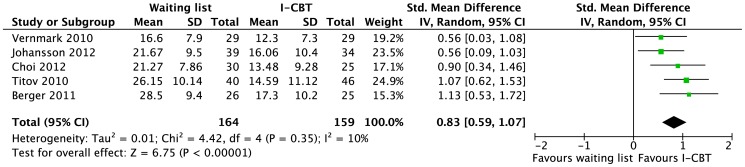
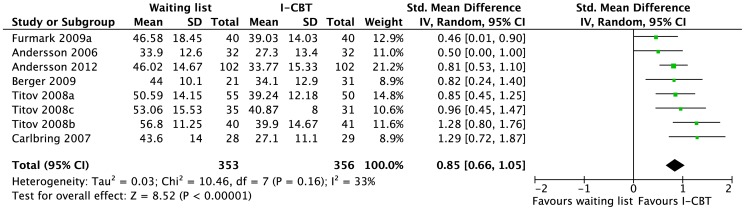
BACKGROUND: Greater access to evidence-based psychological treatments is needed. This review aimed to evaluate whether internet-delivered psychological treatments for mood and anxiety disorders are efficacious, noninferior to established treatments, safe, and cost-effective for children, adolescents and adults. METHODS: We searched the literature for studies published until March 2013. Randomized controlled trials (RCTs) were considered for the assessment of short-term efficacy and safety and were pooled in meta-analyses. Other designs were also considered for long-term effect and cost-effectiveness. Comparisons against established treatments were evaluated for noninferiority. Two reviewers independently assessed the relevant studies for risk of bias. The quality of the evidence was graded using an international grading system. RESULTS: A total of 52 relevant RCTs were identified whereof 12 were excluded due to high risk of bias. Five cost-effectiveness studies were identified and three were excluded due to high risk of bias. The included trials mainly evaluated internet-delivered cognitive behavioral therapy (I-CBT) against a waiting list in adult volunteers and 88% were conducted in Sweden or Australia. One trial involved children. For adults, the quality of evidence was graded as moderate for the short-term efficacy of I-CBT vs. waiting list for mild/moderate depression (d = 0.83; 95% CI 0.59, 1.07) and social phobia (d = 0.85; 95% CI 0.66, 1.05), and moderate for no efficacy of internet-delivered attention bias modification vs. sham treatment for social phobia (d = -0.04; 95% CI -0.24, 0.35). The quality of evidence was graded as low/very low for other disorders, interventions, children/adolescents, noninferiority, adverse events, and cost-effectiveness. CONCLUSIONS: I-CBT is a viable treatment option for adults with depression and some anxiety disorders who request this treatment modality. Important questions remain before broad implementation can be supported. Future research would benefit from prioritizing adapting treatments to children/adolescents and using noninferiority designs with established forms of treatment.
Overview
The claims and statistics of this paper haven’t been checked yet.
Free: it reads the open-access text and checks the first 5 claims that cite a source we can check. Create a free account to check every claim.
Integrity signals
Registry
Cites
Statistics
Figures

Verification
Claims the paper makes
The claims and statistics of this paper haven’t been checked yet.
Free: it reads the open-access text and checks the first 5 claims that cite a source we can check. Create a free account to check every claim.
Claims other papers make about this one
Each is checked against this paper’s own text: does it say what the citing paper says it does?
The source backs part of the claim, not all of it — or backs it for a different population, condition or comparison.
In the citing paper
“The efficacy of CBT-based internet interventions for treating depression in younger and middle-aged adults is well established (10) (11).”
From Harnessing Peer Support in an Online Intervention for Older Adults with Depression (2017) · cites this paper as [11]
Experimental — accuracy not yet measuredThe source backs part of the claim, not all of it — or backs it for a different population, condition or comparison.
In the citing paper
“Meta-analyses and reviews of computer-based psychological treatment for the treatment of MDD, whether delivered over the Internet or as a stand-alone program, confirm efficacy.[144][145][146][147][148][149][150]”
From Canadian Network for Mood and Anxiety Treatments (CANMAT) 2016 Clinical Guidelines for the Management of Adults with Major Depressive Disorder (2016) · cites this paper as [145]
Experimental — accuracy not yet measuredThe source backs part of the claim, not all of it — or backs it for a different population, condition or comparison.
In the citing paper
“The online intervention in both of them proved to be cost-effective regarding the compared treatment (treatment as usual and group CBT).”
From Using a transdiagnostic, psychodynamic online self-help intervention to maintain inpatient psychosomatic treatment effects: Study protocol of a feasibility study (2016) · cites this paper as Arnberg et al., 2014
Experimental — accuracy not yet measuredThe cited source says what the claim attributes to it.
In the citing paper
“However broad economic evaluations in this research context are still scarce.24”
In the citing paper
“provide remote access to effective treatments, for example computerised cognitive behavioural therapy for mental health and somatic problems. 10–14”
From Evaluating Digital Health Interventions (2016) · cites this paper as [10]
1 more claim about this paper
Create a free account to see every claim other papers make about this one.
Self-check
Percentages, sums and reported differences re-computed from the paper’s own numbers.
The self-check needs the paper’s full text.
Citations
Cites
Diagnostic and Statistical Manual of Mental Disorders
Williams, J. B. W., & First, M. (2013) · Encyclopedia of Social Work · doi:10.1093/acrefore/9780199975839.013.104 · Cited by 109,519
Statistical power analysis for the behavioral sciences
(1990) · Computers, Environment and Urban Systems · doi:10.1016/0198-9715(90)90050-4 · Cited by 65,269
Duval, S., & Tweedie, R. (2000) · Biometrics · doi:10.1111/j.0006-341x.2000.00455.x · Cited by 14,099 · cited 1×
“Potential publication bias was assessed for plausibly effective interventions by inspecting funnel plots and by a trim-and-fill procedure [37], which yields an estimate of the effect size after taking bias into account (analyses performed in Comprehensive Meta-Analysis v2, Biostat Inc.”
MethodKessler, R. C., Chiu, W. T., Demler, O., & Walters, E. E. (2005) · Archives of General Psychiatry · doi:10.1001/archpsyc.62.6.617 · Cited by 12,052
GRADE guidelines: 3. Rating the quality of evidence
Balshem, H., Helfand, M., Schünemann, H. J., Oxman, A. D., Kunz, R., Brozek, J., Vist, G. E., Falck-Ytter, Y., Meerpohl, J., & Norris, S. (2011) · Journal of Clinical Epidemiology · doi:10.1016/j.jclinepi.2010.07.015 · Cited by 8,285
Diagnostic and Statistical Manual of Mental Disorders, 5th Edition
(2013) · American Psychiatric Association Publishing eBooks · doi:10.1176/appi.books.9780890425596.893619 · Cited by 4,383
Trivedi, M. H., Rush, A. J., Wisniewski, S. R., Nierenberg, A. A., Warden, D., Ritz, L., Norquist, G., Howland, R. H., Lebowitz, B., McGrath, P. J., et al. (2006) · American Journal of Psychiatry · doi:10.1176/appi.ajp.163.1.28 · Cited by 3,879
(2008) · Cited by 3,790
The size and burden of mental disorders and other disorders of the brain in Europe 2010
Wittchen, H. U., Jacobi, F., Rehm, J., Gustavsson, A., Svensson, M., Jönsson, B., Olesen, J., Allgulander, C., Alonso, J., Faravelli, C., et al. (2011) · European Neuropsychopharmacology · doi:10.1016/j.euroneuro.2011.07.018 · Cited by 3,754 · cited 2×
“Nearly 40% of the population is estimated to be in need of treatment at some time during their life for anxiety or depression [1].”
BackgroundInternational Statistical Classification of Diseases and Related Health Problems
Eisfeld, J. (2014) · TSQ: Transgender Studies Quarterly · doi:10.1215/23289252-2399740 · Cited by 3,570
Research works printed but not linked: 3
- 25. Collaboration TC (2014) Cochrane editorial and publishing policy resource: Conflicts of interest and Cochrane Reviews. Oxford, UK: The Cochrane Collaboration.
- 87. Hedman E, Ljo ´tsson B, Lindefors N (2012) Cognitive behavior therapy via the Internet: a systematic review of applications, clinical efficacy and cost- effectiveness. Expert Rev Pharmacoecon Outcomes Res 12: 745-764. · DOI · Paper page
- 88. Chambless DL, Baker MJ, Baucom DH, Beutler LE, Calhoun KS, et al. (1998) Update on empirically validated therapies, II. Clinical Psychologist 51: 3-16.
Cited by
Items 301–331 of 331
Missing People in Spain: An App for Trauma Recovery – A Digital Health Intervention for Survivors
Escudero, C. (2020) · Advances in human services and public health (AHSPH) book series · doi:10.4018/978-1-7998-6705-0.ch005
Angststörungen in der Kindheit
In‐Albon, T., & Pfeiffer, S. (2020) · Springer eBooks · doi:10.1007/978-3-662-45995-9_33-1
Jones, S. H., Atanasova, D., Dodd, S. R., Flowers, S., Rosala-Harris, A., Robinson, H., Semino, E., & Lobban, F. A. (2021) · doi:10.2196/preprints.35837
Cardiovascular prevention and rehabilitation
Jennings, C. S., Berra, K. A., Hayman, L. L., Gibson, I., Jones, J. L., Atrey, A., Thompson, D. R., Ski, C. F., Kerins, M., Conboy, T., et al. (2021) · Oxford University Press eBooks · doi:10.1093/med/9780198849315.003.0011
van Dijke, A., Emmory-Lijde, G. R. M., & Deen, M. L. (2021) · doi:10.2196/preprints.34507
A Framework for Designing and Evaluating Internet Interventions to Improve Tinnitus Care
Beukes, E. W., Andersson, G., Manchaiah, V. K. C., Allen, P. M., & Baguley, D. (2021) · IGI Global eBooks · doi:10.4018/978-1-7998-8052-3.ch007
The Use of Mobile Phones for Frontline Health-Care Workers to Manage Depression
Musyimi, C. W., Lai, Y., Mutiso, V., & Ndetei, D. M. (2021) · Springer eBooks · doi:10.1007/978-3-030-57296-9_12 · Cited by 1
Bibliography: Psychotherapy: New Evidence and New Approaches
(2014) · FOCUS The Journal of Lifelong Learning in Psychiatry · doi:10.1176/appi.focus.12.3.317
Kosten-Effektivitäts- und Kosten-Nutzen-Analyse
Neumer, S., Jacobi, F., & Margraf, J. (2018) · Springer eBooks · doi:10.1007/978-3-662-54911-7_57
(2016) · Elsevier eBooks · doi:10.1016/b978-3-437-21833-0.16001-2
Alavi, N., & Omrani, M. (2018) · Springer eBooks · doi:10.1007/978-3-319-99151-1_1
Coulter, R. W. S., Sang, J. M., Louth-Marquez, W., Henderson, E. R., Espelage, D. L., Hunter, S. C., DeLucas, M., Abebe, K. Z., Miller, E. P., Morrill, B. A., et al. (2018) · doi:10.2196/preprints.12164
An Internet-delivered treatment for Flying Phobia using 360º images: a feasibility study
Mor, S. (2022) · Tesis Doctorals en Xarxa (Consorci de Serveis Universitaris de Catalunya) · doi:10.6035/14109.2022.366833
(2021) · Mardaga eBooks · doi:10.3917/mard.hanse.2021.01.0359
Entwicklung einer mHealth Anwendung zur psychosozialen Unterstützung von pflegenden Angehörigen
Freie Universität Berlin, G., Krassa, J., Fisahn, P. C., Koschnik, D., & Freie Universität Berlin, G. (2022) · doi:10.30844/akwi_2022_29
Weser, V. U., Opara, I., Budge, M., Duncan, L. R., Fernandes, C.-S. F., Hussett-Richardson, S., Sands, B. E., & Hieftje, K. D. (2022) · doi:10.2196/preprints.43666
Claro, H. G., Menezes, P. R., Fernandes, I. F. D. A. L., Seward, N., Miranda, J. J., Saidel, M. G. B., Baquete, A. G. D. L., Daley, K., Aschar, S. C. D. A. L., Cruz, D. V., et al. (2024) · Brazilian Journal of Psychiatry · doi:10.47626/1516-4446-2023-3172 · Cited by 1
Severo, M., Calvio, A., & Guillén, V. (2024) · Rivista di Psicologia Clinica · doi:10.3280/rpc2-2023oa15915 · Cited by 1
Implementing a mental health app library in primary care: A feasibility study
Lane, J., Manceau, L. M., de Chantal, P., Chagnon, A., Cardinal, M., Lauzier‐Jobin, F., & Lanoue, S. (2024) · Evaluation and Program Planning · doi:10.1016/j.evalprogplan.2024.102413 · Cited by 1
Ragan, K., Kelly, C., & Thwaites, R. (2024) · The Cognitive Behaviour Therapist · doi:10.1017/s1754470x24000345
Tifft, E. D. (2023) · Scholars Archive - University at Albany (University at Albany, State University of New York) · doi:10.54014/naqt-ghda · Cited by 2
Vicente-Escudero, J. L. (2025) · Current Psychology · doi:10.1007/s12144-025-08096-0 · Cited by 1
Meiksin, R., Meléndez‐Torres, G. J., Falconer, J., Witzel, T. C., Weatherburn, P., & Bonell, C. P. (2021) · Figshare · doi:10.6084/m9.figshare.13552003
Meiksin, R., Meléndez‐Torres, G. J., Falconer, J., Witzel, T. C., Weatherburn, P., & Bonell, C. P. (2021) · Figshare · doi:10.6084/m9.figshare.13552006
Emery, J. B., Matheson, L. N., Shaw, O., Mannan, N., Cota, M. R., Fu, A., Haight, T. J., & Brody, D. L. (2026) · medRxiv · doi:10.64898/2026.09.24.26363933
Hesslow, T., & Nilsson, M. (2015) · DiVA (Stockholm University)
Capello, F. (2015) · TELe-Health · doi:10.1007/978-3-319-16378-9_5
Metadata
- Authors
- Arnberg, F. K., Linton, S. J., Hultcrantz, M., Heintz, E., & Jonsson, U.
- Affiliations
- Uppsala University (SE)
- Örebro University (SE)
- SBU - Swedish Agency for Health Technology Assessment and Assessment of Social Services (SE)
- Linköping University (SE)
- Karolinska Institutet (SE)
- Corresponding author
- Arnberg, Filip K.
- Venue
- PLoS ONE
- Publisher
- Public Library of Science (PLoS)
- Published
- 2014-05-20
- Volume
- 9
- Issue
- 5
- Pages
- e98118
- ISSN
- 1932-6203 (ISSN-L)
- PMC
- PMC4028301
- OpenAlex
- W2113690422
- Semantic Scholar
- 4581e3daba74bcfa3954d2d6f9df0a958154e06d
- Cited by
- 330
- References
- 101
- Citations by year
- 2026: 3 · 2025: 6 · 2024: 12 · 2023: 11 · 2022: 29 · 2021: 41 · 2020: 39 · 2019: 28 · 2018: 43 · 2017: 51 · 2016: 42 · 2015: 21 · 2014: 4
- FWCI
- 4.76
- Type
- journal article
- Language
- en
- Open access
- gold
- doi.org
- Locations
- PLoS ONE (publishedVersion, cc-by)
- Europe PMC (PubMed Central) (publishedVersion, other-oa)
- PubMed Central (publishedVersion, cc-by)
- PubMed (publishedVersion)
- DiVA (Linkoping University) (submittedVersion, other-oa)
- Uppsala University Publications (Uppsala University) (submittedVersion, other-oa)
- RePEc: Research Papers in Economics (submittedVersion)
- DOAJ (DOAJ: Directory of Open Access Journals) (submittedVersion, cc-by-sa)
- Figshare (submittedVersion, cc-by)
- Topics
- Social Sciences › Psychology › Applied Psychology › Digital Mental Health Interventions
- Social Sciences › Psychology › Experimental and Cognitive Psychology › Anxiety, Depression, Psychometrics, Treatment, Cognitive Processes
- Health Sciences › Medicine › Public Health, Environmental and Occupational Health › Telemedicine and Telehealth Implementation
- Keywords
- mood disorders, anxiety disorders, internet-based cognitive behavioral therapy, depression, social anxiety disorder, attentional bias modification, treatment efficacy, treatment safety, cost-effectiveness, non-inferiority, children and adolescents, waiting list comparison
- MeSH terms
- Adolescent, Adult, Anxiety Disorders, Child, Child, Preschool, Cost-Benefit Analysis, Humans, Psychotherapy, Time Factors, Cognitive Behavioral Therapy, Randomized Controlled Trials as Topic, Treatment Outcome, Publication Bias, Mood Disorders, Internet
About these checks
Registry, retraction, Cites and statistics results are computed, not judged, with one exception: a printed reference that no index lists is read once by a model before it counts as a citation error. Claims are extracted by a model and kept only when their quote appears verbatim in the text; each cited source is then checked, with a model’s help, for whether it says what the claim relies on. Those verdicts can be wrong — read the claim’s quote and the cited source before relying on one.
Statistics and arithmetic are recomputed, not judged.
Confidence bands are shown only for fields calibrated on our annotated test set. None is calibrated yet, so no band is shown.
What counts as a claim ›How we measure confidence ›How we check this ›
Are you an author, or do you see a problem with this page? Request a review
Data sources
Bibliographic data: Semantic Scholar, OpenAlex, Crossref.
Contains information from the Semantic Scholar Academic Graph Datasets, made available under the ODC Attribution License (ODC-BY 1.0).
Semantic Scholar’s data is described in: Kinney, R., et al. (2023). The Semantic Scholar Open Data Platform. arXiv:2301.10140.
