

Internet-Delivered Psychological Treatments for Mood and Anxiety Disorders: A Systematic Review of Their Efficacy, Safety, and Cost-Effectiveness
Open accessThe DOI matches its Crossref record; 101 of the 101 references it cites were found in a registry or an index.
Abstract
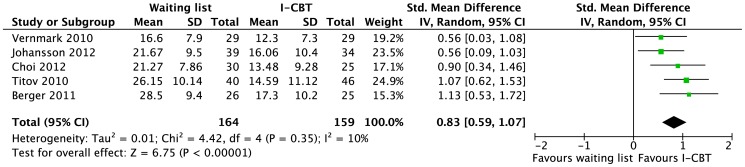
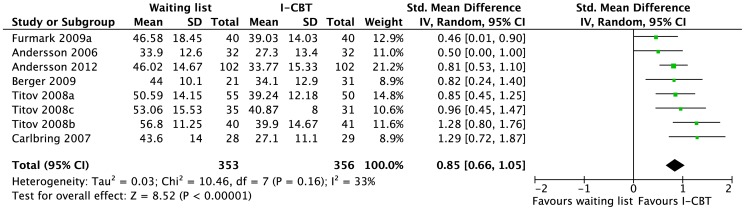
BACKGROUND: Greater access to evidence-based psychological treatments is needed. This review aimed to evaluate whether internet-delivered psychological treatments for mood and anxiety disorders are efficacious, noninferior to established treatments, safe, and cost-effective for children, adolescents and adults. METHODS: We searched the literature for studies published until March 2013. Randomized controlled trials (RCTs) were considered for the assessment of short-term efficacy and safety and were pooled in meta-analyses. Other designs were also considered for long-term effect and cost-effectiveness. Comparisons against established treatments were evaluated for noninferiority. Two reviewers independently assessed the relevant studies for risk of bias. The quality of the evidence was graded using an international grading system. RESULTS: A total of 52 relevant RCTs were identified whereof 12 were excluded due to high risk of bias. Five cost-effectiveness studies were identified and three were excluded due to high risk of bias. The included trials mainly evaluated internet-delivered cognitive behavioral therapy (I-CBT) against a waiting list in adult volunteers and 88% were conducted in Sweden or Australia. One trial involved children. For adults, the quality of evidence was graded as moderate for the short-term efficacy of I-CBT vs. waiting list for mild/moderate depression (d = 0.83; 95% CI 0.59, 1.07) and social phobia (d = 0.85; 95% CI 0.66, 1.05), and moderate for no efficacy of internet-delivered attention bias modification vs. sham treatment for social phobia (d = -0.04; 95% CI -0.24, 0.35). The quality of evidence was graded as low/very low for other disorders, interventions, children/adolescents, noninferiority, adverse events, and cost-effectiveness. CONCLUSIONS: I-CBT is a viable treatment option for adults with depression and some anxiety disorders who request this treatment modality. Important questions remain before broad implementation can be supported. Future research would benefit from prioritizing adapting treatments to children/adolescents and using noninferiority designs with established forms of treatment.
Overview
The claims and statistics of this paper haven’t been checked yet.
Free: it reads the open-access text and checks the first 5 claims that cite a source we can check. Create a free account to check every claim.
Integrity signals
Registry
Cites
Statistics
Figures

Verification
Claims the paper makes
The claims and statistics of this paper haven’t been checked yet.
Free: it reads the open-access text and checks the first 5 claims that cite a source we can check. Create a free account to check every claim.
Claims other papers make about this one
Each is checked against this paper’s own text: does it say what the citing paper says it does?
The source backs part of the claim, not all of it — or backs it for a different population, condition or comparison.
In the citing paper
“The efficacy of CBT-based internet interventions for treating depression in younger and middle-aged adults is well established (10) (11).”
From Harnessing Peer Support in an Online Intervention for Older Adults with Depression (2017) · cites this paper as [11]
Experimental — accuracy not yet measuredThe source backs part of the claim, not all of it — or backs it for a different population, condition or comparison.
In the citing paper
“Meta-analyses and reviews of computer-based psychological treatment for the treatment of MDD, whether delivered over the Internet or as a stand-alone program, confirm efficacy.[144][145][146][147][148][149][150]”
From Canadian Network for Mood and Anxiety Treatments (CANMAT) 2016 Clinical Guidelines for the Management of Adults with Major Depressive Disorder (2016) · cites this paper as [145]
Experimental — accuracy not yet measuredThe source backs part of the claim, not all of it — or backs it for a different population, condition or comparison.
In the citing paper
“The online intervention in both of them proved to be cost-effective regarding the compared treatment (treatment as usual and group CBT).”
From Using a transdiagnostic, psychodynamic online self-help intervention to maintain inpatient psychosomatic treatment effects: Study protocol of a feasibility study (2016) · cites this paper as Arnberg et al., 2014
Experimental — accuracy not yet measuredThe cited source says what the claim attributes to it.
In the citing paper
“However broad economic evaluations in this research context are still scarce.24”
In the citing paper
“provide remote access to effective treatments, for example computerised cognitive behavioural therapy for mental health and somatic problems. 10–14”
From Evaluating Digital Health Interventions (2016) · cites this paper as [10]
1 more claim about this paper
Create a free account to see every claim other papers make about this one.
Self-check
Percentages, sums and reported differences re-computed from the paper’s own numbers.
The self-check needs the paper’s full text.
Citations
Cites
Diagnostic and Statistical Manual of Mental Disorders
Williams, J. B. W., & First, M. (2013) · Encyclopedia of Social Work · doi:10.1093/acrefore/9780199975839.013.104 · Cited by 109,519
Statistical power analysis for the behavioral sciences
(1990) · Computers, Environment and Urban Systems · doi:10.1016/0198-9715(90)90050-4 · Cited by 65,269
Duval, S., & Tweedie, R. (2000) · Biometrics · doi:10.1111/j.0006-341x.2000.00455.x · Cited by 14,099 · cited 1×
“Potential publication bias was assessed for plausibly effective interventions by inspecting funnel plots and by a trim-and-fill procedure [37], which yields an estimate of the effect size after taking bias into account (analyses performed in Comprehensive Meta-Analysis v2, Biostat Inc.”
MethodKessler, R. C., Chiu, W. T., Demler, O., & Walters, E. E. (2005) · Archives of General Psychiatry · doi:10.1001/archpsyc.62.6.617 · Cited by 12,052
GRADE guidelines: 3. Rating the quality of evidence
Balshem, H., Helfand, M., Schünemann, H. J., Oxman, A. D., Kunz, R., Brozek, J., Vist, G. E., Falck-Ytter, Y., Meerpohl, J., & Norris, S. (2011) · Journal of Clinical Epidemiology · doi:10.1016/j.jclinepi.2010.07.015 · Cited by 8,285
Diagnostic and Statistical Manual of Mental Disorders, 5th Edition
(2013) · American Psychiatric Association Publishing eBooks · doi:10.1176/appi.books.9780890425596.893619 · Cited by 4,383
Trivedi, M. H., Rush, A. J., Wisniewski, S. R., Nierenberg, A. A., Warden, D., Ritz, L., Norquist, G., Howland, R. H., Lebowitz, B., McGrath, P. J., et al. (2006) · American Journal of Psychiatry · doi:10.1176/appi.ajp.163.1.28 · Cited by 3,879
(2008) · Cited by 3,790
The size and burden of mental disorders and other disorders of the brain in Europe 2010
Wittchen, H. U., Jacobi, F., Rehm, J., Gustavsson, A., Svensson, M., Jönsson, B., Olesen, J., Allgulander, C., Alonso, J., Faravelli, C., et al. (2011) · European Neuropsychopharmacology · doi:10.1016/j.euroneuro.2011.07.018 · Cited by 3,754 · cited 2×
“Nearly 40% of the population is estimated to be in need of treatment at some time during their life for anxiety or depression [1].”
BackgroundInternational Statistical Classification of Diseases and Related Health Problems
Eisfeld, J. (2014) · TSQ: Transgender Studies Quarterly · doi:10.1215/23289252-2399740 · Cited by 3,570
Research works printed but not linked: 3
- 25. Collaboration TC (2014) Cochrane editorial and publishing policy resource: Conflicts of interest and Cochrane Reviews. Oxford, UK: The Cochrane Collaboration.
- 87. Hedman E, Ljo ´tsson B, Lindefors N (2012) Cognitive behavior therapy via the Internet: a systematic review of applications, clinical efficacy and cost- effectiveness. Expert Rev Pharmacoecon Outcomes Res 12: 745-764. · DOI · Paper page
- 88. Chambless DL, Baker MJ, Baucom DH, Beutler LE, Calhoun KS, et al. (1998) Update on empirically validated therapies, II. Clinical Psychologist 51: 3-16.
Cited by
Items 101–200 of 331
Eriksson, M. C. M., Kivi, M., Hange, D., Petersson, E.-L., Ariai, N., Häggblad, P., Ågren, H., Spak, F., Lindblad, U., Johansson, B., et al. (2017) · Scandinavian Journal of Primary Health Care · doi:10.1080/02813432.2017.1333299 · Cited by 43
Schneider, L. H., Hadjistavropoulos, H. D., Dear, B. F., & Titov, N. (2020) · Internet Interventions · doi:10.1016/j.invent.2020.100324 · Cited by 43
Internet-Based Interventions for Women’s Sexual Dysfunction
van Lankveld, J. J. D. M. (2016) · Current Sexual Health Reports · doi:10.1007/s11930-016-0087-9 · Cited by 45
Blended CBT versus face-to-face CBT: a randomised non-inferiority trial
Mathiasen, K., Andersen, T. E., Riper, H., Kleiboer, A. A. M., & Roessler, K. K. (2016) · BMC Psychiatry · doi:10.1186/s12888-016-1140-y · Cited by 42
Chatterton, M. L., Rapee, R. M., Catchpool, M., Lyneham, H. J., Wuthrich, V., Hudson, J. L., Kangas, M., & Mihalopoulos, C. (2019) · Australian & New Zealand Journal of Psychiatry · doi:10.1177/0004867418823272 · Cited by 42
Mackie, C., Dunn, N., MacLean, S., Testa, V., Heisel, M., & Hatcher, S. (2017) · Evidence Based Mental Health · doi:10.1136/eb-2017-102764 · Cited by 41
Radomski, A. D., Wozney, L., McGrath, P., Huguet, A., Hartling, L., Dyson, M. P., Bennett, K., & Newton, A. S. (2019) · Journal of Medical Internet Research · doi:10.2196/11128 · Cited by 40
“Cognitive behavioral therapy (CBT) is recommended as a first-line treatment for children and adolescents with anxiety [1-4].”
BackgroundMaroti, D., Lumley, M. A., Schubiner, H., Lilliengren, P., Bileviciute-Ljungar, I., Ljótsson, B., & Johansson, R. (2022) · Journal of Psychosomatic Research · doi:10.1016/j.jpsychores.2022.111068 · Cited by 40
AL-Asadi, A. M., Klein, B., & Meyer, D. (2014) · Journal of Medical Internet Research · doi:10.2196/jmir.3513 · Cited by 40
Bellanti, D. M., Kelber, M. S., Workman, D. E., Beech, E. H., & Belsher, B. E. (2021) · Military Medicine · doi:10.1093/milmed/usab318 · Cited by 45
Rozental, A., Forsström, D., Tangen, J. A., & Carlbring, P. (2015) · Internet Interventions · doi:10.1016/j.invent.2015.05.001 · Cited by 39
Baumeister, H., Lin, J., & Ebert, D. D. (2017) · Bundesgesundheitsblatt - Gesundheitsforschung - Gesundheitsschutz · doi:10.1007/s00103-017-2518-9 · Cited by 44
Lenhard, F., Vigerland, S., Engberg, H., Hallberg, A., Thermaenius, H., & Serlachius, E. (2016) · PLOS ONE · doi:10.1371/journal.pone.0164311 · Cited by 37
“For example, a review of ICBT for mood and anxiety disorders that included all ages found 52 studies of which only four included children and adolescents [15].”
Are digital interventions effective in reducing suicidal ideation and self-harm? A systematic review
Stefanopoulou, E., Hogarth, H., Taylor, M., Russell-Haines, K., Lewis, D., & Larkin, J. (2020) · Journal of Mental Health · doi:10.1080/09638237.2020.1714009 · Cited by 37
Use of Computer and Mobile Technologies in the Treatment of Depression
Callan, J. A., Wright, J. H., Siegle, G. J., Howland, R. H., & Kepler, B. B. (2016) · Archives of Psychiatric Nursing · doi:10.1016/j.apnu.2016.10.002 · Cited by 44
Kwasny, M. J., Schueller, S. M., Lattie, E., Gray, E. L., & Mohr, D. C. (2019) · JMIR Mental Health · doi:10.2196/11572 · Cited by 37
Gili, M., Castro, A., García-Palacios, A., Garcia-Campayo, J., Mayoral-Cleries, F., Botella, C., Roca, M., Barceló-Soler, A., Hurtado, M. M., Navarro, M., et al. (2020) · Journal of Medical Internet Research · doi:10.2196/15845 · Cited by 37
Zhang, M., Fan, C. G., Ma, L., Wang, H., Zu, Z., Lin-xi, Y., Chen, F., Wei, W., & Li, X. (2024) · General Psychiatry · doi:10.1136/gpsych-2023-101355 · Cited by 49
Jankovic, D., Bojke, L., Marshall, D., Saramago Goncalves, P., Churchill, R., Melton, H., Brabyn, S., & Gega, L. (2021) · Applied Health Economics and Health Policy · doi:10.1007/s40258-020-00607-3 · Cited by 36
“internet-delivered CBT [28–31] or guided internet interventions [32]) and digital interventions for a specific condition (depression [28, 32, 33], anxiety disorders [34]), but this review identified additional factors specific to DMHIs that need to be taken into consideration, such as the role of interventions in the…”
BackgroundMathiasen, K., Andersen, T. E., Lichtenstein, M. B., Ehlers, L. H., Riper, H., Kleiboer, A., & Roessler, K. K. (2022) · Journal of Medical Internet Research · doi:10.2196/36577 · Cited by 34
Cunningham, C. E., Zipursky, R. B., Christensen, B. K., Bieling, P. J., Madsen, V., Rimas, H., Mielko, S., Wilson, F., Furimsky, I., Jeffs, L., et al. (2017) · Journal of American College Health · doi:10.1080/07448481.2017.1322090 · Cited by 35
Relative Cost Effectiveness of In‐Person and Internet Interventions for Relationship Distress
Salivar, E. G., Rothman, K., Roddy, M. K., & Doss, B. D. (2018) · Family Process · doi:10.1111/famp.12414 · Cited by 37
Wilson, F. A., Rampa, S., Trout, K. E., & Stimpson, J. P. (2017) · Psychiatric Services · doi:10.1176/appi.ps.201700017 · Cited by 35
Wozney, L., Olthuis, J., Lingley-Pottie, P., McGrath, P. J., Chaplin, W., Elgar, F., Cheney, B., Huguet, A., Turner, K., & Kennedy, J. (2017) · Archives of Women's Mental Health · doi:10.1007/s00737-017-0732-y · Cited by 33
“Telehealth delivery has been widely explored for other mental health problems and for parents specifically (e.g. Arnberg et al. 2014; Olthuis et al. 2015; McGrath et al. 2011; Corkum et al. 2016; Sourander et al. 2016) suggesting its potential to increase access to and uptake of services for women…”
BackgroundLobban, F., Dodd, A. L., Sawczuk, A. P., Asar, O., Dagnan, D., Diggle, P. J., Griffiths, M., Honary, M., Knowles, D., Long, R., et al. (2017) · Journal of Medical Internet Research · doi:10.2196/jmir.7008 · Cited by 34
Lundgren, J., Johansson, P., Jaarsma, T., Andersson, G., & Kärner Köhler, A. (2018) · Journal of Medical Internet Research · doi:10.2196/10302 · Cited by 33
Economic Evaluations of Digital Health Interventions for Children and Adolescents: Systematic Review
Stanic, T., Avşar, T. S., & Gomes, M. (2023) · Journal of Medical Internet Research · doi:10.2196/45958 · Cited by 41
Depression in the Primary Care Setting
Ellis, P., Kitay, B. M., & Schmidt, C. J. (2019) · New England Journal of Medicine · doi:10.1056/nejmc1903259 · Cited by 34
Lukka, L., & Palva, J. M. (2023) · JMIR Serious Games · doi:10.2196/42173 · Cited by 40
Duffy, D. J., Richards, D., Hisler, G. C., & Timulák, L. (2025) · Journal of Medical Internet Research · doi:10.2196/47927 · Cited by 43
Norman‐Nott, N., Hesam‐Shariati, N., Wewege, M. A., Rizzo, R. R. N., Cashin, A. G., Wilks, C. R., Quidé, Y., McAuley, J. H., & Gustin, S. M. (2024) · European Journal of Pain · doi:10.1002/ejp.2268 · Cited by 39
Abrahamsson, N., Ahlund, L., Ahrin, E., & Alfonsson, S. (2018) · Journal of Behavior Therapy and Experimental Psychiatry · doi:10.1016/j.jbtep.2018.06.010 · Cited by 30
Team-Based Telecare for Bipolar Disorder
Bauer, M. S., Krawczyk, L., Miller, C. J., Abel, E., Osser, D. N., Franz, A., Brandt, C., Rooney, M., Fleming, J., & Godleski, L. (2016) · Telemedicine and e-Health · doi:10.1089/tmj.2015.0255 · Cited by 29
Klein, N. S., Bockting, C. L., Wijnen, B., Kok, G. D., van Valen, E., Riper, H., Cuijpers, P., Dekker, J., van der Heiden, C., Burger, H., et al. (2018) · Journal of Medical Internet Research · doi:10.2196/10437 · Cited by 29
Coulter, R. W. S., Sang, J. M., Louth-Marquez, W., Henderson, E. R., Espelage, D. L., Hunter, S. C., DeLucas, M., Abebe, K. Z., Miller, E. P., Morrill, B. A., et al. (2019) · JMIR Research Protocols · doi:10.2196/12164 · Cited by 30
Mangolini, V. I., Andrade, L. H., Neto, F. L., & Wang, Y. (2019) · Clinics · doi:10.6061/clinics/2019/e1316 · Cited by 41
Digital Technology for Caregivers of People With Psychosis: Systematic Review
Onwumere, J., Amaral, F., & Valmaggia, L. (2018) · JMIR Mental Health · doi:10.2196/mental.9857 · Cited by 33
Digitally Delivered Psychological Interventions for Anxiety Disorders: a Comprehensive Review
Stefanopoulou, E., Lewis, D., Taylor, M., Broscombe, J., & Larkin, J. (2018) · Psychiatric Quarterly · doi:10.1007/s11126-018-9620-5 · Cited by 34
Jacob, G. A., Hauer, A., Köhne, S., Assmann, N., Schaich, A., Schweiger, U., & Faßbinder, E. (2018) · JMIR Mental Health · doi:10.2196/10983 · Cited by 34
Mason, M. J., Zaharakis, N. M., Moore, M. R., Brown, A., Garcia, C., Seibers, A., & Stephens, C. J. (2018) · Psychology of Addictive Behaviors · doi:10.1037/adb0000403 · Cited by 34
Han, A., & Kim, T. H. (2022) · Journal of Psychiatric Research · doi:10.1016/j.jpsychires.2022.05.031 · Cited by 26
A review of youth mental health promotion apps towards their fit with youth media preferences
Michel, T., Tachtler, F. M., Slovák, P., & Fitzpatrick, G. (2019) · EAI Endorsed Transactions on Pervasive Health and Technology · doi:10.4108/eai.13-7-2018.161419 · Cited by 31
Psychenet.de: development and process evaluation of an e-mental health portal
Dirmaier, J., Liebherz, S., Sänger, S., Härter, M. C., & Tlach, L. (2015) · Informatics for Health and Social Care · doi:10.3109/17538157.2015.1008486 · Cited by 28
Lehr, D., Heber, E., Sieland, B., Hillert, A., Funk, B., & Ebert, D. D. (2016) · Prävention und Gesundheitsförderung · doi:10.1007/s11553-016-0541-6 · Cited by 29
Piera-Jiménez, J., Etzelmueller, A., Kolovos, S., Folkvord, F., & Lupiáñez‐Villanueva, F. (2021) · Journal of Medical Internet Research · doi:10.2196/27410 · Cited by 30
Jonas, B., Leuschner, F., & Tossmann, P. (2016) · Anxiety Stress & Coping · doi:10.1080/10615806.2016.1233324 · Cited by 27
Acceptance of the German e-mental health portal www.psychenet.de: an online survey
Tlach, L., Thiel, J., Härter, M. C., Liebherz, S., & Dirmaier, J. (2016) · PeerJ · doi:10.7717/peerj.2093 · Cited by 27
Merza, D., Amani, B., Savoy, C. D., Babiy, Z., Bieling, P., Streiner, D. L., Ferro, M. A., & Lieshout, R. J. V. (2023) · Acta Psychiatrica Scandinavica · doi:10.1111/acps.13611 · Cited by 40
Klein, J. P., Gamon, C., Späth, C., Berger, T., Meyer, B., Hohagen, F., Hautzinger, M., Lutz, W., Vettorazzi, E., Moritz, S., et al. (2017) · BMJ Open · doi:10.1136/bmjopen-2016-015391 · Cited by 24
Lobban, F. A., Akers, N., Appelbe, D., Capuccinello, R. I., Chapman, L. J., Collinge, L., Dodd, S. R., Flowers, S., Hollingsworth, B. P., Honary, M., et al. (2020) · Health Technology Assessment · doi:10.3310/hta24320 · Cited by 31
Meiksin, R., Meléndez‐Torres, G. J., Falconer, J., Witzel, T. C., Weatherburn, P., & Bonell, C. P. (2021) · Systematic Reviews · doi:10.1186/s13643-020-01523-2 · Cited by 26
Rozental, A., Shafran, R., Wade, T. D., Kothari, R., Egan, S. J., Ekberg, L., Wiss, M., Carlbring, P., & Andersson, G. (2018) · Journal of Medical Internet Research · doi:10.2196/jmir.9823 · Cited by 30
Dodd, A. L., Mallinson, S., Griffiths, M., Morriss, R., Jones, S. H., & Lobban, F. (2017) · Evidence Based Mental Health · doi:10.1136/eb-2017-102754 · Cited by 21
Späth, C., Hapke, U., Maske, U., Schröder, J., Moritz, S., Berger, T., Meyer, B., Rose, M., Nolte, S., & Klein, J. P. (2017) · Internet Interventions · doi:10.1016/j.invent.2017.05.003 · Cited by 23
New Developments in Cognitive-Behavioral Therapy for Social Anxiety Disorder
Stangier, U. (2016) · Current Psychiatry Reports · doi:10.1007/s11920-016-0667-4 · Cited by 25
Apolinário-Hagen, J. (2019) · Psychiatry Investigation · doi:10.30773/pi.2018.06.26 · Cited by 20
Alavi, N., Stefanoff, M., Hirji, A., & Khalid‐Khan, S. (2018) · International Journal of Pediatrics · doi:10.1155/2018/1396216 · Cited by 25
Challenges and opportunities for e-mental health policy: an Estonian case study
Sogomonjan, M. (2020) · Contemporary Social Science · doi:10.1080/21582041.2020.1720795 · Cited by 19
Görges, F., Oehler, C., von Hirschhausen, E., Hegerl, U., & Rummel‐Kluge, C. (2018) · Internet Interventions · doi:10.1016/j.invent.2018.03.001 · Cited by 23
Friedl, N., Krieger, T., Chevreul, K., Hazo, J. B., Holtzmann, J., Hoogendoorn, M., Kleiboer, A., Mathiasen, K., Urech, A., Riper, H., et al. (2020) · Journal of Clinical Medicine · doi:10.3390/jcm9020490 · Cited by 19
Dominguez-Rodriguez, A., Martínez-Arriaga, R. J., Herdoiza-Arroyo, P. E., Bautista-Valerio, E., de la Rosa-Gómez, A., Castellanos Vargas, R. O., Lacomba-Trejo, L., Mateu-Mollá, J., Lupercio Ramírez, M. D. J., Figueroa González, J. A., et al. (2022) · International Journal of Environmental Research and Public Health · doi:10.3390/ijerph191912749 · Cited by 18
“[38] analyzed the cost-effectiveness of psychological online interventions, citing a study [39] which concluded that internet-delivered cognitive behavioral therapy had a cost per qualityadjusted life year of £20 000compared to treatment as usual.”
BackgroundDuffecy, J., Grekin, R., Long, J. D., Mills, J. A., & O'Hara, M. (2022) · Journal of Affective Disorders · doi:10.1016/j.jad.2022.05.123 · Cited by 19
Lobban, F., Robinson, H., Appelbe, D., Barraclough, J., Bedson, E., Collinge, L., Dodd, S., Flowers, S., Honary, M., Johnson, S., et al. (2017) · BMJ Open · doi:10.1136/bmjopen-2017-016965 · Cited by 18
Clough, B. A., Rowland, D. P., & Casey, L. M. (2019) · Internet Interventions · doi:10.1016/j.invent.2019.100288 · Cited by 21
O’Kearney, R., Kim, S., Dawson, R. L., & Calear, A. L. (2019) · Australian & New Zealand Journal of Psychiatry · doi:10.1177/0004867419864433 · Cited by 23
Attridge, M. D. (2020) · SAGE Open · doi:10.1177/2158244020914398 · Cited by 22
Oddo, L. E., Garner, A. M., Novick, D. R., Meinzer, M. C., & Chronis-Tuscano, A. M. (2020) · Evidence-Based Practice in Child and Adolescent Mental Health · doi:10.1080/23794925.2020.1855614 · Cited by 21
Goodwin, G. M., Holmes, E. A., Andersson, E., Browning, M. D., Jones, A., Lass‐Hennemann, J., Månsson, K. N. T., Moessnang, C., Salemink, E., Sánchez-López, Á., et al. (2018) · European Neuropsychopharmacology · doi:10.1016/j.euroneuro.2017.10.036 · Cited by 22
Economic Evaluation of Cognitive Behavioral Therapy for Depression: A Systematic Review
Li, M., Bai, F., Yao, L., Yu, Q., Chen, K., Xin, T., Ma, X., Ma, Y., Zhou, Y., Dai, H., et al. (2022) · Value in Health · doi:10.1016/j.jval.2021.11.1379 · Cited by 21
Meléndez‐Torres, G. J., Meiksin, R., Witzel, T. C., Weatherburn, P., Falconer, J., & Bonell, C. P. (2022) · JMIR Public Health and Surveillance · doi:10.2196/27061 · Cited by 20
Jonsson, U., Linton, S. J., Ybrandt, H., Ringborg, A., Leander, L., Moberg, K., Hultcrantz, M., & Arnberg, F. K. (2022) · Journal of Affective Disorders · doi:10.1016/j.jad.2022.11.036 · Cited by 20
Self-citationRozental, A., Forsell, E., Svensson, A., Andersson, G., & Carlbring, P. (2016) · Cognitive Behaviour Therapy · doi:10.1080/16506073.2016.1236287 · Cited by 16
Woodford, J., Wikman, A., Einhorn, K., Cernvall, M., Grönqvist, H., Romppala, A., & von Essén, L. (2018) · JMIR Mental Health · doi:10.2196/10085 · Cited by 17
WeChat-based mHealth intention and preferences among people living with schizophrenia
Xiao, S., Li, T., Zhou, W., Shen, M., & Yu, Y. (2020) · PeerJ · doi:10.7717/peerj.10550 · Cited by 15
Internet- und mobilebasierte Intervention bei psychischen Störungen
Paganini, S., Lin, J., Ebert, D. D., & Baumeister, H. (2016) · NeuroTransmitter · doi:10.1007/s15016-016-5393-y · Cited by 16
Beading Native Twitter: Indigenous arts-based approaches to healing and resurgence
Ansloos, J. P., Morford, A. C., Dunn, N. S., DuPré, L., & Kucheran, R. (2022) · The Arts in Psychotherapy · doi:10.1016/j.aip.2022.101914 · Cited by 16
Moriuchi, E., Berbary, C. M., & Easton, C. J. (2023) · Journal of Technology in Behavioral Science · doi:10.1007/s41347-022-00298-8 · Cited by 16
Andersson, G., Wagner, B., & Cuijpers, P. J. (2016) · Springer eBooks · doi:10.1007/978-3-319-06083-5_2 · Cited by 18
Internetbasierte Gesundheitsinterventionen
Gieselmann, A., Böckermann, M., & Pietrowsky, R. (2015) · Psychotherapeut · doi:10.1007/s00278-015-0038-3 · Cited by 15
Young, C., Mohebbi, M., Staudacher, H. M., KAY‐LAMBKIN, F. J., Berk, M., Jacka, F. N., & O'Neil, A. E. (2021) · JMIR Mental Health · doi:10.2196/24871 · Cited by 17
Lessons Learned: Providing Supportive Accountability in an Online Anxiety Intervention
Werntz, A. J., Silverman, A. L., Behan, H. C., Patel, S. K., Beltzer, M., Boukhechba, M., Barnes, L. E., & Teachman, B. A. (2021) · Behavior Therapy · doi:10.1016/j.beth.2021.12.002 · Cited by 15
Digital Interventions for PTSD Symptoms in the General Population: a Review
Stefanopoulou, E., Lewis, D., Mughal, A., & Larkin, J. (2020) · Psychiatric Quarterly · doi:10.1007/s11126-020-09745-2 · Cited by 17
Craemer, K. A., Garland, C. E., Sayah, L., Duffecy, J. L., GELLER, S. E., & Maki, P. M. (2023) · General Hospital Psychiatry · doi:10.1016/j.genhosppsych.2023.05.007 · Cited by 15
Mor, S., Grimaldos, J., Tur, C., Miguel, C., Cuijpers, P. J., Botella, C., & Quero, S. (2021) · Internet Interventions · doi:10.1016/j.invent.2021.100462 · Cited by 19
Rabasco, A., McKay, D., Smits, J. A., Powers, M. B., Meuret, A. E., & McGrath, P. B. (2022) · Journal of Anxiety Disorders · doi:10.1016/j.janxdis.2022.102528 · Cited by 14
Zill, J. M., Meyer, B., Topp, J., Daubmann, A., Härter, M. C., & Dirmaier, J. (2016) · BMC Psychiatry · doi:10.1186/s12888-016-0725-9 · Cited by 17
Lambert, S., Grover, S. A., Laizner, A. M., McCusker, J., Belzile, É., Moodie, E. E. M., Kayser, J. W., Lowensteyn, I., Vallis, M., Walker, M., et al. (2021) · Patient Education and Counseling · doi:10.1016/j.pec.2021.10.020 · Cited by 16
Behavioral Intervention Technologies and Psychotherapy with Youth: A Review of the Literature
Bunge, E. L., Dickter, B., Jones, M. K., Alie, G., Spear, A., & Perales, R. (2015) · Current Psychiatry Reviews · doi:10.2174/1573400511666150930232254 · Cited by 17
Assessing the costs and cost-effectiveness of ICare internet-based interventions (protocol)
Beecham, J., Bonin, E.-M., Görlich, D., Baños, R., Beintner, I., Buntrock, C., Bolinski, F., Botella, C., Ebert, D. D., Herrero, R., et al. (2019) · Internet Interventions · doi:10.1016/j.invent.2018.02.009 · Cited by 13
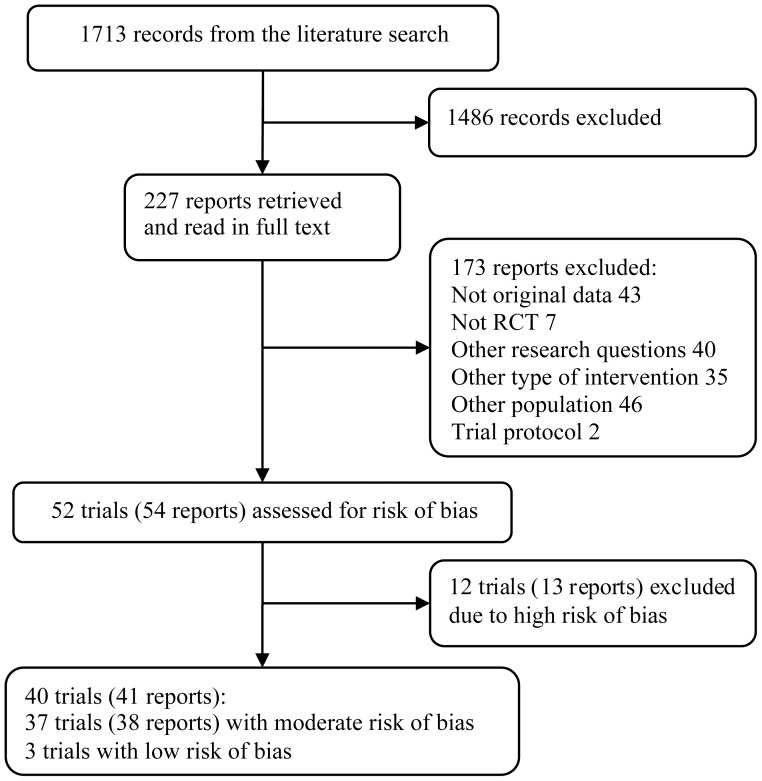
“Literature searches up to March 2013 revealed five cost-effectiveness studies of internet-based interventions for mood and anxiety disorders (139 papers screened), of which three were excluded due to a high risk of bias (Arnberg et al., 2014).”
BackgroundAlmeida, A. M. P., Almeida, H., & Figueiredo‐Braga, M. (2018) · Procedia Computer Science · doi:10.1016/j.procs.2018.10.013 · Cited by 16
Löbner, M., Stein, J., Luppa, M., Bleckwenn, M., Mehnert-Theuerkauf, A., & Riedel-Heller, S. G. (2022) · International Journal of Environmental Research and Public Health · doi:10.3390/ijerph19106203 · Cited by 15
Moshe, I., Terhorst, Y., Cuijpers, P. J., Cristea, I. A., Pulkki-Råbäck, L., & Sander, L. (2020) · JMIR Research Protocols · doi:10.2196/14860 · Cited by 15
Meyer, B., Weiss, M., Holtkamp, M., Arnold, S., Brückner, K., Schröder, J., Scheibe, F., & Nestoriuc, Y. (2017) · BMC Psychiatry · doi:10.1186/s12888-017-1229-y · Cited by 12
Internetbasierte Therapie in der Versorgung von Patienten mit depressiven Störungen: Ein Überblick
Backenstraß, M., & Wolf, M. (2017) · Zeitschrift für Psychiatrie Psychologie und Psychotherapie · doi:10.1024/1661-4747/a000339 · Cited by 12
Prevention of Adolescent Depression in Primary Care: Barriers and Relational Work Solutions
Mahoney, N., Gladstone, T. R. G., DeFrino, D. T., Stinson, A., Nidetz, J., Canel, J., Ching, E., Berry, A. D., Cantorna, J., Fogel, J., et al. (2017) · Californian Journal of Health Promotion · doi:10.32398/cjhp.v15i2.1895 · Cited by 13
Radomski, A. D., Wozney, L., McGrath, P. J., Huguet, A., Hartling, L., Dyson, M. P., BENNETT, K. J., & Newton, A. S. (2019) · JMIR Mental Health · doi:10.2196/13807 · Cited by 13
Maximizing the impact of E-Therapy and Serious Gaming: Time for a paradigm shift
Fleming, T. M., Beurs, D. P. D., Khazaal, Y., Gaggioli, A., Riva, G., Botella, C., Baños, R., Aschieri, F., Bavin, L. M., Kleiboer, A. M., et al. (2020) · Open Access Victoria University of Wellington | Te Herenga Waka (Figshare) · doi:10.26686/wgtn.12331280 · Cited by 14
Becker, J., Zwerenz, R., Johansson, R., Frederick, R. J., Andersson, G., & Beutel, M. E. (2016) · Internet Interventions · doi:10.1016/j.invent.2016.07.003 · Cited by 11
“Arnberg et al. (2014) identified two eligible studies in their meta-analysis with statements on costeffectiveness.”
BackgroundPerinatal anxiety disorders screening study: a study protocol
Fairbrother, N., Stagg, B., Scoten, O. C., Keeney, C., & Cargnelli, C. (2024) · BMC Psychiatry · doi:10.1186/s12888-024-05575-9 · Cited by 16
Kaiser, T., Boschloo, L., Berger, T., Meyer, B., Späth, C., Schröder, J., Hohagen, F., Moritz, S., & Klein, J. P. (2021) · Frontiers in Psychiatry · doi:10.3389/fpsyt.2021.598317 · Cited by 12
Metadata
- Authors
- Arnberg, F. K., Linton, S. J., Hultcrantz, M., Heintz, E., & Jonsson, U.
- Affiliations
- Uppsala University (SE)
- Örebro University (SE)
- SBU - Swedish Agency for Health Technology Assessment and Assessment of Social Services (SE)
- Linköping University (SE)
- Karolinska Institutet (SE)
- Corresponding author
- Arnberg, Filip K.
- Venue
- PLoS ONE
- Publisher
- Public Library of Science (PLoS)
- Published
- 2014-05-20
- Volume
- 9
- Issue
- 5
- Pages
- e98118
- ISSN
- 1932-6203 (ISSN-L)
- PMC
- PMC4028301
- OpenAlex
- W2113690422
- Semantic Scholar
- 4581e3daba74bcfa3954d2d6f9df0a958154e06d
- Cited by
- 330
- References
- 101
- Citations by year
- 2026: 3 · 2025: 6 · 2024: 12 · 2023: 11 · 2022: 29 · 2021: 41 · 2020: 39 · 2019: 28 · 2018: 43 · 2017: 51 · 2016: 42 · 2015: 21 · 2014: 4
- FWCI
- 4.76
- Type
- journal article
- Language
- en
- Open access
- gold
- doi.org
- Locations
- PLoS ONE (publishedVersion, cc-by)
- Europe PMC (PubMed Central) (publishedVersion, other-oa)
- PubMed Central (publishedVersion, cc-by)
- PubMed (publishedVersion)
- DiVA (Linkoping University) (submittedVersion, other-oa)
- Uppsala University Publications (Uppsala University) (submittedVersion, other-oa)
- RePEc: Research Papers in Economics (submittedVersion)
- DOAJ (DOAJ: Directory of Open Access Journals) (submittedVersion, cc-by-sa)
- Figshare (submittedVersion, cc-by)
- Topics
- Social Sciences › Psychology › Applied Psychology › Digital Mental Health Interventions
- Social Sciences › Psychology › Experimental and Cognitive Psychology › Anxiety, Depression, Psychometrics, Treatment, Cognitive Processes
- Health Sciences › Medicine › Public Health, Environmental and Occupational Health › Telemedicine and Telehealth Implementation
- Keywords
- mood disorders, anxiety disorders, internet-based cognitive behavioral therapy, depression, social anxiety disorder, attentional bias modification, treatment efficacy, treatment safety, cost-effectiveness, non-inferiority, children and adolescents, waiting list comparison
- MeSH terms
- Adolescent, Adult, Anxiety Disorders, Child, Child, Preschool, Cost-Benefit Analysis, Humans, Psychotherapy, Time Factors, Cognitive Behavioral Therapy, Randomized Controlled Trials as Topic, Treatment Outcome, Publication Bias, Mood Disorders, Internet
About these checks
Registry, retraction, Cites and statistics results are computed, not judged, with one exception: a printed reference that no index lists is read once by a model before it counts as a citation error. Claims are extracted by a model and kept only when their quote appears verbatim in the text; each cited source is then checked, with a model’s help, for whether it says what the claim relies on. Those verdicts can be wrong — read the claim’s quote and the cited source before relying on one.
Statistics and arithmetic are recomputed, not judged.
Confidence bands are shown only for fields calibrated on our annotated test set. None is calibrated yet, so no band is shown.
What counts as a claim ›How we measure confidence ›How we check this ›
Are you an author, or do you see a problem with this page? Request a review
Data sources
Bibliographic data: Semantic Scholar, OpenAlex, Crossref.
Contains information from the Semantic Scholar Academic Graph Datasets, made available under the ODC Attribution License (ODC-BY 1.0).
Semantic Scholar’s data is described in: Kinney, R., et al. (2023). The Semantic Scholar Open Data Platform. arXiv:2301.10140.
