

The DOI matches its Crossref record; 85 of the 85 references it cites were found in a registry or an index; none of the 61 sources its claims cite is checked for support yet.
Effectiveness of Guided and Unguided Low-Intensity Internet Interventions for Adult Alcohol Misuse: A Meta-Analysis
Open accessAbstract
BACKGROUND: Alcohol misuse ranks within the top ten health conditions with the highest global burden of disease. Low-intensity, Internet interventions for curbing adult alcohol misuse have been shown effective. Few meta-analyses have been carried out, however, and they have involved small numbers of studies, lacked indicators of drinking within low risk guidelines, and examined the effectiveness of unguided self-help only. We therefore conducted a more thorough meta-analysis that included both guided and unguided interventions. METHODS: Systematic literature searches were performed up to September 2013. Primary outcome was the mean level of alcohol consumption and drinking within low risk guidelines for alcohol consumption at post-treatment. FINDINGS: We selected 16 randomised controlled trials (with 23 comparisons and 5,612 participants) for inclusion. Results, showed a small but significant overall effect size in favour of Internet interventions (g = 0.20, 95% CI: 0.13-0.27, p<.001). Participants in Internet interventions drunk on average 22 grams of ethanol less than controls and were significantly more likely to be adhering to low-risk drinking guidelines at post-treatment (RD 0.13, 95% CI: 0.09-0.17, p<.001). Subgroup analyses revealed no significant differences in potential moderators for the outcome of alcohol consumption, although there was a near-significant difference between comparisons with waitlist control and those with assessment-only or alcohol information control conditions (p = .056). CONCLUSIONS: Internet interventions are effective in reducing adult alcohol consumption and inducing alcohol users to adhere to guidelines for low-risk drinking. This effect is small but from a public health point of view this may warrant large scale implementation at low cost of Internet interventions for adult alcohol misuse. Moderator analyses with sufficient power are, however, needed in order to assess the robustness of these overall results and to assess whether these interventions may impact on subgroups with different levels of success.
Overview
AI snapshot
Written from the paper’s full text.
TL;DR
This meta-analysis of 16 RCTs (23 comparisons, 5,612 participants) found that low-intensity Internet interventions for adult alcohol misuse produced a small but significant reduction in alcohol consumption versus controls (g = 0.20) and increased adherence to low-risk drinking guidelines. Effects were not significant at 6–12 month follow-up for the unguided interventions with available follow-up data.
Key findings
- Overall post-treatment effect favoured Internet interventions: g = 0.20 (95% CI: 0.13–0.27, p < .001; NNT = 8.93). Intervention participants drank on average 22 grams of ethanol less per week than controls (n = 14; 95% CI: 0.87–3.46, p = .001).
- Intervention participants were significantly more likely to be drinking within low-risk guidelines at post-treatment: RD = 0.13 (95% CI: 0.09–0.17, p < .001; n = 6).
- Subgroup analyses found no significant moderators for alcohol consumption. Control type was near-significant (p = .056): waitlist g = 0.48, alcohol brochure g = 0.20, assessment-only g = 0.15. Guided (g = 0.23) versus unguided (g = 0.20) did not differ significantly.
- At 6–12 month follow-up, no significant difference remained for six unguided interventions (8 comparisons): g = 0.06 (95% CI: −0.14–0.25, p = .567). Publication bias was indicated: trim-and-fill reduced g from 0.20 to 0.14 (95% CI: 0.06–0.22; 8 trimmed studies), and Egger’s test was significant (p = .028).
Methods
- Systematic literature searches up to September 2013 in MEDLINE, PsycINFO, Science Citation Index Expanded, Social Sciences Citation Index, Arts and Humanities Citation Index, CINAHL, PUBMED, and EMBASE. Included RCTs comparing web-based low-intensity self-help interventions (guided or unguided) with assessment-only, waitlist, or alcohol information brochure controls; adults aged 18+ exceeding low-risk drinking guidelines; primary outcome was mean alcohol consumption and drinking within low-risk guidelines at post-treatment.
- Included 16 RCTs with 23 comparisons and 5,612 participants (3,268 experimental, 2,344 control). Random-effects meta-analysis calculated Hedges’s g; heterogeneity assessed with I²; subgroup and meta-regression analyses examined moderators; publication bias assessed with funnel plots, Egger’s test, and Duval and Tweedie trim-and-fill; risk of bias assessed with Cochrane criteria.
Limitations
- Stated by the paper: the number of studies in subgroup analyses was low, limiting statistical power; some included studies had substantial dropout rates above 30%; control group drinking assessment may have motivated controls to reduce consumption, possibly underestimating intervention effects; negative side-effects could not be evaluated because studies lacked reports on them.
- Evident from the text: publication bias was detected, with trim-and-fill reducing the pooled effect size; follow-up effects were non-significant for unguided interventions; only 5 guided comparisons were available, limiting conclusions about guided versus unguided interventions.
Model-written summary. Check it against the paper before relying on it.
Integrity signals
Registry
Cites
Statistics
Figures
Verification
Claims the paper makes
37 Not checked yet · 31 Own result · 16 Own method · 5 Own interpretation · 2 No basis given
A result the paper reports from its own data — it cites no other source for it, so there is none to check. The quote shows it is in the paper.
In the paper
“There was evidence of publication bias in terms of Duval and Tweedie’s trim-and-fill method.”
§ Effectiveness of Guided and Unguided Low-Intensity Internet Interventions for Adult Alcohol Misuse: A Meta-Analysis > Results > Publication Bias
plainn = 8- Asserted: passes — The authors put it forward as true.
- Checkable: passes — It can be checked against evidence.
- Load-bearing: unclear — It is unclear whether the paper’s conclusions depend on it.
- Based: passes — The paper gives a reason why it holds.
A result the paper reports from its own data — it cites no other source for it, so there is none to check. The quote shows it is in the paper.
In the paper
“Egger’s test indicated an asymmetric funnel plot (p = .028, two-tailed).”
§ Effectiveness of Guided and Unguided Low-Intensity Internet Interventions for Adult Alcohol Misuse: A Meta-Analysis > Results > Publication Bias
hedged- Asserted: passes — The authors put it forward as true.
- Checkable: passes — It can be checked against evidence.
- Load-bearing: passes — The paper’s conclusions depend on it.
- Based: passes — The paper gives a reason why it holds.
A result the paper reports from its own data — it cites no other source for it, so there is none to check. The quote shows it is in the paper.
In the paper
“Participants in Internet interventions drunk on average 22 grams of ethanol less than controls”
§ Effectiveness of Guided and Unguided Low-Intensity Internet Interventions for Adult Alcohol Misuse: A Meta-Analysis > Abstract > Findings
plaindirectn = 5,612- Asserted: passes — The authors put it forward as true.
- Checkable: passes — It can be checked against evidence.
- Load-bearing: passes — The paper’s conclusions depend on it.
- Based: passes — The paper gives a reason why it holds.
- Rests on an assumption: The control conditions used in the included trials (assessment-only, waitlist, alcohol information brochure) function as no-intervention controls.
- Rests on an assumption: Self-reported alcohol consumption is a valid measure of actual drinking.
A result the paper reports from its own data — it cites no other source for it, so there is none to check. The quote shows it is in the paper.
In the paper
“No significant differences in effect remained at follow-up (6 to 12 months after baseline) between the six unguided interventions (8 comparisons) and control groups (g = 0.06, 95% CI: −0.14–0.25, p = .567, random effects model) for which such follow-up assessments were available.”
§ Effectiveness of Guided and Unguided Low-Intensity Internet Interventions for Adult Alcohol Misuse: A Meta-Analysis > Results > Follow-up Assessments
plain- Asserted: passes — The authors put it forward as true.
- Checkable: passes — It can be checked against evidence.
- Load-bearing: passes — The paper’s conclusions depend on it.
- Based: passes — The paper gives a reason why it holds.
A result the paper reports from its own data — it cites no other source for it, so there is none to check. The quote shows it is in the paper.
In the paper
“and were significantly more likely to be adhering to low-risk drinking guidelines at post-treatment (RD 0.13, 95% CI: 0.09–0.17, p<.001).”
§ Effectiveness of Guided and Unguided Low-Intensity Internet Interventions for Adult Alcohol Misuse: A Meta-Analysis > Abstract > Findings
plaindirectn = 5,612 ·- Asserted: passes — The authors put it forward as true.
- Checkable: passes — It can be checked against evidence.
- Load-bearing: passes — The paper’s conclusions depend on it.
- Based: passes — The paper gives a reason why it holds.
- Rests on an assumption: The control conditions used in the included trials (assessment-only, waitlist, alcohol information brochure) function as no-intervention controls.
- Rests on an assumption: Self-reported alcohol consumption is a valid measure of actual drinking.
A result the paper reports from its own data — it cites no other source for it, so there is none to check. The quote shows it is in the paper.
In the paper
“Heterogeneity was low but with a moderate confidence interval (I2 = 27, 95% CI: 0–56).”
§ Effectiveness of Guided and Unguided Low-Intensity Internet Interventions for Adult Alcohol Misuse: A Meta-Analysis > Results > Meta-analysis
plain- Asserted: passes — The authors put it forward as true.
- Checkable: passes — It can be checked against evidence.
- Load-bearing: unclear — It is unclear whether the paper’s conclusions depend on it.
- Based: passes — The paper gives a reason why it holds.
A result the paper reports from its own data — it cites no other source for it, so there is none to check. The quote shows it is in the paper.
In the paper
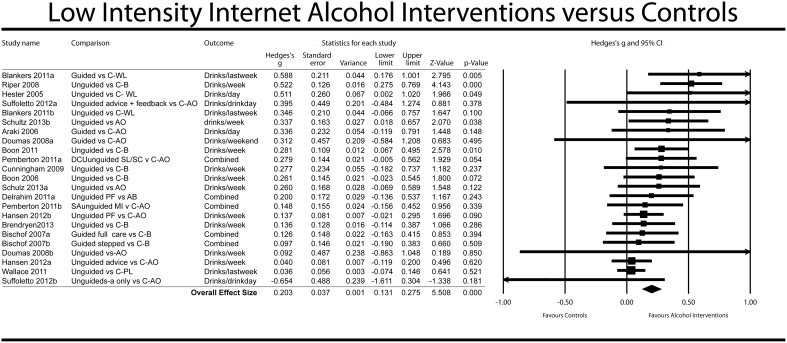
“On average, the intervention participants were drinking 2,2 alcohol consumptions (22 grams of ethanol) less per week at post-treatment than controls (n = 14; 95% CI: 0.87–3.46, p = .001, I2 = 0, p<.001; mean difference).”
§ Effectiveness of Guided and Unguided Low-Intensity Internet Interventions for Adult Alcohol Misuse: A Meta-Analysis > Results > Mean Alcohol Consumption Reduction and Drinking within Low Risk Guidelines
plaindirectn = 14 ·- Asserted: passes — The authors put it forward as true.
- Checkable: passes — It can be checked against evidence.
- Load-bearing: passes — The paper’s conclusions depend on it.
- Based: passes — The paper gives a reason why it holds.
A result the paper reports from its own data — it cites no other source for it, so there is none to check. The quote shows it is in the paper.
In the paper
“After adjustment for missing studies, the effect size for decreased alcohol consumption diminished from g = 0.20 to g = 0.14 (95% CI: 0.06–0.22; trimmed studies n = 8, random effects model).”
§ Effectiveness of Guided and Unguided Low-Intensity Internet Interventions for Adult Alcohol Misuse: A Meta-Analysis > Results > Publication Bias
plainn = 8- Asserted: passes — The authors put it forward as true.
- Checkable: passes — It can be checked against evidence.
- Load-bearing: passes — The paper’s conclusions depend on it.
- Based: passes — The paper gives a reason why it holds.
A result the paper reports from its own data — it cites no other source for it, so there is none to check. The quote shows it is in the paper.
In the paper
“Post-test differences [37], [61], [63]–[65]) revealed that intervention participants were significantly more likely than controls to have reduced their alcohol consumption to within the low-risk guidelines as compared to controls (n = 6; RD 0.13, 95% CI: 0.09–0.17, p<.001, I2 = 0, non-significant).”
- Also stated in: § Discussion · plain
“In our study, Internet intervention participants were 13% more likely than controls to stay within the guidelines after treatment (n = 6).”
§ Effectiveness of Guided and Unguided Low-Intensity Internet Interventions for Adult Alcohol Misuse: A Meta-Analysis > Results > Mean Alcohol Consumption Reduction and Drinking within Low Risk Guidelines
plaindirectn = 6 ·- Asserted: passes — The authors put it forward as true.
- Checkable: passes — It can be checked against evidence.
- Load-bearing: passes — The paper’s conclusions depend on it.
- Based: passes — The paper gives a reason why it holds.
- Also stated in: § Discussion · plain
A result the paper reports from its own data — it cites no other source for it, so there is none to check. The quote shows it is in the paper.
In the paper
“Results, showed a small but significant overall effect size in favour of Internet interventions (g = 0.20, 95% CI: 0.13–0.27, p<.001).”
- Also stated in: § Meta-analyses · plain
“All studies a | | 23 | 0.20 | 0.13–0.27*** | 27 | 0∼56 | | 8.93”
§ Effectiveness of Guided and Unguided Low-Intensity Internet Interventions for Adult Alcohol Misuse: A Meta-Analysis > Abstract > Findings
plaindirectn = 5,612 ·- Asserted: passes — The authors put it forward as true.
- Checkable: passes — It can be checked against evidence.
- Load-bearing: passes — The paper’s conclusions depend on it.
- Based: passes — The paper gives a reason why it holds.
- Rests on an assumption: The control conditions used in the included trials (assessment-only, waitlist, alcohol information brochure) function as no-intervention controls.
- Rests on an assumption: Self-reported alcohol consumption is a valid measure of actual drinking.
- Also stated in: § Meta-analyses · plain
- Probably not a substantial claim. 32
- It may state two separate claims as one. 11
A result the paper reports from its own data — it cites no other source for it, so there is none to check. The quote shows it is in the paper.
In the paper
“Seven studies applied a single-focus therapeutic strategy, which in six cases was personalised normative feedback (PNF) and in one case a generic health education approach.”
§ Effectiveness of Guided and Unguided Low-Intensity Internet Interventions for Adult Alcohol Misuse: A Meta-Analysis > Results > Characteristics of Included Studies
plainn = 6- Asserted: passes — The authors put it forward as true.
- Checkable: passes — It can be checked against evidence.
- Load-bearing: fails — The paper’s conclusions may not depend on it.
- Based: passes — The paper gives a reason why it holds.
Probably not a substantial claim. The paper’s conclusions may not depend on it.
A result the paper reports from its own data — it cites no other source for it, so there is none to check. The quote shows it is in the paper.
In the paper
“Two studies applied both AUDIT and alcohol consumption cut-off points; one selected on the basis of GGT (gamma-glutamyl transpeptidase) testing.”
§ Effectiveness of Guided and Unguided Low-Intensity Internet Interventions for Adult Alcohol Misuse: A Meta-Analysis > Results > Characteristics of Included Studies
plain- Asserted: passes — The authors put it forward as true.
- Checkable: passes — It can be checked against evidence.
- Load-bearing: fails — The paper’s conclusions may not depend on it.
- Based: passes — The paper gives a reason why it holds.
Probably not a substantial claim. The paper’s conclusions may not depend on it.
A result the paper reports from its own data — it cites no other source for it, so there is none to check. The quote shows it is in the paper.
In the paper
“Seven studies applied a single-focus therapeutic strategy, which in six cases was personalised normative feedback (PNF) and in one case a generic health education approach.”
§ Effectiveness of Guided and Unguided Low-Intensity Internet Interventions for Adult Alcohol Misuse: A Meta-Analysis > Results > Characteristics of Included Studies
plainn = 7- Asserted: passes — The authors put it forward as true.
- Checkable: passes — It can be checked against evidence.
- Load-bearing: fails — The paper’s conclusions may not depend on it.
- Based: passes — The paper gives a reason why it holds.
Probably not a substantial claim. The paper’s conclusions may not depend on it.
None of the sources cited for this claim have been checked yet.
In the paper
“Five other studies applied the Alcohol Use Identification Test (AUDIT [55]) or the Fast Alcohol Screening Test (FAST [56]).”
§ Effectiveness of Guided and Unguided Low-Intensity Internet Interventions for Adult Alcohol Misuse: A Meta-Analysis > Results > Characteristics of Included Studies
What the sources say
- Not checked yetcites [55] JB Saunders, 1993, Development of the Alcohol Use Disorders Identification Test (AUDIT): WHO Collaborative Project on Early Detection of Persons with Harmful Alcohol Consumption II, Addiction source
- Not checked yetcites [56] R Hodgson, 2002, The FAST Alcohol Screening Test, Alcohol Alcohol source
plain- Asserted: passes — The authors put it forward as true.
- Checkable: passes — It can be checked against evidence.
- Load-bearing: fails — The paper’s conclusions may not depend on it.
- Based: passes — The paper gives a reason why it holds.
Probably not a substantial claim. The paper’s conclusions may not depend on it.
A result the paper reports from its own data — it cites no other source for it, so there is none to check. The quote shows it is in the paper.
In the paper
“The other nine studies used combined treatment approaches consisting of motivational interviewing (MI), personalised normative feedback (PNF), cognitive-behavioural therapy (CBT) and/or behavioural self-control and change principles.”
§ Effectiveness of Guided and Unguided Low-Intensity Internet Interventions for Adult Alcohol Misuse: A Meta-Analysis > Results > Characteristics of Included Studies
plain- Asserted: passes — The authors put it forward as true.
- Checkable: passes — It can be checked against evidence.
- Load-bearing: fails — The paper’s conclusions may not depend on it.
- Based: passes — The paper gives a reason why it holds.
Probably not a substantial claim. The paper’s conclusions may not depend on it.
The paper states this without a source or data behind it here, so there is nothing to check it against. The quote shows it is in the paper.
In the paper
“The outcome assessments to indicate alcohol consumption were expressed in terms of mean standard drinks per drinking day, total numbers of standard drinks in the previous week, mean standard drinks per drinking occasion or amounts of alcohol in grams.”
§ Effectiveness of Guided and Unguided Low-Intensity Internet Interventions for Adult Alcohol Misuse: A Meta-Analysis > Results > Characteristics of Included Studies
plain- Asserted: passes — The authors put it forward as true.
- Checkable: passes — It can be checked against evidence.
- Load-bearing: fails — The paper’s conclusions may not depend on it.
- Based: passes — The paper gives a reason why it holds.
Probably not a substantial claim. The paper’s conclusions may not depend on it.
A result the paper reports from its own data — it cites no other source for it, so there is none to check. The quote shows it is in the paper.
In the paper
“In five studies, sample inclusion was based on self-reported alcohol consumption, using cut-off points indicative of alcohol use exceeding low-risk guidelines, with differing levels for men and women.”
§ Effectiveness of Guided and Unguided Low-Intensity Internet Interventions for Adult Alcohol Misuse: A Meta-Analysis > Results > Characteristics of Included Studies
plain- Asserted: passes — The authors put it forward as true.
- Checkable: passes — It can be checked against evidence.
- Load-bearing: fails — The paper’s conclusions may not depend on it.
- Based: passes — The paper gives a reason why it holds.
Probably not a substantial claim. The paper’s conclusions may not depend on it.
A result the paper reports from its own data — it cites no other source for it, so there is none to check. The quote shows it is in the paper.
In the paper
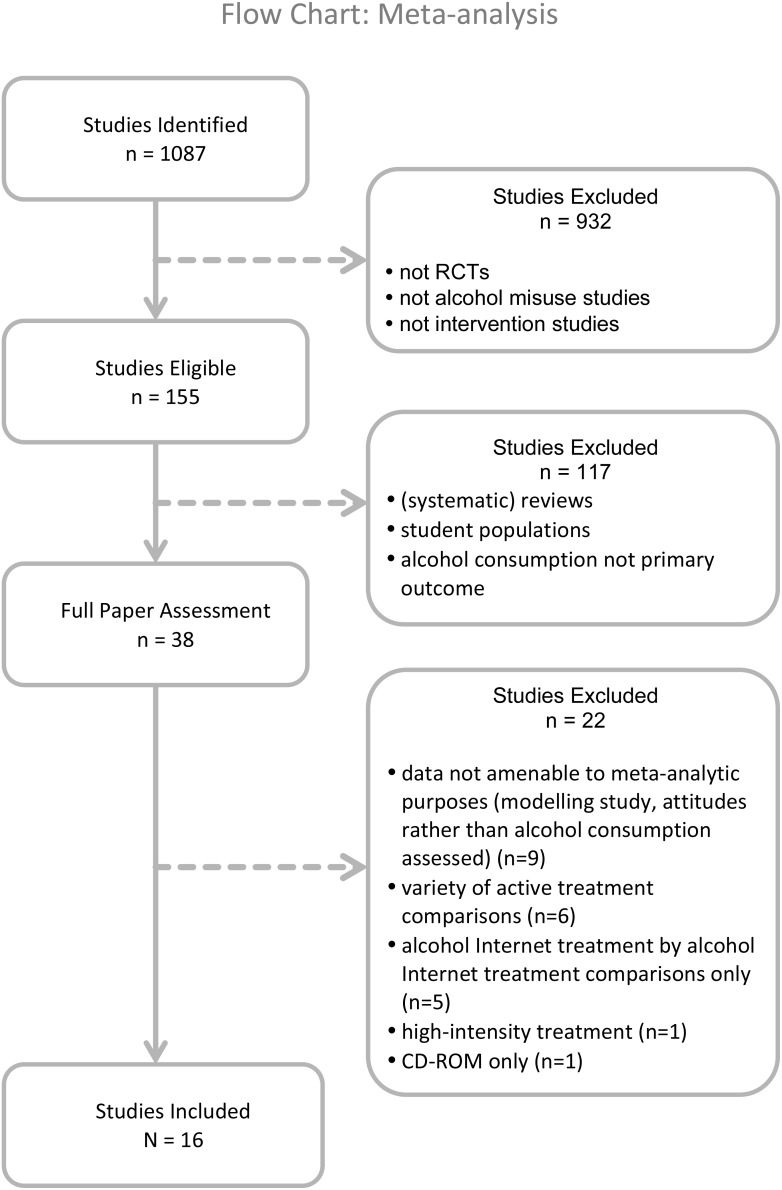
“We selected 16 randomised controlled trials (with 23 comparisons and 5,612 participants) for inclusion.”
- Also stated in: § Characteristics of Included Studies · plain
“Table 1 summarises the selected characteristics of the 16 studies (containing 23 comparisons) included in the meta-analysis.”
- Also stated in: § Characteristics of Included Studies · plain
“The studies assessed a total of 5,612 participants (3,268 in experimental and 2,344 in control conditions)”
§ Effectiveness of Guided and Unguided Low-Intensity Internet Interventions for Adult Alcohol Misuse: A Meta-Analysis > Abstract > Findings
plainn = 5,612- Asserted: passes — The authors put it forward as true.
- Checkable: passes — It can be checked against evidence.
- Load-bearing: passes — The paper’s conclusions depend on it.
- Based: passes — The paper gives a reason why it holds.
It may state two separate claims as one.
- Also stated in: § Characteristics of Included Studies · plain
A result the paper reports from its own data — it cites no other source for it, so there is none to check. The quote shows it is in the paper.
In the paper
“The control groups represented assessment-only (n = 6), waitlisted (n = 3) or alcohol information brochure conditions (n = 7).”
§ Effectiveness of Guided and Unguided Low-Intensity Internet Interventions for Adult Alcohol Misuse: A Meta-Analysis > Results > Characteristics of Included Studies
plainn = 6- Asserted: passes — The authors put it forward as true.
- Checkable: passes — It can be checked against evidence.
- Load-bearing: fails — The paper’s conclusions may not depend on it.
- Based: passes — The paper gives a reason why it holds.
Probably not a substantial claim. The paper’s conclusions may not depend on it. It may state two separate claims as one.
A result the paper reports from its own data — it cites no other source for it, so there is none to check. The quote shows it is in the paper.
In the paper
“Seven studies applied a single-focus therapeutic strategy, which in six cases was personalised normative feedback (PNF) and in one case a generic health education approach.”
§ Effectiveness of Guided and Unguided Low-Intensity Internet Interventions for Adult Alcohol Misuse: A Meta-Analysis > Results > Characteristics of Included Studies
plain- Asserted: passes — The authors put it forward as true.
- Checkable: passes — It can be checked against evidence.
- Load-bearing: fails — The paper’s conclusions may not depend on it.
- Based: passes — The paper gives a reason why it holds.
Probably not a substantial claim. The paper’s conclusions may not depend on it.
A result the paper reports from its own data — it cites no other source for it, so there is none to check. The quote shows it is in the paper.
In the paper
“As table 2 shows, removal of the comparisons with the highest effect sizes had almost no influence on the pooled effect size nor did removing the comparisons with the lowest effect sizes.”
§ Effectiveness of Guided and Unguided Low-Intensity Internet Interventions for Adult Alcohol Misuse: A Meta-Analysis > Results > Meta-analysis
plain- Asserted: passes — The authors put it forward as true.
- Checkable: passes — It can be checked against evidence.
- Load-bearing: passes — The paper’s conclusions depend on it.
- Based: passes — The paper gives a reason why it holds.
It may state two separate claims as one.
A result the paper reports from its own data — it cites no other source for it, so there is none to check. The quote shows it is in the paper.
In the paper
“Meta-regression analyses with Hedges’s g as the dependent variable uncovered no significant associations between effect size and either the number of alcohol intervention sessions (β = −0.0001, 95% CI: −0.004–0.003, p = .938) or the risk of bias (β = 0.068, 95% CI: −0.15–0.01, p = .089) in the studies assessed.”
§ Effectiveness of Guided and Unguided Low-Intensity Internet Interventions for Adult Alcohol Misuse: A Meta-Analysis > Results > Regression Analyses
plain- Asserted: passes — The authors put it forward as true.
- Checkable: passes — It can be checked against evidence.
- Load-bearing: unclear — It is unclear whether the paper’s conclusions depend on it.
- Based: passes — The paper gives a reason why it holds.
It may state two separate claims as one.
None of the sources cited for this claim have been checked yet.
In the paper
“Two of the sixteen studies [57], [58] included anyone interested in participating; for these studies, we confined our analysis to subgroups belonging to the at-risk drinking population.”
§ Effectiveness of Guided and Unguided Low-Intensity Internet Interventions for Adult Alcohol Misuse: A Meta-Analysis > Results > Characteristics of Included Studies
What the sources say
- Not checked yetcites [57] DM Doumas, 2008, Preventing high-risk drinking in youth in the workplace: a web-based normative feedback program, J Subst Abuse Treat source
- Not checked yetcites [58] MR Pemberton, 2011, Evaluation of two web-based alcohol interventions in the U.S. military, J Stud Alcohol Drugs source
plain- Asserted: passes — The authors put it forward as true.
- Checkable: passes — It can be checked against evidence.
- Load-bearing: fails — The paper’s conclusions may not depend on it.
- Based: passes — The paper gives a reason why it holds.
Probably not a substantial claim. The paper’s conclusions may not depend on it.
A result the paper reports from its own data — it cites no other source for it, so there is none to check. The quote shows it is in the paper.
In the paper
“Two studies applied both AUDIT and alcohol consumption cut-off points; one selected on the basis of GGT (gamma-glutamyl transpeptidase) testing.”
§ Effectiveness of Guided and Unguided Low-Intensity Internet Interventions for Adult Alcohol Misuse: A Meta-Analysis > Results > Characteristics of Included Studies
plain- Asserted: passes — The authors put it forward as true.
- Checkable: passes — It can be checked against evidence.
- Load-bearing: fails — The paper’s conclusions may not depend on it.
- Based: passes — The paper gives a reason why it holds.
Probably not a substantial claim. The paper’s conclusions may not depend on it.
A result the paper reports from its own data — it cites no other source for it, so there is none to check. The quote shows it is in the paper.
In the paper
“AUDIT scores among the latter were high (averaging around 20, indicating a potentially high risk of alcohol dependence amongst participants.”
§ Effectiveness of Guided and Unguided Low-Intensity Internet Interventions for Adult Alcohol Misuse: A Meta-Analysis > Discussion > Subgroup Analyses
hedgedcorrelational- Asserted: passes — The authors put it forward as true.
- Checkable: passes — It can be checked against evidence.
- Load-bearing: unclear — It is unclear whether the paper’s conclusions depend on it.
- Based: passes — The paper gives a reason why it holds.
It may state two separate claims as one.
In the paper
“and that guided Internet interventions are as effective as face to face interventions [36].”
§ Effectiveness of Guided and Unguided Low-Intensity Internet Interventions for Adult Alcohol Misuse: A Meta-Analysis > Introduction
What the sources say
- Not checked yetcites [36] Cuijpers P, Donker T, van Straten A, Li J, Andersson G (2010) Is guided self-help as effective as face-to-face psychotherapy for depression and anxiety disorders? A systematic review and meta-analysis of comparative outcome studies. Psychol Med 1–15. source
plain- Asserted: passes — The authors put it forward as true.
- Checkable: passes — It can be checked against evidence.
- Load-bearing: fails — The paper’s conclusions may not depend on it.
- Based: passes — The paper gives a reason why it holds.
Probably not a substantial claim. The paper’s conclusions may not depend on it.
What the paper did — it cites no source for this, so there is none to check. The quote shows it is in the paper.
In the paper
“The risk of bias varied among the studies (table 1), with 14 studies reporting adequate sequence generation, 6 reporting allocation to conditions by an independent party, 15 reporting blinding of outcome assessors or using self-report outcomes only, and 10 using intention-to-treat analyses.”
§ Effectiveness of Guided and Unguided Low-Intensity Internet Interventions for Adult Alcohol Misuse: A Meta-Analysis > Results > Characteristics of Included Studies
plain- Asserted: passes — The authors put it forward as true.
- Checkable: passes — It can be checked against evidence.
- Load-bearing: fails — The paper’s conclusions may not depend on it.
- Based: passes — The paper gives a reason why it holds.
Probably not a substantial claim. The paper’s conclusions may not depend on it.
What the paper did — it cites no source for this, so there is none to check. The quote shows it is in the paper.
In the paper
“The same raters assessed the effect sizes and moderator variables in the included studies.”
§ Effectiveness of Guided and Unguided Low-Intensity Internet Interventions for Adult Alcohol Misuse: A Meta-Analysis > Methods > Identification of Studies
plain- Asserted: passes — The authors put it forward as true.
- Checkable: passes — It can be checked against evidence.
- Load-bearing: fails — The paper’s conclusions may not depend on it.
- Based: passes — The paper gives a reason why it holds.
Probably not a substantial claim. The paper’s conclusions may not depend on it.
What the paper did — it cites no source for this, so there is none to check. The quote shows it is in the paper.
In the paper
“The risk of bias varied among the studies (table 1), with 14 studies reporting adequate sequence generation, 6 reporting allocation to conditions by an independent party, 15 reporting blinding of outcome assessors or using self-report outcomes only, and 10 using intention-to-treat analyses.”
§ Effectiveness of Guided and Unguided Low-Intensity Internet Interventions for Adult Alcohol Misuse: A Meta-Analysis > Results > Characteristics of Included Studies
plain- Asserted: passes — The authors put it forward as true.
- Checkable: passes — It can be checked against evidence.
- Load-bearing: fails — The paper’s conclusions may not depend on it.
- Based: passes — The paper gives a reason why it holds.
Probably not a substantial claim. The paper’s conclusions may not depend on it.
In the paper
“We assessed the validity of the included studies on the basis of four criteria from the risk-of-bias assessment tool developed by the Cochrane Collaboration [39].”
§ Effectiveness of Guided and Unguided Low-Intensity Internet Interventions for Adult Alcohol Misuse: A Meta-Analysis > Methods > Risk-of-bias Assessment and Data Extraction
What the sources say
- Not checked yetcites [39] Higgins JPT, Green S (2008 February) Higgins JPT, Green S (editors). Cochrane Handbook for Systematic Reviews of Interventions Version 5.0.0. The Cochrane Collaboration. Available. source
plain- Asserted: passes — The authors put it forward as true.
- Checkable: passes — It can be checked against evidence.
- Load-bearing: passes — The paper’s conclusions depend on it.
- Based: passes — The paper gives a reason why it holds.
Probably not a substantial claim.
What the paper did — it cites no source for this, so there is none to check. The quote shows it is in the paper.
In the paper
“All papers included or excluded at all stages were assessed by two independent raters (authors HR and HH) (see figure 1).”
§ Effectiveness of Guided and Unguided Low-Intensity Internet Interventions for Adult Alcohol Misuse: A Meta-Analysis > Methods > Identification of Studies
plain- Asserted: passes — The authors put it forward as true.
- Checkable: passes — It can be checked against evidence.
- Load-bearing: fails — The paper’s conclusions may not depend on it.
- Based: passes — The paper gives a reason why it holds.
Probably not a substantial claim. The paper’s conclusions may not depend on it.
In the paper
“For example, Richards and Richardson [34] were able to include 19 RCTs on depression in their 2012 meta-analysis.”
§ Effectiveness of Guided and Unguided Low-Intensity Internet Interventions for Adult Alcohol Misuse: A Meta-Analysis > Introduction
What the sources say
- Not checked yetcites [34] D Richards, 2012, Computer-based psychological treatments for depression: a systematic review and meta-analysis, Clin Psychol Rev source
plain- Asserted: passes — The authors put it forward as true.
- Checkable: passes — It can be checked against evidence.
- Load-bearing: fails — The paper’s conclusions may not depend on it.
- Based: passes — The paper gives a reason why it holds.
Probably not a substantial claim. The paper’s conclusions may not depend on it.
What the paper did — it cites no source for this, so there is none to check. The quote shows it is in the paper.
In the paper
“Authors HH and MB assessed risk of bias as Yes, No or Unclear using the Cochrane Collaboration tool (see 2.3).”
§ Effectiveness of Guided and Unguided Low-Intensity Internet Interventions for Adult Alcohol Misuse: A Meta-Analysis > Methods > Risk-of-bias Assessment and Data Extraction
plain- Asserted: passes — The authors put it forward as true.
- Checkable: passes — It can be checked against evidence.
- Load-bearing: fails — The paper’s conclusions may not depend on it.
- Based: passes — The paper gives a reason why it holds.
Probably not a substantial claim. The paper’s conclusions may not depend on it.
None of the sources cited for this claim have been checked yet.
In the paper
“For these disorders, overall evidence is accumulating that guided interventions generally lead to a greater reduction of depressive or anxiety symptoms than unguided interventions [34], [35]”
§ Effectiveness of Guided and Unguided Low-Intensity Internet Interventions for Adult Alcohol Misuse: A Meta-Analysis > Introduction
What the sources say
- Not checked yetcites [34] D Richards, 2012, Computer-based psychological treatments for depression: a systematic review and meta-analysis, Clin Psychol Rev source
- Not checked yetcites [35] P Cuijpers, 2009, Computer-aided psychotherapy for anxiety disorders: a meta-analytic review, Cogn Behav Ther source
hedgeddirect- Asserted: passes — The authors put it forward as true.
- Checkable: passes — It can be checked against evidence.
- Load-bearing: fails — The paper’s conclusions may not depend on it.
- Based: passes — The paper gives a reason why it holds.
Probably not a substantial claim. The paper’s conclusions may not depend on it.
What the paper did — it cites no source for this, so there is none to check. The quote shows it is in the paper.
In the paper
“The risk of bias varied among the studies (table 1), with 14 studies reporting adequate sequence generation, 6 reporting allocation to conditions by an independent party, 15 reporting blinding of outcome assessors or using self-report outcomes only, and 10 using intention-to-treat analyses.”
§ Effectiveness of Guided and Unguided Low-Intensity Internet Interventions for Adult Alcohol Misuse: A Meta-Analysis > Results > Characteristics of Included Studies
plainn = 6- Asserted: passes — The authors put it forward as true.
- Checkable: passes — It can be checked against evidence.
- Load-bearing: fails — The paper’s conclusions may not depend on it.
- Based: passes — The paper gives a reason why it holds.
Probably not a substantial claim. The paper’s conclusions may not depend on it.
The paper states this without a source or data behind it here, so there is nothing to check it against. The quote shows it is in the paper.
In the paper
“To the best of our knowledge, this is the first meta-analysis that includes both guided and unguided Internet interventions to address problematic alcohol consumption among adults.”
§ Effectiveness of Guided and Unguided Low-Intensity Internet Interventions for Adult Alcohol Misuse: A Meta-Analysis > Introduction
hedged- Asserted: passes — The authors put it forward as true.
- Checkable: passes — It can be checked against evidence.
- Load-bearing: passes — The paper’s conclusions depend on it.
- Based: fails — The paper may give no reason why it holds.
Probably not a substantial claim. The paper may give no reason why it holds.
In the paper
“The Riper meta-analysis [26], for example, identified only 7 eligible randomised controlled trials.”
§ Effectiveness of Guided and Unguided Low-Intensity Internet Interventions for Adult Alcohol Misuse: A Meta-Analysis > Introduction
What the sources say
- Not checked yetcites [26] H Riper, 2011, Effectiveness of E-self-help interventions for curbing adult problem drinking: a meta-analysis, J Med Internet Res source
plain- Asserted: passes — The authors put it forward as true.
- Checkable: passes — It can be checked against evidence.
- Load-bearing: fails — The paper’s conclusions may not depend on it.
- Based: passes — The paper gives a reason why it holds.
Probably not a substantial claim. The paper’s conclusions may not depend on it.
What the paper did — it cites no source for this, so there is none to check. The quote shows it is in the paper.
In the paper
“Dropout rates varied from 0% to 42%.”
§ Effectiveness of Guided and Unguided Low-Intensity Internet Interventions for Adult Alcohol Misuse: A Meta-Analysis > Results > Characteristics of Included Studies
plain- Asserted: passes — The authors put it forward as true.
- Checkable: passes — It can be checked against evidence.
- Load-bearing: fails — The paper’s conclusions may not depend on it.
- Based: passes — The paper gives a reason why it holds.
Probably not a substantial claim. The paper’s conclusions may not depend on it.
What the paper did — it cites no source for this, so there is none to check. The quote shows it is in the paper.
In the paper
“The risk of bias varied among the studies (table 1), with 14 studies reporting adequate sequence generation, 6 reporting allocation to conditions by an independent party, 15 reporting blinding of outcome assessors or using self-report outcomes only, and 10 using intention-to-treat analyses.”
§ Effectiveness of Guided and Unguided Low-Intensity Internet Interventions for Adult Alcohol Misuse: A Meta-Analysis > Results > Characteristics of Included Studies
plain- Asserted: passes — The authors put it forward as true.
- Checkable: passes — It can be checked against evidence.
- Load-bearing: fails — The paper’s conclusions may not depend on it.
- Based: passes — The paper gives a reason why it holds.
Probably not a substantial claim. The paper’s conclusions may not depend on it.
In the paper
“In reporting the results we followed the guidelines of the PRISMA statement (see Checklist S1) [54].”
§ Effectiveness of Guided and Unguided Low-Intensity Internet Interventions for Adult Alcohol Misuse: A Meta-Analysis > Results > Selection and Inclusion of Studies
What the sources say
- Not checked yetcites [54] D Moher, 2010, Preferred reporting items for systematic reviews and meta-analyses: the PRISMA statement, Int J Surg source
plain- Asserted: passes — The authors put it forward as true.
- Checkable: passes — It can be checked against evidence.
- Load-bearing: fails — The paper’s conclusions may not depend on it.
- Based: passes — The paper gives a reason why it holds.
Probably not a substantial claim. The paper’s conclusions may not depend on it.
What the paper did — it cites no source for this, so there is none to check. The quote shows it is in the paper.
In the paper
“Any disagreement was resolved by discussion.”
§ Effectiveness of Guided and Unguided Low-Intensity Internet Interventions for Adult Alcohol Misuse: A Meta-Analysis > Methods > Identification of Studies
plain- Asserted: passes — The authors put it forward as true.
- Checkable: passes — It can be checked against evidence.
- Load-bearing: fails — The paper’s conclusions may not depend on it.
- Based: passes — The paper gives a reason why it holds.
Probably not a substantial claim. The paper’s conclusions may not depend on it.
In the paper
“Decreasing alcohol consumption as well as abstinence and adherence to low-risk guidelines are health benefits in their own right and potential predictors of longer-term maintenance of decreased alcohol consumption [85].”
§ Effectiveness of Guided and Unguided Low-Intensity Internet Interventions for Adult Alcohol Misuse: A Meta-Analysis > Discussion > Clinical Implications
What the sources say
- Not checked yetcites [85] M Roerecke, 2013, Reduction of alcohol consumption and subsequent mortality in alcohol use disorders: systematic review and meta-analyses, J Clin Psychiatry source
hedgedcorrelational- Asserted: passes — The authors put it forward as true.
- Checkable: passes — It can be checked against evidence.
- Load-bearing: unclear — It is unclear whether the paper’s conclusions depend on it.
- Based: passes — The paper gives a reason why it holds.
It may state two separate claims as one.
In the paper
“This is in line with the study of Jonas and colleagues [15] who showed that those receiving primary care alcohol interventions were 11% more likely to do so when compared with controls.”
§ Effectiveness of Guided and Unguided Low-Intensity Internet Interventions for Adult Alcohol Misuse: A Meta-Analysis > Discussion
What the sources say
- Not checked yetcites [15] DE Jonas, 2012, Behavioral counseling after screening for alcohol misuse in primary care: a systematic review and meta-analysis for the U.S. Preventive Services Task Force, Ann Intern Med source
plaindirect- Asserted: passes — The authors put it forward as true.
- Checkable: passes — It can be checked against evidence.
- Load-bearing: fails — The paper’s conclusions may not depend on it.
- Based: passes — The paper gives a reason why it holds.
Probably not a substantial claim. The paper’s conclusions may not depend on it.
None of the sources cited for this claim have been checked yet.
In the paper
“High study (and treatment) dropout rates are a common phenomenon in both online and offline self-help interventions for alcohol misuse and in Internet interventions in general [81], [82].”
§ Effectiveness of Guided and Unguided Low-Intensity Internet Interventions for Adult Alcohol Misuse: A Meta-Analysis > Discussion > Subgroup Analyses
What the sources say
plain- Asserted: passes — The authors put it forward as true.
- Checkable: passes — It can be checked against evidence.
- Load-bearing: fails — The paper’s conclusions may not depend on it.
- Based: passes — The paper gives a reason why it holds.
Probably not a substantial claim. The paper’s conclusions may not depend on it.
None of the sources cited for this claim have been checked yet.
In the paper
“Such a decay of intervention effects is not uncommon; larger effect sizes are generally found at the earliest follow-ups [15], [68].”
§ Effectiveness of Guided and Unguided Low-Intensity Internet Interventions for Adult Alcohol Misuse: A Meta-Analysis > Discussion
What the sources say
- Not checked yetcites [15] DE Jonas, 2012, Behavioral counseling after screening for alcohol misuse in primary care: a systematic review and meta-analysis for the U.S. Preventive Services Task Force, Ann Intern Med source
- Not checked yetcites [68] A Moyer, 2002, Brief interventions for alcohol problems: a meta-analytic review of controlled investigations in treatment-seeking and non-treatment-seeking populations, Addiction source
plaincorrelational- Asserted: passes — The authors put it forward as true.
- Checkable: passes — It can be checked against evidence.
- Load-bearing: unclear — It is unclear whether the paper’s conclusions depend on it.
- Based: passes — The paper gives a reason why it holds.
It may state two separate claims as one.
None of the sources cited for this claim have been checked yet.
In the paper
“The current overall effect also compares with meta-analyses of face-to-face primary care samples [3], [30], [67], [68] and of non-clinical samples performing postal self-help interventions based on bibliotherapy [69]–[71]. These studies all showed significant small to moderate effect sizes for curbing alcohol misuse.”
§ Effectiveness of Guided and Unguided Low-Intensity Internet Interventions for Adult Alcohol Misuse: A Meta-Analysis > Discussion
What the sources say
- Not checked yetcites [3] VA Moyer, 2013, Screening and behavioral counseling interventions in primary care to reduce alcohol misuse: U.S. preventive services task force recommendation statement, Ann Intern Med source
- Not checked yetcites [30] Kaner EF, Beyer F, Dickinson HO, Pienaar E, Campbell F, et al. (2007) Effectiveness of brief alcohol interventions in primary care populations. Cochrane Database Syst Rev CD004148. source
- Not checked yetcites [67]–[71]
plaindirect- Asserted: passes — The authors put it forward as true.
- Checkable: passes — It can be checked against evidence.
- Load-bearing: unclear — It is unclear whether the paper’s conclusions depend on it.
- Based: passes — The paper gives a reason why it holds.
It may state two separate claims as one.
None of the sources cited for this claim have been checked yet.
In the paper
“In the case of Internet-based interventions for alcohol misuse, however, female uptake appears equally as high as male uptake [28], [77] and have been seen to have similar impacts on female and on male drinking, or possibly even greater influence on females, as suggested by Riper and colleagues (2008, [78]).”
§ Effectiveness of Guided and Unguided Low-Intensity Internet Interventions for Adult Alcohol Misuse: A Meta-Analysis > Discussion > Subgroup Analyses
What the sources say
- Not checked yetcites [28] H Riper, 2009, Translating effective web-based self-help for problem drinking into the real world, Alcohol Clin Exp Res source
- Not checked yetcites [77] JA Cunningham, 2010, Internet-based interventions for problem drinkers: From efficacy trials to implementation, Drug Alcohol Rev source
- Not checked yetcites [78] H Riper, 2008, Predicting successful treatment outcome of web-based self-help for problem drinkers: secondary analysis from a randomized controlled trial, J Med Internet Res source
hedged- Asserted: passes — The authors put it forward as true.
- Checkable: passes — It can be checked against evidence.
- Load-bearing: unclear — It is unclear whether the paper’s conclusions depend on it.
- Based: passes — The paper gives a reason why it holds.
It may state two separate claims as one.
In the paper
“A modelling study by Smit and colleagues [86] has suggested that if online interventions were to partially replace conventional face-to-face brief alcohol interventions, that could sustain comparable levels of population health at lower costs.”
§ Effectiveness of Guided and Unguided Low-Intensity Internet Interventions for Adult Alcohol Misuse: A Meta-Analysis > Discussion > Clinical Implications
What the sources say
- Not checked yetcites [86] F Smit, 2011, Modeling the cost-effectiveness of health care systems for alcohol use disorders: how implementation of eHealth interventions improves cost-effectiveness, J Med Internet Res source
hedgedconditional- Asserted: passes — The authors put it forward as true.
- Checkable: passes — It can be checked against evidence.
- Load-bearing: fails — The paper’s conclusions may not depend on it.
- Based: passes — The paper gives a reason why it holds.
Probably not a substantial claim. The paper’s conclusions may not depend on it.
None of the sources cited for this claim have been checked yet.
In the paper
“Although the literature is somewhat inconclusive [75], it provides some confirmation for our current findings [30], [68], [76].”
§ Effectiveness of Guided and Unguided Low-Intensity Internet Interventions for Adult Alcohol Misuse: A Meta-Analysis > Discussion > Subgroup Analyses
What the sources say
- Not checked yetcites [75] VA Moyer, 2013, Screening and behavioral counseling interventions in primary care to reduce alcohol misuse: U.S. preventive services task force recommendation statement, Ann Intern Med source
- Not checked yetcites [30] Kaner EF, Beyer F, Dickinson HO, Pienaar E, Campbell F, et al. (2007) Effectiveness of brief alcohol interventions in primary care populations. Cochrane Database Syst Rev CD004148. source
- Not checked yetcites [68] A Moyer, 2002, Brief interventions for alcohol problems: a meta-analytic review of controlled investigations in treatment-seeking and non-treatment-seeking populations, Addiction source
hedged- Asserted: passes — The authors put it forward as true.
- Checkable: passes — It can be checked against evidence.
- Load-bearing: fails — The paper’s conclusions may not depend on it.
- Based: passes — The paper gives a reason why it holds.
Probably not a substantial claim. The paper’s conclusions may not depend on it. It may state two separate claims as one.
None of the sources cited for this claim have been checked yet.
In the paper
“Some studies of brief interventions for problem drinking have nonetheless reported positive influences on alcohol reduction up to four years later [67] and on mortality [72].”
§ Effectiveness of Guided and Unguided Low-Intensity Internet Interventions for Adult Alcohol Misuse: A Meta-Analysis > Discussion
What the sources say
- Not checked yetcites [67] A O’Donnell, 2014, The impact of brief alcohol interventions in primary healthcare: a systematic review of reviews, Alcohol Alcohol source
- Not checked yetcites [72] P Cuijpers, 2004, The effects on mortality of brief interventions for problem drinking: a meta-analysis, Addiction source
hedgeddirect- Asserted: passes — The authors put it forward as true.
- Checkable: passes — It can be checked against evidence.
- Load-bearing: fails — The paper’s conclusions may not depend on it.
- Based: passes — The paper gives a reason why it holds.
Probably not a substantial claim. The paper’s conclusions may not depend on it. It may state two separate claims as one.
The paper relies on this without support.
The control conditions used in the included trials (assessment-only, waitlist, alcohol information brochure) function as no-intervention controls.
“compared a web-based intervention with a control group (in an assessment-only, waitlisted or alcohol information brochure control condition)”
“in comparison with no-intervention controls”
The paper relies on this without support.
Self-reported alcohol consumption is a valid measure of actual drinking.
“blinding of outcome assessors or using self-report outcomes only”
“The outcome assessments to indicate alcohol consumption were expressed in terms of mean standard drinks per drinking day, total numbers of standard drinks in the previous week, mean standard drinks per drinking occasion or amounts of alcohol in grams.”
Claims other papers make about this one
Each is checked against this paper’s own text: does it say what the citing paper says it does?
The source backs part of the claim, not all of it — or backs it for a different population, condition or comparison.
In the citing paper
“On a population level, the gains could then be considerable, given that such unguided interventions can be scaled up at relatively low financial expense as there are no costs for therapists or coaches involved (Donker et al., 2009; Riper et al., 2014).”
From The effect of e-mental health interventions on academic performance in university and college students: A meta-analysis of randomized controlled trials (2020) · cites this paper as Riper et al., 2014
Experimental — accuracy not yet measuredIn the citing paper
“Several RCTs of guided digital treatments for alcohol and substance abuse have shown significant but more modest benefits of DMHTs (31, 32).”
From Banbury forum consensus statement on the path forward for digital mental health treatment (2021) · cites this paper as [31]
Self-check
Percentages, sums and reported differences re-computed from the paper’s own numbers.
Each contradiction between two passages listed here was confirmed by an independent check.
Rated minor: it would not touch a result — a value no result rests on, a p-value that stays on the same side of the significance level, or a conflict that is clerical, resolved elsewhere in the paper, or outside its own findings.
In the paper
§ Effectiveness of Guided and Unguided Low-Intensity Internet Interventions for Adult Alcohol Misuse: A Meta-Analysis > Results > Regression Analyses
“β = 0.068”
§ Effectiveness of Guided and Unguided Low-Intensity Internet Interventions for Adult Alcohol Misuse: A Meta-Analysis > Results > Regression Analyses
“95% CI: −0.15–0.01”
Rated minor: it would not touch a result — a value no result rests on, a p-value that stays on the same side of the significance level, or a conflict that is clerical, resolved elsewhere in the paper, or outside its own findings.
In the paper
§ Effectiveness of Guided and Unguided Low-Intensity Internet Interventions for Adult Alcohol Misuse: A Meta-Analysis > Results > Characteristics of Included Studies
“Dropout rates varied from 0% to 42%.”
§ Effectiveness of Guided and Unguided Low-Intensity Internet Interventions for Adult Alcohol Misuse: A Meta-Analysis > Methods > Risk-of-bias Assessment and Data Extraction
“Unguided vs CW | 582/695 | Drinks in past week | ITT | 3 months | 45%”
Citations
Cites
Preferred Reporting Items for Systematic Reviews and Meta-Analyses: the PRISMA statement
Moher, D., Liberati, A., Tetzlaff, J., Altman, D. G., & for the PRISMA Group (2009) · BMJ · doi:10.1136/bmj.b2535 · Cited by 83,823
Measuring inconsistency in meta-analyses
Higgins, J. P. T., Thompson, S. G., Deeks, J. J., & Altman, D. G. (2003) · BMJ · doi:10.1136/bmj.327.7414.557 · Cited by 63,139
Bias in meta-analysis detected by a simple, graphical test
Egger, M., Smith, G. D., Schneider, M., & Minder, C. (1997) · BMJ · doi:10.1136/bmj.315.7109.629 · Cited by 56,722
Cochrane Handbook for Systematic Reviews of Interventions: Cochrane Book Series
(2008) · doi:10.1002/9780470712184 · Cited by 25,048
Borenstein, M., Hedges, L. V., Higgins, J. P. T., & Rothstein, H. R. (2009) · doi:10.1002/9780470743386 · Cited by 14,225
Duval, S., & Tweedie, R. (2000) · Biometrics · doi:10.1111/j.0006-341x.2000.00455.x · Cited by 14,099
SAUNDERS, J. B., AASLAND, O. G., BABOR, T. F., DE LA FUENTE, J. R., & GRANT, M. (1993) · Addiction · doi:10.1111/j.1360-0443.1993.tb02093.x · Cited by 13,597 · cited 4×
“No difference in effect sizes emerged between studies that used cut-off points in alcohol consumption as study inclusion criteria and those that applied stricter measurements such as AUDIT [55].”
MethodInfluentialPreferred reporting items for systematic reviews and meta-analyses: The PRISMA statement
Moher, D., Liberati, A., Tetzlaff, J., & Altman, D. G. (2010) · International Journal of Surgery · doi:10.1016/j.ijsu.2010.02.007 · Cited by 12,156
Borenstein, M., Hedges, L. V., Higgins, J. P. T., & Rothstein, H. R. (2021) · doi:10.1002/9781119558378 · Cited by 9,799
The Transtheoretical Model of Health Behavior Change.
Prochaska, J. O., & Velicer, W. F. (1997) · American Journal of Health Promotion · doi:10.4278/0890-1171-12.1.38 · Cited by 7,782
Research works printed but not linked: 4
- Latimer N, Guillaume L (2009) Prevention and early identification of alcohol use disorders in adults and young people: screening and brief interventions: cost effectiveness review. Sheffield: ScHARR Public Health Collaborating Centre.
- Cohen J (1997) Statistical power analyses for the behavioral sciences (revised ed.). New York: Academic Press.
- VA Moyer, 2013, Screening and behavioral counseling interventions in primary care to reduce alcohol misuse: U.S. preventive services task force recommendation statement, Ann Intern Med, 159, 210, 10.7326/0003-4819-159-3-201308060-00652 · DOI · Paper page
- J McCambridge, 2014, Regression to the mean and alcohol consumption: a cohort study exploring implications for the interpretation of change in control groups in brief intervention trials, Drug Alcohol Depend, 135, 156, 10.1016/j.drugalcdep.2013.11.017 · DOI · Paper page
Cited by
Sorted by citations
Auerbach, R. P., Collaborators, W. W.-I., Mortier, P., Bruffaerts, R., Alonso, J., Benjet, C., Cuijpers, P., Demyttenaere, K., Ebert, D. D., Green, J. G., et al. (2018) · Journal of Abnormal Psychology · doi:10.1037/abn0000362 · Cited by 2,522
“…of these conditions (e.g., Ebert et al., 2015; Josephine, Josefine, Philipp, David, & Harald, 2017; Olthuis, Watt, Bailey, Hayden, & Stewart, 2015; Riper et al., 2014; Rosso et al., 2017; van Straten, Cuijpers, & T hi s do cu m en t is co py ri gh te d by th e A m er ic an Ps yc ho lo gi ca l A…”
Self-citationUnderstanding and Promoting Effective Engagement With Digital Behavior Change Interventions
Yardley, L., Spring, B. J., Riper, H., Morrison, L. G., Crane, D. H., Curtis, K., Merchant, G. C., Naughton, F., & Blandford, A. (2016) · American Journal of Preventive Medicine · doi:10.1016/j.amepre.2016.06.015 · Cited by 1,118
Self-citationInternet-delivered psychological treatments: from innovation to implementation
Andersson, G., Titov, N., Dear, B. F., Rozental, A., & Carlbring, P. (2019) · World Psychiatry · doi:10.1002/wps.20610 · Cited by 750
The Lancet Psychiatry Commission on psychological treatments research in tomorrow's science
Holmes, E. A., Ghaderi, A., Harmer, C. J., Ramchandani, P. G., Cuijpers, P., Morrison, A. P., Roiser, J. P., Bockting, C. L. H., O'Connor, R. C., Shafran, R., et al. (2018) · The Lancet Psychiatry · doi:10.1016/s2215-0366(17)30513-8 · Cited by 624
Self-citationErbe, D., Eichert, H.-C., Riper, H., & Ebert, D. D. (2017) · Journal of Medical Internet Research · doi:10.2196/jmir.6588 · Cited by 532
Self-citation
Metadata
- Authors
- Riper, H., Blankers, M., Hadiwijaya, H., Cunningham, J., Clarke, S., Wiers, R., Ebert, D., & Cuijpers, P.
- Affiliations
- Leuphana University of Lüneburg (DE)
- Amsterdam UMC Location University of Amsterdam (NL)
- Tilburg University (NL)
- Australian National University (AU)
- NHS Fife (GB)
- University of Amsterdam (NL)
- Corresponding author
- Riper, Heleen
- ORCID
- Venue
- PLoS ONE
- Publisher
- Public Library of Science (PLoS)
- Published
- 2014-06-17
- Volume
- 9
- Issue
- 6
- Pages
- e99912
- ISSN
- 1932-6203 (ISSN-L)
- PMC
- PMC4061051
- OpenAlex
- W2102290516
- Cited by
- 265
- References
- 85
- Citations by year
- 2026: 4 · 2025: 7 · 2024: 9 · 2023: 11 · 2022: 11 · 2021: 36 · 2020: 25 · 2019: 24 · 2018: 34 · 2017: 38 · 2016: 35 · 2015: 24 · 2014: 6
- FWCI
- 4.58
- Type
- journal article
- Language
- en
- Open access
- gold
- doi.org
- Locations
- PLoS ONE (publishedVersion, cc-by)
- Europe PMC (PubMed Central) (publishedVersion, cc-by)
- PubMed Central (publishedVersion, cc-by)
- PubMed (publishedVersion)
- UvA-DARE (University of Amsterdam) (publishedVersion, other-oa)
- Amsterdam UMC (VU Amsterdam) - Institutional Repository (publishedVersion, other-oa)
- Multilingual Matters (Channel View Publications) (publishedVersion, cc-by)
- VU Research Portal (publishedVersion, other-oa)
- Research portal (Tilburg University) (submittedVersion, other-oa)
- Data Archiving and Networked Services (DANS) (submittedVersion, other-oa)
- Data Archiving and Networked Services (DANS) (submittedVersion)
- RePEc: Research Papers in Economics (submittedVersion)
- Digital Academic REpository of VU University Amsterdam (Vrije Universiteit Amsterdam) (submittedVersion)
- DOAJ (DOAJ: Directory of Open Access Journals) (submittedVersion, cc-by-sa)
- ANU Open Research (Australian National University) (submittedVersion, cc-by)
- Topics
- Health Sciences › Medicine › Epidemiology › Substance Abuse Treatment and Outcomes
- Social Sciences › Psychology › Applied Psychology › Digital Mental Health Interventions
- Health Sciences › Medicine › Pathology and Forensic Medicine › Alcohol Consumption and Health Effects
- Keywords
- alcohol abuse, online intervention, low-intensity intervention, guided self-help, alcohol consumption, low-risk drinking guidelines, alcohol consumption reduction
- MeSH terms
- Alcohol Drinking, Alcoholism, Humans, Patient Compliance, Health Behavior, Randomized Controlled Trials as Topic, Treatment Outcome, Internet
About these checks
Registry, retraction, Cites and statistics results are computed, not judged, with one exception: a printed reference that no index lists is read once by a model before it counts as a citation error. Claims are extracted by a model and kept only when their quote appears verbatim in the text; each cited source is then checked, with a model’s help, for whether it says what the claim relies on. Those verdicts can be wrong — read the claim’s quote and the cited source before relying on one.
A language model drew the claims from the paper on 2026-10-07, under version 3 of the claim definition (model deepseek-v4.1-flash, prompt extract-v3).
A second model labelled each claim on 2026-10-07 (model jev-1.13-20260917, definition revision gold-guideline-v0.2).
Statistics and arithmetic are recomputed, not judged.
Confidence bands are shown only for fields calibrated on our annotated test set. None is calibrated yet, so no band is shown.
What counts as a claim ›How we measure confidence ›How we check this ›
Are you an author, or do you see a problem with this page? Request a review
