

The Involvement of the Mid1/Cch1/Yvc1 Calcium Channels in Aspergillus fumigatus Virulence
Open accessThe DOI matches its Crossref record; 75 of the 75 references it cites were found in a registry or an index.
Abstract
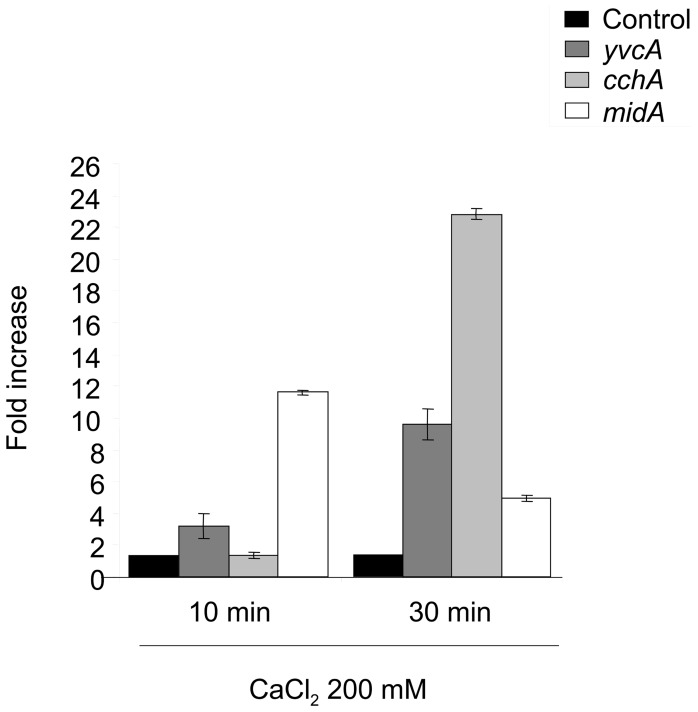
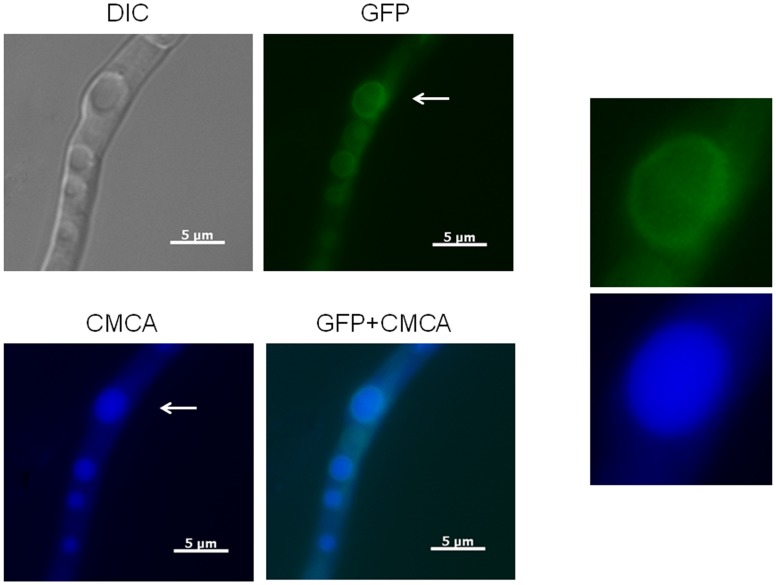
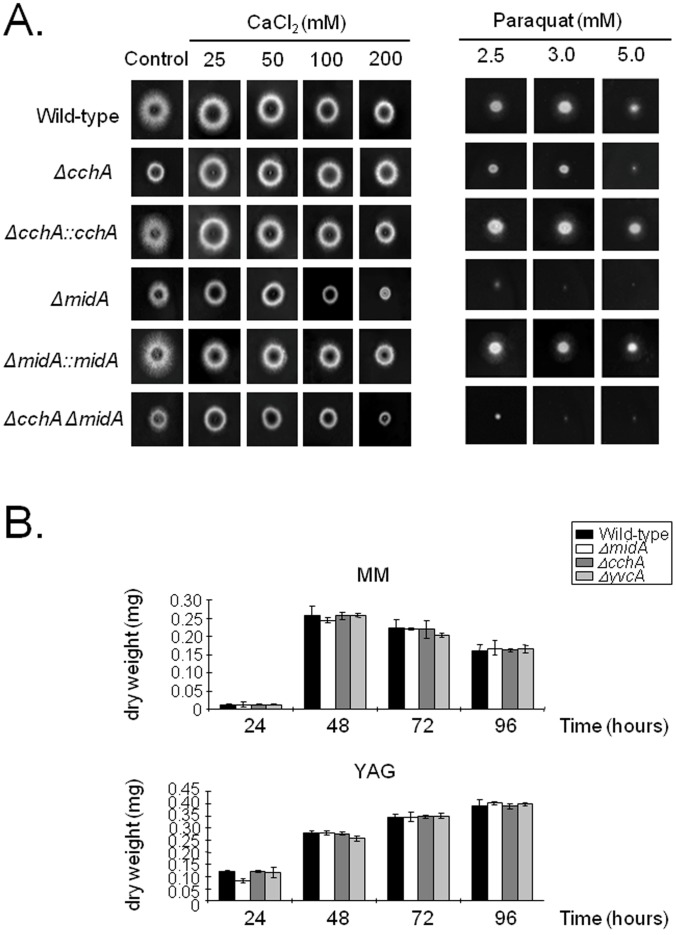
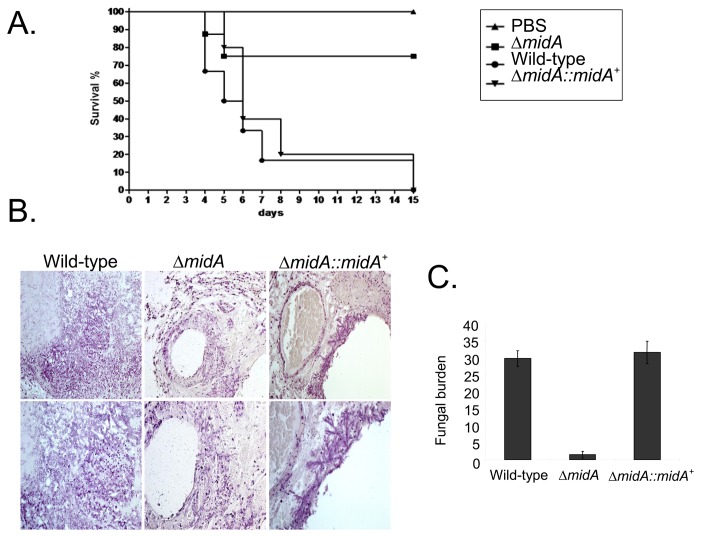
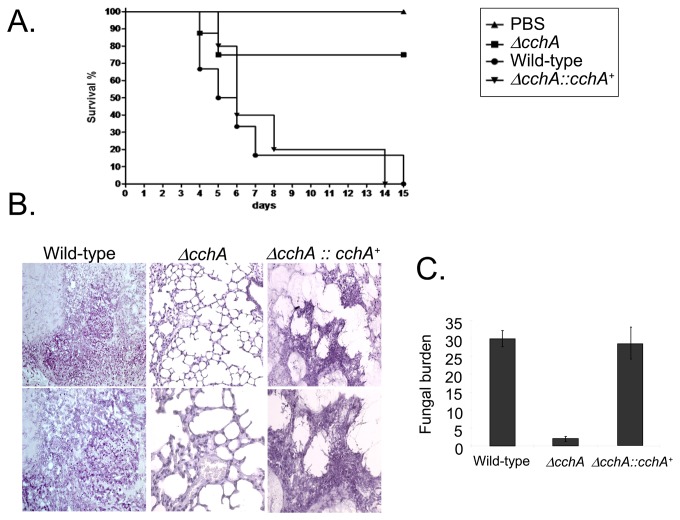
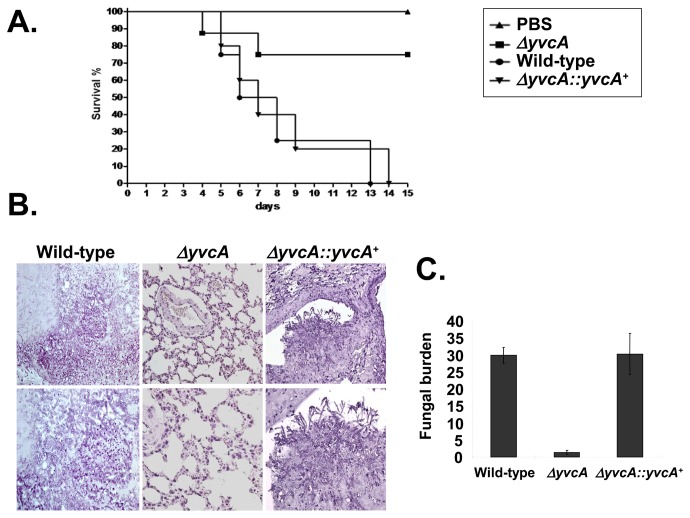
Aspergillus fumigatus is a major opportunistic pathogen and allergen of mammals. Calcium homeostasis and signaling is essential for numerous biological processes and also influences A. fumigatus pathogenicity. The presented study characterized the function of the A. fumigatus homologues of three Saccharomyces cerevisiae calcium channels, voltage-gated Cch1, stretch-activated Mid1 and vacuolar Yvc1. The A. fumigatus calcium channels cchA, midA and yvcA were regulated at transcriptional level by increased calcium levels. The YvcA::GFP fusion protein localized to the vacuoles. Both ΔcchA and ΔmidA mutant strains showed reduced radial growth rate in nutrient-poor minimal media. Interestingly, this growth defect in the ΔcchA strain was rescued by the exogenous addition of CaCl2. The ΔcchA, ΔmidA, and ΔcchA ΔmidA strains were also sensitive to the oxidative stress inducer, paraquat. Restriction of external Ca(2+) through the addition of the Ca(2+)-chelator EGTA impacted upon the growth of the ΔcchA and ΔmidA strains. All the A. fumigatus ΔcchA, ΔmidA, and ΔyvcA strains demonstrated attenuated virulence in a neutropenic murine model of invasive pulmonary aspergillosis. Infection with the parental strain resulted in a 100% mortality rate at 15 days post-infection, while the mortality rate of the ΔcchA, ΔmidA, and ΔyvcA strains after 15 days post-infection was only 25%. Collectively, this investigation strongly indicates that CchA, MidA, and YvcA play a role in A. fumigatus calcium homeostasis and virulence.
Overview
The claims and statistics of this paper haven’t been checked yet.
Free: it reads the open-access text and checks the first 5 claims that cite a source we can check. Create a free account to check every claim.
Integrity signals
Registry
Cites
Statistics
Figures
Verification
Claims the paper makes
The claims and statistics of this paper haven’t been checked yet.
Free: it reads the open-access text and checks the first 5 claims that cite a source we can check. Create a free account to check every claim.
Claims other papers make about this one
Each is checked against this paper’s own text: does it say what the citing paper says it does?
In the citing paper
“High-affinity plasma membrane calcium channels Cch1 and Mid1 have been characterized (377).”
From Aspergillus fumigatus and Aspergillosis in 2019 (2019) · cites this paper as [377]
Self-check
Percentages, sums and reported differences re-computed from the paper’s own numbers.
The self-check needs the paper’s full text.
Citations
Cites
The versatility and universality of calcium signalling
Berridge, M. J., Lipp, P., & Bootman, M. D. (2000) · Nature Reviews Molecular Cell Biology · doi:10.1038/35036035 · Cited by 5,701
Calcium signalling: dynamics, homeostasis and remodelling
Berridge, M. J., Bootman, M. D., & Roderick, H. L. (2003) · Nature Reviews Molecular Cell Biology · doi:10.1038/nrm1155 · Cited by 5,585 · cited 3×
“Calcium-mediated signaling regulates a diverse array of biological processes including gene transcription, protein conformation, energy metabolism, endo- and exo-cytosis, cytoskeletal arrangement, and cell physiology [1,2].”
BackgroundSchiestl, R. H., & Gietz, R. D. (1989) · Current Genetics · doi:10.1007/bf00340712 · Cited by 2,131 · cited 1×
“cerevisiae strain SC94721 using the lithium acetate method [67].”
MethodColot, H. V., Park, G., Turner, G. E., Ringelberg, C., Crew, C. M., Litvinkova, L., Weiss, R. L., Borkovich, K. A., & Dunlap, J. C. (2006) · Proceedings of the National Academy of Sciences · doi:10.1073/pnas.0601456103 · Cited by 1,117
Pathogenesis of Aspergillus fumigatus in Invasive Aspergillosis
Dagenais, T. R. T., & Keller, N. P. (2009) · Clinical Microbiology Reviews · doi:10.1128/cmr.00055-08 · Cited by 993 · cited 2×
“Aspergillus fumigatus is a major opportunistic pathogen and allergen of mammals [40], [41].”
BackgroundMeiotic and Mitotic Recombination in Aspergillus and Its Chromosomal Aberrations
Käfer, E. (1977) · Advances in Genetics · doi:10.1016/s0065-2660(08)60245-x · Cited by 736
Allergic bronchopulmonary aspergillosis
Greenberger, P. A. (2002) · Journal of Allergy and Clinical Immunology · doi:10.1067/mai.2002.130179 · Cited by 476
Yoshimoto, H., Saltsman, K., Gasch, A. P., Li, H. X., Ogawa, N., Botstein, D., Brown, P. O., & Cyert, M. S. (2002) · Journal of Biological Chemistry · doi:10.1074/jbc.m202718200 · Cited by 404
Calcineurin signaling in Saccharomyces cerevisiae: how yeast go crazy in response to stress.
Cyert, M. S. (2003) · Biochemical and Biophysical Research Communications · doi:10.1016/s0006-291x(03)01552-3 · Cited by 333 · cited 1×
“restoration of calcium homeostasis [9–12].”
Harnessing calcineurin as a novel anti-infective agent against invasive fungal infections.
Steinbach, W. J., Reedy, J. L., Cramer, R. A., Perfect, J. R., & Heitman, J. (2007) · Nature Reviews Microbiology · doi:10.1038/nrmicro1680 · Cited by 313 · cited 1×
“Calcium homeostasis and signaling is essential for numerous biological processes and importantly impacts upon the growth, stress tolerance and virulence of fungal pathogens [1], [48], [49].”
Background
Cited by
Aspergillus fumigatus and Aspergillosis in 2019
Latgé, J.-P., & Chamilos, G. (2019) · Clinical Microbiology Reviews · doi:10.1128/cmr.00140-18 · Cited by 1,400
Liu, S., Hou, Y., Liu, W., Lu, C., Wang, W., & Sun, S. (2015) · Eukaryotic Cell · doi:10.1128/ec.00271-14 · Cited by 174
“In aspergilli, the homologs of CCH1 and MID1, cchA and midA, not only have the functional benefits of fast growth but also play important roles in calcium homeostasis and virulence (50, 51).”
BackgroundPark, H.-S., Lee, S. C., Cardenas, M. E., & Heitman, J. (2019) · Cell Host & Microbe · doi:10.1016/j.chom.2019.08.004 · Cited by 168
Pathogenicity and virulence of Aspergillus fumigatus
Earle, K., Valero, C., Conn, D. P., Vere, G., Cook, P. C., Bromley, M., Bowyer, P., & Gago, S. (2023) · Virulence · doi:10.1080/21505594.2023.2172264 · Cited by 132
Lange, M., & Peiter, E. (2020) · Frontiers in Microbiology · doi:10.3389/fmicb.2019.03100 · Cited by 93
“Aspergillus fumigatus harbors three Pmc1 homologs (PmcA, PmcB, and PmcC).”
BackgroundInfluential
Metadata
- Authors
- de Castro, P. A., Chiaratto, J., Winkelströter, L. K., Bom, V. L. P., Ramalho, L. N. Z., Goldman, M. H. S., Brown, N. A., & Goldman, G. H.
- Affiliations
- Universidade de São Paulo (BR)
- Corresponding author
- Chiaratto, Jéssica
- Winkelströter, Lizziane K.
- Bom, Vinícius Leite Pedro
- Goldman, Maria Helena S.
- Brown, Neil Andrew
- Goldman, Gustavo H.
- ORCID
- Venue
- PLoS ONE
- Publisher
- Public Library of Science (PLoS)
- Published
- 2014-08-01
- Volume
- 9
- Issue
- 8
- Pages
- e103957
- ISSN
- 1932-6203 (ISSN-L)
- PMC
- PMC4118995
- OpenAlex
- W2047882185
- Cited by
- 60
- References
- 75
- Citations by year
- 2026: 5 · 2025: 3 · 2024: 3 · 2023: 9 · 2022: 3 · 2021: 3 · 2020: 9 · 2019: 5 · 2018: 1 · 2017: 5 · 2016: 8 · 2015: 5 · 2014: 1
- FWCI
- 2.60
- Type
- journal article
- Language
- en
- Open access
- gold
- doi.org
- Locations
- PLoS ONE (publishedVersion, cc-by)
- PubMed Central (publishedVersion, cc-by)
- PubMed (publishedVersion)
- DOAJ (DOAJ: Directory of Open Access Journals) (submittedVersion, cc-by-sa)
- Figshare (submittedVersion, cc-by)
- Funders
- Fundação de Amparo à Pesquisa do Estado de São Paulo
- Conselho Nacional de Desenvolvimento Científico e Tecnológico
- Topics
- Life Sciences › Biochemistry, Genetics and Molecular Biology › Molecular Biology › Fungal and yeast genetics research
- Health Sciences › Medicine › Infectious Diseases › Antifungal resistance and susceptibility
- Life Sciences › Biochemistry, Genetics and Molecular Biology › Molecular Biology › Ion channel regulation and function
- Keywords
- Aspergillus fumigatus, calcium channels, MID1, calcium homeostasis, fungal virulence, invasive pulmonary aspergillosis, oxidative stress, paraquat sensitivity, vacuolar calcium, transcriptional regulation, fungal pathogenicity
- MeSH terms
- Animals, Antifungal Agents, Aspergillus fumigatus, Cytoplasm, Disease Models, Animal, Female, Fungal Proteins, Mice, Inbred BALB C, Mutation, Neutropenia, RNA, Messenger, Virulence, Calcium Channels, Gene Expression Regulation, Fungal, Sequence Homology, Amino Acid, Green Fluorescent Proteins
About these checks
Registry, retraction, Cites and statistics results are computed, not judged, with one exception: a printed reference that no index lists is read once by a model before it counts as a citation error. Claims are extracted by a model and kept only when their quote appears verbatim in the text; each cited source is then checked, with a model’s help, for whether it says what the claim relies on. Those verdicts can be wrong — read the claim’s quote and the cited source before relying on one.
Statistics and arithmetic are recomputed, not judged.
Confidence bands are shown only for fields calibrated on our annotated test set. None is calibrated yet, so no band is shown.
What counts as a claim ›How we measure confidence ›How we check this ›
Are you an author, or do you see a problem with this page? Request a review
Data sources
Bibliographic data: Semantic Scholar, OpenAlex, Crossref.
Contains information from the Semantic Scholar Academic Graph Datasets, made available under the ODC Attribution License (ODC-BY 1.0).
Semantic Scholar’s data is described in: Kinney, R., et al. (2023). The Semantic Scholar Open Data Platform. arXiv:2301.10140.
