

The DOI matches its Crossref record; 44 of the 44 references it cites were found in a registry or an index.
Disclosure of Genetic Information and Change in Dietary Intake: A Randomized Controlled Trial
Open accessAbstract
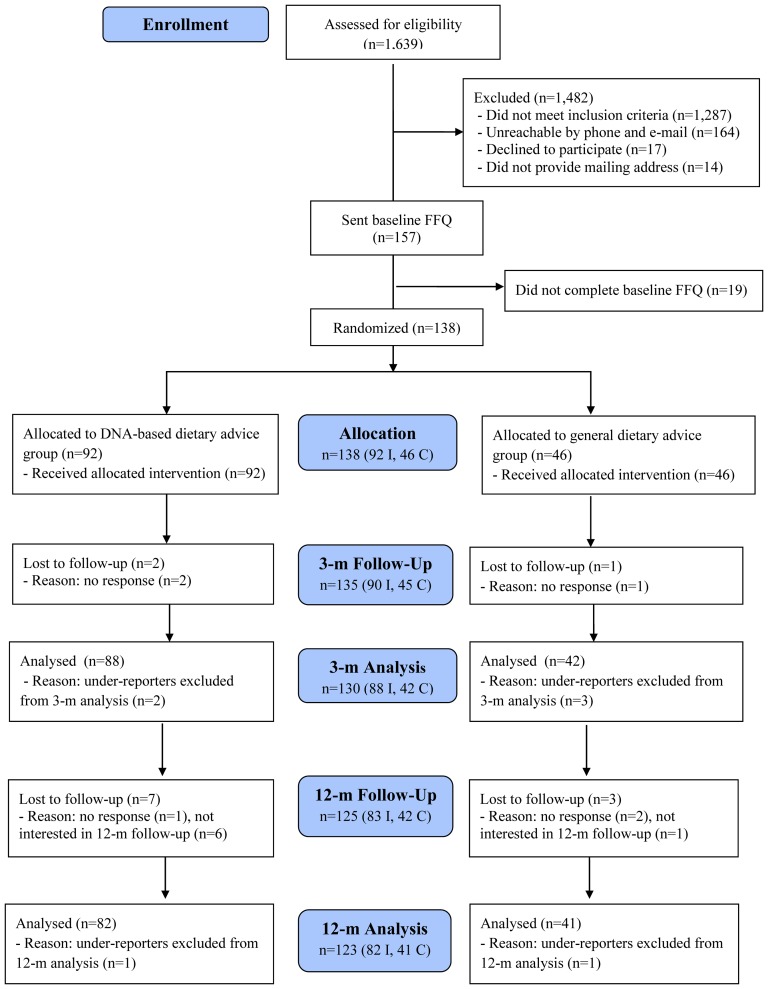
BACKGROUND: Proponents of consumer genetic tests claim that the information can positively impact health behaviors and aid in chronic disease prevention. However, the effects of disclosing genetic information on dietary intake behavior are not clear. METHODS: A double-blinded, parallel group, 2:1 online randomized controlled trial was conducted to determine the short- and long-term effects of disclosing nutrition-related genetic information for personalized nutrition on dietary intakes of caffeine, vitamin C, added sugars, and sodium. Participants were healthy men and women aged 20-35 years (n = 138). The intervention group (n = 92) received personalized DNA-based dietary advice for 12-months and the control group (n = 46) received general dietary recommendations with no genetic information for 12-months. Food frequency questionnaires were collected at baseline and 3- and 12-months after the intervention to assess dietary intakes. General linear models were used to compare changes in intakes between those receiving general dietary advice and those receiving DNA-based dietary advice. RESULTS: Compared to the control group, no significant changes to dietary intakes of the nutrients were observed at 3-months. At 12-months, participants in the intervention group who possessed a risk version of the ACE gene, and were advised to limit their sodium intake, significantly reduced their sodium intake (mg/day) compared to the control group (-287.3 ± 114.1 vs. 129.8 ± 118.2, p = 0.008). Those who had the non-risk version of ACE did not significantly change their sodium intake compared to the control group (12-months: -244.2 ± 150.2, p = 0.11). Among those with the risk version of the ACE gene, the proportion who met the targeted recommendation of 1500 mg/day increased from 19% at baseline to 34% after 12 months (p = 0.06). CONCLUSIONS: These findings demonstrate that disclosing genetic information for personalized nutrition results in greater changes in intake for some dietary components compared to general population-based dietary advice. TRIAL REGISTRATION: ClinicalTrials.gov NCT01353014.
Overview
The claims and statistics of this paper haven’t been checked yet.
Run the check — free, no account needed. It reads the open-access text and checks the sources it cites.
Integrity signals
Registry
Cites
Statistics
Figures
Verification
Claims the paper makes
The claims and statistics of this paper haven’t been checked yet.
Run the check — free, no account needed. It reads the open-access text and checks the sources it cites.
Claims other papers make about this one
Each is checked against this paper’s own text: does it say what the citing paper says it does?
The source backs part of the claim, not all of it — or backs it for a different population, condition or comparison.
In the citing paper
“Some studies identify variants related to lipid, caffeine, and sodium metabolism [145,146].”
From The Seven Methods for the Evaluation of Nutritional Status—ABCDEFG: Narrative Review (2026) · cites this paper as [145]
Experimental — accuracy not yet measuredThe cited source says what the claim attributes to it.
In the citing paper
“Previous PN interventions have achieved improvements in sodium intake in individuals at higher genotypic-based risk (20), however, the Food4Me PoP study was the first to examine the effect of including genotype-based PN on overall patterns of healthy eating.”
From Effect of an Internet-based, personalized nutrition randomized trial on dietary changes associated with the Mediterranean diet: the Food4Me Study (2016) · cites this paper as [20]
Self-check
Percentages, sums and reported differences re-computed from the paper’s own numbers.
The self-check needs the paper’s full text.
Citations
Cites
Genetics of Food Intake Self-Regulation in Childhood: Literature Review and Research Opportunities
Faith, M. S., Carnell, S., & Kral, T. V. E. (2013) · Human Heredity · doi:10.1159/000353879 · Cited by 7,633
Projected effect of dietary salt reductions on future cardiovascular disease
Bibbins-Domingo, K., Chertow, G. M., Coxson, P. G., Moran, A., Lightwood, J. M., Pletcher, M. J., & Goldman, L. (2010) · New England Journal of Medicine · doi:10.1056/nejmoa0907355 · Cited by 1,253
Effects of caffeine on human health
Nawrot, P., Jordan, S., Eastwood, J., Rotstein, J., Hugenholtz, A., & Feeley, M. (2003) · Food Additives and Contaminants · doi:10.1080/0265203021000007840 · Cited by 1,199
Charting a course for genomic medicine from base pairs to bedside
Green, E. D., & Guyer, M. S. (2011) · Nature · doi:10.1038/nature09764 · Cited by 914
Medeiros, D. M. (2007) · American Journal of Clinical Nutrition · doi:10.1093/ajcn/85.3.924 · Cited by 765
Nishida, C., Uauy, R., Kumanyika, S., & Shetty, P. (2004) · Public Health Nutrition · doi:10.1079/phn2003592 · Cited by 744
Effect of Direct-to-Consumer Genomewide Profiling to Assess Disease Risk
Bloss, C. S., Schork, N. J., & Topol, E. J. (2011) · New England Journal of Medicine · doi:10.1056/nejmoa1011893 · Cited by 565
Coffee, CYP1A2 genotype, and risk of myocardial infarction
Cornelis, M. C., El-Sohemy, A., Kabagambe, E. K., & Campos, H. (2006) · JAMA · doi:10.1001/jama.295.10.1135 · Cited by 490 · cited 3×
“Dietary Reports and Recommendations Subjects in the intervention group were genotyped for variants that affect caffeine metabolism (CYP1A2) [18,19], vitamin C utilization (GSTT1 and GSTM1) [17], sweet taste perception (TAS1R2) [20], and sodium-sensitivity (ACE) [21,22] (Table 1).”
MethodSodium Intake in Populations: Assessment of Evidence
Strom, B. L., Yaktine, A. L., Oria, M. P., & Nutrition Board (2013) · Cited by 274
Effects of communicating DNA-based disease risk estimates on risk-reducing behaviours
Marteau, T. M., French, D., Griffin, S. J., Prevost, A. T., Sutton, S. R., Watkinson, C., Attwood, S., & Hollands, G. J. (2010) · Cochrane Database of Systematic Reviews · doi:10.1002/14651858.cd007275.pub2 · Cited by 270
Research works printed but not linked: 1
- National Research Council (2006) Dietary Reference Intakes: The Essential Guide to Nutrient Requirements. The National Academies Press: Washington, DC.
Cited by
Sorted by citations
Items 101–157 of 157
Individualization, Precision Nutrition Developments for the 21st Century
Hazas, M. L. D. L., & Dávalos, A. (2022) · Springer eBooks · doi:10.1007/978-3-031-10153-3_2 · Cited by 2
Fenotypowanie metaboliczne w rozwoju dietetyki spersonalizowanej
Grabowski, M., Barski, J. J., & Liśkiewicz, D. (2020) · Postępy Biochemii · doi:10.18388/pb.2020_329 · Cited by 2
Miles, H., & Barrow, M. (2018) · Current Research in Nutrition and Food Science Journal · doi:10.12944/crnfsj.6.1.06 · Cited by 2
Personalized Nutrition: Making It Happen
Stewart-Knox, B. J., Gibney, E. R., Abrahams, M., Rankin, A., Bryant, E. J., Oliveira, B. M. P. M., & Poínhos, R. (2019) · Elsevier eBooks · doi:10.1016/b978-0-12-816403-7.00010-6 · Cited by 2
The Essential Vitamins: From A to K
Davison, K. (2022) · Nutrition and health · doi:10.1007/978-3-030-82515-7_34 · Cited by 2
Diet–Gene Interactions: Haptoglobin Genotype and Nutrient Status
Cahill, L. E., & Rimm, E. B. (2015) · Springer eBooks · doi:10.1007/978-3-319-22431-2_7 · Cited by 2
Knowledge and Perception of College Students Toward Genetic Testing for Personalized Nutrition Care
Wilkins, J. G. (2017) · OhioLink ETD Center (Ohio Library and Information Network) · Cited by 2
Genetic Modifiers of Caffeine and Endurance Performance in Athletes
Guest, N. S. (2019) · TSpace (University of Toronto) · Cited by 2
Nacis, J. S., Labrador, J. P. H., Ronquillo, D. G. D., Rementilla, J. C., Rodriguez, M. P., Madrid, M. L., Frane, R. D., Santos, N. L. C., Dablo, A. M. F. D., Carrillo, J. J. V., et al. (2025) · medRxiv · doi:10.1101/2025.03.02.25323063 · Cited by 2
King, A., Glaister, M., Lawrence, K., Nixon, J., Pilić, L., & Mavrommatis, Y. (2024) · Nutrition Bulletin · doi:10.1111/nbu.12710 · Cited by 1
Harnessing Personalized Nutrition and Clinical Chemistry: Opportunities to Improve Public Health
Mathers, J. C. (2025) · Clinical Chemistry · doi:10.1093/clinchem/hvaf114 · Cited by 1
Bulczak, E., & Chmurzyńska, A. (2025) · Nutrients · doi:10.3390/nu17203236 · Cited by 1
Human Gut Microbiome in Relation to Food, Nutrition, Health and Disease
Menkovska, M., & Raza, S. (2025) · Advances in Bioscience and Biotechnology · doi:10.4236/abb.2025.1612036 · Cited by 1
Afruza, R. (2026) · Interdisciplinary biotechnological advances · doi:10.1007/978-981-95-3612-2_10 · Cited by 1
Brown, J. E., Hedges, C. P., Plank, L. D., & Braakhuis, A. J. (2026) · Nutrients · doi:10.3390/nu18030400 · Cited by 1
Russo, L., Lentini, N., Farina, S., Cristiano, A., Adduci, A., Perilli, A., Cao, C., Pastorino, R., Boccia, S., & Ioannidis, J. P. A. (2026) · BMJ Medicine · doi:10.1136/bmjmed-2025-002347 · Cited by 1
Singh, C., Sharma, A., Bishnoi, M., Kondepudi, K. K., & Singh, R. P. (2020) · Springer eBooks · doi:10.1007/978-981-15-2874-3_12 · Cited by 1
Dong, O. M. (2021) · Lifestyle Genomics · doi:10.1159/000517760 · Cited by 1
Herawati, M., Muliadi, R. D., Kartawidjajaputra, F., & Suwanto, A. (2024) · Food Research · doi:10.26656/fr.2017.8(3).239 · Cited by 1
Priyadarshini, R. D., & Mahjabeen (2017) · doi:10.35841/nutrition-human-health.1.2.9-12 · Cited by 1
Guidelines to Evaluate the Scientific Validity for Genotype-Based Dietary Advice
Grimaldi, K. A. (2019) · Elsevier eBooks · doi:10.1016/b978-0-12-816403-7.00002-7 · Cited by 1
Moschonis, G., Livingstone, K. M., & Biesiekierski, J. R. (2019) · MDPI eBooks · doi:10.3390/books978-3-03921-446-4 · Cited by 1
The Future for Personalised Nutrition
Mathers, J. C. (2025) · Nutrition Bulletin · doi:10.1111/nbu.70024 · Cited by 1
Nutrigenetics and Nutrigenomic Is Changing the Field of Nutrition
Alpert, P. T. (2015) · Home Health Care Management & Practice · doi:10.1177/1084822314568343
Summaries of the Micronutrient Symposium of the 2016 Meeting of the American College of Nutrition
El‐Sohemy, A., Brewer, G. J., & Prasad, A. S. (2017) · Journal of the American College of Nutrition · doi:10.1080/07315724.2017.1305256
Self-citationMicronutrient Status in Affluent Societies
Troesch, B. (2017) · Springer eBooks · doi:10.1007/978-3-319-55942-1_11
Cogbill, S. J., Louca, P. K., Pilić, L., & Mavrommatis, Y. (2019) · Proceedings of The Nutrition Society · doi:10.1017/s0029665119000727
Horne, J. R. (2020) · Scholarship@Western (Western University)
Is there utility to genetic information in elite sport?
Pickering, C. (2020) · CLOK (University of Central Lancashire) · doi:10.13140/rg.2.2.25902.54081 · Cited by 1
Martin, R. L. (2021) · Lifestyle Genomics · doi:10.1159/000512690
Alev, K., Kütt, A., & Viigimaa, M. (2021) · Frontiers in Digital Health · doi:10.3389/fdgth.2020.567656
Littlejohn, P. T., Cop, I., Brown, E., Afroze, R., & Davison, K. (2018) · doi:10.2196/preprints.9846
Changing lifestyle behaviors with personalized feedback delivered via the Internet
Marsaux, C. F. M. (2016) · Research Publications (Maastricht University) · doi:10.26481/dis.20160420cm
Corella, D. (2018) · MDPI eBooks · doi:10.3390/books978-3-03842-996-8 · Cited by 1
Noninvasive Ventilation Use Among Medicare Beneficiaries at the End of Life
Hung, H. (2021) · Journal of clinical outcomes management · doi:10.12788/jcom.0037
Aguilar-Salinas, C. A. (2019) · Faculty Opinions – Post-Publication Peer Review of the Biomedical Literature · doi:10.3410/f.729078595.793558326
Mateo (2021) · Journal of clinical outcomes management · doi:10.12788/jcom.0038
¿MEJORA LA DIETA BASADA EN EL ADN LOS PARÁMETROS DE SALUD Y LA COMPOSICIÓN CORPORAL?
Arreguín, A., & Ríos-Lugo, M. J. (2024) · Actas del Congreso de Investigación, Desarrollo e Innovación IDI-UNICyT · doi:10.47300/actasidi-unicyt-2023-35
Pharmacogenomics, nutrigenomics, and microbial omics
Vishwakarma, N. P., & Keshavani, S. Z. (2024) · Elsevier eBooks · doi:10.1016/b978-0-443-16092-9.00005-9
Stoian, C.-D., Negru, D.-S., & Niculescu, M. D. (2024) · The Romanian Journal of Nutrition. · doi:10.26416/journutri.1.1.2024.9483
Saputri, R., Muliadi, R. D., Subali, D., Kartawidjajaputra, F., & Suwanto, A. (2024) · Food Research · doi:10.26656/fr.2017.8(4).240
Russo, L., Lentini, N., Farina, S., Cristiano, A., Adduci, A., Perilli, A., Cao, C., Pastorino, R., Boccia, S., & Ioannidis, J. P. A. (2025) · medRxiv · doi:10.1101/2025.11.04.25339466
Livingstone, K. M., Celis-Morales, C., Navas‐Carretero, S., San-Cristóbal, R., Forster, H., Woolhead, C., O’Donovan, C. B., Moschonis, G., Manios, Y., Traczyk, I., et al. (2021) · Figshare · doi:10.6084/m9.figshare.14741093
Livingstone, K. M., Celis-Morales, C., Navas‐Carretero, S., San-Cristóbal, R., Forster, H., Woolhead, C., O’Donovan, C. B., Moschonis, G., Manios, Y., Traczyk, I., et al. (2021) · Figshare · doi:10.6084/m9.figshare.14741078
Livingstone, K. M., Celis-Morales, C., Navas‐Carretero, S., San-Cristóbal, R., Forster, H., Woolhead, C., O’Donovan, C. B., Moschonis, G., Manios, Y., Traczyk, I., et al. (2021) · Figshare · doi:10.6084/m9.figshare.14741081
Livingstone, K. M., Celis-Morales, C., Navas‐Carretero, S., San-Cristóbal, R., Forster, H., Woolhead, C., O’Donovan, C. B., Moschonis, G., Manios, Y., Traczyk, I., et al. (2021) · Figshare · doi:10.6084/m9.figshare.14741090
Livingstone, K. M., Celis-Morales, C., Navas‐Carretero, S., San-Cristóbal, R., Forster, H., Woolhead, C., O’Donovan, C. B., Moschonis, G., Manios, Y., Traczyk, I., et al. (2021) · Figshare · doi:10.6084/m9.figshare.14741084
Livingstone, K. M., Celis-Morales, C., Navas‐Carretero, S., San-Cristóbal, R., Forster, H., Woolhead, C., O’Donovan, C. B., Moschonis, G., Manios, Y., Traczyk, I., et al. (2021) · Figshare · doi:10.6084/m9.figshare.14741075
Livingstone, K. M., Celis-Morales, C., Navas‐Carretero, S., San-Cristóbal, R., Forster, H., Woolhead, C., O’Donovan, C. B., Moschonis, G., Manios, Y., Traczyk, I., et al. (2021) · Figshare · doi:10.6084/m9.figshare.14741096
Livingstone, K. M., Celis-Morales, C., Navas‐Carretero, S., San-Cristóbal, R., Forster, H., Woolhead, C., O’Donovan, C. B., Moschonis, G., Manios, Y., Traczyk, I., et al. (2021) · Figshare · doi:10.6084/m9.figshare.14741087
Future Trends in Nutrigenomics and Food Science
Anila, H. L., & Soumya, P. S. (2026) · Springer eBooks · doi:10.1007/978-3-032-12415-9_11
Chua, S., Mohaghegh, M., Paul, S. P., & Miranda-Soberanis, V. (2026) · Nutrition and Health · doi:10.1177/02601060251415144
PRECISION NUTRITION IN CERTAIN SITUATIONS THAT POSE A RISK OF MALNUTRITION: A COMPREHENSIVE REVIEW
Tokpunar, M. (2026) · Genel Tıp Dergisi · doi:10.54005/geneltip.1750967
Jung, S. H., & Park, Y. K. (2026) · Healthcare · doi:10.3390/healthcare14060766
Guillen-Ahlers, H., Nigam, R., Pekarek, H., Gorden, K. V., O’Brien, F., Ricklefs-Johnson, K., Patel, J. M., & Zhang, Y. (2026) · BMC Nutrition · doi:10.1186/s40795-026-01311-6
Veloudi, P., Loizidou, E. M., Kyriacou, A., Bargiotas, P., Antoniadou, A., Ioannides, M., Bagourdis, A., Δίπλα, Κ., Zafeiridis, A., Karaglani, E., et al. (2026) · Translational Journal of the American College of Sports Medicine · doi:10.1249/tjx.0000000000000361
Genetic modifiers of the Portfolio Diet Score and LDL cholesterol in young adults
Chen, V., Chiavaroli, L., Glenn, A. J., Kavanagh, M. E., Zeitoun, T., Kendall, C. W. C., Jenkins, D., Mahdavi, S. M., El‐Sohemy, A., & Sievenpiper, J. L. (2026) · Nutrition Metabolism and Cardiovascular Diseases · doi:10.1016/j.numecd.2026.104797
Self-citation
Metadata
- Authors
- Nielsen, D. E., & El-Sohemy, A.
- Affiliations
- University of Toronto (CA)
- ORCID
- Nielsen, Daiva E.
- Venue
- PLoS ONE
- Publisher
- Public Library of Science (PLoS)
- Published
- 2014-11-14
- Volume
- 9
- Issue
- 11
- Pages
- e112665
- ISSN
- 1932-6203 (ISSN-L)
- PMC
- PMC4232422
- OpenAlex
- W1989879035
- Cited by
- 157
- References
- 44
- Citations by year
- 2026: 12 · 2025: 11 · 2024: 9 · 2023: 11 · 2022: 11 · 2021: 23 · 2020: 19 · 2019: 16 · 2018: 11 · 2017: 11 · 2016: 20 · 2015: 3
- FWCI
- 7.44
- Type
- journal article
- Language
- en
- Open access
- gold
- doi.org
- Locations
- PLoS ONE (publishedVersion, cc-by)
- PubMed Central (publishedVersion, cc-by)
- PubMed (publishedVersion)
- DOAJ (DOAJ: Directory of Open Access Journals) (submittedVersion)
- Figshare (submittedVersion, cc-by)
- Funders
- Advanced Foods and Materials Network
- Canadian Institutes of Health Research (89829_1)
- Topics
- Life Sciences › Biochemistry, Genetics and Molecular Biology › Genetics › Nutrition, Genetics, and Disease
- Health Sciences › Nursing › Nutrition and Dietetics › Sodium Intake and Health
- Health Sciences › Nursing › Nutrition and Dietetics › Nutrition, Health and Food Behavior
- Keywords
- genetic information disclosure, consumer genetic testing, personalized nutrition, ACE gene, sodium intake, caffeine consumption, vitamin C intake, added sugars, chronic disease prevention
- MeSH terms
- Adult, Diet, Female, Genetic Testing, Humans, Male, Linear Models, Disclosure, Nutrigenomics, Precision Medicine
About these checks
Registry, retraction, Cites and statistics results are computed, not judged, with one exception: a printed reference that no index lists is read once by a model before it counts as a citation error. Claims are extracted by a model and kept only when their quote appears verbatim in the text; each cited source is then checked, with a model’s help, for whether it says what the claim relies on. Those verdicts can be wrong — read the claim’s quote and the cited source before relying on one.
Statistics and arithmetic are recomputed, not judged.
Confidence bands are shown only for fields calibrated on our annotated test set. None is calibrated yet, so no band is shown.
What counts as a claim ›How we measure confidence ›How we check this ›
Are you an author, or do you see a problem with this page? Request a review
