

Measuring Client Experiences in Maternity Care under Change: Development of a Questionnaire Based on the WHO Responsiveness Model
Open accessThe DOI matches its Crossref record; 34 of the 35 references it cites were found in a registry or an index, and 1 are not checked yet.
Abstract
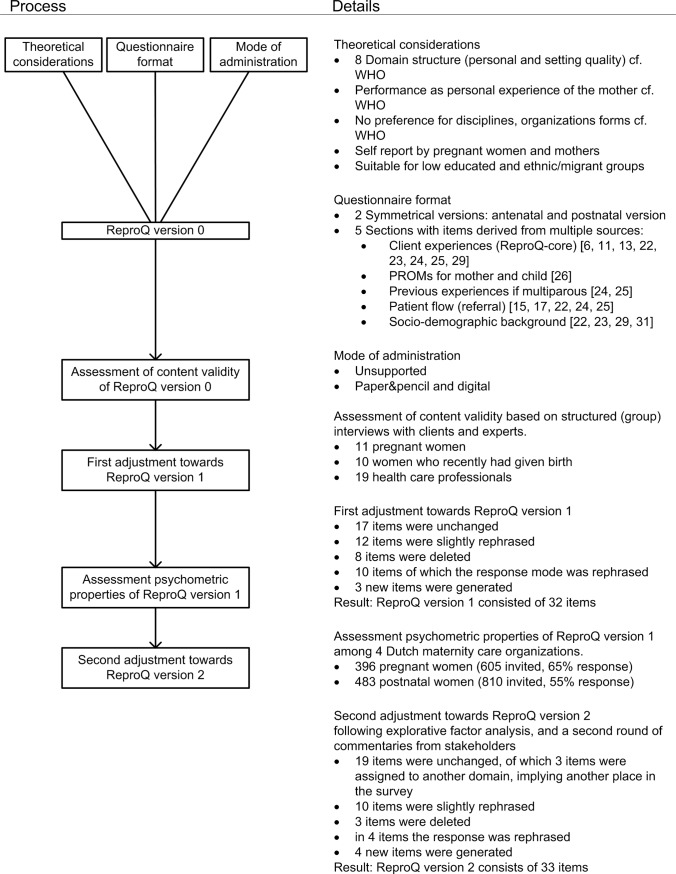
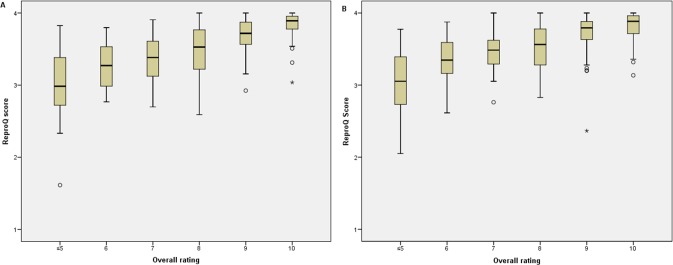
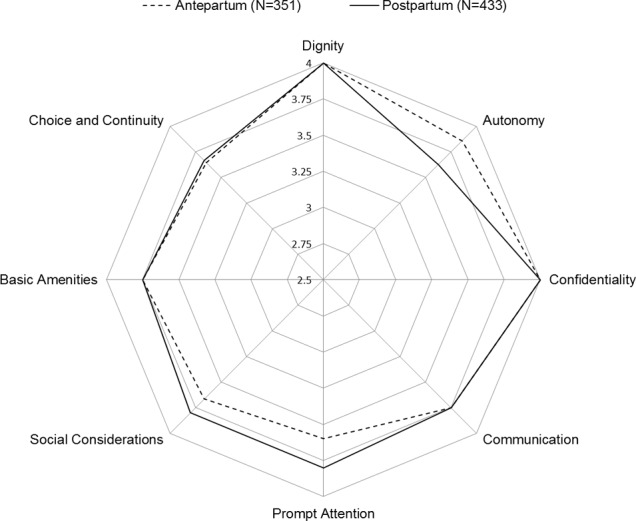
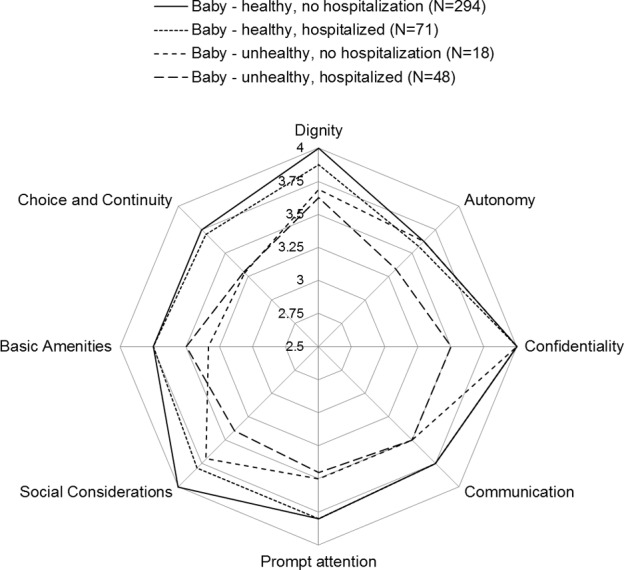
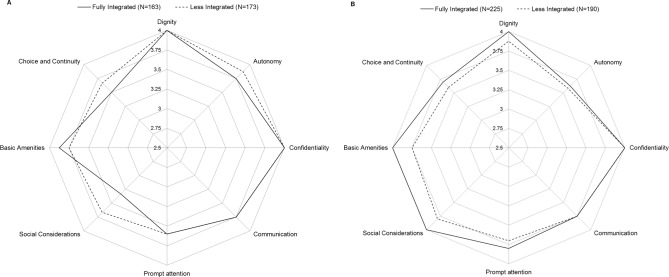
BACKGROUND: Maternity care is an integrated care process, which consists of different services, involves different professionals and covers different time windows. To measure performance of maternity care based on clients' experiences, we developed and validated a questionnaire. METHODS AND FINDINGS: We used the 8-domain WHO Responsiveness model, and previous materials to develop a self-report questionnaire. A dual study design was used for development and validation. Content validity of the ReproQ-version-0 was determined through structured interviews with 11 pregnant women (≥28 weeks), 10 women who recently had given birth (≤12 weeks), and 19 maternity care professionals. Structured interviews established the domain relevance to the women; all items were separately commented on. All Responsiveness domains were judged relevant, with Dignity and Communication ranking highest. Main missing topic was the assigned expertise of the health professional. After first adaptation, construct validity of the ReproQ-version-1 was determined through a web-based survey. Respondents were approached by maternity care organizations with different levels of integration of services of midwives and obstetricians. We sent questionnaires to 605 third trimester pregnant women (response 65%), and 810 women 6 weeks after delivery (response 55%). Construct validity was based on: response patterns; exploratory factor analysis; association of the overall score with a Visual Analogue Scale (VAS), known group comparisons. Median overall ReproQ score was 3.70 (range 1-4) showing good responsiveness. The exploratory factor analysis supported the assumed domain structure and suggested several adaptations. Correlation of the VAS rating and overall ReproQ score (antepartum, postpartum) supported validity (r = 0.56; 0.59, p<0.001 Spearman's correlation coefficient). Pre-stated group comparisons confirmed the expected difference following a good vs. adverse birth outcome. Fully integrated organizations performed slightly better (median = 3.78) than less integrated organizations (median = 3.63; p<0.001). Participation rate of women with a low educational level and/or a non-western origin was low. CONCLUSIONS: The ReproQ appears suitable for assessing quality of maternity care from the clients' perspective. Recruitment of disadvantaged groups requires additional non-digital approaches.
Overview
The claims and statistics of this paper haven’t been checked yet.
Free: it reads the open-access text and checks the first 5 claims that cite a source we can check. Create a free account to check every claim.
Integrity signals
Registry
Cites
Statistics
Figures
Verification
Claims the paper makes
The claims and statistics of this paper haven’t been checked yet.
Free: it reads the open-access text and checks the first 5 claims that cite a source we can check. Create a free account to check every claim.
Claims other papers make about this one
Each is checked against this paper’s own text: does it say what the citing paper says it does?
The cited source says what the claim attributes to it.
In the citing paper
“When able to reach the ANC an important aspect that determines the quality of care is how the women experience the received care (Campbell et al., 2000, van der Kooy et al., 2017, Scheerhagen et al., 2015).”
From Migrant women’s experience of antenatal care in an urban and rural setting in north and North-West Thailand: A cross sectional survey (2025) · cites this paper as Scheerhagen et al., 2015
Self-check
Percentages, sums and reported differences re-computed from the paper’s own numbers.
The self-check needs the paper’s full text.
Citations
Cites
Applied Multivariate Statistics for the Social Sciences
Stevens, J. P. (2012) · Routledge eBooks · doi:10.4324/9780203843130 · Cited by 10,648
Applied multivariate statistics for the social sciences
Stevens, J. P., & Stevens, J. P. (2001) · doi:10.4324/9781410604491 · Cited by 4,993
Patient satisfaction: A review of issues and concepts
Sitzia, J., & Wood, N. (1997) · Social Science & Medicine · doi:10.1016/s0277-9536(97)00128-7 · Cited by 1,690 · cited 1×
“These client experiences with health care provision are supposed to be important for two reasons: 1) client experiences represent an independent outcome of performance, which may guide choices of health care provider if outcomes are similar [6]; 2) client experiences may affect clinical outcomes through several ways,…”
Campbell, S. M., Roland, M. O., & Buetow, S. A. (2000) · Social Science & Medicine · doi:10.1016/s0277-9536(00)00057-5 · Cited by 1,170 · cited 1×
“These client experiences with health care provision are supposed to be important for two reasons: 1) client experiences represent an independent outcome of performance, which may guide choices of health care provider if outcomes are similar [6]; 2) client experiences may affect clinical outcomes through several ways,…”
Patient satisfaction: A valid concept?
Williams, B. (1994) · Social Science & Medicine · doi:10.1016/0277-9536(94)90247-x · Cited by 1,145 · cited 1×
“These client experiences with health care provision are supposed to be important for two reasons: 1) client experiences represent an independent outcome of performance, which may guide choices of health care provider if outcomes are similar [6]; 2) client experiences may affect clinical outcomes through several ways,…”
Health systems performance assessment: debates, methods and empiricism.
Murray, C. J. L., & EVANS, D. B. (2003) · Cited by 855
Wensing, M., Jung, H. P., Mainz, J., Olesen, F., & Grol, R. (1998) · Social Science & Medicine · doi:10.1016/s0277-9536(98)00222-6 · Cited by 369
Preterm birth time trends in Europe: a study of 19 countries
Zeitlin, J., Szamotulska, K., Drewniak, N., Mohangoo, A., Chalmers, J., Sakkeus, L., Irgens, L., Gatt, M., Gissler, M., Blondel, B., et al. (2013) · BJOG: An International Journal of Obstetrics & Gynaecology · doi:10.1111/1471-0528.12281 · Cited by 328
Bobak, M., Pikhart, H., Hertzman, C., Rose, R., & Marmot, M. (1998) · Social Science & Medicine · doi:10.1016/s0277-9536(98)00095-1 · Cited by 318 · cited 1×
“An explanation may be lack of perceived control of these women, which is reflected in reluctance to participate: they do not believe that participation or responding matters [37].”
BackgroundGröne (2001) · doi:10.5334/ijic.28 · Cited by 291
Cited by
A systematic review of the validity and reliability of patient‐reported experience measures
Bull, C., Byrnes, J., Hettiarachchi, R., & Downes, M. (2019) · Health Services Research · doi:10.1111/1475-6773.13187 · Cited by 331
Nilvér, H., Begley, C., & Berg, M. (2017) · BMC Pregnancy and Childbirth · doi:10.1186/s12884-017-1356-y · Cited by 196
“These included: The Childbirth Experience Questionnaire [34], The maternal satisfaction scale for caesarean section [35], The Responsiveness in Perinatal and Obstetric Health Care Questionnaire [36, 37], Pregnancy and maternity care patients experiences questionnaire [38] and The Childbirth Perception Scale [39].”
MethodBohren, M. A., Vogel, J. P., Fawole, B., Maya, E. T., Maung, T. M., Baldé, M. D., Oyeniran, A. A., Ogunlade, M., Adu‐Bonsaffoh, K., Mon, N. O., et al. (2018) · BMC Medical Research Methodology · doi:10.1186/s12874-018-0603-x · Cited by 132
van der Pijl, M. S. G., Kasperink, M., Hollander, M., Verhoeven, C. J. M., Kingma, E., & de Jonge, A. (2021) · PLoS ONE · doi:10.1371/journal.pone.0246697 · Cited by 82
“The data of interest consisted of a sample of Dutch-speaking women who gave birth between 2015–2018 and shared their experiences through a web-based validated questionnaire (ReproQ) [33].”
BackgroundPhommachanh, S., Essink, D. R., Wright, P. E., Broerse, J. E. W., & Mayxay, M. (2021) · PLoS ONE · doi:10.1371/journal.pone.0244181 · Cited by 73
“Food restriction was considered a negative factor here, but in other settings the same practice may mean low intake of unhealthy foods such as sugar, white bread, processed meat, and considered a positive factor for fetal development [52].”
BackgroundClient-centred maternity care from women's perspectives: Need for responsiveness
Petit‐Steeghs, V., Lips, S. R., Schuitmaker‐Warnaar, T. J., & Broerse, J. E. W. (2019) · Midwifery · doi:10.1016/j.midw.2019.03.016 · Cited by 45
Poels, M., van Stel, H. F., Franx, A., & Koster, M. P. H. (2017) · Midwifery · doi:10.1016/j.midw.2017.04.015 · Cited by 48
Self-citationThe perceptions and experiences of women who achieved and did not achieve a waterbirth
Lewis, L. N., Hauck, Y. L., Crichton, C., Barnes, C., Poletti, C., Overing, H., Keyes, L., & Thomson, B. (2018) · BMC Pregnancy and Childbirth · doi:10.1186/s12884-017-1637-5 · Cited by 53
Hitzert, M. F., Hermus, M. A. A., Scheerhagen, M., Boesveld, I. C., Wiegers, T. A., Marle, M. E. V. D. A., van Dommelen, P., Bruin, K. M. V. D. P., & de Graaf, J. P. (2016) · Midwifery · doi:10.1016/j.midw.2016.06.004 · Cited by 46
“The questionnaire avoids any implicit or explicit preference towards the providers or the organizational structures, leaving room to compare different organizational structures and different levels of care (Scheerhagen et al., 2015).”
BackgroundMethodSelf-citationScheerhagen, M., van Stel, H. F., Tholhuijsen, D. J. C., Birnie, E., Franx, A., & Bonsel, G. J. (2016) · PeerJ · doi:10.7717/peerj.2092 · Cited by 38
“Most likely this is selective non-response, as non-Western women report more negative experiences than Western women (Scheerhagen et al., 2015a), and non-Western women are more often low educated and/or more health illiterate (Agyemang et al., 2006; Engelhard, 2007; Fransen, Harris & Essink-Bot,…”
BackgroundMethodInfluentialSelf-citationBeecher, C., Greene, R., O’Dwyer, L., Ryan, E., White, M., Beattie, M., & Devane, D. (2021) · Women and Birth · doi:10.1016/j.wombi.2020.05.002 · Cited by 29
Klootwijk, A., Bakx, P., Franx, A., Bijma, H. H., Ernst‐Smelt, H. E., Ruiter, M. L.-D., Posthumus, A. G., & van Rijn, B. B. (2023) · BMJ Open Quality · doi:10.1136/bmjoq-2022-001922 · Cited by 33
“10–14 Our study uses uniform international PROMs and PREMs specific for pregnancy and childbirth, enabling comparative effectiveness analysis (eg, benchmarking).”
Self-citationBull, C. F., Carrandi, A., Slavin, V., Teede, H. J., & Callander, E. J. (2023) · American Journal of Obstetrics & Gynecology MFM · doi:10.1016/j.ajogmf.2023.101102 · Cited by 25
Peters, I. A., Posthumus, A. G., Steegers, E. A. P., & Denktaş, S. (2019) · PLoS ONE · doi:10.1371/journal.pone.0210506 · Cited by 29
van Stenus, C. M. V., Gotink, M. J., Boere‐Boonekamp, M. M., Sools, A. M., & Need, A. (2017) · BMC Pregnancy and Childbirth · doi:10.1186/s12884-017-1369-6 · Cited by 24
“the antepartum period, labour and childbirth, and the postpartum period) [8].”
BackgroundStapleton, S. R., Wright, J., & Jolles, D. R. (2020) · The Journal of Perinatal & Neonatal Nursing · doi:10.1097/jpn.0000000000000454 · Cited by 23
Maas, V. Y. F., Koster, M. P. H., Ista, E., Auweele, K. V., de Bie, R. W. A., de Smit, D. J., Visser, B. C., van Vliet‐Lachotzki, E. H., Franx, A., & Poels, M. (2020) · BMC Public Health · doi:10.1186/s12889-020-8329-1 · Cited by 19
Self-citationApproaches and geographical locations of respectful maternity care research: A scoping review
Shuman, H. L., Grupp, A. M., Robb, L., Akers, K. G., Bedi, G., Shah, M. A., Janis, A., Caldart, C. G., Gupta, U., Vaghasia, J. K., et al. (2023) · PLoS ONE · doi:10.1371/journal.pone.0290434 · Cited by 20
“The remaining four studies employed diverse research approaches, including analyzing social media content [75], using descriptive phenomenology [76], performing qualitative secondary analysis [74], and developing a questionnaire [77].”
BackgroundSchulz, A. A., & Wirtz, M. A. (2023) · Frontiers in Psychology · doi:10.3389/fpsyg.2023.1143110 · Cited by 22
Clark, E., Vedam, S., Mclean, A., Stoll, K. H., Lo, W., & Hall, W. A. (2022) · Journal of Nursing Measurement · doi:10.1891/jnm-2021-0030 · Cited by 15
Measuring women’s experiences during antenatal care (ANC): scoping review of measurement tools
Mehrtash, H., Stein, K., Barreix, M., Bonet, M., Bohren, M. A., & Tunçalp, Ö. (2023) · Reproductive Health · doi:10.1186/s12978-023-01653-5 · Cited by 17
Client experiences with perinatal healthcare for high-risk and low-risk women
van Stenus, C. M. V., Boere‐Boonekamp, M. M., Kerkhof, E. F. G. M., & Need, A. (2018) · Women and Birth · doi:10.1016/j.wombi.2018.01.006 · Cited by 16
van Stenus, C. M. V., Boere‐Boonekamp, M. M., Kerkhof, E. F. G. M., & Need, A. (2017) · Midwifery · doi:10.1016/j.midw.2017.02.007 · Cited by 14
Development of a survey instrument to evaluate women’s experiences of their maternity care
Beecher, C., Drummond, L., Foley, C., White, M., Greene, R. A., Ryan, E., O’Dwyer, L. M., Dowling, M., & Devane, D. (2020) · Women and Birth · doi:10.1016/j.wombi.2020.07.007 · Cited by 13
Schulz, A. A., & Wirtz, M. A. (2025) · Healthcare · doi:10.3390/healthcare13151798 · Cited by 12
“The dependence on the care setting is attributed to specific characteristics of the healthcare system [34].”
Groenen, C. J. M., Faber, M. J., Kremer, J. A. M., Vandenbussche, F. P. H. A., & van Duijnhoven, N. T. L. (2016) · Trials · doi:10.1186/s13063-016-1326-0 · Cited by 15
“overall scores, ranging from one to four [15].”
BackgroundMethodInfluentialLeahy‐Warren, P., & Nieuwenhuijze, M. J. (2023) · Heliyon · doi:10.1016/j.heliyon.2023.e14591 · Cited by 12
Leijerzapf, D. R., van der Pijl, M. S. G., Hollander, M., Kingma, E., de Jonge, A., & Verhoeven, C. J. M. (2024) · BMC Pregnancy and Childbirth · doi:10.1186/s12884-024-06360-y · Cited by 16
“A study in the Netherlands using four domains of the ReproQ questionnaire (based on the WHO responsiveness model) showed that most postpartum women are positive about patient-provider interaction in maternity care (mean score above 3.5 in a scale 1–4 for every domain) [13, 14].”
MethodInfluentialStojanovski, K., Holla, A., Hoxha, I. S., Howell, E. A., & Janevic, T. M. (2017) · PubMed Central · Cited by 13
Childbirth experience assessment tools based on COSMIN guidelines: A systematic review
Cheng, Y., Bai, R., Shan, S., Zhao, X., & Xia, C. (2024) · International Journal of Nursing Sciences · doi:10.1016/j.ijnss.2024.12.001 · Cited by 8
“However, due to the Cronbach ’ s a co-ef fi cient for individual dimensions in the other four studies [19,28,30,32] were less than 0.7, so the internal consistency was rated as “ inadequate ” .”
InfluentialShared agenda making for quality improvement; towards more synergy in maternity care
Groenen, C. J. M., van Duijnhoven, N. T. L., Kremer, J. A. M., Scheerhagen, M., Vandenbussche, F. P. H. A., & Faber, M. J. (2017) · European Journal of Obstetrics & Gynecology and Reproductive Biology · doi:10.1016/j.ejogrb.2017.10.007 · Cited by 7
Self-citationLagendijk, J., Sijpkens, M. K., Ernst‐Smelt, H. E., Verbiest, S., Been, J. V., & Steegers, E. A. P. (2020) · PLoS ONE · doi:10.1371/journal.pone.0242187 · Cited by 12
Perriman, N., Davis, D. L., & Muggleton, S. (2021) · Women and Birth · doi:10.1016/j.wombi.2021.01.008 · Cited by 9
Measuring clients’ experiences with antenatal care before or after childbirth: it matters
Scheerhagen, M., Birnie, E., Franx, A., van Stel, H. F., & Bonsel, G. J. (2018) · PeerJ · doi:10.7717/peerj.5851 · Cited by 7
Self-citationGap Analysis: Quality and Women's Satisfaction Regarding Postnatal Care
Al-Hussainy, R. H., Fouly, H., & Hashish, E. A. A. (2022) · The Open Nursing Journal · doi:10.2174/18744346-v16-e2204280 · Cited by 9
The discriminative power of the ReproQ: a client experience questionnaire in maternity care
Scheerhagen, M., van Stel, H. F., Franx, A., Birnie, E., & Bonsel, G. J. (2019) · PeerJ · doi:10.7717/peerj.7575 · Cited by 5
Self-citationBeecher, C., Greene, R. A., O’Dwyer, L. M., Ryan, E., White, M., Beattie, M., & Devane, D. (2020) · Systematic Reviews · doi:10.1186/s13643-019-1261-8 · Cited by 7
Coates, R. (2021) · Best Practice & Research Clinical Obstetrics & Gynaecology · doi:10.1016/j.bpobgyn.2021.08.008 · Cited by 8
“A thorough systematic review and evaluation of the psychometric properties of 36 measures of childbirth experience suggested the following tools had the highest scores indicating that they were valid and reliable(14): The Childbirth Experience Questionnaire (15); The Responsiveness in Perinatal and Obstetric Health Ca…”
MethodEffects of a Personal Health Record in Maternity Care: A Stepped-Wedge Trial
Groenen, C. J. M., Kremer, J. A. M., IntHout, J., Meinders, M. J., van Duijnhoven, N. T. L., & Vandenbussche, F. P. H. A. (2021) · International Journal of Environmental Research and Public Health · doi:10.3390/ijerph181910343 · Cited by 6
Prins, T. J., Rueanprasert, N., Misa, P., Puttanusegsan, A., Aung, J. K. K., Herber, N., Myo, M., Rijken, M. J., van Vugt, M., Angkurawaranon, C., et al. (2025) · Journal of Migration and Health · doi:10.1016/j.jmh.2025.100333 · Cited by 4
“Part two consisted of the questions of the REPRO-Q (van der Kooy et al., 2017, Scheerhagen et al., 2015, Van Der Kooy et al., 2014).”
Women’s reported experience of respectful maternity care measures worldwide: a systematic review
Roga, E. Y., Moti, G., Chaka, E. E., Gabriel, L., Creedy, D. K., & Hastie, C. R. (2026) · BMC Public Health · doi:10.1186/s12889-026-27157-y · Cited by 3
“The Childbirth Abuse and Respect Evaluation-Maternal Questionnaire (CARE-MP) [52], CHOICES [43] and ReproQ-Dutch [73, 74, 84] demonstrated moderate overall quality of content validity, indicating that women reported the content to be significant, complete, and clear.”
Negash, A., Tenkolu, G., Mamo, Z. B., & Tewoldie, M. T. (2022) · International Journal of Africa Nursing Sciences · doi:10.1016/j.ijans.2022.100514 · Cited by 2
de Groot, N., Bijma, H. H., Bonsel, G. J., & den Berg, M. P. L. (2018) · Midwifery · doi:10.1016/j.midw.2018.09.003 · Cited by 2
Self-citationKepuasan Pasien Post Partum terhadap Kualitas Hidup di Ruang Bersalin
Purnanda, A., Utamie, H. M., & Mulyanti, D. (2023) · Jurnal Sains dan Kesehatan · doi:10.57214/jusika.v7i1.272 · Cited by 1
Young, K., & Miller, Y. D. (2023) · Birth · doi:10.1111/birt.12762 · Cited by 1
Subramanian, L., Oluoch, D., Maina, M., Mutua, E., Bobanski, L., Canfora, M., Jepkosgei, J., Jepkosgei, J., Karingu, P., Chesang, C., et al. (2025) · PLOS Global Public Health · doi:10.1371/journal.pgph.0004845 · Cited by 1
“…and families, and while they are satisfied and grateful for the care they receive (consistent with prior studies on maternity care satisfaction [27, 45, 46] quality of care gaps for birth complications can negatively impact mothers’ wellbeing and exacerbate recovery challenges after discharge.”
Dysplastische heupontwikkeling: ervaringen van ouders met de screening door de jeugdgezondheidszorg
Berkenbosch, T. S., Ronde, T., Konijnendijk, A., & Boere‐Boonekamp, M. M. (2016) · JGZ Tijdschrift voor jeugdgezondheidszorg · doi:10.1007/s12452-016-0059-5
Hitzert, M. F., Boesveld, I. C., Hermus, M. A. A., de Graaf, J. P., Wiegers, T. A., Steegers, E. A. P., Meijboom, B. R., & Akkermans, H. A. (2018) · Journal of Evaluation in Clinical Practice · doi:10.1111/jep.12939
Wildschut, H. I. J., de Jonge, A., Denktaş, S., Achterberg, P. W., Truijens, S. E. M., Boesveld, I. C., & de Winter, G. (2018) · Bohn Stafleu van Loghum eBooks · doi:10.1007/978-90-368-2202-2_5
van der Pijl, M. S. G. (2023) · doi:10.5463/thesis.36 · Cited by 1
Lambermon, F. J., van Duijnhoven, N. T. L., Dedding, C. W. M., & Kremer, J. A. M. (2024) · Birth · doi:10.1111/birt.12824 · Cited by 1
Aboushady, A. T., Seddik, S. A., Ateek, A. E., Qareh, N. M. E., Ramadan, A., Atta, R. M., Shaban, N. A. A.-F., & Hegazy, A. A. (2025) · Journal of Public Health Research · doi:10.1177/22799036251399280
Leijerzapf, D. R., van der Pijl, M. S. G., Hollander, M., Kingma, E., de Jonge, A., & Verhoeven, C. J. M. (2024) · Figshare · doi:10.6084/m9.figshare.26687079
Leijerzapf, D. R., van der Pijl, M. S. G., Hollander, M., Kingma, E., de Jonge, A., & Verhoeven, C. J. M. (2024) · Figshare · doi:10.6084/m9.figshare.26687085
Leijerzapf, D. R., van der Pijl, M. S. G., Hollander, M., Kingma, E., de Jonge, A., & Verhoeven, C. J. M. (2024) · Figshare · doi:10.6084/m9.figshare.26687082
Taimeh, D., Ríordáin, R. N., Fedele, S., & Leeson, R. (2026) · Oral Surgery Oral Medicine Oral Pathology and Oral Radiology · doi:10.1016/j.oooo.2026.01.007
Chabbert, M. (2020) · theses.fr (ABES) · doi:10.70675/6a0d17e1zd4e1z4bcfz9a29zec72cb0995b7 · Cited by 1
Simmelink, R., Martín-Arribas, A., Hermsen, B. B. J., van der Pijl, M. S. G., Henrichs, J., Verhoeven, C. J. M., & de Jonge, A. (2026) · Birth · doi:10.1111/birt.70117
Metadata
- Authors
- Scheerhagen, M., van Stel, H. F., Birnie, E., Franx, A., & Bonsel, G. J.
- Affiliations
- Erasmus MC (NL)
- Erasmus University Rotterdam (NL)
- University Medical Center Utrecht (NL)
- Venue
- PLoS ONE
- Publisher
- Public Library of Science (PLoS)
- Published
- 2015-02-11
- Volume
- 10
- Issue
- 2
- Pages
- e0117031
- ISSN
- 1932-6203 (ISSN-L)
- PMC
- PMC4324965
- OpenAlex
- W1992305088
- Cited by
- 67
- References
- 35
- Citations by year
- 2026: 3 · 2025: 4 · 2024: 6 · 2023: 9 · 2022: 3 · 2021: 5 · 2020: 7 · 2019: 8 · 2018: 10 · 2017: 6 · 2016: 6
- FWCI
- 13.41
- Type
- journal article
- Language
- en
- Open access
- gold
- doi.org
- Licence
- Locations
- PLoS ONE (publishedVersion, cc-by)
- PubMed Central (publishedVersion, cc-by)
- PubMed (publishedVersion)
- EUR Research Repository (Erasmus University Rotterdam) (publishedVersion, other-oa)
- EUR Research Repository (Erasmus University Rotterdam) (submittedVersion, other-oa)
- RePub (Erasmus University Rotterdam) (submittedVersion, other-oa)
- RePEc: Research Papers in Economics (submittedVersion)
- DOAJ (DOAJ: Directory of Open Access Journals) (submittedVersion, cc-by-sa)
- Utrecht University Repository (Utrecht University) (submittedVersion, other-oa)
- Topics
- Health Sciences › Health Professions › General Health Professions › Patient Satisfaction in Healthcare
- Health Sciences › Medicine › Obstetrics and Gynecology › Maternal and Perinatal Health Interventions
- Health Sciences › Nursing › Research and Theory › Health Education and Validation
- Keywords
- obstetric care, customer experience, patient-reported quality of care, postpartum care, antepartum care, content validity, construct validity, patient recruitment, disadvantaged groups
- MeSH terms
- Adult, Female, Humans, Maternal Health Services, Pregnancy, Psychometrics, Surveys and Questionnaires, World Health Organization, Models, Statistical, Program Evaluation, Patient Satisfaction, Young Adult, Self Report
About these checks
Registry, retraction, Cites and statistics results are computed, not judged, with one exception: a printed reference that no index lists is read once by a model before it counts as a citation error. Claims are extracted by a model and kept only when their quote appears verbatim in the text; each cited source is then checked, with a model’s help, for whether it says what the claim relies on. Those verdicts can be wrong — read the claim’s quote and the cited source before relying on one.
Statistics and arithmetic are recomputed, not judged.
Confidence bands are shown only for fields calibrated on our annotated test set. None is calibrated yet, so no band is shown.
What counts as a claim ›How we measure confidence ›How we check this ›
Are you an author, or do you see a problem with this page? Request a review
Data sources
Bibliographic data: Semantic Scholar, OpenAlex, Crossref.
Contains information from the Semantic Scholar Academic Graph Datasets, made available under the ODC Attribution License (ODC-BY 1.0).
Semantic Scholar’s data is described in: Kinney, R., et al. (2023). The Semantic Scholar Open Data Platform. arXiv:2301.10140.
