

Measuring Client Experiences in Maternity Care under Change: Development of a Questionnaire Based on the WHO Responsiveness Model
Open accessThe DOI matches its Crossref record; 34 of the 35 references it cites were found in a registry or an index, and 1 are not checked yet.
Abstract
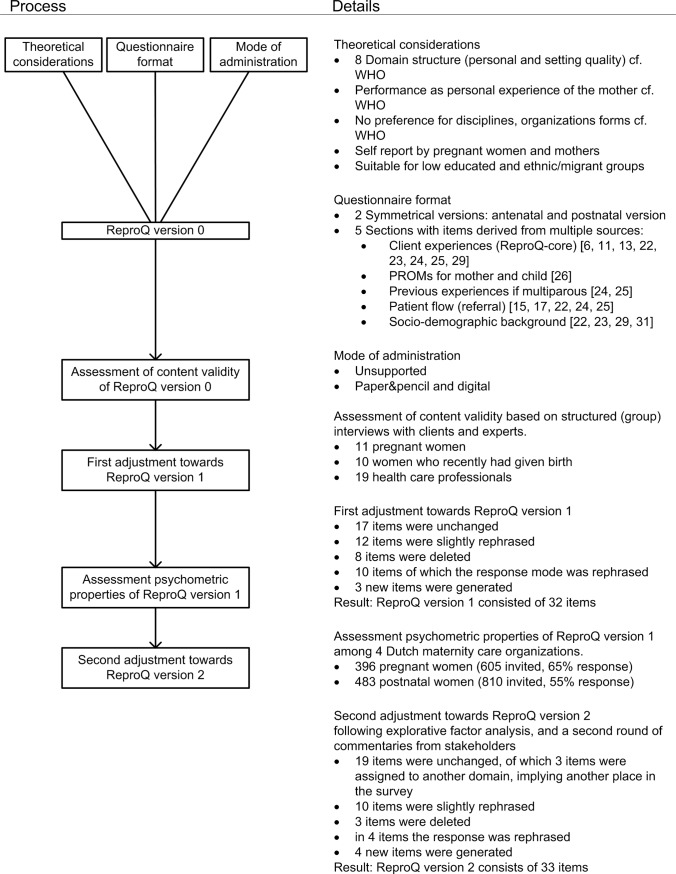
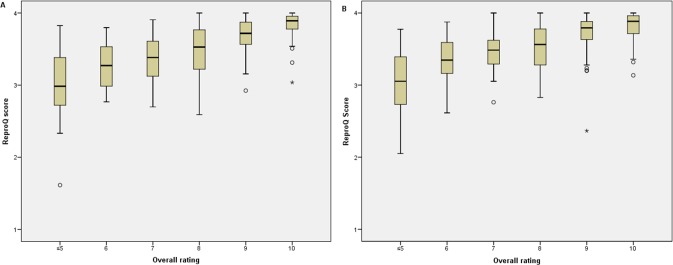
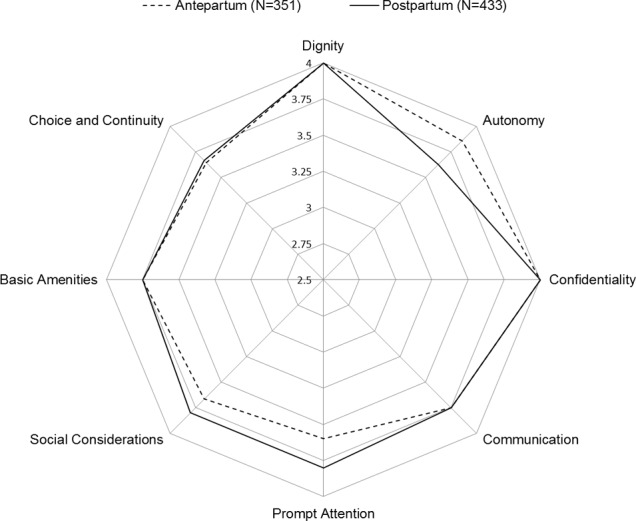
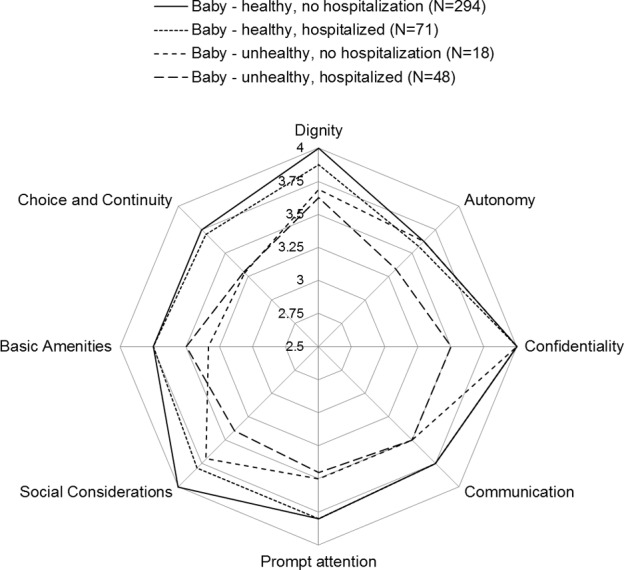
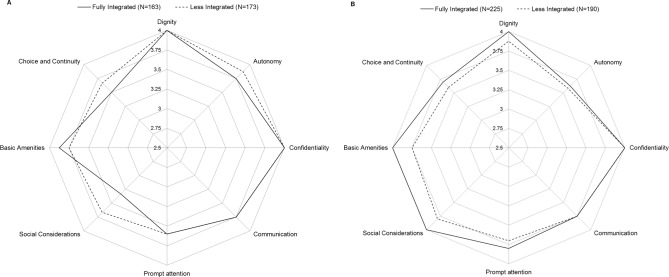
BACKGROUND: Maternity care is an integrated care process, which consists of different services, involves different professionals and covers different time windows. To measure performance of maternity care based on clients' experiences, we developed and validated a questionnaire. METHODS AND FINDINGS: We used the 8-domain WHO Responsiveness model, and previous materials to develop a self-report questionnaire. A dual study design was used for development and validation. Content validity of the ReproQ-version-0 was determined through structured interviews with 11 pregnant women (≥28 weeks), 10 women who recently had given birth (≤12 weeks), and 19 maternity care professionals. Structured interviews established the domain relevance to the women; all items were separately commented on. All Responsiveness domains were judged relevant, with Dignity and Communication ranking highest. Main missing topic was the assigned expertise of the health professional. After first adaptation, construct validity of the ReproQ-version-1 was determined through a web-based survey. Respondents were approached by maternity care organizations with different levels of integration of services of midwives and obstetricians. We sent questionnaires to 605 third trimester pregnant women (response 65%), and 810 women 6 weeks after delivery (response 55%). Construct validity was based on: response patterns; exploratory factor analysis; association of the overall score with a Visual Analogue Scale (VAS), known group comparisons. Median overall ReproQ score was 3.70 (range 1-4) showing good responsiveness. The exploratory factor analysis supported the assumed domain structure and suggested several adaptations. Correlation of the VAS rating and overall ReproQ score (antepartum, postpartum) supported validity (r = 0.56; 0.59, p<0.001 Spearman's correlation coefficient). Pre-stated group comparisons confirmed the expected difference following a good vs. adverse birth outcome. Fully integrated organizations performed slightly better (median = 3.78) than less integrated organizations (median = 3.63; p<0.001). Participation rate of women with a low educational level and/or a non-western origin was low. CONCLUSIONS: The ReproQ appears suitable for assessing quality of maternity care from the clients' perspective. Recruitment of disadvantaged groups requires additional non-digital approaches.
Overview
The claims and statistics of this paper haven’t been checked yet.
Free: it reads the open-access text and checks the first 5 claims that cite a source we can check. Create a free account to check every claim.
Integrity signals
Registry
Cites
Statistics
Figures
Verification
Claims the paper makes
The claims and statistics of this paper haven’t been checked yet.
Free: it reads the open-access text and checks the first 5 claims that cite a source we can check. Create a free account to check every claim.
Claims other papers make about this one
Each is checked against this paper’s own text: does it say what the citing paper says it does?
The cited source says what the claim attributes to it.
In the citing paper
“When able to reach the ANC an important aspect that determines the quality of care is how the women experience the received care (Campbell et al., 2000, van der Kooy et al., 2017, Scheerhagen et al., 2015).”
From Migrant women’s experience of antenatal care in an urban and rural setting in north and North-West Thailand: A cross sectional survey (2025) · cites this paper as Scheerhagen et al., 2015
Self-check
Percentages, sums and reported differences re-computed from the paper’s own numbers.
The self-check needs the paper’s full text.
Citations
Cites
Applied Multivariate Statistics for the Social Sciences
Stevens, J. P. (2012) · Routledge eBooks · doi:10.4324/9780203843130 · Cited by 10,648
Applied multivariate statistics for the social sciences
Stevens, J. P., & Stevens, J. P. (2001) · doi:10.4324/9781410604491 · Cited by 4,993
Patient satisfaction: A review of issues and concepts
Sitzia, J., & Wood, N. (1997) · Social Science & Medicine · doi:10.1016/s0277-9536(97)00128-7 · Cited by 1,690 · cited 1×
“These client experiences with health care provision are supposed to be important for two reasons: 1) client experiences represent an independent outcome of performance, which may guide choices of health care provider if outcomes are similar [6]; 2) client experiences may affect clinical outcomes through several ways,…”
Campbell, S. M., Roland, M. O., & Buetow, S. A. (2000) · Social Science & Medicine · doi:10.1016/s0277-9536(00)00057-5 · Cited by 1,170 · cited 1×
“These client experiences with health care provision are supposed to be important for two reasons: 1) client experiences represent an independent outcome of performance, which may guide choices of health care provider if outcomes are similar [6]; 2) client experiences may affect clinical outcomes through several ways,…”
Patient satisfaction: A valid concept?
Williams, B. (1994) · Social Science & Medicine · doi:10.1016/0277-9536(94)90247-x · Cited by 1,145 · cited 1×
“These client experiences with health care provision are supposed to be important for two reasons: 1) client experiences represent an independent outcome of performance, which may guide choices of health care provider if outcomes are similar [6]; 2) client experiences may affect clinical outcomes through several ways,…”
Health systems performance assessment: debates, methods and empiricism.
Murray, C. J. L., & EVANS, D. B. (2003) · Cited by 855
Wensing, M., Jung, H. P., Mainz, J., Olesen, F., & Grol, R. (1998) · Social Science & Medicine · doi:10.1016/s0277-9536(98)00222-6 · Cited by 369
Preterm birth time trends in Europe: a study of 19 countries
Zeitlin, J., Szamotulska, K., Drewniak, N., Mohangoo, A., Chalmers, J., Sakkeus, L., Irgens, L., Gatt, M., Gissler, M., Blondel, B., et al. (2013) · BJOG: An International Journal of Obstetrics & Gynaecology · doi:10.1111/1471-0528.12281 · Cited by 328
Bobak, M., Pikhart, H., Hertzman, C., Rose, R., & Marmot, M. (1998) · Social Science & Medicine · doi:10.1016/s0277-9536(98)00095-1 · Cited by 318 · cited 1×
“An explanation may be lack of perceived control of these women, which is reflected in reluctance to participate: they do not believe that participation or responding matters [37].”
BackgroundGröne (2001) · doi:10.5334/ijic.28 · Cited by 291
Discount Functions and the Measurement of Patients' Values: Women's Decisions During Childbirth
Christensen-Szalanski, J. J. J. (1984) · Medical Decision Making · doi:10.1177/0272989x8400400108 · Cited by 209 · cited 2×
“To prevent cross-over effects from labour and birth to the antenatal experiences [28], we created two separate questionnaires to measure the experiences during pregnancy and the experiences during delivery and postpartum care.”
BackgroundMethodAssessing Quality in Obstetrical Care: Development of Standardized Measures
Mann, S., Pratt, S., Gluck, P., Nielsen, P., Risser, D., Greenberg, P., Marcus, R., Goldman, M., Shapiro, D., Pearlman, M., et al. (2006) · The Joint Commission Journal on Quality and Patient Safety · doi:10.1016/s1553-7250(06)32065-x · Cited by 165
Delivered With Care. A National Survey of Women's Experience of Maternity Care 2010
Redshaw, M., & Heikkilä, K. (2010) · LSHTM Research Online (London School of Hygiene and Tropical Medicine) · Cited by 149
The quality of maternity care services as experienced by women in the Netherlands
Wiegers, T. A. (2009) · BMC Pregnancy and Childbirth · doi:10.1186/1471-2393-9-18 · Cited by 146
Mohangoo, A. D., Buitendijk, S. E., Szamotulska, K., Chalmers, J., Irgens, L. M., Bolumar, F., Nijhuis, J. G., Zeitlin, J., & the Euro-Peristat Scientific Committee (2011) · PLoS ONE · doi:10.1371/journal.pone.0024727 · Cited by 99
The Canadian maternity experiences survey: design and methods.
Dzakpasu, S., Kaczorowski, J., Chalmers, B., Heaman, M., Duggan, J., & Neusy, E. (2008) · Journal of Obstetrics and Gynaecology Canada · doi:10.1016/s1701-2163(16)32757-8 · Cited by 99
Zeitlin, J., Mohangoo, A. D., Delnord, M., Cuttini, M., & the EURO-PERISTAT Scientific Committee (2013) · Journal of Epidemiology and Community Health · doi:10.1136/jech-2013-203291 · Cited by 99 · cited 2×
“Such outcomes differ globally, countrywise, and also within countries where health care quality differences may be in part responsible [1–5].”
Peterson, W. E., Charles, C., DiCenso, A., & Sword, W. A. (2005) · Journal of Advanced Nursing · doi:10.1111/j.1365-2648.2005.03634.x · Cited by 95
Smith, L. F. P. (2001) · Quality in Health Care · doi:10.1136/qhc.10.1.17 · Cited by 91 · cited 1×
“The effect that participants rarely use the most negative response modus, is known from other self-report instruments in maternity care and may be partially caused by the fact that pregnancy and childbirth are not a disease and generally have good outcome [23,34–36].”
Valentine, N., Bonsel, G. J., & Murray, C. (2007) · Quality of Life Research · doi:10.1007/s11136-007-9189-1 · Cited by 84 · cited 3×
“extensive testing during its development and thereafter [6,13].”
BackgroundMethodSelf-citationAgyemang, C. O., Denktaş, S., Bruijnzeels, M. A., & Foets, M. (2006) · Public Health · doi:10.1016/j.puhe.2006.03.002 · Cited by 80
Persisting Rise in Referrals During Labor in Primary Midwife‐led Care in The Netherlands
Offerhaus, P. M., Hukkelhoven, C. W. P. M., de Jonge, A., Bruin, K. M. V. D. P., Scheepers, P. L. H., & Lagro-Janssen, A. L. M. (2013) · Birth · doi:10.1111/birt.12055 · Cited by 67 · cited 1×
“This is particularly true in the Netherlands where currently the maternity care is changing from a two-tier system to an integrated care system [14–18].”
Living in deprived urban districts increases perinatal health inequalities
de Graaf, J. P., Ravelli, A. C. J., de Haan, M. A. M., Steegers, E. A. P., & Bonsel, G. J. (2013) · The Journal of Maternal-Fetal & Neonatal Medicine · doi:10.3109/14767058.2012.735722 · Cited by 65
Self-citationChristiaens, W., Gouwy, A., & Bracke, P. (2007) · BMC Health Services Research · doi:10.1186/1472-6963-7-109 · Cited by 59
Decreasing perinatal mortality in The Netherlands, 2000–2006: a record linkage study
Ravelli, A. C. J., Tromp, M., van Huis, M., Steegers, E. A. P., Tamminga, P., Eskes, M., & Bonsel, G. J. (2009) · Journal of Epidemiology and Community Health · doi:10.1136/jech.2008.080440 · Cited by 57
Self-citationAn approach to measuring quality of midwifery care
Wiegers, T. A., Keirse, M. J. N. C., Berghs, G. A. H., & van der Zee, J. (1996) · Journal of Clinical Epidemiology · doi:10.1016/0895-4356(95)00549-8 · Cited by 52 · cited 1×
“The Dutch Consumer Quality Index for primary maternity care [24] and a similar survey for postnatal care [25] focus on the care delivered by one professional group (community midwife, maternity nurse) for specific phases (antenatal, delivery, first postnatal week) assuming monodisciplinary care as standard, i.”
MethodTransfer from Home to Hospital: What Is Its Effect on the Experience of Childbirth?
Wiegers, T. A., Zee, J. V. D., & Keirse, M. J. N. C. (1998) · Birth · doi:10.1046/j.1523-536x.1998.00019.x · Cited by 51
Smith, L. F. (2011) · British Journal of General Practice · doi:10.3399/bjgp11x601334 · Cited by 41
[Perinatal mortality in The Netherlands 2000-2006; risk factors and risk selection].
Ravelli, A. C. J., Eskes, M., Tromp, M., van Huis, A. M., Steegers, E. A. P., Tamminga, P., & Bonsel, G. J. (2008) · PubMed · Cited by 33
Self-citationFransen, M. P., Harris, V., & Essink‐Bot, M. (2013) · PubMed · Cited by 30
Regional differences in Dutch maternal mortality
de Graaf, J., Schutte, J., Poeran, J. J., van Roosmalen, J., Bonsel, G. J., & Steegers, E. (2012) · BJOG An International Journal of Obstetrics & Gynaecology · doi:10.1111/j.1471-0528.2012.03283.x · Cited by 26
Self-citationOfferhaus, P. M., de Jonge, A., Bruin, K. M. V. D. P., Hukkelhoven, C. W. P. M., Scheepers, P. L. H., & Lagro-Janssen, A. L. M. (2013) · Midwifery · doi:10.1016/j.midw.2013.06.013 · Cited by 22
Preterm Birth Time Trends in Europe
Zeitlin, J. A., Szamotulska, K., Drewniak, N., Hindori‐Mohangoo, A. D., Chalmers, J. C., Sakkeus, L., Irgens, L. M., Gatt, M., Gissler, M., & Blondel, B. (2014) · Obstetric Anesthesia Digest · doi:10.1097/01.aoa.0000455581.02695.03 · Cited by 16
Management of Acquired Haemophilia Bleed in the Backdrop of Multiple Myeloma
Ross, C. R., Kuriakose, K., Aswath, G., et al. (2013) · Indian Journal of Hematology and Blood Transfusion · doi:10.1007/s12288-013-0266-z · Cited by 6
Regional Differences in Dutch Maternal Mortality
de Graaf, J. P., Schutte, J. M., Poeran, J. J., van Roosmalen, J., Bonsel, G. J., & Steegers, E. (2013) · Obstetric Anesthesia Digest · doi:10.1097/01.aoa.0000432354.53722.26 · Cited by 5
Self-citation
Cited by
A systematic review of the validity and reliability of patient‐reported experience measures
Bull, C., Byrnes, J., Hettiarachchi, R., & Downes, M. (2019) · Health Services Research · doi:10.1111/1475-6773.13187 · Cited by 331
Nilvér, H., Begley, C., & Berg, M. (2017) · BMC Pregnancy and Childbirth · doi:10.1186/s12884-017-1356-y · Cited by 196
“These included: The Childbirth Experience Questionnaire [34], The maternal satisfaction scale for caesarean section [35], The Responsiveness in Perinatal and Obstetric Health Care Questionnaire [36, 37], Pregnancy and maternity care patients experiences questionnaire [38] and The Childbirth Perception Scale [39].”
MethodBohren, M. A., Vogel, J. P., Fawole, B., Maya, E. T., Maung, T. M., Baldé, M. D., Oyeniran, A. A., Ogunlade, M., Adu‐Bonsaffoh, K., Mon, N. O., et al. (2018) · BMC Medical Research Methodology · doi:10.1186/s12874-018-0603-x · Cited by 132
van der Pijl, M. S. G., Kasperink, M., Hollander, M., Verhoeven, C. J. M., Kingma, E., & de Jonge, A. (2021) · PLoS ONE · doi:10.1371/journal.pone.0246697 · Cited by 82
“The data of interest consisted of a sample of Dutch-speaking women who gave birth between 2015–2018 and shared their experiences through a web-based validated questionnaire (ReproQ) [33].”
BackgroundPhommachanh, S., Essink, D. R., Wright, P. E., Broerse, J. E. W., & Mayxay, M. (2021) · PLoS ONE · doi:10.1371/journal.pone.0244181 · Cited by 73
“Food restriction was considered a negative factor here, but in other settings the same practice may mean low intake of unhealthy foods such as sugar, white bread, processed meat, and considered a positive factor for fetal development [52].”
Background
Metadata
- Authors
- Scheerhagen, M., van Stel, H. F., Birnie, E., Franx, A., & Bonsel, G. J.
- Affiliations
- Erasmus MC (NL)
- Erasmus University Rotterdam (NL)
- University Medical Center Utrecht (NL)
- Venue
- PLoS ONE
- Publisher
- Public Library of Science (PLoS)
- Published
- 2015-02-11
- Volume
- 10
- Issue
- 2
- Pages
- e0117031
- ISSN
- 1932-6203 (ISSN-L)
- PMC
- PMC4324965
- OpenAlex
- W1992305088
- Cited by
- 67
- References
- 35
- Citations by year
- 2026: 3 · 2025: 4 · 2024: 6 · 2023: 9 · 2022: 3 · 2021: 5 · 2020: 7 · 2019: 8 · 2018: 10 · 2017: 6 · 2016: 6
- FWCI
- 13.41
- Type
- journal article
- Language
- en
- Open access
- gold
- doi.org
- Licence
- Locations
- PLoS ONE (publishedVersion, cc-by)
- PubMed Central (publishedVersion, cc-by)
- PubMed (publishedVersion)
- EUR Research Repository (Erasmus University Rotterdam) (publishedVersion, other-oa)
- EUR Research Repository (Erasmus University Rotterdam) (submittedVersion, other-oa)
- RePub (Erasmus University Rotterdam) (submittedVersion, other-oa)
- RePEc: Research Papers in Economics (submittedVersion)
- DOAJ (DOAJ: Directory of Open Access Journals) (submittedVersion, cc-by-sa)
- Utrecht University Repository (Utrecht University) (submittedVersion, other-oa)
- Topics
- Health Sciences › Health Professions › General Health Professions › Patient Satisfaction in Healthcare
- Health Sciences › Medicine › Obstetrics and Gynecology › Maternal and Perinatal Health Interventions
- Health Sciences › Nursing › Research and Theory › Health Education and Validation
- Keywords
- obstetric care, customer experience, patient-reported quality of care, postpartum care, antepartum care, content validity, construct validity, patient recruitment, disadvantaged groups
- MeSH terms
- Adult, Female, Humans, Maternal Health Services, Pregnancy, Psychometrics, Surveys and Questionnaires, World Health Organization, Models, Statistical, Program Evaluation, Patient Satisfaction, Young Adult, Self Report
About these checks
Registry, retraction, Cites and statistics results are computed, not judged, with one exception: a printed reference that no index lists is read once by a model before it counts as a citation error. Claims are extracted by a model and kept only when their quote appears verbatim in the text; each cited source is then checked, with a model’s help, for whether it says what the claim relies on. Those verdicts can be wrong — read the claim’s quote and the cited source before relying on one.
Statistics and arithmetic are recomputed, not judged.
Confidence bands are shown only for fields calibrated on our annotated test set. None is calibrated yet, so no band is shown.
What counts as a claim ›How we measure confidence ›How we check this ›
Are you an author, or do you see a problem with this page? Request a review
Data sources
Bibliographic data: Semantic Scholar, OpenAlex, Crossref.
Contains information from the Semantic Scholar Academic Graph Datasets, made available under the ODC Attribution License (ODC-BY 1.0).
Semantic Scholar’s data is described in: Kinney, R., et al. (2023). The Semantic Scholar Open Data Platform. arXiv:2301.10140.
