

The DOI matches its Crossref record; 26 of the 26 references it cites were found in a registry or an index.
Declining Incidence of Candidemia and the Shifting Epidemiology of Candida Resistance in Two US Metropolitan Areas, 2008–2013: Results from Population-Based Surveillance
Open accessAbstract
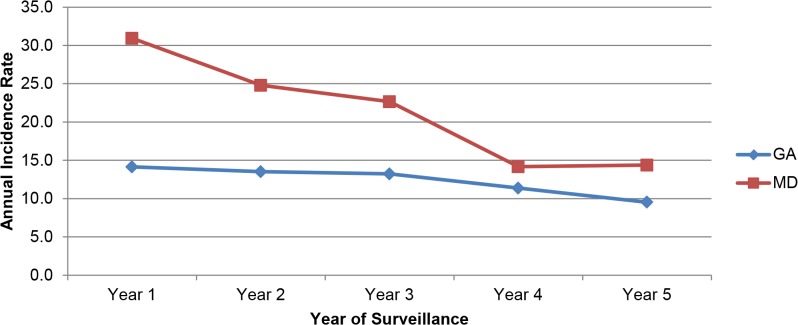
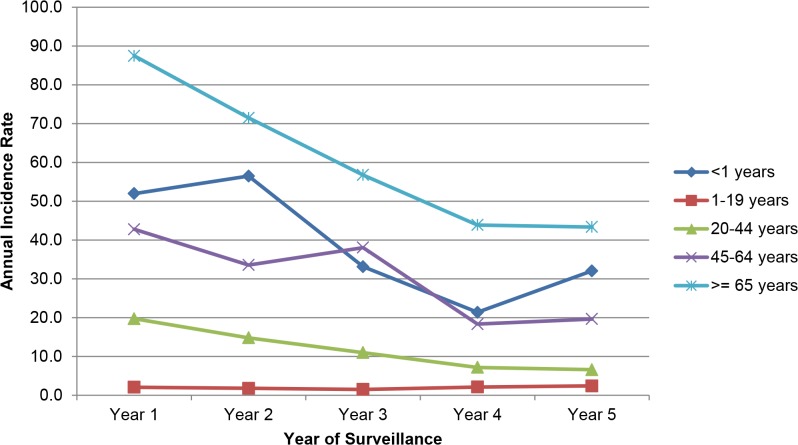
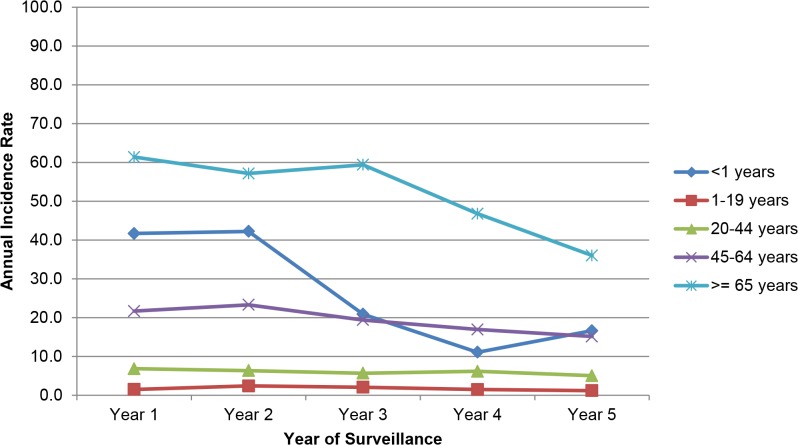
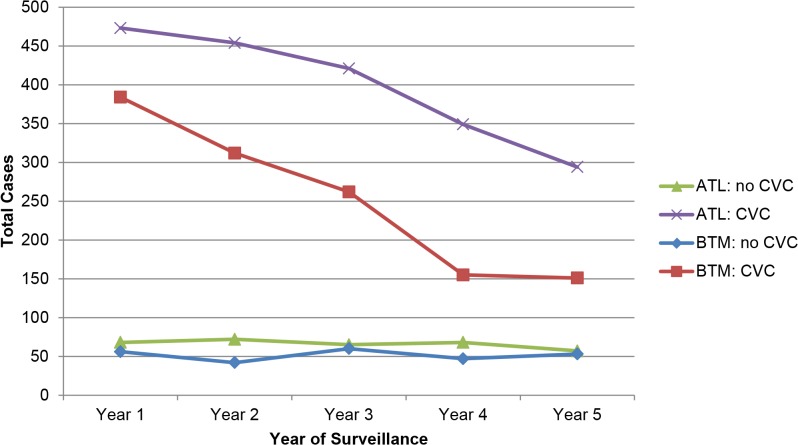
BACKGROUND: Recent reports have demonstrated a decline in bacterial bloodstream infections (BSIs) following adherence to central line insertion practices; however, declines have been less evident for BSIs due to Candida species. METHODS: We conducted active, population-based laboratory surveillance for candidemia in metropolitan Atlanta, GA and Baltimore, MD over a 5-year period. We calculated annual candidemia incidence and antifungal drug resistance rates. RESULTS: We identified 3,848 candidemia cases from 2008-2013. Compared with 2008, candidemia incidence per 100,000 person-years decreased significantly by 2013 in both locations (GA: 14.1 to 9.5, p<0.001; MD: 30.9 to 14.4, p<0.001). A total of 3,255 cases (85%) had a central venous catheter (CVC) in place within 2 days before the BSI culture date. In both locations, the number of CVC-associated cases declined (GA: 473 to 294; MD: 384 to 151). Candida albicans (CA, 36%) and Candida glabrata (CG, 27%) were the most common species recovered. In both locations, the proportion of cases with fluconazole resistance decreased (GA: 8.0% to 7.1%, -10%; MD: 6.6% to 4.9%, -25%), while the proportion of cases with an isolate resistant to an echinocandin increased (GA: 1.2% to 2.9%, +147%; MD: 2.0% to 3.5%, +77%). Most (74%) echinocandin-resistant isolates were CG; 17 (<1%) isolates were resistant to both drug categories (multidrug resistant [MDR], 16/17 were CG). The proportion of CG cases with MDR Candida increased from 1.8% to 2.6%. CONCLUSIONS: We observed a significant decline in the incidence of candidemia over a five-year period, and increases in echinocandin-resistant and MDR Candida. Efforts to strengthen infection control practices may be preventing candidemia among high-risk patients. Further surveillance for resistant Candida is warranted.
Overview
The claims and statistics of this paper haven’t been checked yet.
Run the check — free, no account needed. It reads the open-access text and checks the sources it cites.
Integrity signals
Registry
Cites
Statistics
Figures
Verification
Claims the paper makes
The claims and statistics of this paper haven’t been checked yet.
Run the check — free, no account needed. It reads the open-access text and checks the sources it cites.
Claims other papers make about this one
Each is checked against this paper’s own text: does it say what the citing paper says it does?
The source backs part of the claim, not all of it — or backs it for a different population, condition or comparison.
In the citing paper
“Findings from EIP surveillance data have indicated a decrease in overall candidemia incidence in their longest-running surveillance sites of Atlanta, GA, and Baltimore, MD, with the incidence of all species decreasing except C. tropicalis [8].”
From Invasive candidiasis species distribution and trends, United States, 2009-2017 (2021) · cites this paper as [8]
Experimental — accuracy not yet measuredThe source backs part of the claim, not all of it — or backs it for a different population, condition or comparison.
In the citing paper
“A more nuanced assessment using data from active population-based surveillance showed the incidence of candidemia decreased from 2008 to 2017 across multiple US sites,25,27,35 with a coincident increase in the incidence of IC from non-blood sources, including abdominal sterile sites, from 2009–2017.34”
From Epidemiology of Invasive Candidiasis (2024) · cites this paper as [35]
Experimental — accuracy not yet measuredThe source backs part of the claim, not all of it — or backs it for a different population, condition or comparison.
In the citing paper
“In population-based surveillance performed in the metropolitan areas of Atlanta, Georgia, and Baltimore, Maryland, candidemia incidence (primarily among adults) increased 10%–40% from the early 1990s and the late 2000s, which was followed by more recent reports of decreases in these areas (6,28–30).”
From Population-Based Active Surveillance for Culture-Confirmed Candidemia — Four Sites, United States, 2012–2016 (2019) · cites this paper as [28]
Experimental — accuracy not yet measuredThe source backs part of the claim, not all of it — or backs it for a different population, condition or comparison.
In the citing paper
“This contrasts with data from the early 1990s, when infants had the highest incidence (6), followed by substantial decreases by the late 2000s (26,28).”
From Population-Based Active Surveillance for Culture-Confirmed Candidemia — Four Sites, United States, 2012–2016 (2019) · cites this paper as [28]
Experimental — accuracy not yet measuredThe cited source says what the claim attributes to it.
In the citing paper
“although C. glabrata has been reported to represent more than 30% of the non-albicans Candida in some geographic areas [4, 6–9].”
From Invasive candidiasis species distribution and trends, United States, 2009-2017 (2021) · cites this paper as [8]
The cited source says what the claim attributes to it.
In the citing paper
“Population-based surveillance in two U.S. metropolitan areas found that annual candidemia incidence per 100,000 population declined during 2008–2013 (from 14.1 to 9.5 in Atlanta and 30.9 to 14.4 in Baltimore), likely because of improved infection prevention and control practices (17).”
From Population-Based Active Surveillance for Culture-Confirmed Candidemia — 10 Sites, United States, 2017–2021 (2025) · cites this paper as [17]
The check wasn’t confident either way, so it gives no verdict — never disputed.
In the citing paper
“Limited data from resource-limited settings suggest that timely administration of antimicrobials in patients with sepsis and septic shock is beneficial and potentially feasible (121-126).”
From Surviving Sepsis Campaign: International Guidelines for Management of Sepsis and Septic Shock 2021. (2021) · cites this paper as [122]
Experimental — accuracy not yet measuredThe check wasn’t confident either way, so it gives no verdict — never disputed.
In the citing paper
“The percentage of Black patients affected by candidemia increased during the study period, likely mirroring the disproportionate effect of the COVID-19 pandemic on Black patients (3,17,25).”
From Population-Based Active Surveillance for Culture-Confirmed Candidemia — 10 Sites, United States, 2017–2021 (2025) · cites this paper as [17]
Experimental — accuracy not yet measuredIn the citing paper
“Candida strains with acquired resistance to echinocandins, specifically C. glabrata, while still generally infrequent, are increasing in incidence in some hospitals [10,14].”
From Treatment of Invasive Candidiasis: A Narrative Review (2018) · cites this paper as [10]
In the citing paper
“Specifically, C. glabrata has become an important pathogen in North America, Europe (with the exception of Spain), and Australia, whereas C. parapsilosis is the dominant non-albicans species in South America, Japan, and Spain [8,9,10].”
From Treatment of Invasive Candidiasis: A Narrative Review (2018) · cites this paper as [10]
In the citing paper
“The use of echinocandins and development of cross-resistance is creating apprehension, for the signs of multidrug resistance amongst azoles and echinocandins have already been described [168,169,170].”
From Candida glabrata Biofilms: How Far Have We Come? (2017) · cites this paper as [170]
Self-check
Percentages, sums and reported differences re-computed from the paper’s own numbers.
The self-check needs the paper’s full text.
Citations
Cites
Wisplinghoff, H., Bischoff, T., Tallent, S. M., Seifert, H., Wenzel, R. P., & Edmond, M. B. (2004) · Clinical Infectious Diseases · doi:10.1086/421946 · Cited by 4,496
An Intervention to Decrease Catheter-Related Bloodstream Infections in the ICU
Pronovost, P., Needham, D., Berenholtz, S., Sinopoli, D., Chu, H., Cosgrove, S., Sexton, B., Hyzy, R., Welsh, R., Roth, G., et al. (2006) · New England Journal of Medicine · doi:10.1056/nejmoa061115 · Cited by 4,387
Pappas, P. G., Kauffman, C. A., Andes, D., Benjamin, D. K., Calandra, T. F., Edwards, J. E., Filler, S. G., Fisher, J. F., Kullberg, B.-J., Zeichner, L. O., et al. (2009) · Clinical Infectious Diseases · doi:10.1086/596757 · Cited by 3,191
Health Care–Associated Infections
Zimlichman, E., Henderson, D., Tamir, O., Franz, C., Song, P., Yamin, C. K., Keohane, C. A., Denham, C. R., & Bates, D. W. (2013) · JAMA Internal Medicine · doi:10.1001/jamainternmed.2013.9763 · Cited by 1,927
Candida Infections of Medical Devices
Kojic, E. M., & Darouiche, R. O. (2004) · Clinical Microbiology Reviews · doi:10.1128/cmr.17.2.255-267.2004 · Cited by 1,055
Alexander, B. D., Johnson, M. D., Pfeiffer, C. D., Jiménez-Ortigosa, C., Catania, J., Booker, R., Castanheira, M., Messer, S. A., Perlin, D. S., & Pfaller, M. A. (2013) · Clinical Infectious Diseases · doi:10.1093/cid/cit136 · Cited by 778
Vital Signs: Central Line–Associated Blood Stream Infections—United States, 2001, 2008, and 2009
Liang, S. Y., & Marschall, J. (2011) · Annals of Emergency Medicine · doi:10.1016/j.annemergmed.2011.07.035 · Cited by 471
Pfaller, M. A., Castanheira, M., Lockhart, S. R., Ahlquist, A. M., Messer, S. A., & Jones, R. N. (2012) · Journal of Clinical Microbiology · doi:10.1128/jcm.06112-11 · Cited by 377
Self-citationCleveland, A. A., Farley, M. M., Harrison, L. H., Stein, B., Hollick, R., Lockhart, S. R., Magill, S. S., Derado, G., Park, B. J., & Chiller, T. M. (2012) · Clinical Infectious Diseases · doi:10.1093/cid/cis697 · Cited by 366
Self-citationSchulman, J. D., Stricof, R. L., Stevens, T. P., Horgan, M. J., Gase, K., Holzman, I. R., Koppel, R. I., Nafday, S. M., Gibbs, K., Angert, R. M., et al. (2011) · PEDIATRICS · doi:10.1542/peds.2010-2873 · Cited by 313
The Long-Term Effect of Premier Pay for Performance on Patient Outcomes
Jha, A. K., Joynt, K. E., Orav, E. J., & Epstein, A. M. (2012) · New England Journal of Medicine · doi:10.1056/nejmsa1112351 · Cited by 306
Lockhart, S. R., Iqbal, N., Cleveland, A. A., Farley, M. M., Harrison, L. H., Bolden, C. B., Baughman, W., Stein, B., Hollick, R., Park, B. J., et al. (2012) · Journal of Clinical Microbiology · doi:10.1128/jcm.01283-12 · Cited by 299
Self-citationPfaller, M. A., Messer, S. A., Woosley, L. N., Jones, R. N., & Castanheira, M. (2013) · Journal of Clinical Microbiology · doi:10.1128/jcm.00308-13 · Cited by 237
Effect of Nonpayment for Preventable Infections in U.S. Hospitals
Lee, G. M., KLEINMAN, K. P., Soumerai, S. B., Kawai, A. T., Cole, D. S., Fridkin, S. K., Horan, T. C., Platt, R. G., Gay, C., Kassler, W. J., et al. (2012) · New England Journal of Medicine · doi:10.1056/nejmsa1202419 · Cited by 218
Espinel-Ingroff, A., Arendrup, M. C., Pfaller, M. A., Bonfietti, L. X., Bustamante, B., Canton, E., Chryssanthou, E., Cuenca-Estrella, M., Dannaoui, E., Fothergill, A., et al. (2013) · Antimicrobial Agents and Chemotherapy · doi:10.1128/aac.01519-13 · Cited by 216
Self-citationReagan, D. R., Pfaller, M. A., Hollis, R. J., & Wenzel, R. P. (1990) · Journal of Clinical Microbiology · doi:10.1128/jcm.28.12.2733-2738.1990 · Cited by 205
Vital signs: central line-associated blood stream infections--United States, 2001, 2008, and 2009.
(2011) · PubMed · Cited by 142
Lewis, J. S., Wiederhold, N. P., Wickes, B. L., Patterson, T. F., & Jorgensen, J. H. (2013) · Antimicrobial Agents and Chemotherapy · doi:10.1128/aac.01144-13 · Cited by 101
Marcos, M., Soriano, À., Iñurrieta, A., Martínez, J. A., Romero, A. R., Cobos, N., Hernandez, C., Almela, M., Marco, F., & Mensa, J. (2011) · Journal of Antimicrobial Chemotherapy · doi:10.1093/jac/dkr231 · Cited by 100
Fagan, R. P., Edwards, J. R., Park, B. J., Fridkin, S. K., & Magill, S. S. (2013) · Infection Control and Hospital Epidemiology · doi:10.1086/671724 · Cited by 93
Self-citationPham, C. D., Bolden, C. B., Kuykendall, R. J., & Lockhart, S. R. (2013) · Journal of Clinical Microbiology · doi:10.1128/jcm.03378-13 · Cited by 50
Self-citationPeasah, S. K., McKay, N. L., Harman, J. S., Al‐Amin, M., & Cook, R. (2013) · Medicare & Medicaid Research Review · doi:10.5600/mmrr.003.03.a08 · Cited by 49
National Estimates of Central Line–Associated Bloodstream Infections in Critical Care Patients
Wise, M. E., Scott, R. D., Baggs, J. M., Edwards, J. R., Ellingson, K., Fridkin, S. K., McDonald, L. C., & Jernigan, J. A. (2013) · Infection Control and Hospital Epidemiology · doi:10.1086/670629 · Cited by 37
Trends in Central Line–Associated Bloodstream Infections in a Trauma-Surgical Intensive Care Unit
Ong, A. W. (2011) · Archives of Surgery · doi:10.1001/archsurg.2011.9 · Cited by 23
Hammarskjöld, F., Mernelius, S., Andersson, R. E., Berg, S., Hanberger, H., Löfgren, S., Malmvall, B., Petzold, M., & Matussek, A. (2013) · Journal of Hospital Infection · doi:10.1016/j.jhin.2013.06.002 · Cited by 18
When Counting Central Line Infections Counts
Dixon‐Woods, M., & Perencevich, E. N. (2013) · Infection Control and Hospital Epidemiology · doi:10.1086/670630 · Cited by 10
Research works printed but not linked: 1
- J Schulman, 2011, Statewide NICU Central-Line-Associated Bloodstream Infection Rates Decline After Bundles and Checklists, Pediatrics, 127, 436, 10.1542/peds.2010-2873 · DOI
Cited by
Sorted by citations
Surviving sepsis campaign: international guidelines for management of sepsis and septic shock 2021
Evans, L., Rhodes, A., Alhazzani, W., Antonelli, M., Coopersmith, C. M., French, C., Machado, F. R., Mcintyre, L., Ostermann, M., Prescott, H. C., et al. (2021) · Intensive Care Medicine · doi:10.1007/s00134-021-06506-y · Cited by 5,082
Surviving Sepsis Campaign: International Guidelines for Management of Sepsis and Septic Shock 2021.
Evans, L., Rhodes, A., Alhazzani, W., Antonelli, M., Coopersmith, C. M., French, C., Machado, F. R., Mcintyre, L., Ostermann, M., Prescott, H. C., et al. (2021) · Critical Care Medicine · doi:10.1097/ccm.0000000000005337 · Cited by 2,935
Pappas, P. G., Lionakis, M. S., Arendrup, M. C., Ostrosky-Zeichner, L., & Kullberg, B. J. (2018) · Nature Reviews Disease Primers · doi:10.1038/nrdp.2018.26 · Cited by 1,636
Kullberg, B. J., & Arendrup, M. C. (2015) · New England Journal of Medicine · doi:10.1056/nejmra1315399 · Cited by 1,315
Azole Antifungal Resistance in Candida albicans and Emerging Non-albicans Candida Species
Whaley, S. G., Berkow, E. L., Rybak, J. M., Nishimoto, A. T., Barker, K. S., & Rogers, P. D. (2017) · Frontiers in Microbiology · doi:10.3389/fmicb.2016.02173 · Cited by 900
Metadata
- Authors
- Cleveland, A. A., Harrison, L. H., Farley, M. M., Hollick, R., Stein, B., Chiller, T. M., Lockhart, S. R., & Park, B. J.
- Affiliations
- Centers for Disease Control and Prevention (US)
- Johns Hopkins University (US)
- Emory University (US)
- Corresponding author
- Cleveland, Angela Ahlquist
- Venue
- PLOS ONE
- Publisher
- Public Library of Science (PLoS)
- Published
- 2015-03-30
- Volume
- 10
- Issue
- 3
- Pages
- e0120452
- ISSN
- 1932-6203 (ISSN-L)
- PMC
- PMC4378850
- OpenAlex
- W2044502735
- Cited by
- 304
- References
- 26
- Citations by year
- 2026: 10 · 2025: 18 · 2024: 21 · 2023: 28 · 2022: 31 · 2021: 27 · 2020: 32 · 2019: 36 · 2018: 31 · 2017: 31 · 2016: 28 · 2015: 11
- FWCI
- 26.22
- Type
- journal article
- Language
- en
- Open access
- gold
- doi.org
- Licence
- public-domain
- creativecommons.org/publicdomain/zero/1.0/ (vor)
- Locations
- PLoS ONE (publishedVersion, public-domain)
- Europe PMC (PubMed Central) (publishedVersion, public-domain)
- PubMed Central (publishedVersion, public-domain)
- PubMed (publishedVersion)
- DOAJ (DOAJ: Directory of Open Access Journals) (submittedVersion, cc-by-sa)
- Funders
- Centers for Disease Control and Prevention
- Topics
- Health Sciences › Medicine › Infectious Diseases › Antifungal resistance and susceptibility
- Health Sciences › Medicine › Ophthalmology › Ocular Infections and Treatments
- Health Sciences › Medicine › Cardiology and Cardiovascular Medicine › Infective Endocarditis Diagnosis and Management
- Keywords
- candidemia, candidemia incidence, antifungal resistance, echinocandin resistance, fluconazole resistance, Candida glabrata, Candida albicans, multidrug resistance, central venous catheters, bloodstream infection, infection control, Atlanta, Baltimore, population-based surveillance, central line-associated bloodstream infection
- MeSH terms
- Adolescent, Adult, Aged, Aged, 80 and over, Antifungal Agents, Candida, Child, Child, Preschool, Female, Georgia, Humans, Infant, Infant, Newborn, Male, Microbial Sensitivity Tests, Middle Aged, Population Surveillance, Baltimore, Incidence, Drug Resistance, Fungal, Young Adult, Candidemia
About these checks
Registry, retraction, Cites and statistics results are computed, not judged, with one exception: a printed reference that no index lists is read once by a model before it counts as a citation error. Claims are extracted by a model and kept only when their quote appears verbatim in the text; each cited source is then checked, with a model’s help, for whether it says what the claim relies on. Those verdicts can be wrong — read the claim’s quote and the cited source before relying on one.
Statistics and arithmetic are recomputed, not judged.
Confidence bands are shown only for fields calibrated on our annotated test set. None is calibrated yet, so no band is shown.
What counts as a claim ›How we measure confidence ›How we check this ›
Are you an author, or do you see a problem with this page? Request a review
