

The DOI matches its Crossref record; 114 of the 114 references it cites were found in a registry or an index.
A Social Network Approach Reveals Associations between Mouse Social Dominance and Brain Gene Expression
Open accessAbstract
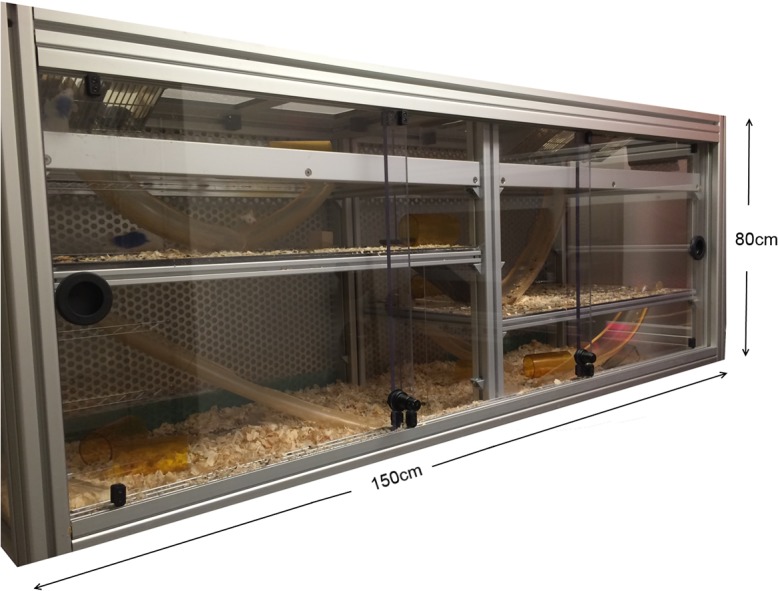
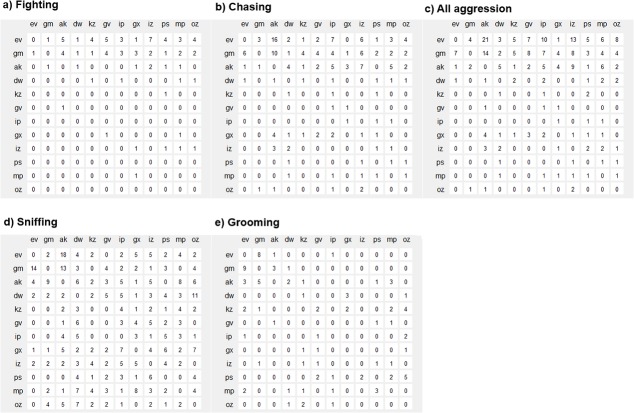
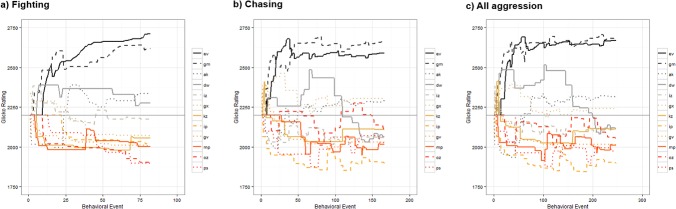
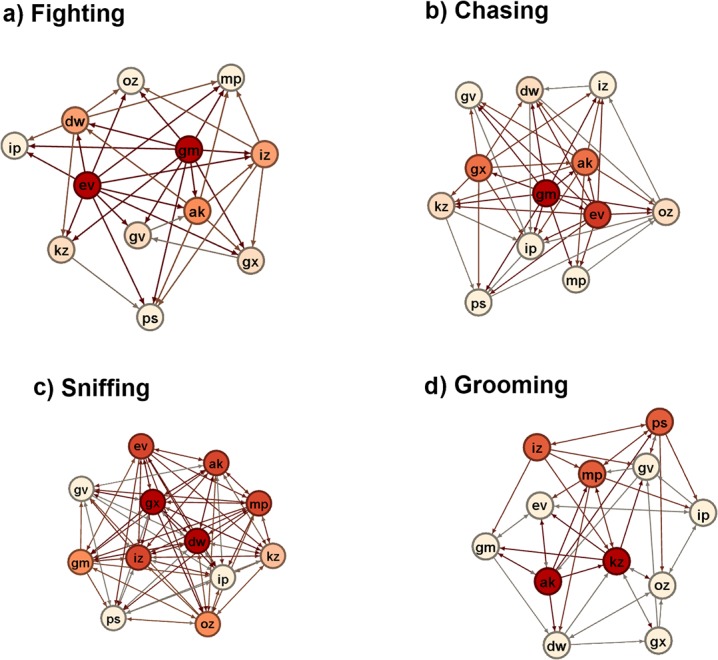
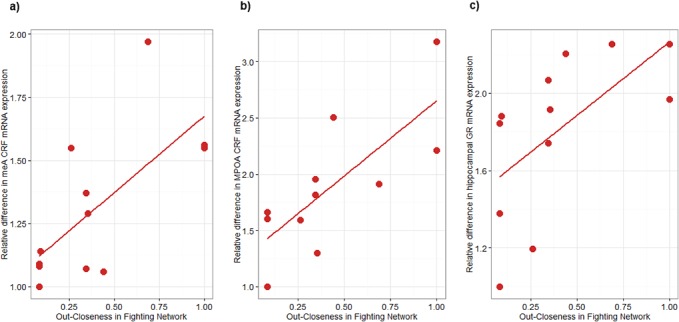
Modelling complex social behavior in the laboratory is challenging and requires analyses of dyadic interactions occurring over time in a physically and socially complex environment. In the current study, we approached the analyses of complex social interactions in group-housed male CD1 mice living in a large vivarium. Intensive observations of social interactions during a 3-week period indicated that male mice form a highly linear and steep dominance hierarchy that is maintained by fighting and chasing behaviors. Individual animals were classified as dominant, sub-dominant or subordinate according to their David's Scores and I& SI ranking. Using a novel dynamic temporal Glicko rating method, we ascertained that the dominance hierarchy was stable across time. Using social network analyses, we characterized the behavior of individuals within 66 unique relationships in the social group. We identified two individual network metrics, Kleinberg's Hub Centrality and Bonacich's Power Centrality, as accurate predictors of individual dominance and power. Comparing across behaviors, we establish that agonistic, grooming and sniffing social networks possess their own distinctive characteristics in terms of density, average path length, reciprocity out-degree centralization and out-closeness centralization. Though grooming ties between individuals were largely independent of other social networks, sniffing relationships were highly predictive of the directionality of agonistic relationships. Individual variation in dominance status was associated with brain gene expression, with more dominant individuals having higher levels of corticotropin releasing factor mRNA in the medial and central nuclei of the amygdala and the medial preoptic area of the hypothalamus, as well as higher levels of hippocampal glucocorticoid receptor and brain-derived neurotrophic factor mRNA. This study demonstrates the potential and significance of combining complex social housing and intensive behavioral characterization of group-living animals with the utilization of novel statistical methods to further our understanding of the neurobiological basis of social behavior at the individual, relationship and group levels.
Overview
The claims and statistics of this paper haven’t been checked yet.
Run the check — free, no account needed. It reads the open-access text and checks the sources it cites.
Integrity signals
Registry
Cites
Statistics
Figures
Verification
Claims the paper makes
The claims and statistics of this paper haven’t been checked yet.
Run the check — free, no account needed. It reads the open-access text and checks the sources it cites.
Claims other papers make about this one
Each is checked against this paper’s own text: does it say what the citing paper says it does?
In the citing paper
“In some studies the subordinates form linear hierarchies, 136,138,141 while in others ranking is more despotic.80,97,142”
From Ecological validity of social interaction tests in rats and mice (2019) · cites this paper as [141]
Self-check
Percentages, sums and reported differences re-computed from the paper’s own numbers.
The self-check needs the paper’s full text.
Citations
Cites
R: A Language and Environment for Statistical Computing
R Core Team (2000) · doi:10.32614/r.manuals · Cited by 355,893
The igraph software package for complex network research
Csárdi, G., & Nepusz, T. (2006) · Medical Entomology and Zoology · Cited by 10,078
Power and Centrality: A Family of Measures
Bonacich, P. (1987) · American Journal of Sociology · doi:10.1086/228631 · Cited by 5,261
Introduction to Social Network Methods
Hanneman, R. A. (2001) · Cited by 3,895
Authoritative sources in a hyperlinked environment
Kleinberg, J. M. (1998) · Symposium on Discrete Algorithms · doi:10.5555/314613.315045 · Cited by 1,815
Sustained hippocampal chromatin regulation in a mouse model of depression and antidepressant action
Tsankova, N. M., Berton, O., Renthal, W., Kumar, A., Neve, R. L., & Nestler, E. J. (2006) · Nature Neuroscience · doi:10.1038/nn1659 · Cited by 1,780
Phasic vs Sustained Fear in Rats and Humans: Role of the Extended Amygdala in Fear vs Anxiety
Davis, M., Walker, D. L., Miles, L., & Grillon, C. (2010) · Neuropsychopharmacology · doi:10.1038/npp.2009.109 · Cited by 1,513 · cited 1×
“Further, the medial and capsular subdivisions of the CeA, a nucleus that is critical for the coordination of sensory experience, social learning and memory and emotional behaviors [29], receives substantial innervations from the MeA [94].”
BackgroundHippocampal BDNF mediates the efficacy of exercise on synaptic plasticity and cognition
Vaynman, S., Ying, Z., & Gomez‐Pinilla, F. (2004) · European Journal of Neuroscience · doi:10.1111/j.1460-9568.2004.03720.x · Cited by 1,460
The Method of Paired Comparisons.
Curnow, R. N., & David, H. A. (1964) · Journal of the Royal Statistical Society Series A (General) · doi:10.2307/2344014 · Cited by 1,285
CRF and CRF receptors: role in stress responsivity and other behaviors
Bale, T. L., & Vale, W. W. (2004) · Annual Review of Pharmacology and Toxicology · doi:10.1146/annurev.pharmtox.44.101802.121410 · Cited by 1,270
Research works printed but not linked: 1
- RJ Berry, 1970, The Natural History of the House Mouse, Field Studies, 3, 219
Cited by
Sorted by citations
Items 101–135 of 135
Network Hawkes Process Models for Exploring Latent Hierarchy in Social Animal Interactions
Ward, O. G., Wu, J., Zheng, T., Smith, A. L., & Curley, J. P. (2022) · Journal of the Royal Statistical Society Series C (Applied Statistics) · doi:10.1111/rssc.12581 · Cited by 3
“Along with the I&SI method, So et al. (2015) and Williamson et al. (2016) use the Glicko rating system to calculate temporal changes in dominance scores of each animal in each cohort.”
InfluentialSelf-citationInheritance of social dominance is associated with global sperm DNA methylation in inbred male mice
Hou, G.-M., Zhang, Y., & Zhang, J. (2022) · Current Zoology · doi:10.1093/cz/zoac030 · Cited by 3
“…as the medial prefrontal cortex, hypothalamus and thalamo-prefrontal cortical circuit; androgen, androgen receptors, and GluR4 are some of the related neuroendocrine molecules (Nelson and Trainor 2007; Wang et al. 2011; So et al. 2015; Zhou et al. 2017; Palle et al. 2019; Rizzardi et al. 2019).”
BackgroundLee, W., Milewski, T. M., Dwortz, M. F., Young, R. L., Gaudet, A. D., Fonken, L. K., Champagne, F. A., & Curley, J. P. (2021) · bioRxiv (Cold Spring Harbor Laboratory) · doi:10.1101/2021.09.04.458987 · Cited by 3
“Despite their higher caloric intake, it is notable that their transcriptomic profile is more similar to fasting animals that switch to using fatty acids as an energy source for the liver (Sokolović et al., 2008).”
BackgroundSelf-citationHistorical loss weakens competitive behavior by remodeling ventral hippocampal dynamics
Lai, C., Chen, K., Huang, H., Huang, X., Zhang, J., Wang, Y., Chen, Z., Hu, F., Guo, Z., Man, H., et al. (2025) · Cell Discovery · doi:10.1038/s41421-024-00751-3 · Cited by 2
“All animal experiments were carried out according to the “ Policies on the Use of Animals and Humans in Neuroscience Research ” revised and approved by the Society for Neuroscience in 1995, the ethics approval document code is 2019S1874.”
Moskalenko, A. M., Ikrin, A. N., Kozlova, A. V., Mukhamadeev, R. R., de Abreu, M. S., Riga, V. D., Kolesnikova, T. O., & Kalueff, A. V. (2024) · Neuroscience · doi:10.1016/j.neuroscience.2024.06.004 · Cited by 2
Sex-dependent resource defense in a nectar-feeding batPreprint
Wintergerst, S., Winter, Y., & Nachev, V. (2021) · bioRxiv (Cold Spring Harbor Laboratory) · doi:10.1101/2021.08.16.456451 · Cited by 2
“In the Glicko rating algorithm individuals gain or lose ranking points based on their wins or losses and the rating of their opponent (Glickman 1999; So et al. 2015).”
BackgroundMethodMeloni, E. G., Carlezon, W. A., & Bolshakov, V. Y. (2023) · bioRxiv (Cold Spring Harbor Laboratory) · doi:10.1101/2023.05.03.539254 · Cited by 2
“…stress peptides such as corticotropin releasing factor (CRF) 25-27 , previous studies have shown alterations in CRF mRNA levels in dominant versus subordinate animals 14,24 , suggesting a relationship between social dominance and this important regulator of stress and social behavior 28-30 .”
Serotonin drives aggression and social behaviours of laboratory mice in a semi-natural environmentPreprint
Rivalan, M., Alonso, L., Mosienko, V., Bey, P., Hyde, A., Bäder, M., Winter, Y., & Alenina, N. V. (2024) · bioRxiv (Cold Spring Harbor Laboratory) · doi:10.1101/2024.02.02.578690 · Cited by 2
Advancements in the study of neural mechanisms underlying mammalian grouping behaviour
Kelly, A. M. (2023) · Frontiers in Ethology · doi:10.3389/fetho.2023.1273613 · Cited by 1
Collective behavior diverges independently of the benthic-limnetic axis in stickleback
Neumann, K., Eckert, L., Miranda, D., Kemp, A., & Bell, A. M. (2025) · Behavioral Ecology and Sociobiology · doi:10.1007/s00265-025-03599-z · Cited by 1
“This adds to growing evidence that stickleback are a strong model for studying the evolution of social networks (Webster et al. 2013; Kleinhappel et al. 2014), as has been done in other model organisms like mice and bees (So et al. 2015; Traniello et al. 2022).”
Huisken, J. L., & Rehan, S. M. (2025) · Insectes Sociaux · doi:10.1007/s00040-025-01067-5 · Cited by 1
“Evidence from both wild and laboratory mice has found differences in gene expression depending on social network size and individual position in the social network (So et al., 2015; Williamson et al., 2016; Lopes and König, 2020).”
Milewski, T. M., Lee, W., Rada, K. R., & Curley, J. P. (2025) · European Journal of Neuroscience · doi:10.1111/ejn.70295 · Cited by 2
Self-citationPoint Process Models for Heterogeneous Event Time Data
Wu, J. (2019) · doi:10.7916/d8-cgvn-xa71 · Cited by 1
“So et al. (2015) and Williamson et al. (2016) take advantage of outcomes of all the aggressive interactions by applying the Glicko rating system.”
BackgroundMethodInfluentialBarabas, A. J., Soini, H. A., Novotný, M. V., Lucas, J. R., Erasmus, M. A., Cheng, H. W., Palme, R., & Gaskill, B. N. (2022) · PLoS ONE · doi:10.1371/journal.pone.0276844 · Cited by 1
“This aligns with past work showing a correlation between an individual’s place in a grooming network and their place in a chasing, but not fighting, network [50].”
BackgroundChourbaji, S., Elmi, A., Langermans, J. A. M., Louwerse, A. L., Stocker, M., Raeves, Y. D., & Mocho, J.-P. (2024) · Laboratory animal science and medicine · doi:10.1007/978-3-031-65414-5_7 · Cited by 1
Mind the gap: A systematic review and meta-analysis of how social memory is studiedPreprint
Cum, M., Pérez, J. S., Wangia, E., Lopez, N., Wright, E. S., Iwata, R. L., Li, A. S., Chambers, A. R., & Padilla-Coreano, N. (2023) · bioRxiv (Cold Spring Harbor Laboratory) · doi:10.1101/2023.12.20.572606 · Cited by 1
“Furthermore, in captivity, both wild mice 9,10 and laboratory mice 11,12 form social hierarchies.”
The evolution of social dominance in house sparrows
Sánchez‐Tójar, A. (2018) · KOPS (University of Konstanz)
Śledziowska, M. (2020) · ORCA Online Research @Cardiff (Cardiff University)
Orlando, B. C. G. S., Kiataqui, K. E., Reis-Silva, T. M., Mori, C. M. C., Manes, M., Santos, D. N. L., Massironi, S. M. G., Bondan, E. F., Kirsten, T. B., & Bernardi, M. M. (2021) · SSRN Electronic Journal · doi:10.2139/ssrn.3994526
(2018) · PeerJ · doi:10.7287/peerj.5617v0.2/reviews/1
“…Previously, we have demonstrated that groups of 12 male outbred CD-1 male mice living in a 88 complex housing system rapidly form stable and linear social hierarchies (So et al., 2015; 89 Williamson, Lee & Curley, 2016; Curley, 2016b; Williamson, Romeo & Curley, 2017; Lee, 90 Khan & Curley, 2017).”
BackgroundMethodReply to Qiu et al.: Hunting for leadership “causal” genes: Mission possible?
Song, Z., Li, W., & Fan, Q. (2022) · Proceedings of the National Academy of Sciences · doi:10.1073/pnas.2208115119
Differences in physiology and behavior between male winner and loser mice in the tube test
Wang, L., Huang, N., Cai, Q., Guo, S., & Ai, H. (2024) · Behavioural Processes · doi:10.1016/j.beproc.2024.105013
Neural circuit mechanisms underlying dominance traits and social competition
Yan, H., & Wang, J. (2025) · Biophysics Reviews · doi:10.1063/5.0221909
Shiraishi, M., Suzuki, N., Kurokawa, Y., & Obitsu, T. (2025) · Animal Science Journal · doi:10.1111/asj.70128
Temporal patterns of dominance in a hummingbird assemblagePreprint
Téllez-Colmenares, N., Fernandes, A. M., Stiles, F. G., & Rico‐Guevara, A. (2025) · bioRxiv (Cold Spring Harbor Laboratory) · doi:10.64898/2025.12.05.692456
“The patterning of relationships between species across di(cid:27)erent months and days was compared using the quadratic assignment procedure (QAP) regression in UCINET (Krack-hardt, 1987[58]; So et al., 2015[54]).”
InfluentialCooperation: Behavioral manifestations and neural mechanisms
Jiang, M., Chang, S. W. C., & Hong, W. (2026) · Current Opinion in Neurobiology · doi:10.1016/j.conb.2026.103177
Atypical social behaviors in mouse models for Rett syndrome
Acevedo-Triana, C. A., Medeiros, D., Gonçalez, J. L., Li, W., & Pozzo‐Miller, L. D. (2026) · Frontiers in Neurology · doi:10.3389/fneur.2026.1744450
“In males, hippocampal BDNF supports social learning during hierarchy formation, with dominant individuals exhibiting higher expression (135).”
Mutovina, A., Sapronova, A. A., Mezhevalova, P., Airiyants, K. A., Ryabushkina, Y. A., Salman, R., & Bondar, N. P. (2026) · Neuroscience and Behavioral Physiology · doi:10.1007/s11055-026-02006-y
“Increased Crh expression is associated with elevated aggression, for example, in dominant animals [So et al., 2015].”
Systemic metabolic correlates of environmental sensitivity in group-housed micePreprint
Joko, N., & Abe, K. (2026) · bioRxiv (Cold Spring Harbor Laboratory) · doi:10.64898/2026.05.18.725769
Beyond the barrier: an assessment of social behaviour in mice using a modified 3-chamber test
Sofyana, M., Piggins, H. D., Jackson, M. G., & Robinson, E. S. J. (2026) · Physiology & Behavior · doi:10.1016/j.physbeh.2026.115381
Food competition, but not other common assays, reveals social dominance in female and male CD1 micePreprint
Illescas-Huerta, E., Casselman, H., Taylor, L., Smith, S., & Padilla-Coreano, N. (2026) · Research Square · doi:10.21203/rs.3.rs-11078463/v1
“Common approaches include the tube test 19–21 , observation of agonistic behaviors 9,14,16,22 , urine marking as a measure of territorial dominance 13,23,24 , and food competition tasks 14,17,25 .”
Metadata
- Authors
- So, N., Franks, B., Lim, S., & Curley, J. P.
- Affiliations
- Columbia University (US)
- University of British Columbia (CA)
- Corresponding author
- Curley, James P.
- Venue
- PLOS ONE
- Publisher
- Public Library of Science (PLoS)
- Published
- 2015-07-30
- Volume
- 10
- Issue
- 7
- Pages
- e0134509
- ISSN
- 1932-6203 (ISSN-L)
- PMC
- PMC4520683
- OpenAlex
- W1852628838
- Cited by
- 135
- References
- 114
- Citations by year
- 2026: 6 · 2025: 10 · 2024: 15 · 2023: 10 · 2022: 17 · 2021: 17 · 2020: 14 · 2019: 15 · 2018: 16 · 2017: 6 · 2016: 9
- FWCI
- 16.91
- Type
- journal article
- Language
- en
- Open access
- gold
- doi.org
- Licence
- Locations
- PLoS ONE (publishedVersion, cc-by)
- Europe PMC (PubMed Central) (publishedVersion, cc-by)
- PubMed Central (publishedVersion, cc-by)
- PubMed (publishedVersion)
- DOAJ (DOAJ: Directory of Open Access Journals) (submittedVersion, cc-by-sa)
- Figshare (submittedVersion, cc-by)
- Columbia Academic Commons (Columbia University)
- Topics
- Life Sciences › Neuroscience › Endocrine and Autonomic Systems › Neuroendocrine regulation and behavior
- Life Sciences › Agricultural and Biological Sciences › Ecology, Evolution, Behavior and Systematics › Primate Behavior and Ecology
- Life Sciences › Agricultural and Biological Sciences › Ecology, Evolution, Behavior and Systematics › Animal Behavior and Reproduction
- Keywords
- social dominance, dominance hierarchy, social network analysis, mouse social behavior, ICR mice, grooming, sniffing, agonistic behavior, corticotropin-releasing factor, amygdala, medial preoptic area, hippocampus, glucocorticoid receptor, brain-derived neurotrophic factor, gene expression
- MeSH terms
- Animals, Brain, Gene Expression Regulation, Male, Social Behavior, Social Dominance, Mice, Real-Time Polymerase Chain Reaction
About these checks
Registry, retraction, Cites and statistics results are computed, not judged, with one exception: a printed reference that no index lists is read once by a model before it counts as a citation error. Claims are extracted by a model and kept only when their quote appears verbatim in the text; each cited source is then checked, with a model’s help, for whether it says what the claim relies on. Those verdicts can be wrong — read the claim’s quote and the cited source before relying on one.
Statistics and arithmetic are recomputed, not judged.
Confidence bands are shown only for fields calibrated on our annotated test set. None is calibrated yet, so no band is shown.
What counts as a claim ›How we measure confidence ›How we check this ›
Are you an author, or do you see a problem with this page? Request a review
