

The DOI matches its Crossref record; 37 of the 37 references it cites were found in a registry or an index.
Gut Dysbiosis in Patients with Anorexia Nervosa
Open accessAbstract
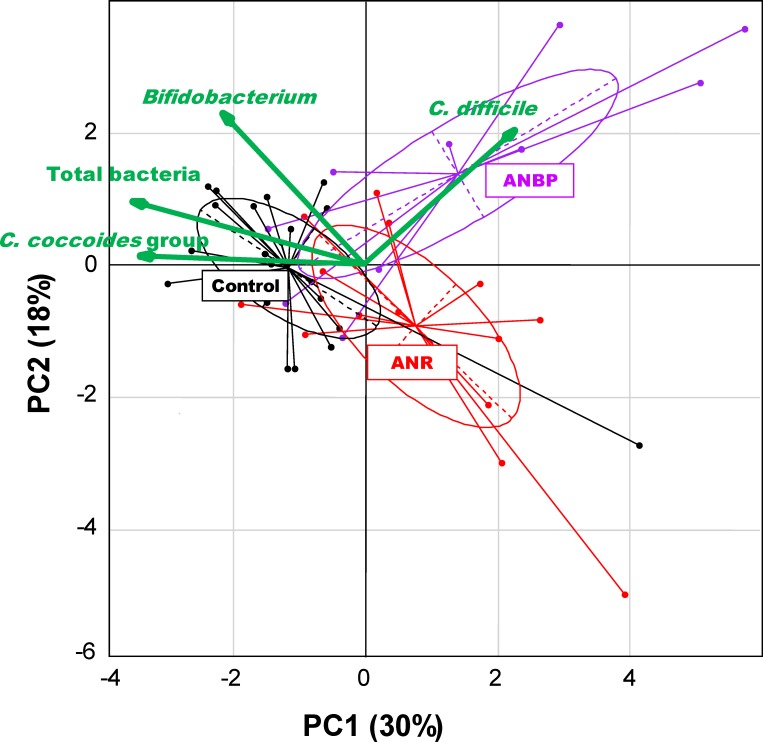
Anorexia nervosa (AN) is a psychological illness with devastating physical consequences; however, its pathophysiological mechanism remains unclear. Because numerous reports have indicated the importance of gut microbiota in the regulation of weight gain, it is reasonable to speculate that AN patients might have a microbial imbalance, i.e. dysbiosis, in their gut. In this study, we compared the fecal microbiota of female patients with AN (n = 25), including restrictive (ANR, n = 14) and binge-eating (ANBP, n = 11) subtypes, with those of age-matched healthy female controls (n = 21) using the Yakult Intestinal Flora-SCAN based on 16S or 23S rRNA-targeted RT-quantitative PCR technology. AN patients had significantly lower amounts of total bacteria and obligate anaerobes including those from the Clostridium coccoides group, Clostridium leptum subgroup, and Bacteroides fragilis group than the age-matched healthy women. Lower numbers of Streptococcus were also found in the AN group than in the control group. In the analysis based on AN subtypes, the counts of the Bacteroides fragilis group in the ANR and ANBP groups and the counts of the Clostridium coccoides group in the ANR group were significantly lower than those in the control group. The detection rate of the Lactobacillus plantarum subgroup was significantly lower in the AN group than in the control group. The AN group had significantly lower acetic and propionic acid concentrations in the feces than the control group. Moreover, the subtype analysis showed that the fecal concentrations of acetic acid were lower in the ANR group than in the control group. Principal component analysis confirmed a clear difference in the bacterial components between the AN patients and healthy women. Collectively, these results clearly indicate the existence of dysbiosis in the gut of AN patients.
Overview
The claims and statistics of this paper haven’t been checked yet.
Run the check — free, no account needed. It reads the open-access text and checks the sources it cites.
Integrity signals
Registry
Cites
Statistics
Figures
Verification
Claims the paper makes
The claims and statistics of this paper haven’t been checked yet.
Run the check — free, no account needed. It reads the open-access text and checks the sources it cites.
Claims other papers make about this one
Each is checked against this paper’s own text: does it say what the citing paper says it does?
The cited source says what the claim attributes to it.
In the citing paper
“Nonetheless, decreased fecal SCFA levels have been reported in various disorders where brain physiology and behavior are changed, including anorexia nervosa (Morita et al., 2015) and Parkinson's disease (Unger et al., 2016).”
From The Microbiota-Gut-Brain Axis (2019) · cites this paper as Morita et al., 2015
In the citing paper
“Surprisingly though, literature on this area is scarce, with only a handful of studies measuring gut microbial profile in patients with AN [29,30,31,32] and no data are available on other forms of eating disorders.”
In the citing paper
“Morita et al. [29] found no significant difference between the two subtypes when the abundances of individual species were compared.”
Self-check
Percentages, sums and reported differences re-computed from the paper’s own numbers.
The self-check needs the paper’s full text.
Citations
Cites
An obesity-associated gut microbiome with increased capacity for energy harvest
Turnbaugh, P. J., Ley, R. E., Mahowald, M. A., Magrini, V., Mardis, E. R., & Gordon, J. I. (2006) · Nature · doi:10.1038/nature05414 · Cited by 12,444
Human gut microbes associated with obesity
Ley, R. E., Turnbaugh, P. J., Klein, S., & Gordon, J. I. (2006) · Nature · doi:10.1038/4441022a · Cited by 8,785
A core gut microbiome in obese and lean twins
Turnbaugh, P. J., Hamady, M., Yatsunenko, T., Cantarel, B. L., Duncan, A., Ley, R. E., Sogin, M. L., Jones, W. J., Roe, B. A., Affourtit, J. P., et al. (2009) · Nature · doi:10.1038/nature07540 · Cited by 7,823
Effect size estimates: Current use, calculations, and interpretation.
Fritz, C. O., Morris, P. E., & Richler, J. J. (2012) · Journal of Experimental Psychology: General · doi:10.1037/a0024338 · Cited by 5,199 · cited 1×
“1, a small effect [24, 25].”
Gut flora in health and disease
Guarner, F., & Malagelada, J. (2003) · The Lancet · doi:10.1016/s0140-6736(03)12489-0 · Cited by 3,480
Normal gut microbiota modulates brain development and behavior
Heijtz, R. D., Wang, S., Anuar, F., Qian, Y., Björkholm, B., Samuelsson, A., Hibberd, M. L., Forssberg, H., & Pettersson, S. (2011) · Proceedings of the National Academy of Sciences · doi:10.1073/pnas.1010529108 · Cited by 3,228
Human Genetics Shape the Gut Microbiome
Goodrich, J. K., Waters, J. L., Poole, A. C., Sutter, J. L., Koren, O., Blekhman, R., Beaumont, M., Van Treuren, W., Knight, R., Bell, J. T., et al. (2014) · Cell · doi:10.1016/j.cell.2014.09.053 · Cited by 3,164
Cohen, S. H., Gerding, D. N., Johnson, S., Kelly, C. P., Loo, V. G., McDonald, L. C., Pépin, J., & Wilcox, M. H. (2010) · Infection Control and Hospital Epidemiology · doi:10.1086/651706 · Cited by 2,931
Sudo, N., Chida, Y., Aiba, Y., Sonoda, J., Oyama, N., Yu, X., Kubo, C., & Koga, Y. (2004) · The Journal of Physiology · doi:10.1113/jphysiol.2004.063388 · Cited by 2,735
Self-citationLoo, V. G., Poirier, L., Miller, M. A., Oughton, M., Libman, M., Michaud, S., Bourgault, A., Nguyen, T., Frenette, C. H., Kelly, M., et al. (2005) · New England Journal of Medicine · doi:10.1056/nejmoa051639 · Cited by 1,962
Cited by
Sorted by citations
Items 201–238 of 238
Anoreksiya Nervosalı Hastalarda İntestinal Mikrobiyotanın Rolü
Almasi, N., Çetin, A. K., & Göktaş, Z. (2022) · Psikiyatride Guncel Yaklasimlar - Current Approaches in Psychiatry · doi:10.18863/pgy.944592
Dréan, G. L., Pocheron, A.-L., Hélène, B., Pagniez, A., Grit, I., Parnet, P., Chappuis, E., Rolli‐Derkinderen, M., & Michel, C. (2019) · NutriXiv (OSF Preprints) · doi:10.31232/osf.io/yt378
Intestinal Microbiota in Eating Disorders
Bulik‐Sullivan, E. C., Thomas, S., Carroll, I. M., & Bulik, C. M. (2017) · Springer eBooks · doi:10.1007/978-981-287-104-6_193
Intestinal Microbiota in Eating Disorders
Bulik‐Sullivan, E. C., Thomas, S., Carroll, I. M., & Bulik, C. M. (2016) · Springer eBooks · doi:10.1007/978-981-287-087-2_193-1
Probiotics and gut-brain axis modulation
de Oliveira, M. E. G. (2022) · Elsevier eBooks · doi:10.1016/b978-0-323-89908-6.00018-2
Linking Anorexia Nervosa with the Gut Microbiota
Roubalová, R., Procházková, P., & Papežová, H. (2022) · Springer eBooks · doi:10.1007/978-3-030-67929-3_26-1
Moreno, A. G. M. (2022) · Revista Mexicana de Trastornos Alimentarios/Mexican Journal of Eating Disorders · doi:10.22201/fesi.20071523e.2022.2.736 · Cited by 2
Gut Microbiota and Eating Disorders on the Extremes of Aging
Miller, B. C., Mishra, S. P., Jain, S., Marotta, F., & Yadav, H. (2023) · Healthy ageing and longevity · doi:10.1007/978-3-031-14023-5_6
The Study of Gut Microbiota Pattern in Anorexia Nervosa Patients
Anbara, T. (2022) · Current Research in Diabetes & Obesity Journal · doi:10.19080/crdoj.2022.16.555934
Exploring the Microbiome through Probiotics and Psychobiotics: Deciphering the Gut-Brain Link
Pathak, R., Tirumalai, P. S., & Kashyap, S. (2023) · ACTA SCIENTIFIC MICROBIOLOGY · doi:10.31080/asmi.2023.06.1315
Gut Microbiome and Psychiatric Disorders
Middleton, F. A., Mihaila, D. M., Waldman, T., & Szombathy, A. M. (2023) · Springer eBooks · doi:10.1007/978-3-030-42825-9_169-1
Hassib, L. (2023) · Digital Library of Theses and Dissertations (Universidade de São Paulo) · doi:10.11606/d.17.2023.tde-05022024-160439
Sharma, S., Gandhi, D. N., Kaur, H., Kanigicherla, S. S., Chun, K. L. B., & Thakkar, J. J. (2024) · InterConf · doi:10.51582/interconf.19-20.02.2024.028
Microbiota-Gut-Brain Axis and ED
Mack, I., & Seitz, J. (2024) · Springer eBooks · doi:10.1007/978-3-030-97416-9_43-1
Gut Microbiome and Psychiatric Disorders
Middleton, F. A., Mihaila, D. M., Waldman, T., & Szombathy, A. M. (2024) · Springer eBooks · doi:10.1007/978-3-030-51366-5_169
Complications of anorexia nervosa - literature review
Buszek, S., Widawska, K., Bajak, M., Czerniak, P., Buszek, J., Wajdowicz, H., Warzocha, M., Sokołowska, A., & Dacz, K. (2024) · Quality in Sport · doi:10.12775/qs.2024.35.56393
Microbiota-Gut-Brain Axis and ED
Mack, I., & Seitz, J. (2024) · Springer eBooks · doi:10.1007/978-3-031-46096-8_43
Application of the human trypsinogen 2 detection kit “AP Check” for human fecal identification
Kariya, Y., Komori, R., & Takai, R. (2025) · Japanese Journal of Forensic Science and Technology · doi:10.3408/jafst.883
Significance of the GH/IGF-I Axis for the Development and Course of Anorexia Nervosa
Walter, C., & Wild, B. (2024) · Springer eBooks · doi:10.1007/978-3-031-32035-4_125-1
Suzuyama, C. A., Takakura, S., Takii, M., Kishimoto, J., Suematsu, T., Toda, K., Yamashita, M., Hata, T., & Sudo, N. (2025) · BioPsychoSocial Medicine · doi:10.1186/s13030-025-00332-0
Self-citationThe Microbiome–Gut–Brain Axis in Anorexia Nervosa
Seitz, J., & Trinh, S. (2025) · Oxford University Press eBooks · doi:10.1093/9780197675212.003.0025
Psikobiyotiklerin Bağırsak Mikrobiyotası ve Nörolojik Fonksiyonlara Etkisi
Avci, E., & Kalyoncu, Z. (2025) · Bandırma Onyedi Eylül Üniversitesi Sağlık Bilimleri ve Araştırmaları Dergisi · doi:10.46413/boneyusbad.1514178
Promoting Gut Microbiome Diversity in Anorexic Patients: A Neurobiological Review
Shankar, A., Wong, H., Kwe, I., & Wang, L. (2025) · Berkeley Pharma Tech Journal of Medicine · doi:10.52243/bptjm.v5i1.72
Significance of the GH/IGF-I Axis for the Development and Course of Anorexia Nervosa
Walter, C., & Wild, B. (2025) · Springer eBooks · doi:10.1007/978-3-031-73368-0_125
Yeme Bozuklukları ve Bağırsak Mikrobiyotası Etkileşimi
AFACAN, F. Ö., Demir, G., & Özenoğlu, A. (2025) · Sağlık Bilimlerinde Değer · doi:10.33631/sabd.1580392
Gut microbiota and mental issues in humans
Singh, J., Mistry, C. R., Sharma, A., Baiju, A., Kumar, B., Maji, A., Sharma, M., Singh, A., Prasad, V., Lalbiaktluangi, C., et al. (2025) · Elsevier eBooks · doi:10.1016/b978-0-443-29932-2.00013-x
Zhou, J., Li, W., Zhang, Y., Liu, J., Deng, X., Bin, X., Sun, Y., He, Z., Yang, J., Shen, J., et al. (2025) · Journal of Affective Disorders · doi:10.1016/j.jad.2025.120432
Detection of Self-Induced Vomiting in Eating Disorders Through Oral Microbiota ProfilingPreprint
Díaz-Perdigones, C. M., Agüera, Z., Artero, C., Baenas, I., Subiri-Verdugo, A., Jiménez‐Múrcia, S., Moreno‐Indias, I., Tinahones, F. J., & Fernández‐Aranda, F. (2025) · Research Square · doi:10.21203/rs.3.rs-8046238/v1
Seidel, M., Ehrlich, S., Breithaupt, L. E., Welch, E., Wiklund, C. A., Hübel, C., Thornton, L. M., Savva, A., Fundín, B. T., Pege, J., et al. (2020) · Figshare · doi:10.6084/m9.figshare.13093703
Hovland, I. H., Bang, L., Herfindal, A. M., Strømland, S. S., Spernes, T. B., Jahanshahi, A., Otterdal, K. L., Arsenovic, D., Aspholm, T. E., Vik, Y., et al. (2026) · medRxiv · doi:10.64898/2026.01.21.26344578
Hovland, I. H., Bang, L., Herfindal, A. M., Strømland, S. S., Spernes, T. B., Jahanshahi, A., Otterdal, K. L., Arsenovic, D., Aspholm, T. E., Vik, Y., et al. (2026) · PLoS ONE · doi:10.1371/journal.pone.0342275 · Cited by 1
Etude du microbiote digestif des enfants atteints de malnutrition sévère aiguë
Alou, M. T. (2016) · theses.fr (ABES) · doi:10.70675/3249e3e2zb9b9z4952zaa29zc323f3bdeb78
Pocheron, A.-L. (2019) · theses.fr (ABES) · doi:10.70675/29969b86z2649z4b67zb315za23a1106f4ef
Galmiche, M. C. (2019) · theses.fr (ABES) · doi:10.70675/86478abdzfb8bz4442z8e08z65e991beb2b0
Gabriel-Segard, T. (2023) · theses.fr (ABES) · doi:10.70675/2f469c9fz7a22z4f47z9e37zcf0e1f890660
Livingston, D. B. H., Rodrigue, A. F., Obeid, N., Lavallée, N., Granville, S., Spettigue, W. J., Pope, L., Norris, M. L., & Power, K. A. (2026) · Research Square · doi:10.21203/rs.3.rs-10854173/v1
Refeeding the Gut in Anorexia Nervosa: Microbiome, Nutritional Rehabilitation and Dietetic Care
Margioula, P., Nakas, A., Adamidou, L., Simou, E., Rafailidis, P. I., Konstantinidis, T. G., Tsakri, D., Nikolaidis, C. G., Gyriki, D., Tsigalou, C., et al. (2026) · Nutrients · doi:10.3390/nu18183054
Metadata
- Authors
- Morita, C., Tsuji, H., Hata, T., Gondo, M., Takakura, S., Kawai, K., Yoshihara, K., Ogata, K., Nomoto, K., Miyazaki, K., & Sudo, N.
- Affiliations
- Kyushu University (JP)
- Yakult Central Institute (JP)
- Corresponding author
- Sudo, Nobuyuki
- ORCID
- Venue
- PLOS ONE
- Publisher
- Public Library of Science (PLoS)
- Published
- 2015-12-18
- Volume
- 10
- Issue
- 12
- Pages
- e0145274
- ISSN
- 1932-6203 (ISSN-L)
- PMC
- PMC4687631
- OpenAlex
- W2205656408
- Cited by
- 238
- References
- 37
- Citations by year
- 2026: 9 · 2025: 22 · 2024: 22 · 2023: 33 · 2022: 28 · 2021: 32 · 2020: 23 · 2019: 31 · 2018: 18 · 2017: 10 · 2016: 10
- FWCI
- 5.50
- Type
- journal article
- Language
- en
- Open access
- gold
- doi.org
- Licence
- Locations
- PLoS ONE (publishedVersion, cc-by)
- PubMed Central (publishedVersion, cc-by)
- PubMed (publishedVersion)
- RePEc: Research Papers in Economics (submittedVersion)
- DOAJ (DOAJ: Directory of Open Access Journals) (submittedVersion, cc-by-sa)
- Topics
- Life Sciences › Biochemistry, Genetics and Molecular Biology › Molecular Biology › Gut microbiota and health
- Social Sciences › Psychology › Clinical Psychology › Eating Disorders and Behaviors
- Health Sciences › Medicine › Gastroenterology › Gastrointestinal motility and disorders
- Keywords
- anorexia nervosa, gut dysbiosis, gut microbiota, fecal microbiota, restrictive anorexia nervosa, Bacteroides fragilis group, Lactobacillus plantarum, short-chain fatty acids, acetic acid, propionic acid, Streptococcus, anaerobic bacteria
- MeSH terms
- Gastrointestinal Microbiome, Adult, Anorexia Nervosa, Feces, Female, Humans, Case-Control Studies, Young Adult, Dysbiosis
About these checks
Registry, retraction, Cites and statistics results are computed, not judged, with one exception: a printed reference that no index lists is read once by a model before it counts as a citation error. Claims are extracted by a model and kept only when their quote appears verbatim in the text; each cited source is then checked, with a model’s help, for whether it says what the claim relies on. Those verdicts can be wrong — read the claim’s quote and the cited source before relying on one.
Statistics and arithmetic are recomputed, not judged.
Confidence bands are shown only for fields calibrated on our annotated test set. None is calibrated yet, so no band is shown.
What counts as a claim ›How we measure confidence ›How we check this ›
Are you an author, or do you see a problem with this page? Request a review
