

The DOI matches its Crossref record; 57 of the 58 references it cites were found in a registry or an index.
Changes in Gut and Plasma Microbiome following Exercise Challenge in Myalgic Encephalomyelitis/Chronic Fatigue Syndrome (ME/CFS)
Open accessAbstract
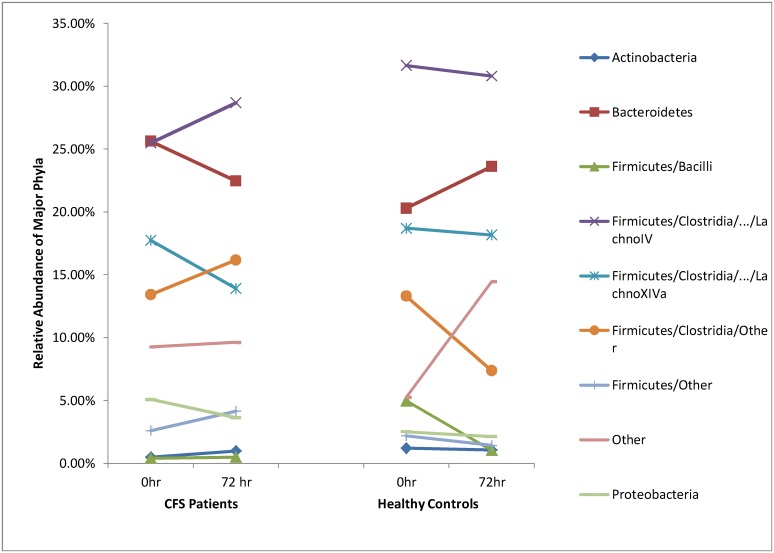
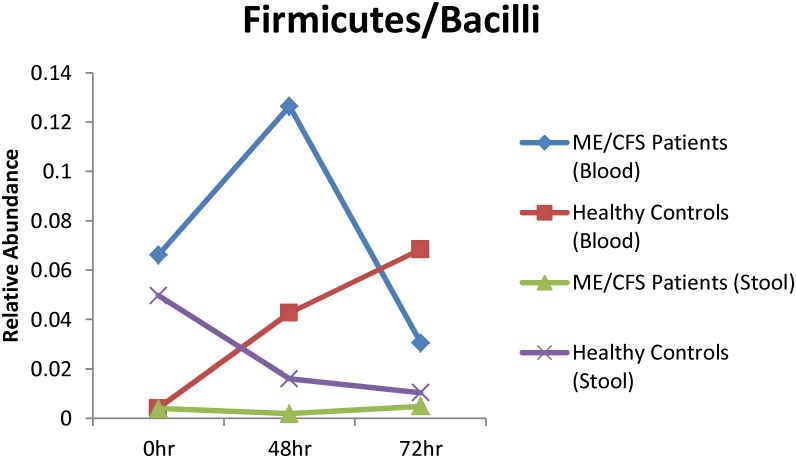
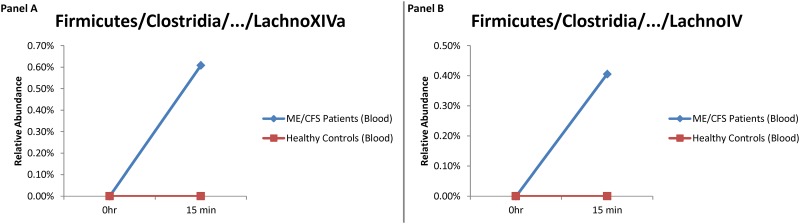
Myalgic encephalomyelitis/chronic fatigue syndrome (ME/CFS) is a disease characterized by intense and debilitating fatigue not due to physical activity that has persisted for at least 6 months, post-exertional malaise, unrefreshing sleep, and accompanied by a number of secondary symptoms, including sore throat, memory and concentration impairment, headache, and muscle/joint pain. In patients with post-exertional malaise, significant worsening of symptoms occurs following physical exertion and exercise challenge serves as a useful method for identifying biomarkers for exertion intolerance. Evidence suggests that intestinal dysbiosis and systemic responses to gut microorganisms may play a role in the symptomology of ME/CFS. As such, we hypothesized that post-exertion worsening of ME/CFS symptoms could be due to increased bacterial translocation from the intestine into the systemic circulation. To test this hypothesis, we collected symptom reports and blood and stool samples from ten clinically characterized ME/CFS patients and ten matched healthy controls before and 15 minutes, 48 hours, and 72 hours after a maximal exercise challenge. Microbiomes of blood and stool samples were examined. Stool sample microbiomes differed between ME/CFS patients and healthy controls in the abundance of several major bacterial phyla. Following maximal exercise challenge, there was an increase in relative abundance of 6 of the 9 major bacterial phyla/genera in ME/CFS patients from baseline to 72 hours post-exercise compared to only 2 of the 9 phyla/genera in controls (p = 0.005). There was also a significant difference in clearance of specific bacterial phyla from blood following exercise with high levels of bacterial sequences maintained at 72 hours post-exercise in ME/CFS patients versus clearance in the controls. These results provide evidence for a systemic effect of an altered gut microbiome in ME/CFS patients compared to controls. Upon exercise challenge, there were significant changes in the abundance of major bacterial phyla in the gut in ME/CFS patients not observed in healthy controls. In addition, compared to controls clearance of bacteria from the blood was delayed in ME/CFS patients following exercise. These findings suggest a role for an altered gut microbiome and increased bacterial translocation following exercise in ME/CFS patients that may account for the profound post-exertional malaise experienced by ME/CFS patients.
Overview
The claims and statistics of this paper haven’t been checked yet.
Run the check — free, no account needed. It reads the open-access text and checks the sources it cites.
Integrity signals
Registry
Cites
Statistics
Figures
Verification
Claims the paper makes
The claims and statistics of this paper haven’t been checked yet.
Run the check — free, no account needed. It reads the open-access text and checks the sources it cites.
Claims other papers make about this one
Each is checked against this paper’s own text: does it say what the citing paper says it does?
In the citing paper
“Acute effects of exercise have also been studied using maximal bicycle ergometer test that showed an increase in the abundance of 7 out of 9 major taxa in patients with myalgic encephalomyelitis/chronic fatigue syndrome compared to 2 of 9 in healthy controls (Shukla et al., 2015).”
From Six-Week Endurance Exercise Alters Gut Metagenome That Is not Reflected in Systemic Metabolism in Over-weight Women (2018) · cites this paper as Shukla et al., 2015
Self-check
Percentages, sums and reported differences re-computed from the paper’s own numbers.
The self-check needs the paper’s full text.
Citations
Cites
Statistical Power Analysis for the Behavioral Sciences
Muller, K. E., & Cohen, J. (1989) · Technometrics · doi:10.2307/1270020 · Cited by 99,603
Statistical power analysis for the behavioral sciences
Cohen, J. (1990) · Computers Environment and Urban Systems · doi:10.1016/0198-9715(90)90050-4 · Cited by 65,417
Naive Bayesian Classifier for Rapid Assignment of rRNA Sequences into the New Bacterial Taxonomy
Wang, Q., Garrity, G. M., Tiedje, J. M., & Cole, J. R. (2007) · Applied and Environmental Microbiology · doi:10.1128/aem.00062-07 · Cited by 20,145
The Chronic Fatigue Syndrome: A Comprehensive Approach to Its Definition and Study
Fukuda, K., Straus, S. E., Hickie, I., Sharpe, M. C., Dobbins, J. G., Komaroff, A., & and International Chronic Fatigue Syndrome Study Group. (1994) · Annals of Internal Medicine · doi:10.7326/0003-4819-121-12-199412150-00009 · Cited by 4,969 · cited 2×
“All patients met the ME/CFS case definition criteria established by Fukuda et al in 1994 [13].”
MethodThe short-form McGill pain questionnaire
Melzack, R. (1987) · Pain · doi:10.1016/0304-3959(87)91074-8 · Cited by 4,368
Smets, E. M. A., Garssen, B., Bonke, B., & de Haes, J. C. J. M. (1995) · Journal of Psychosomatic Research · doi:10.1016/0022-3999(94)00125-o · Cited by 3,622
McNair, D. M. (1992) · Medical Entomology and Zoology · Cited by 2,527
Critical Evaluation of Two Primers Commonly Used for Amplification of Bacterial 16S rRNA Genes
Frank, J. A., Reich, C. I., Sharma, S., Weisbaum, J. S., Wilson, B. A., & Olsen, G. J. (2008) · Applied and Environmental Microbiology · doi:10.1128/aem.02272-07 · Cited by 1,935
Gut/brain axis and the microbiota
Mayer, E. A., Tillisch, K., & Gupta, A. (2015) · Journal of Clinical Investigation · doi:10.1172/jci76304 · Cited by 1,503
Exercise and associated dietary extremes impact on gut microbial diversity
Clarke, S. F., Murphy, E. F., O'Sullivan, O., Lucey, A. J., Humphreys, M., Hogan, A., Hayes, P., O'Reilly, M., Jeffery, I. B., Wood-Martin, R., et al. (2014) · Gut · doi:10.1136/gutjnl-2013-306541 · Cited by 1,439
Cited by
Sorted by citations
Ticinesi, A., Lauretani, F., Milani, C., Nouvenne, A., Tana, C., Del Rio, D., Maggio, M., Ventura, M., & Meschi, T. (2017) · Nutrients · doi:10.3390/nu9121303 · Cited by 401
Exercise Training Modulates Gut Microbiota Profile and Improves Endotoxemia
MOTIANI, K. K., COLLADO, M. C., ESKELINEN, J.-J., VIRTANEN, K. A., LÖYTTYNIEMI, E., SALMINEN, S., NUUTILA, P., KALLIOKOSKI, K. K., & HANNUKAINEN, J. C. (2020) · Medicine & Science in Sports & Exercise · doi:10.1249/mss.0000000000002112 · Cited by 333
Komaroff, A. L., & Lipkin, W. I. (2023) · Frontiers in Medicine · doi:10.3389/fmed.2023.1187163 · Cited by 366
Munukka, E., Ahtiainen, J. P., Puigbó, P., Jalkanen, S., Pahkala, K., Keskitalo, A., Kujala, U. M., Pietilä, S., Hollmén, M., Elo, L., et al. (2018) · Frontiers in Microbiology · doi:10.3389/fmicb.2018.02323 · Cited by 237
Nagy‐Szakal, D., Williams, B. L., Mishra, N., Che, X., Lee, B., Bateman, L., Klimas, N. G., Komaroff, A. L., Levine, S. M., Montoya, J. G., et al. (2017) · Microbiome · doi:10.1186/s40168-017-0261-y · Cited by 228
Metadata
- Authors
- Shukla, S. K., Cook, D., Meyer, J., Vernon, S. D., Le, T., Clevidence, D., Robertson, C. E., Schrodi, S. J., Yale, S., & Frank, D. N.
- Affiliations
- Marshfield Clinic Research Foundation (US)
- University of Wisconsin–Madison (US)
- William S. Middleton Memorial Veterans Hospital (US)
- Bateman Horne Center (US)
- University of Colorado Anschutz (US)
- Marshfield Clinic (US)
- Corresponding author
- Shukla, Sanjay K.
- ORCID
- Venue
- PLOS ONE
- Publisher
- Public Library of Science (PLoS)
- Published
- 2015-12-18
- Volume
- 10
- Issue
- 12
- Pages
- e0145453
- ISSN
- 1932-6203 (ISSN-L)
- PMC
- PMC4684203
- OpenAlex
- W2218212850
- Cited by
- 137
- References
- 58
- Citations by year
- 2026: 6 · 2025: 8 · 2024: 13 · 2023: 19 · 2022: 15 · 2021: 9 · 2020: 21 · 2019: 14 · 2018: 11 · 2017: 15 · 2016: 6
- FWCI
- 4.63
- Type
- journal article
- Language
- en
- Open access
- gold
- doi.org
- Licence
- Locations
- PLoS ONE (publishedVersion, cc-by)
- PubMed Central (publishedVersion, cc-by)
- PubMed (publishedVersion)
- DOAJ (DOAJ: Directory of Open Access Journals) (submittedVersion, cc-by-sa)
- Topics
- Life Sciences › Biochemistry, Genetics and Molecular Biology › Molecular Biology › Gut microbiota and health
- Health Sciences › Medicine › Psychiatry and Mental health › Fibromyalgia and Chronic Fatigue Syndrome Research
- Health Sciences › Medicine › Gastroenterology › Gastrointestinal motility and disorders
- Keywords
- chronic fatigue syndrome, gut microbiota, exercise challenge, post-exertional malaise, bacterial translocation, gut dysbiosis, bacterial clearance
- MeSH terms
- Bacillota, Gastrointestinal Microbiome, Adult, Bacillus, Physical Exertion, Feces, Female, Humans, Male, Middle Aged, Fatigue Syndrome, Chronic, Case-Control Studies, Bacteremia
About these checks
Registry, retraction, Cites and statistics results are computed, not judged, with one exception: a printed reference that no index lists is read once by a model before it counts as a citation error. Claims are extracted by a model and kept only when their quote appears verbatim in the text; each cited source is then checked, with a model’s help, for whether it says what the claim relies on. Those verdicts can be wrong — read the claim’s quote and the cited source before relying on one.
Statistics and arithmetic are recomputed, not judged.
Confidence bands are shown only for fields calibrated on our annotated test set. None is calibrated yet, so no band is shown.
What counts as a claim ›How we measure confidence ›How we check this ›
Are you an author, or do you see a problem with this page? Request a review
