

The DOI matches its Crossref record; 32 of the 33 references it cites were found in a registry or an index.
The Effects of Local Police Surges on Crime and Arrests in New York City
Open accessAbstract
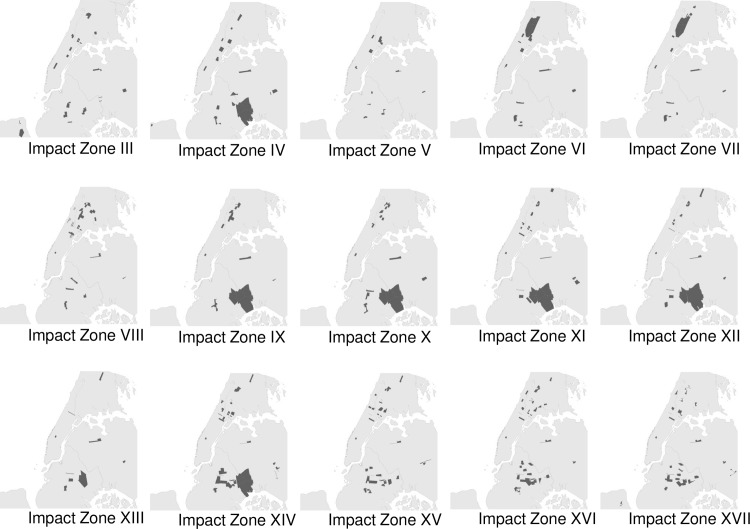
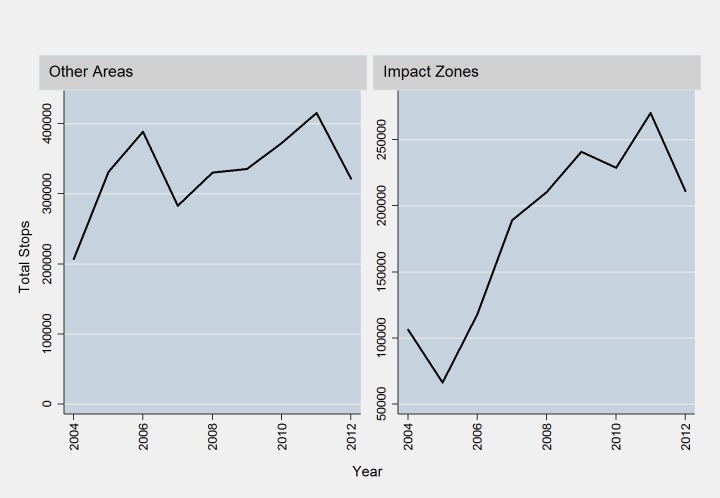
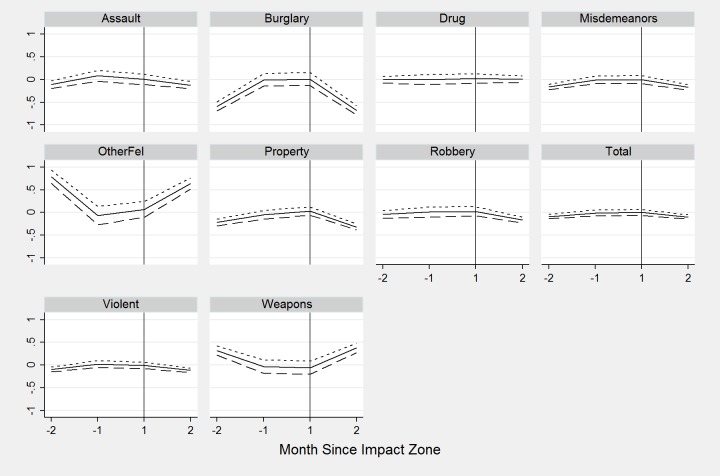
The New York Police Department (NYPD) under Operation Impact deployed extra police officers to high crime areas designated as impact zones. Officers were encouraged to conduct investigative stops in these areas. City officials credited the program as one of the leading causes of New York City's low crime rate. We tested the effects of Operation Impact on reported crimes and arrests from 2004 to 2012 using a difference-in-differences approach. We used Poisson regression models to compare differences in crime and arrest counts before and after census block groups were designated as impact zones compared to census block groups in the same NYPD precincts but outside impact zones. Impact zones were significantly associated with reductions in total reported crimes, assaults, burglaries, drug violations, misdemeanor crimes, felony property crimes, robberies, and felony violent crimes. Impact zones were significantly associated with increases in total reported arrests, arrests for burglary, arrests for weapons, arrests for misdemeanor crimes, and arrests for property felony crimes. Impact zones were also significantly associated with increases in investigative stops for suspected crimes, but only the increase in stops made based on probable cause indicators of criminal behaviors were associated with crime reductions. The largest increase in investigative stops in impact zones was based on indicators of suspicious behavior that had no measurable effect on crime. The findings suggest that saturating high crime blocks with police helped reduce crime in New York City, but that the bulk of the investigative stops did not play an important role in the crime reductions. The findings indicate that crime reduction can be achieved with more focused investigative stops.
Overview
The claims and statistics of this paper haven’t been checked yet.
Run the check — free, no account needed. It reads the open-access text and checks the sources it cites.
Integrity signals
Registry
Cites
Statistics
Figures
Verification
Claims the paper makes
The claims and statistics of this paper haven’t been checked yet.
Run the check — free, no account needed. It reads the open-access text and checks the sources it cites.
Claims other papers make about this one
Each is checked against this paper’s own text: does it say what the citing paper says it does?
The cited source says what the claim attributes to it.
In the citing paper
“Although there is evidence that these NYPD strategies were associated with modest crime control gains (MacDonald et al., 2016;Weisburd et al., 2016), numerous studies suggested that these policing efforts generated racially disparate impacts on police stops and arrests of Black and Hispanic residents (e.g., Fagan & Davies, 2000;Gelman et al., 2007;Jones-Brown et al., 2010).”
From Police reform in public housing contexts: Body‐worn cameras, surveillance, and harm reduction in New York City Housing Authority Developments (2024) · cites this paper as MacDonald et al., 2016
Self-check
Percentages, sums and reported differences re-computed from the paper’s own numbers.
The self-check needs the paper’s full text.
Citations
Cites
Understanding Why Crime Fell in the 1990s: Four Factors that Explain the Decline and Six that Do Not
Levitt, S. D. (2004) · The Journal of Economic Perspectives · doi:10.1257/089533004773563485 · Cited by 1,155
General deterrent effects of police patrol in crime “hot spots”: A randomized, controlled trial
Sherman, L. W., & Weisburd, D. (1995) · Justice Quarterly · doi:10.1080/07418829500096221 · Cited by 1,029
Using the Longitudinal Structure of Earnings to Estimate the Effect of Training Programs
Ashenfelter, O., & Card, D. (1985) · The Review of Economics and Statistics · doi:10.2307/1924810 · Cited by 1,023
Using the Longitudinal Structure of Earnings to Estimate the Effect of Training Programs
Ashenfelter, O., & Card, D. (1984) · National Bureau of Economic Research · doi:10.3386/w1489 · Cited by 885
Do Police Reduce Crime? Estimates Using the Allocation of Police Forces After a Terrorist Attack
Tella, R. D., & Schargrodsky, E. (2004) · American Economic Review · doi:10.1257/000282804322970733 · Cited by 770
POLICING CRIME AND DISORDER HOT SPOTS: A RANDOMIZED CONTROLLED TRIAL*
BRAGA, A. A., & BOND, B. J. (2008) · Criminology · doi:10.1111/j.1745-9125.2008.00124.x · Cited by 497
Turnaround: how America's top cop reversed the crime epidemic
(1998) · Choice Reviews Online · doi:10.5860/choice.36-0610 · Cited by 395
REFORMING TO PRESERVE: COMPSTAT AND STRATEGIC PROBLEM SOLVING IN AMERICAN POLICING*
WEISBURD, D., MASTROFSKI, S. D., MCNALLY, A. M., GREENSPAN, R., & WILLIS, J. J. (2003) · Criminology & Public Policy · doi:10.1111/j.1745-9133.2003.tb00006.x · Cited by 389
Panic on the Streets of London: Police, Crime, and the July 2005 Terror Attacks
Draca, M., Machin, S. J., & Witt, R. (2011) · American Economic Review · doi:10.1257/aer.101.5.2157 · Cited by 365
Using Terror Alert Levels to Estimate the Effect of Police on Crime
Klick, J., & Tabarrok, A. T. (2005) · The Journal of Law and Economics · doi:10.1086/426877 · Cited by 330
Research works printed but not linked: 3
- A Chalfin, 2013, Are US Cities Under-Policed? Theory and Evidence, NBER Working Paper, 18815
- D Weisburd, 2015, Do Stop, Question, and Frisk Practices Deter Crime?, Criminology & Public Policy
- H MacDonald, 2013, How to increase the crime rate nationwide, Wall St J
Cited by
Sorted by citations
Hot spots policing and crime reduction: an update of an ongoing systematic review and meta-analysis
Braga, A. A., Turchan, B. S., Papachristos, A. V., & Hureau, D. M. (2019) · Journal of Experimental Criminology · doi:10.1007/s11292-019-09372-3 · Cited by 352
Militarization fails to enhance police safety or reduce crime but may harm police reputation
Mummolo, J. (2018) · Proceedings of the National Academy of Sciences · doi:10.1073/pnas.1805161115 · Cited by 231
Hot spots policing of small geographic areas effects on crime
Braga, A. A., Turchan, B., Papachristos, A. V., & Hureau, D. M. (2019) · Campbell Systematic Reviews: Better Evidence for a Better World · doi:10.1002/cl2.1046 · Cited by 260
Aggressive policing and the educational performance of minority youth
Legewie, J., & Fagan, J. (2019) · American Sociological Review · doi:10.1177/0003122419826020 · Cited by 212
Self-citationGlaeser, E. L. (2021) · Urban Studies · doi:10.1177/00420980211052230 · Cited by 192
Metadata
- Authors
- MacDonald, J., Fagan, J., & Geller, A.
- Affiliations
- University of Pennsylvania (US)
- Columbia University (US)
- New York University (US)
- Corresponding author
- MacDonald, John
- Venue
- PLOS ONE
- Publisher
- Public Library of Science (PLoS)
- Published
- 2016-06-16
- Volume
- 11
- Issue
- 6
- Pages
- e0157223
- ISSN
- 1932-6203 (ISSN-L)
- PMC
- PMC4911104
- OpenAlex
- W2177794968
- Cited by
- 145
- References
- 33
- Citations by year
- 2026: 10 · 2025: 10 · 2024: 11 · 2023: 12 · 2022: 27 · 2021: 23 · 2020: 16 · 2019: 13 · 2018: 13 · 2017: 10
- FWCI
- 60.75
- Type
- journal article
- Language
- en
- Open access
- gold
- doi.org
- Licence
- Locations
- PLoS ONE (publishedVersion, cc-by)
- Europe PMC (PubMed Central) (publishedVersion, cc-by)
- PubMed Central (publishedVersion, cc-by)
- PubMed (publishedVersion)
- bepress Legal Repository (submittedVersion)
- eYLS (Yale Law School) (submittedVersion)
- RePEc: Research Papers in Economics (submittedVersion, cc-by)
- DOAJ (DOAJ: Directory of Open Access Journals) (submittedVersion, cc-by-sa)
- Columbia Academic Commons (Columbia University)
- Topics
- Social Sciences › Political Science and International Relations › Policing Practices and Perceptions
- Social Sciences › Sociology and Political Science › Crime Patterns and Interventions
- Social Sciences › Law › Criminal Justice and Penology
- Keywords
- impact zone, New York City Police Department, crime reduction, arrests, investigative stops, police presence, high-crime neighborhoods, violent crime, property crime, New York City
- MeSH terms
- Workforce, Firesetting Behavior, Homicide, Humans, New York City, Theft, Violence, Models, Statistical, Police, Law Enforcement, Drug Trafficking
About these checks
Registry, retraction, Cites and statistics results are computed, not judged, with one exception: a printed reference that no index lists is read once by a model before it counts as a citation error. Claims are extracted by a model and kept only when their quote appears verbatim in the text; each cited source is then checked, with a model’s help, for whether it says what the claim relies on. Those verdicts can be wrong — read the claim’s quote and the cited source before relying on one.
Statistics and arithmetic are recomputed, not judged.
Confidence bands are shown only for fields calibrated on our annotated test set. None is calibrated yet, so no band is shown.
What counts as a claim ›How we measure confidence ›How we check this ›
Are you an author, or do you see a problem with this page? Request a review
