

The DOI matches its Crossref record; 50 of the 50 references it cites were found in a registry or an index.
Association between Placental Lesions, Cytokines and Angiogenic Factors in Pregnant Women with Preeclampsia
Open accessAbstract
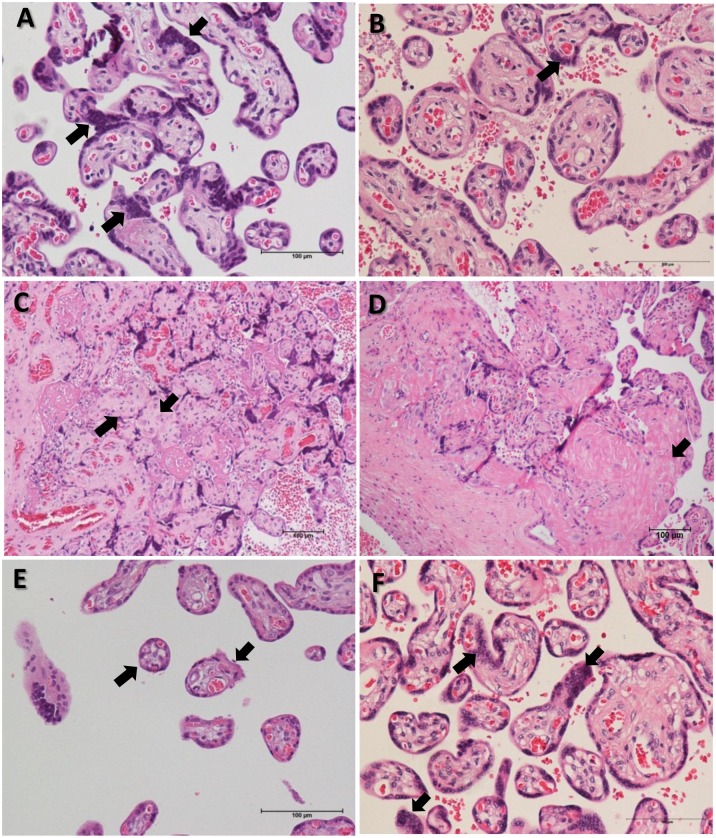
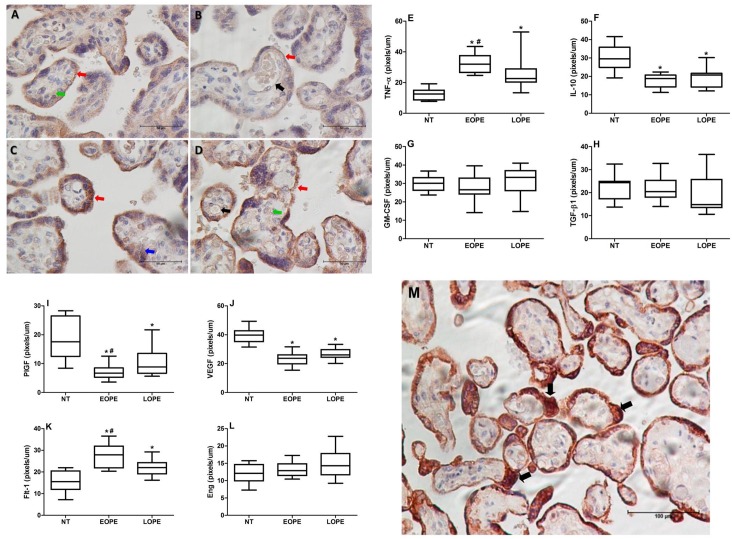
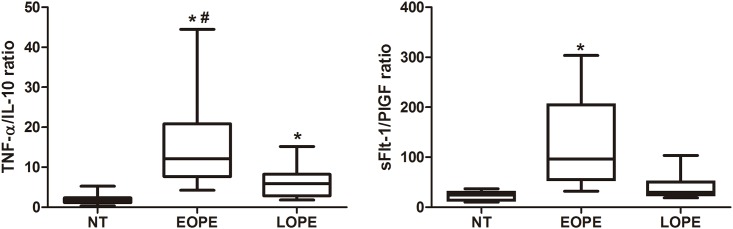
Preeclampsia (PE) is considered the leading cause of maternal and perinatal morbidity and mortality. The placenta seems to play an essential role in this disease, probably due to factors involved in its formation and development. The present study aimed to investigate the association between placental lesions, cytokines and angiogenic factors in pregnant women with preeclampsia (PE). We evaluated 20 normotensive pregnant women, 40 with early-onset PE and 80 with late-onset PE. Placental samples were analyzed for histopathology, immunohistochemistry and determination of granulocyte-macrophage colony-stimulating factor (GM-CSF), interleukin-10 (IL-10), transforming growth factor-beta 1 (TGF-β1), tumor necrosis factor-alpha (TNF-α), placental growth factor (PlGF), vascular endothelial growth factor (VEGF), fms-like tyrosine-kinase-1 (Flt-1) and endoglin (Eng) levels. Higher percentages of increased syncytial knots and increased perivillous fibrin deposits, and greater levels of TNF-α, TGF-β1and Flt-1 were detected in placentas from early-onset PE. Levels of IL-10, VEGF and PlGF were decreased in PE versus normotensive placentas. Both the TNF-α/IL-10 and sFlt-1/PlGF ratios were higher in placental homogenate of early-onset PE than late-onset PE and control groups. The more severe lesions and the imbalance between TNF-α/IL-10 and PlGF/sFlt-1 in placentas from early-onset PE allows differentiation of early and late-onset PE and suggests higher placental impairment in early-onset PE.
Overview
The claims and statistics of this paper haven’t been checked yet.
Run the check — free, no account needed. It reads the open-access text and checks the sources it cites.
Integrity signals
Registry
Cites
Statistics
Figures
Verification
Claims the paper makes
The claims and statistics of this paper haven’t been checked yet.
Run the check — free, no account needed. It reads the open-access text and checks the sources it cites.
Claims other papers make about this one
Each is checked against this paper’s own text: does it say what the citing paper says it does?
In the citing paper
“Although the emphasis on the toxic factors produced by an ischemic placenta has been on the balance between angiogenic and anti-angiogenic factors, evidence now suggests that cytokines, such as TNF-α and IL-10, are altered in early and late preeclampsia, and the changes correlate with the type of histopathological changes in the placenta(185).”
From Metformin, the Aspirin of the 21st Century: Its Role in Gestational Diabetes Mellitus, Prevention of Preeclampsia and Cancer, and the Promotion of Longevity (2017) · cites this paper as [185]
Self-check
Percentages, sums and reported differences re-computed from the paper’s own numbers.
The self-check needs the paper’s full text.
Citations
Cites
Maynard, S. E., Min, J.-Y., Merchan, J., Lim, K.-H., Li, J., Mondal, S., Libermann, T. A., Morgan, J. P., Sellke, F. W., Stillman, I. E., et al. (2003) · Journal of Clinical Investigation · doi:10.1172/jci17189 · Cited by 4,101
Circulating angiogenic factors and the risk of preeclampsia
Levine, R. J., Maynard, S. E., Qian, C., Lim, K.-H., England, L. J., Yu, K. F., Schisterman, E. F., Thadhani, R., Sachs, B. P., Epstein, F. H., et al. (2004) · New England Journal of Medicine · doi:10.1056/nejmoa031884 · Cited by 3,720
Circulating angiogenic factors and the risk of preeclampsia*
(2004) · Obstetrics and Gynecology · doi:10.1097/00006250-200405000-00028 · Cited by 2,623
Latest Advances in Understanding Preeclampsia
Redman, C. W., & Sargent, I. L. (2005) · Science · doi:10.1126/science.1111726 · Cited by 2,607
Soluble endoglin contributes to the pathogenesis of preeclampsia
Venkatesha, S., Toporsian, M., Lam, C., Hanai, J.-I., Mammoto, T., Kim, Y. M., Bdolah, Y., Lim, K.-H., Yuan, H.-T., Libermann, T. A., et al. (2006) · Nature Medicine · doi:10.1038/nm1429 · Cited by 1,855
ACOG Practice Bulletin No. 33: Diagnosis and Management of Preeclampsia and Eclampsia
ACOG Committee on Obstetric Practice (2002) · Obstetrics and Gynecology · doi:10.1016/s0029-7844(01)01747-1 · Cited by 1,180
Placental Origins of Preeclampsia
Huppertz, B. (2008) · Hypertension · doi:10.1161/hypertensionaha.107.107607 · Cited by 899
A Critical Review of Early-Onset and Late-Onset Preeclampsia
Raymond, D., & Peterson, E. L. (2011) · Obstetrical & Gynecological Survey · doi:10.1097/ogx.0b013e3182331028 · Cited by 552
Tsatsaris, V., Goffin, F., Munaut, C., Brichant, J.-F., Pignon, M.-R., Noël, A., Schaaps, J., CABROL, D., Frankenne, F., & Foidart, J. (2003) · The Journal of Clinical Endocrinology & Metabolism · doi:10.1210/jc.2003-030528 · Cited by 465
Gu, Y., Lewis, D. F., & Wang, Y. (2007) · The Journal of Clinical Endocrinology & Metabolism · doi:10.1210/jc.2007-1550 · Cited by 435
Nevo, O., Soleymanlou, N., Wu, Y., Xu, J., Kingdom, J. C., Many, A., Zamudio, S., & Caniggia, I. (2006) · American Journal of Physiology-Regulatory, Integrative and Comparative Physiology · doi:10.1152/ajpregu.00794.2005 · Cited by 361
Preeclampsia and Angiogenic Imbalance
Maynard, S. E., Epstein, F. H., & Karumanchi, S. A. (2007) · Annual Review of Medicine · doi:10.1146/annurev.med.59.110106.214058 · Cited by 334
Oggè, G., Chaiworapongsa, T., Romero, R. J., Hussein, Y., Kusanovic, J. P., Yeo, L., Kim, C. J., & Hassan, S. S. (2011) · Journal of Perinatal Medicine · doi:10.1515/jpm.2011.098 · Cited by 303
Review: Does size matter? Placental debris and the pathophysiology of pre-eclampsia
Redman, C. W. G., Tannetta, D., Dragovic, R., Gardiner, C., Southcombe, J. H., Collett, G. P., & Sargent, I. L. (2012) · Placenta · doi:10.1016/j.placenta.2011.12.006 · Cited by 256
A Deficiency of Placental IL-10 in Preeclampsia
Hennessy, A., Pilmore, H., Simmons, L., & Painter, D. M. (1999) · The Journal of Immunology · doi:10.4049/jimmunol.163.6.3491 · Cited by 250
Cytokines as Key Players in the Pathophysiology of Preeclampsia
Raghupathy, R. (2013) · Medical Principles and Practice · doi:10.1159/000354200 · Cited by 235
Hung, T., Jones, D. S., Skepper, J. N., & Burton, G. J. (2004) · American Journal Of Pathology · doi:10.1016/s0002-9440(10)63192-6 · Cited by 209
Formation of Syncytial Knots is Increased by Hyperoxia, Hypoxia and Reactive Oxygen Species
Heazell, A. E. P., Moll, S. J., Jones, C. J. P., Baker, P. N., & Crocker, I. P. (2007) · Placenta · doi:10.1016/j.placenta.2006.10.007 · Cited by 204
Abnormal Placentation, Angiogenic Factors, and the Pathogenesis of Preeclampsia
Silasi, M., Cohen, B., Karumanchi, S. A., & Rana, S. (2010) · Obstetrics and Gynecology Clinics of North America · doi:10.1016/j.ogc.2010.02.013 · Cited by 199
Rajakumar, A., Cerdeira, A. S., Rana, S., Zsengellér, Z. K., Edmunds, L. R., Jeyabalan, A., Hubel, C. A., Stillman, I. E., Parikh, S. M., & Karumanchi, S. A. (2012) · Hypertension · doi:10.1161/hypertensionaha.111.182170 · Cited by 186
Loukeris, K., Sela, R., & Baergen, R. N. (2009) · Pediatric and Developmental Pathology · doi:10.2350/09-08-0692-oa.1 · Cited by 166
Self-citationACOG Practice Bulletin No. 33: Diagnosis and Management of Preeclampsia and Eclampsia
(2002) · Obstetrics and Gynecology · doi:10.1097/00006250-200201000-00028 · Cited by 156
VEGF-A164/165 and PlGF Roles in Angiogenesis and Arteriogenesis
Nagy, J. A. (2003) · Trends in Cardiovascular Medicine · doi:10.1016/s1050-1738(03)00056-2 · Cited by 145
Makris, A., Xu, B., Yu, B., Thornton, C. E., & Hennessy, A. (2005) · Placenta · doi:10.1016/j.placenta.2005.05.003 · Cited by 112
Are Early and Late Preeclampsia Distinct Subclasses of the Disease—What Does the Placenta Reveal?
van der Merwe, J., Hall, D. R., Wright, C. A., Schubert, P. T., & Grove, D. (2010) · Hypertension in Pregnancy · doi:10.3109/10641950903572282 · Cited by 102
Kovo, M., Schreiber, L., Ben‐Haroush, A., Gold, E., Golan, A., & Bar, J. (2012) · Prenatal Diagnosis · doi:10.1002/pd.3872 · Cited by 92
Sikkema, J. M., Franx, A., Bruinse, H. W., van der Wijk, N. G., de Valk, H. W., & Nikkels, P. G. J. (2002) · Placenta · doi:10.1053/plac.2001.0785 · Cited by 83
Peraçoli, J. C., Castro, C. F. B., Romão‐Veiga, M., Weel, I. C., Ribeiro, V. R., Borges, V. T. M., Rudge, M. V. C., Witkin, S. S., & Peraçoli, M. T. S. (2013) · Journal of Reproductive Immunology · doi:10.1016/j.jri.2013.08.003 · Cited by 78
Self-citationPreeclampsia: A multi-stress disorder
Redman, C. W. G. (2011) · La Revue de Médecine Interne · doi:10.1016/j.revmed.2011.03.331 · Cited by 77
Mechanisms and Potential Therapies for Preeclampsia
George, E. M., & Granger, J. P. (2011) · Current Hypertension Reports · doi:10.1007/s11906-011-0204-0 · Cited by 77
Vinnars, M., Nasiell, J., Ghazi, S. H., Westgren, M., & Papadogiannakis, N. (2010) · Acta Obstetricia Et Gynecologica Scandinavica · doi:10.1111/j.1600-0412.2010.01012.x · Cited by 69
Kaplan, C. G., Lowell, D. M., & Salafia, C. M. (1991) · PubMed · Cited by 67
Cristofalo, R., Castro, C. F. B., Magalhães, C. G., Borges, V. T. M., Peraçoli, J. C., Witkin, S. S., & Peraçoli, M. T. S. (2013) · Free Radical Research · doi:10.3109/10715762.2013.765951 · Cited by 66
Self-citationSankar, K. D., Bhanu, P. S., Kiran, S., Ramakrishna, B., & Shanthi, V. (2012) · Anatomy & Cell Biology · doi:10.5115/acb.2012.45.2.86 · Cited by 62
A case–control study of placental lesions associated with pre‐eclampsia
Devisme, L., Merlot, B., Ego, A., Houfflin‐Debarge, V., Deruelle, P., & Subtil, D. (2012) · International Journal of Gynecology & Obstetrics · doi:10.1016/j.ijgo.2012.08.023 · Cited by 60
Placenta-derived angiogenic proteins and their contribution to the pathogenesis of preeclampsia
Pratt, A., Costa, F. D. S., Borg, A. J., Kalionis, B., Keogh, R. J., & Murthi, P. (2014) · Angiogenesis · doi:10.1007/s10456-014-9452-3 · Cited by 51
Hayashi, M., Hamada, Y., & Ohkura, T. (2004) · American Journal of Obstetrics and Gynecology · doi:10.1016/j.ajog.2003.07.032 · Cited by 48
Tripathi, R., Rath, G., Jain, A., & Salhan, S. (2008) · Annals of Anatomy - Anatomischer Anzeiger · doi:10.1016/j.aanat.2008.08.002 · Cited by 48
Baltajian, K., Hecht, J. L., Wenger, J., Salahuddin, S., Verlohren, S., Perschel, F. H., Zsengellér, Z. K., Thadhani, R., Karumanchi, S. A., & Rana, S. (2014) · Hypertension in Pregnancy · doi:10.3109/10641955.2014.926914 · Cited by 41
New directions in the prediction of pre-eclampsia
Kane, S. C., Costa, F. D. S., & Brennecke, S. P. (2013) · Australian and New Zealand Journal of Obstetrics and Gynaecology · doi:10.1111/ajo.12151 · Cited by 37
Kim, S., Park, M. J., Joo, B., Joo, J., Suh, D., & Lee, K. S. (2012) · Journal of obstetrics and gynaecology research · doi:10.1111/j.1447-0756.2011.01773.x · Cited by 37
Zhou, P., Luo, X., Qi, H., Zong, W.-J., Zhang, H., Liu, D., & Li, Q.-S. (2012) · Inflammation Research · doi:10.1007/s00011-012-0507-x · Cited by 35
Heazell, A. E. P., Moll, S., Jones, C. J. P., Baker, P. N., & Crocker, I. P. (2007) · Placenta · doi:10.1016/j.placenta.2007.06.008 · Cited by 32
Stark, M. W., Clark, L. S., & Craver, R. D. (2014) · Pediatric and Developmental Pathology · doi:10.2350/13-09-1378-oa.1 · Cited by 32
Examining the correlation between placental and serum placenta growth factor in preeclampsia
Weed, S. E., Bastek, J. A., Anton, L., Elovitz, M. A., Parry, S. I., & Srinivas, S. K. (2012) · American Journal of Obstetrics and Gynecology · doi:10.1016/j.ajog.2012.05.003 · Cited by 28
The Placental Syncytium and the Pathophysiology of Preeclampsia and Intrauterine Growth Restriction
Guller, S. M., Ma, Y. Y., Fu, H., Krikun, G., Abrahams, V. M., & Mor, G. (2008) · Annals of the New York Academy of Sciences · doi:10.1196/annals.1434.015 · Cited by 27
sFlt-1/PlGF ratio as a prognostic marker of adverse outcomes in women with early-onset preeclampsia
Oliveira, L. G., Peraçoli, J. C., Peraçoli, M. T. S., Korkes, H. A., Zampieri, G., Moron, A. F., & Sass, N. (2013) · Pregnancy Hypertension · doi:10.1016/j.preghy.2013.02.003 · Cited by 26
Self-citationCalprotectin, RAGE and TNF-α in hypertensive disorders in pregnancy: expression and significance
Feng, C., Tao, Y., Shang, T., & Yu, M. (2009) · Archives of Gynecology and Obstetrics · doi:10.1007/s00404-009-1303-x · Cited by 15
Wang, Y., Zhang, X., Cheng, G., & Ren, C. (2006) · PubMed · doi:10.3760/j.issn:0529-567x.2006.08.004 · Cited by 4
Aumento no material fibrinoide perivilositário nas placentas de gestações com pré-eclâmpsia
de Souza, D. A., Bezerra, A. F. D. S., Wanderley, D. C., & Souto, C. M. B. (2011) · Jornal Brasileiro de Patologia e Medicina Laboratorial · doi:10.1590/s1676-24442011000100010 · Cited by 3
Research works printed but not linked: 1
- DA Souza, 2011, Increase in perivillous fibrinoid material in placentas from pregnancies with preeclampsia, J Bras Patol Med Lab, 47, 71
Cited by
Sorted by citations
Rana (2019) · doi:10.1161/circresaha.118.313276 · Cited by 2,095
Syncytiotrophoblast stress in preeclampsia: the convergence point for multiple pathways
Redman, C. W. G., Staff, A. C., & Roberts, J. M. (2021) · American Journal of Obstetrics and Gynecology · doi:10.1016/j.ajog.2020.09.047 · Cited by 419
Rana, S., Burke, S. D., & Karumanchi, S. A. (2020) · American Journal of Obstetrics and Gynecology · doi:10.1016/j.ajog.2020.10.022 · Cited by 366
Pathogenesis of Preeclampsia and Therapeutic Approaches Targeting the Placenta
Jena, M. K., Sharma, N. R., Petitt, M., Maulik, D., & Nayak, N. R. (2020) · Biomolecules · doi:10.3390/biom10060953 · Cited by 280
Romero, R., Erez, O., Hüttemann, M., Maymon, E., Panaitescu, B., Conde-Agudelo, A., Pacora, P., Yoon, B. H., & Grossman, L. I. (2017) · American Journal of Obstetrics and Gynecology · doi:10.1016/j.ajog.2017.06.003 · Cited by 253
Metadata
- Authors
- Weel, I. C., Baergen, R. N., Romão-Veiga, M., Borges, V. T., Ribeiro, V. R., Witkin, S. S., Bannwart-Castro, C., Peraçoli, J. C., De Oliveira, L., & Peraçoli, M. T.
- Affiliations
- Universidade Estadual Paulista (Unesp) (BR)
- NewYork–Presbyterian Hospital (US)
- Weill Cornell Medicine (US)
- Corresponding author
- Peraçoli, Maria T.
- Venue
- PLoS ONE
- Publisher
- Public Library of Science (PLoS)
- Published
- 2016-06-17
- Volume
- 11
- Issue
- 6
- Pages
- e0157584
- ISSN
- 1932-6203 (ISSN-L)
- PMC
- PMC4912084
- OpenAlex
- W2430003272
- Cited by
- 131
- References
- 50
- Citations by year
- 2026: 11 · 2025: 7 · 2024: 11 · 2023: 5 · 2022: 11 · 2021: 15 · 2020: 17 · 2019: 15 · 2018: 22 · 2017: 17
- FWCI
- 23.25
- Type
- journal article
- Language
- en
- Open access
- gold
- doi.org
- Licence
- Locations
- PLoS ONE (publishedVersion, cc-by)
- Europe PMC (PubMed Central) (publishedVersion, cc-by)
- PubMed Central (publishedVersion, cc-by)
- PubMed (publishedVersion)
- Americanae (AECID Library) (publishedVersion, other-oa)
- DOAJ (DOAJ: Directory of Open Access Journals) (submittedVersion, cc-by-sa)
- LA Referencia (Red Federada de Repositorios Institucionales de Publicaciones Científicas) (submittedVersion, other-oa)
- Topics
- Health Sciences › Medicine › Obstetrics and Gynecology › Pregnancy and preeclampsia studies
- Health Sciences › Medicine › Clinical Neurology › Neurological Complications and Syndromes
- Life Sciences › Immunology and Microbiology › Immunology › Reproductive System and Pregnancy
- Keywords
- preeclampsia, placental lesions, cytokines, angiogenic factors, early-onset preeclampsia, late-onset preeclampsia, syncytiotrophoblastic knots, TNF-α, IL-10, TGF-β1, soluble fms-like tyrosine kinase-1, placental growth factor, vascular endothelial growth factor, CD105, TNF-α/IL-10 ratio, sFlt-1/PlGF ratio, placental pathology
- MeSH terms
- Placenta Growth Factor, Adult, Female, Humans, Placenta, Pre-Eclampsia, Pregnancy, Tumor Necrosis Factor-alpha, Granulocyte-Macrophage Colony-Stimulating Factor, Interleukin-10, Age of Onset, Vascular Endothelial Growth Factor Receptor-1, Vascular Endothelial Growth Factor A
About these checks
Registry, retraction, Cites and statistics results are computed, not judged, with one exception: a printed reference that no index lists is read once by a model before it counts as a citation error. Claims are extracted by a model and kept only when their quote appears verbatim in the text; each cited source is then checked, with a model’s help, for whether it says what the claim relies on. Those verdicts can be wrong — read the claim’s quote and the cited source before relying on one.
Statistics and arithmetic are recomputed, not judged.
Confidence bands are shown only for fields calibrated on our annotated test set. None is calibrated yet, so no band is shown.
What counts as a claim ›How we measure confidence ›How we check this ›
Are you an author, or do you see a problem with this page? Request a review
