

The DOI matches its Crossref record; 111 of the 113 references it cites were found in a registry or an index.
Development and Validation of a Self-Report Measure of Mentalizing: The Reflective Functioning Questionnaire
Open accessAbstract
Reflective functioning or mentalizing is the capacity to interpret both the self and others in terms of internal mental states such as feelings, wishes, goals, desires, and attitudes. This paper is part of a series of papers outlining the development and psychometric features of a new self-report measure, the Reflective Functioning Questionnaire (RFQ), designed to provide an easy to administer self-report measure of mentalizing. We describe the development and initial validation of the RFQ in three studies. Study 1 focuses on the development of the RFQ, its factor structure and construct validity in a sample of patients with Borderline Personality Disorder (BPD) and Eating Disorder (ED) (n = 108) and normal controls (n = 295). Study 2 aims to replicate these findings in a fresh sample of 129 patients with personality disorder and 281 normal controls. Study 3 addresses the relationship between the RFQ, parental reflective functioning and infant attachment status as assessed with the Strange Situation Procedure (SSP) in a sample of 136 community mothers and their infants. In both Study 1 and 2, confirmatory factor analyses yielded two factors assessing Certainty (RFQ_C) and Uncertainty (RFQ_U) about the mental states of self and others. These two factors were relatively distinct, invariant across clinical and non-clinical samples, had satisfactory internal consistency and test-retest stability, and were largely unrelated to demographic features. The scales discriminated between patients and controls, and were significantly and in theoretically predicted ways correlated with measures of empathy, mindfulness and perspective-taking, and with both self-reported and clinician-reported measures of borderline personality features and other indices of maladaptive personality functioning. Furthermore, the RFQ scales were associated with levels of parental reflective functioning, which in turn predicted infant attachment status in the SSP. Overall, this study lends preliminary support for the RFQ as a screening measure of reflective functioning. Further research is needed, however, to investigate in more detail the psychometric qualities of the RFQ.
Overview
The claims and statistics of this paper haven’t been checked yet.
Run the check — free, no account needed. It reads the open-access text and checks the sources it cites.
Integrity signals
Registry
Cites
Statistics
Figures
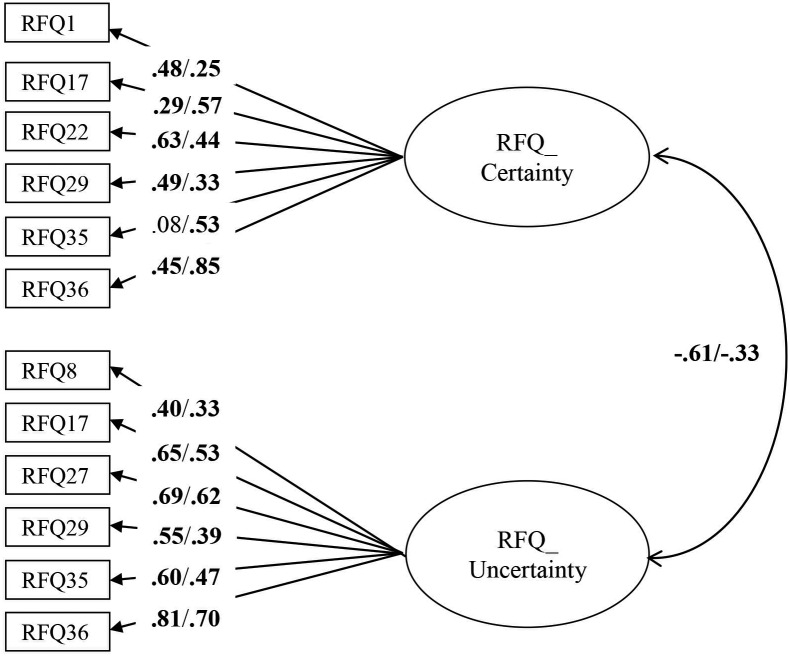
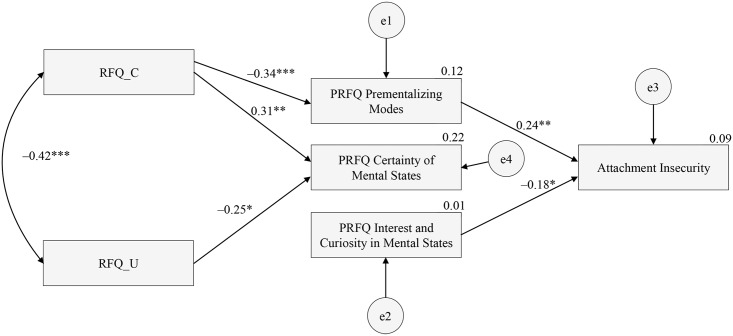
Verification
Claims the paper makes
The claims and statistics of this paper haven’t been checked yet.
Run the check — free, no account needed. It reads the open-access text and checks the sources it cites.
Claims other papers make about this one
Each is checked against this paper’s own text: does it say what the citing paper says it does?
The cited source says what the claim attributes to it.
In the citing paper
“Internal consistency of RFQc and RFQu respectively are α = 0.65 and α = 0.77 in a clinical sample and α = 0.67 and α = 0.63 in a non-clinical sample, respectively [55].”
Self-check
Percentages, sums and reported differences re-computed from the paper’s own numbers.
The self-check needs the paper’s full text.
Citations
Cites
Diagnostic and Statistical Manual of Mental Disorders
Williams, J. B. W., & First, M. B. (2013) · Oxford University Press eBooks · doi:10.1093/acrefore/9780199975839.013.104 · Cited by 109,845
Hu, L., & Bentler, P. M. (1999) · Structural Equation Modeling A Multidisciplinary Journal · doi:10.1080/10705519909540118 · Cited by 108,788
Principles and Practice of Structural Equation Modeling
Tabri, N., & Elliott, C. M. (2012) · Canadian Graduate Journal of Sociology and Criminology · doi:10.15353/cgjsc.v1i1.3787 · Cited by 39,094
(1998) · Cited by 36,049
Structural Equations with Latent Variables
Bollen, K. A. (1989) · Wiley series in probability and statistics · doi:10.1002/9781118619179 · Cited by 17,944
Structural Equations with Latent Variables.
Clogg, C. C., & Bollen, K. A. (1991) · Contemporary Sociology A Journal of Reviews · doi:10.2307/2072165 · Cited by 17,475
Confirmatory factor analysis for applied research
Brown, T. A. (2007) · Choice Reviews Online · doi:10.5860/choice.44-2769 · Cited by 15,621 · cited 1×
“Consistent with state-of-the-art recommendations [55, 56], we limited the number of possible error correlations to a minimum, allowing only error correlations between items that were similar in formulation or meaning (e.”
BackgroundHappiness is everything, or is it? Explorations on the meaning of psychological well-being.
Ryff, C. D. (1989) · Journal of Personality and Social Psychology · doi:10.1037/0022-3514.57.6.1069 · Cited by 14,847 · cited 2×
“PLOS ONE | DOI:10.1371/journal.pone.0158678 July 8, 2016 15 / 28 The Amsterdam Scale of Well-Being (ASWB) [74] assesses well-being rated on the six dimensions described by Ryff (1989).”
BackgroundMethodInfluentialThe benefits of being present: Mindfulness and its role in psychological well-being
Brown, K. W., & Ryan, R. M. (2003) · Journal of Personality and Social Psychology · doi:10.1037/0022-3514.84.4.822 · Cited by 13,448 · cited 3×
“The RFQ_C was, as expected, positively related to other measures of internally based mentalizing, such as the BES and mindfulness as assessed with the MAAS, but was, against expectations, not related to perspective-taking.”
MethodInfluential(1978) · Medical Entomology and Zoology · Cited by 12,570
Cited by
Sorted by citations
The mentalizing approach to psychopathology: State of the art and future directions
Luyten, P., Campbell, C., Allison, E., & Fonagy, P. (2020) · Annual Review of Clinical Psychology · doi:10.1146/annurev-clinpsy-071919-015355 · Cited by 748
“…such impairments and substance abuse, violence, eating disorders, and self-harm, which can all be seen as attempts to regulate, through specific goal-directed behavior, unbearable and unmentalized self-states (Fonagy et al. 2016, Jewell et al. 2016, Suchman et al. 2018, Taubner et al. 2016).”
BackgroundSelf-citationZeegers, M. A. J., Colonnesi, C., Stams, G. J. J. M., & Meins, E. (2017) · Psychological Bulletin · doi:10.1037/bul0000114 · Cited by 478
“The effect size was calculated from the average association of the three PRFQ subscales (i.e., prementalizing modes, certainty of mental states, and interest and curiosity of in mental states) with infant attachment security.”
BackgroundMethodInfluentialDevelopment and validation of a self-report measure of epistemic trust
Campbell, C., Tanzer, M., Saunders, R., Booker, T. L., Allison, E., Li, E. T., O’Dowda, C., Luyten, P., & Fonagy, P. (2021) · PLoS ONE · doi:10.1371/journal.pone.0250264 · Cited by 230
“The Reflective Function Questionnaire (RFQ) [29].”
InfluentialSelf-citationThe bodymind model: a platform for studying the mechanisms of change induced by art therapy
Czamanski-Cohen, J., & Weihs, K. L. (2016) · The Arts in Psychotherapy · doi:10.1016/j.aip.2016.08.006 · Cited by 209
The Mentalization Scale (MentS): A Self-Report Measure for the Assessment of Mentalizing Capacity
Dimitrijević, A., Hanak, N., Dimitrijević, A. A., & Marjanović, Z. J. (2017) · Journal of Personality Assessment · doi:10.1080/00223891.2017.1310730 · Cited by 221
“It is only very recently that this gap has been filled by the Reflective Functioning Questionnaire (RFQ; Badoud et al., 2015; Fonagy et al., 2016).”
Background
Metadata
- Authors
- Fonagy, P., Luyten, P., Moulton-Perkins, A., Lee, Y.-W., Warren, F., Howard, S., Ghinai, R., Fearon, P., & Lowyck, B.
- Affiliations
- University College London (GB)
- University of Surrey (GB)
- KU Leuven (BE)
- Corresponding author
- Fonagy, Peter
- Venue
- PLOS ONE
- Publisher
- Public Library of Science (PLoS)
- Published
- 2016-07-08
- Volume
- 11
- Issue
- 7
- Pages
- e0158678
- ISSN
- 1932-6203 (ISSN-L)
- PMC
- PMC4938585
- OpenAlex
- W2468117220
- Cited by
- 754
- References
- 113
- Citations by year
- 2026: 102 · 2025: 106 · 2024: 112 · 2023: 108 · 2022: 84 · 2021: 95 · 2020: 54 · 2019: 34 · 2018: 32 · 2017: 21 · 2016: 3
- FWCI
- 39.84
- Type
- journal article
- Language
- en
- Open access
- gold
- doi.org
- Licence
- Locations
- PLoS ONE (publishedVersion, cc-by)
- PubMed Central (publishedVersion, cc-by)
- PubMed (publishedVersion)
- Lirias (KU Leuven) (submittedVersion, other-oa)
- RePEc: Research Papers in Economics (submittedVersion)
- DOAJ (DOAJ: Directory of Open Access Journals) (submittedVersion)
- UCL Discovery (University College London) (submittedVersion)
- Funders
- National Institute for Health Research (NF-SI-0514-10157)
- Economic and Social Research Council (RES-060-25-0044)
- Topics
- Social Sciences › Psychology › Clinical Psychology › Personality Disorders and Psychopathology
- Social Sciences › Psychology › Clinical Psychology › Personality Traits and Psychology
- Social Sciences › Psychology › Clinical Psychology › Psychoanalysis and Psychopathology Research
- Keywords
- mentalization, reflective functioning, self-report measure development, borderline personality disorder, eating disorders, parental reflective functioning, infant attachment, Strange Situation Procedure, empathy, mindfulness, perspective taking, psychometric validation, factor structure
- MeSH terms
- Female, Humans, Male, Psychometrics, Surveys and Questionnaires, Theory of Mind, Self Report
About these checks
Registry, retraction, Cites and statistics results are computed, not judged, with one exception: a printed reference that no index lists is read once by a model before it counts as a citation error. Claims are extracted by a model and kept only when their quote appears verbatim in the text; each cited source is then checked, with a model’s help, for whether it says what the claim relies on. Those verdicts can be wrong — read the claim’s quote and the cited source before relying on one.
Statistics and arithmetic are recomputed, not judged.
Confidence bands are shown only for fields calibrated on our annotated test set. None is calibrated yet, so no band is shown.
What counts as a claim ›How we measure confidence ›How we check this ›
Are you an author, or do you see a problem with this page? Request a review
