

CATALISE: A Multinational and Multidisciplinary Delphi Consensus Study. Identifying Language Impairments in Children
Open accessThe DOI matches its Crossref record; 127 of the 129 references it cites were found in a registry or an index.
Abstract
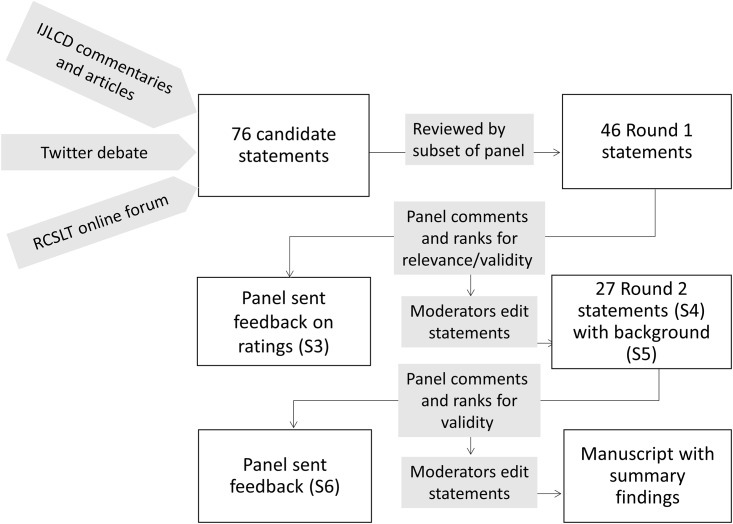
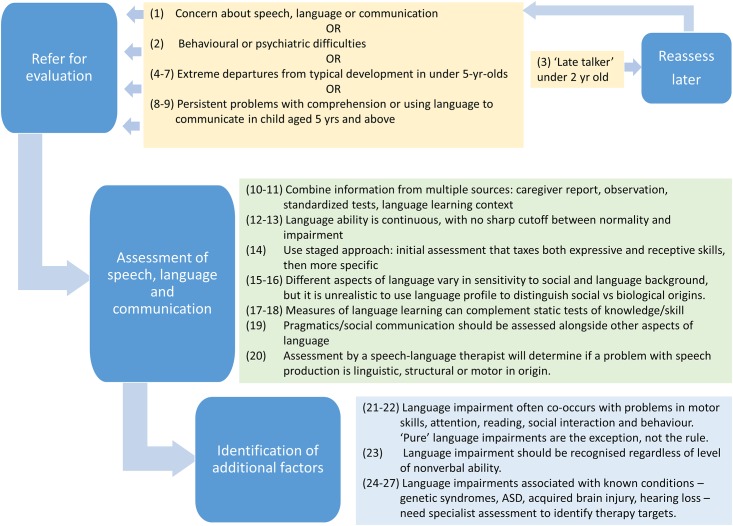
Delayed or impaired language development is a common developmental concern, yet there is little agreement about the criteria used to identify and classify language impairments in children. Children's language difficulties are at the interface between education, medicine and the allied professions, who may all adopt different approaches to conceptualising them. Our goal in this study was to use an online Delphi technique to see whether it was possible to achieve consensus among professionals on appropriate criteria for identifying children who might benefit from specialist services. We recruited a panel of 59 experts representing ten disciplines (including education, psychology, speech-language therapy/pathology, paediatrics and child psychiatry) from English-speaking countries (Australia, Canada, Ireland, New Zealand, United Kingdom and USA). The starting point for round 1 was a set of 46 statements based on articles and commentaries in a special issue of a journal focusing on this topic. Panel members rated each statement for both relevance and validity on a seven-point scale, and added free text comments. These responses were synthesised by the first two authors, who then removed, combined or modified items with a view to improving consensus. The resulting set of statements was returned to the panel for a second evaluation (round 2). Consensus (percentage reporting 'agree' or 'strongly agree') was at least 80 percent for 24 of 27 round 2 statements, though many respondents qualified their response with written comments. These were again synthesised by the first two authors. The resulting consensus statement is reported here, with additional summary of relevant evidence, and a concluding commentary on residual disagreements and gaps in the evidence base.
Overview
The claims and statistics of this paper haven’t been checked yet.
Free: it reads the open-access text and checks the first 5 claims that cite a source we can check. Create a free account to check every claim.
Integrity signals
Registry
Cites
Statistics
Figures
Verification
Claims the paper makes
The claims and statistics of this paper haven’t been checked yet.
Free: it reads the open-access text and checks the first 5 claims that cite a source we can check. Create a free account to check every claim.
Self-check
Percentages, sums and reported differences re-computed from the paper’s own numbers.
The self-check needs the paper’s full text.
Citations
Cites
R: A Language and Environment for Statistical Computing
R Core Team (2025) · doi:10.32614/r.manuals · Cited by 352,181
Diagnostic and Statistical Manual of Mental Disorders
Williams, J. B. W., & First, M. (2013) · Encyclopedia of Social Work · doi:10.1093/acrefore/9780199975839.013.104 · Cited by 109,519
Research guidelines for the Delphi survey technique
Hasson, F. (2000) · Journal of Advanced Nursing · doi:10.1046/j.1365-2648.2000.01567.x · Cited by 5,951 · cited 2×
“The issues we focused on are equally challenging in other countries, but manifestations of language difficulty, and terminology used to describe these, differ across languages [21].”
BackgroundMethodThe Delphi method as a research tool: an example, design considerations and applications
Okoli, C., & Pawlowski, S. D. (2004) · Information & Management · doi:10.1016/j.im.2003.11.002 · Cited by 4,771 · cited 1×
“The advantage of a larger panel is more representative coverage of experts, but a corresponding disadvantage is that the group discussion that is an inherent part of the process gets harder to achieve when more than 40 or 50 participants are involved [27].”
BackgroundThe Delphi Technique: Making Sense of Consensus
Hsu, C.-C., & Sandford, B. A. (2007) · University of Massachusetts Amherst · doi:10.7275/pdz9-th90 · Cited by 4,500
Principles and Practice of Screening for Disease.
(1968) · Annals of Internal Medicine · doi:10.7326/0003-4819-69-5-1085_2 · Cited by 3,066 · cited 1×
“However, as emphasised in the classic text by Wilson and Jungner [33], any screening program must beware of over-identification of problems, which can lead to resources being diverted to cases that do not need them.”
BackgroundPvclust: an R package for assessing the uncertainty in hierarchical clustering
Suzuki, R., & Shimodaira, H. (2006) · Bioinformatics · doi:10.1093/bioinformatics/btl117 · Cited by 2,451 · cited 1×
“The analysis was performed using the R statistical software [31] using the pvclust package [32], which performs hypothesis tests, via bootstrapping, to determine whether a cluster truly exists.”
MethodBoulkedid, R., Abdoul, H., Loustau, M., Sibony, O., & Alberti, C. (2011) · PLoS ONE · doi:10.1371/journal.pone.0020476 · Cited by 2,045 · cited 1×
“Selection of an expert panel is a key part of any Delphi exercise, and has been a topic of some debate in the literature [23].”
BackgroundCurrent validity of the Delphi method in social sciences
Landeta, J. (2006) · Technological Forecasting and Social Change · doi:10.1016/j.techfore.2005.09.002 · Cited by 1,353 · cited 1×
“Although we have noted the advantages of the Delphi technique over in-person consensus meetings, it is important also to recognise its limitations [120].”
BackgroundAn investigation of language impairment in autism: Implications for genetic subgroups
Kjelgaard, M. M., & Tager-Flusberg, H. (2001) · Language and Cognitive Processes · doi:10.1080/01690960042000058 · Cited by 1,130 · cited 1×
“On the other hand, a high proportion of verbal children with ASD have language difficulties similar to those seen in non-autistic children, especially with grammar or phonology [107], though there is debate as to whether the similarities are merely superficial [108].”
Background
Research works printed but not linked: 6
- Baird G (2014) Lumping, splitting, drawing lines, statistical cutoffs and impairment. Commentary on Bishop, D.V.M., 2014, Ten questions about terminology for children with unexplained language problems. Int J Lang Comm Disord 49: 381– 415. PMC4314704 25142090
- Hansson K, Sandgren O, Sahlén B (2014) Changing labels for a concept in change. Commentary on Bishop, D.V.M., 2014, Ten questions about terminology for children with unexplained language problems. Int J Lang Comm Disord 49: 381– 415. PMC4314704 25142090
- Rice M (2014) Advocating for SLI. Commentary on Bishop, D.V.M., 2014, Ten questions about terminology for children with unexplained language problems. Int J Lang Comm Disord 49: 381– 415. PMC4314704 25142090
- Snowling MJ (2014) SLI: Not just a semantic issue. Commentary on Reilly S., Tomblin B., Law J., McKean C., Mensah F. K., Morgan A., Goldfeld S., Nicholson J.M. and Wake M., 2014, Specific language impairment: a convenient label for whom? Int J Lang Comm Disord 49: 416– 451. PMC4303922 25142091 · DOI · Paper page
- Tomblin JB, Zhang X (1999) Are children with SLI a unique group of language learners? In: Tager-Flusberg H, editor. Neurodevelopmental Disorders: contributions to a New Framework from the Cognitive Neuroscience. Cambridge, MA: MIT Press pp. 361– 382.
- Stevenson J (1996) Developmental changes in the mechanisms linking language disabilities and behavior disorders In: Beitchman JH, Cohen NJ, Konstantareas MM, Tannock R, editors. Language, learning, and behavior disorders. Cambridge: Cambridge University Press pp. 78– 100.
Cited by
Bishop, D. V. M., Snowling, M. J., Thompson, P. A., Greenhalgh, T., & and the CATALISE‐2 consortium (2017) · Journal of Child Psychology and Psychiatry · doi:10.1111/jcpp.12721 · Cited by 1,641
“This interpretation has been widely adopted in some circles, but is discredited and is not part of our definition (Bishop et al., 2016) (see also Statement 8).”
InfluentialSelf-citationThe Lancet Commission on the future of care and clinical research in autism
Lord, C., Charman, T., Havdahl, A., Carbone, P., Anagnostou, E., Boyd, B., Carr, T., de Vries, P. J., Dissanayake, C., Divan, G., et al. (2022) · The Lancet · doi:10.1016/s0140-6736(21)01541-5 · Cited by 924
Bishop, D. V. M. (2017) · International Journal of Language & Communication Disorders · doi:10.1111/1460-6984.12335 · Cited by 294
Self-citationChildren’s reading difficulties, language, and reflections on the simple view of reading
Nation, K. (2019) · Australian Journal of Learning Difficulties · doi:10.1080/19404158.2019.1609272 · Cited by 159
Education and employment outcomes of young adults with a history of developmental language disorder
Conti‐Ramsden, G., Durkin, K., Toseeb, U., Botting, N., & Pickles, A. (2018) · International Journal of Language & Communication Disorders · doi:10.1111/1460-6984.12338 · Cited by 256
Evidence‐based pathways to intervention for children with language disorders
Ebbels, S. H., McCartney, E., Slonims, V., Dockrell, J. E., & Norbury, C. F. (2019) · International Journal of Language & Communication Disorders · doi:10.1111/1460-6984.12387 · Cited by 165
Language in autism: domains, profiles and co-occurring conditions
Schaeffer, J., Abd El-Raziq, M., Castroviejo, E., Durrleman, S., Ferré, S., Grama, I., Hendriks, P., Kissine, M., Manenti, M., Marinis, T., et al. (2023) · Journal of Neural Transmission · doi:10.1007/s00702-023-02592-y · Cited by 159
A Cumulative Risk and Resilience Model of Dyslexia
Catts, H. W., & Petscher, Y. (2022) · Journal of Learning Disabilities · doi:10.1177/00222194211037062 · Cited by 160
“Numerous studies have shown that deficits in vocabulary, grammar, and discourse are often present in children with dyslexia (Catts et al., 1999; P. Lyytinen et al., 2001; Scarborough, 1990; Snowling, 2008) and that dyslexia is frequently comorbid with a developmental language disorder (DLD; Catts et al., 2005).”
BackgroundInfluentialDubois, P., St‐Pierre, M., Desmarais, C., & Guay, F. (2020) · Journal of Speech Language and Hearing Research · doi:10.1044/2020_jslhr-20-00127 · Cited by 175
Ziegenfusz, S., Paynter, J. M., Flückiger, B., & Westerveld, M. F. (2022) · Autism & Developmental Language Impairments · doi:10.1177/23969415221099397 · Cited by 151
“…is a lifelong neurodevelopmental condition affecting approximately 7% of the population, characterised by a significant and persistent impairment in the understanding and use of language, resulting in significant impact on everyday functioning (Bishop et al., 2016, 2017; Norbury et al., 2016).”
BackgroundKorrel, H., Mueller, K. L., Silk, T., Anderson, V., & Sciberras, E. (2017) · Journal of Child Psychology and Psychiatry · doi:10.1111/jcpp.12688 · Cited by 138
“While the results found that overall, children with ADHD score lower than their peers on standardized language tests, lower scores may not necessarily result from, or indicate the presence of, a language disorders per se (Bishop et al., 2016).”
ResultQuality of life in children with developmental language disorder
Eadie, P. A., Conway, L. J., Hallenstein, B., Mensah, F. K., McKean, C., & Reilly, S. (2018) · International Journal of Language & Communication Disorders · doi:10.1111/1460-6984.12385 · Cited by 139
“Recent definitions of DLD refer to the significant impact the disorder has on social interactions and educational progress (Bishop et al. 2016).”
Toward a consensus on dyslexia: findings from a Delphi study
Carroll, J. M., Holden, C., Kirby, P., Thompson, P. A., Snowling, M. J., & Panel, T. D. D. (2025) · Journal of Child Psychology and Psychiatry · doi:10.1111/jcpp.14123 · Cited by 136
“The current Delphi study was inspired by a similar project for DLD (CATALISE; Bishop et al., 2016; Bishop et al., 2017) and addresses five broad areas: the nature of dyslexia, experiences of dyslexia, why and when to assess, what to assess, and identification criteria.”
Self-citationClair, M. S., Forrest, C. L., Yew, S. G. K., & Gibson, J. L. (2019) · Journal of Speech Language and Hearing Research · doi:10.1044/2018_jslhr-l-18-0061 · Cited by 120
“We did not use any exclusion criteria based on nonverbal intelligence in line with recent recommendations (Bishop et al., 2016).”
MethodDevelopmental Language Disorder: Applications for Advocacy, Research, and Clinical Service
McGregor, K. K., Goffman, L., Horne, A. O. V., Hogan, T. P., & Finestack, L. H. (2020) · Perspectives of the ASHA Special Interest Groups · doi:10.1044/2019_persp-19-00083 · Cited by 114
“(Bishop et al., 2016, p. 14) “…the boundaries between DLD and other neurodevelopmental disorders are not clear cut (Bishop & Rutter, 2008).””
BackgroundModyanova, N., Perovic, A., & Wexler, K. N. (2017) · Frontiers in Psychology · doi:10.3389/fpsyg.2017.00320 · Cited by 102
Behind the Scenes of Developmental Language Disorder: Time to Call Neuropsychology Back on Stage
Tomas, E., & Vissers, C. (2019) · Frontiers in Human Neuroscience · doi:10.3389/fnhum.2018.00517 · Cited by 105
If We Don’t Look, We Won’t See: Measuring Language Development to Inform Literacy Instruction
Adlof, S. M., & Hogan, T. P. (2019) · Policy Insights from the Behavioral and Brain Sciences · doi:10.1177/2372732219839075 · Cited by 103
Delage, H., & Frauenfelder, U. H. (2019) · Journal of Child Language · doi:10.1017/s0305000919000722 · Cited by 135
Reconceptualizing developmental language disorder as a spectrum disorder: issues and evidence
Lancaster, H. S., & Camarata, S. (2018) · International Journal of Language & Communication Disorders · doi:10.1111/1460-6984.12433 · Cited by 100
“…models: ‘there is no clear cut-off that distinguishes between language impairment [ … ] from the lower end of normal variation of language ability’ (Bishop et al. 2016: 11) and ‘many instruments used to assess child language are insensitive to impairments that affect day-to-day language…”
BackgroundSnowling, M. J., Lervåg, A., Nash, H. M., & Hulme, C. (2018) · Developmental Science · doi:10.1111/desc.12723 · Cited by 100
Self-citationHow to quantify bilingual experience? Findings from a Delphi consensus survey
CAT, C. D., Kašćelan, D., Prévost, P., Serratrice, L., Tuller, L., & Unsworth, S. (2022) · Bilingualism Language and Cognition · doi:10.1017/s1366728922000359 · Cited by 94
Mathematical Abilities in Children With Developmental Language Disorder
Cross, A. M., Joanisse, M. F., & Archibald, L. M. D. (2019) · Language Speech and Hearing Services in Schools · doi:10.1044/2018_lshss-18-0041 · Cited by 95
Lloyd‐Esenkaya, V., Russell, A., & Clair, M. S. (2020) · International Journal of Environmental Research and Public Health · doi:10.3390/ijerph17093140 · Cited by 94
“Studies which only included children with language problems who had Autism Spectrum Disorder (ASD), hearing loss, otitis media, or an identified genetic condition known to cause language problems (for example Downs Syndrome, or Fragile X Syndrome), were not included, in line with guidelines for a diagnosis of DLD [2].”
BackgroundResultLindsay, G., & Strand, S. (2016) · Frontiers in Education · doi:10.3389/feduc.2016.00002 · Cited by 86
Hunt, E. F., Nang, C., Meldrum, S., & Armstrong, E. (2022) · Language Speech and Hearing Services in Schools · doi:10.1044/2021_lshss-21-00094 · Cited by 83
The Genetic and Molecular Basis of Developmental Language Disorder: A Review
Mountford, H. S., Braden, R. O., Newbury, D. F., & Morgan, A. T. (2022) · Children · doi:10.3390/children9050586 · Cited by 89
“To address this lack of consensus in the literature and promote better standards in terminology and diagnostic criteria, a Delphi study led by the CATALISE Consortium recommended the umbrella term developmental language disorder (DLD) as the terminology for idiopathic language impairment [2,4].”
BackgroundStorkel, H. L., Komesidou, R., Pezold, M. J., Pitt, A. R., Fleming, K., & Romine, R. S. (2019) · Language Speech and Hearing Services in Schools · doi:10.1044/2019_lshss-voia-18-0131 · Cited by 83
Forrest, C. L., Gibson, J. L., Halligan, S. L., & Clair, M. S. (2018) · Autism & Developmental Language Impairments · doi:10.1177/2396941518795392 · Cited by 82
“As recommended by recent literature (Bishop et al., 2016), we employ the term DLD to describe the group with receptive and/or expressive language difficulties at age 5 that cannot be accounted for by any other hearing or cognitive impairment.”
MethodWinters, K. L., Jasso, J., Pustejovsky, J. E., & Byrd, C. T. (2022) · Journal of Speech Language and Hearing Research · doi:10.1044/2022_jslhr-22-00017 · Cited by 75
Law, J., Levickis, P. A., Ortiz, I. D. L. R. R., Matić, A., Lyons, R., Messarra, C. M., Hreich, E. K., & Stankova, M. (2019) · Journal of Communication Disorders · doi:10.1016/j.jcomdis.2019.105922 · Cited by 85
Children with Speech Language and Communication Needs in England: Challenges for Practice
Dockrell, J. E., Howell, P., Leung, D., & Fugard, A. J. B. (2017) · Frontiers in Education · doi:10.3389/feduc.2017.00035 · Cited by 80
Sentence Repetition as a Tool for Screening Morphosyntactic Abilities of Bilectal Children with SLI
Theodorou, E., Kambanaros, M., & Grohmann, K. Κ. (2017) · Frontiers in Psychology · doi:10.3389/fpsyg.2017.02104 · Cited by 73
“We acknowledge that there is no consensus regarding the criteria for classification and the related terminology (Bishop et al., 2016), but an in-depth discussion on this matter is beyond the scope of this paper; we will subsequently employ the term SLI, noting that the “S” part may be debatable.”
MethodSmolak, E., McGregor, K. K., Arbisi-Kelm, T., & Eden, N. M. (2020) · Journal of Speech Language and Hearing Research · doi:10.1044/2020_jslhr-20-00265 · Cited by 79
“Approximately 7% of children have developmen-tal language disorder (DLD), which is character-ized by a functional impairment of language in the absence of intellectual disability or overt neurological or physical cause (Bishop et al., 2016; Norbury et al., 2016).”
BackgroundResultSocial Networks of Children With Developmental Language Disorder in Inclusive Preschool Programs
Chen, J., Justice, L. M., Rhoad‐Drogalis, A., Lin, T., & Sawyer, B. E. (2020) · Child Development · doi:10.1111/cdev.13183 · Cited by 77
Duff, D., Hendricks, A. E., Fitton, L., & Adlof, S. M. (2022) · Journal of Learning Disabilities · doi:10.1177/00222194221105515 · Cited by 70
“In contrast, children with developmental language disorder (DLD; see also specific language impairment1) have persistent language difficulties that affect communication or learning, are unlikely to be resolved by age 5, and are not associated with a known biomedical condition (Bishop et al., 2016).”
BackgroundDonolato, E., Toffalini, E., Rogde, K., Nordahl‐Hansen, A., Lervåg, A., Norbury, C., & Melby‐Lervåg, M. (2023) · Campbell Systematic Reviews · doi:10.1002/cl2.1368 · Cited by 72
“…of language disorder in this review we also take into account studies of children where other labels are used, such as developmental language disorder, receptive language disorder and specific language impairment, to name a few (see Bishop, 2017, for a discussion and variations of terms).”
BackgroundInfluentialRelations between toddler expressive language and temper tantrums in a community sample
Manning, B. L., Roberts, M. Y., Estabrook, R., Petitclerc, A., Burns, J. L., Briggs‐Gowan, M. J., Wakschlag, L. S., & Norton, E. S. (2019) · Journal of Applied Developmental Psychology · doi:10.1016/j.appdev.2019.101070 · Cited by 66
Winstanley, M., Webb, R. T., & Conti‐Ramsden, G. (2017) · International Journal of Language & Communication Disorders · doi:10.1111/1460-6984.12339 · Cited by 71
“Tell Me About Your Child”: A Grounded Theory Study of Mothers' Understanding of Language Disorder
Ash, A. C., Christopulos, T. T., & Redmond, S. M. (2020) · American Journal of Speech-Language Pathology · doi:10.1044/2020_ajslp-19-00064 · Cited by 67
“The hope of those contributing to the CATALISE Consortium (Bishop et al., 2017) was that those working in the field of children’s language problems would use developmental language disorder across professional settings.”
MethodInfluentialDevelopmental language disorder – a comprehensive study of more than 46,000 individuals
Nudel, R., Christensen, R. V., Kalnak, N., Schwinn, M., Banasik, K., Dinh, K. M., Erikstrup, C., Pedersen, O. B., Burgdorf, K. S., Ullum, H., et al. (2023) · Psychiatry Research · doi:10.1016/j.psychres.2023.115171 · Cited by 66
“To reach a consensus on both the concept and the label, two Delphi studies by the DLD consortium (Bishop et al., 2016, 2017) were conducted, resulting in the label DLD.”
BackgroundRedmond, S. M., Ash, A. C., Christopulos, T. T., & Pfaff, T. (2019) · Journal of Speech Language and Hearing Research · doi:10.1044/2019_jslhr-l-18-0388 · Cited by 58
“…than interpreted as potentially problematic, it has often been considered a strength because it aligns with widely endorsed views that individuals affected by language impairments constitute a highly heterogeneous group (e.g., Bishop, Snowling, Thompson, Greenhalgh, & CATALISE Consortium, 2016).”
Forrest, C. L., Gibson, J. L., Halligan, S. L., & Clair, M. S. (2020) · Journal of Speech Language and Hearing Research · doi:10.1044/2020_jslhr-19-00188 · Cited by 65
“…children with DLD have disordered language development, not simply a delay, with the majority of the literature investigating DLD and associated socioemotional difficulties examining DLD as an entity based on a clinical cutoff and parental report of poor language functioning (Bishop et al., 2016).”
BackgroundMethodResultInfluentialAcademic Outcomes in Bilingual Children With Developmental Language Disorder: A Longitudinal Study
Aguilar-Mediavilla, E. M., Buil‐Legaz, L., Penadés, R. L., Sanchez-Azanza, V. A., & Adrover‐Roig, D. (2019) · Frontiers in Psychology · doi:10.3389/fpsyg.2019.00531 · Cited by 67
“Developmental Language Disorder (DLD; Bishop et al., 2016, 2017) has been previously named SLI (Stark and Tallal, 1981; Leonard, 1998).”
BackgroundJoye, N., Broc, L., Olive, T., & Dockrell, J. E. (2018) · Scientific Studies of Reading · doi:10.1080/10888438.2018.1491584 · Cited by 61
“While representative of the DLD literature (Bishop et al., 2016), these variations raise challenges for establishing the links between specific oral language difficulties and spelling across development, and as such, developing explanatory models.”
BackgroundAdlof, S. M. (2020) · Journal of Speech Language and Hearing Research · doi:10.1044/2020_jslhr-20-00118 · Cited by 61
“Following the publication of the CATALISE statements (Bishop et al., 2016, 2017), a few of the studies reviewed in this section used the term DLD instead of SLI (e.g., Adlof et al., 2020; Alt et al., 2019; Duff et al., 2020; Gray et al., 2019).”
MethodStaff, T. P. O. (2016) · PLoS ONE · doi:10.1371/journal.pone.0168066 · Cited by 56
Thordardottir, E. T., & Topbaş, S. (2020) · Journal of Communication Disorders · doi:10.1016/j.jcomdis.2020.106057 · Cited by 64
What Factors Influence Language Impairment Considering Resilience as well as Risk
Conti‐Ramsden, G., & Durkin, K. (2015) · Folia Phoniatrica et Logopaedica · doi:10.1159/000444750 · Cited by 58
Glasby, J., Graham, L. J., White, S. L. J., & Tancredi, H. (2022) · Teaching and Teacher Education · doi:10.1016/j.tate.2022.103868 · Cited by 60
Finestack, L. H. (2018) · Journal of Speech Language and Hearing Research · doi:10.1044/2018_jslhr-l-17-0339 · Cited by 62
“The study criterion we used is consistent with a diagnosis of DLD, which includes children with below average nonverbal cognitive abilities (Bishop et al., 2016; Norbury et al., 2016).”
MethodConway, L. J., Levickis, P. A., Smith, J., Mensah, F., Wake, M., & Reilly, S. (2018) · International Journal of Language & Communication Disorders · doi:10.1111/1460-6984.12352 · Cited by 52
Bowles, R. P., Justice, L. M., Khan, K. S., Piasta, S. B., Skibbe, L. E., & Foster, T. D. (2020) · Language Speech and Hearing Services in Schools · doi:10.1044/2019_lshss-19-00038 · Cited by 53
“Use of a valid, reliable, and easy-to-use narrative task may provide clinicians with information about a child ’ s narrative skills that augments information from other tasks, such as standardized testing and observations (Bishop et al., 2016).”
BackgroundInfluentialEffectiveness of vocabulary intervention for older children with (developmental) language disorder
Wright, L., Pring, T., & Ebbels, S. H. (2017) · International Journal of Language & Communication Disorders · doi:10.1111/1460-6984.12361 · Cited by 59
Plante, E., Tucci, A., Nicholas, K., Arizmendi, G. D., & Vance, R. (2018) · Language Speech and Hearing Services in Schools · doi:10.1044/2017_lshss-17-0077 · Cited by 51
Valera-Pozo, M., Adrover‐Roig, D., Pérez-Castelló, J. A., Sanchez-Azanza, V. A., & Aguilar-Mediavilla, E. M. (2020) · International Journal of Environmental Research and Public Health · doi:10.3390/ijerph17061949 · Cited by 54
“For instance, the Catalise consortium include social difficulties (poverty and low level of parental education) as a risk factor of a developmental language disorder [1,2].”
BackgroundDescripción del cambio del TEL al TDL en contexto angloparlante
Andreu, L., Ahufinger, N., Igualada, A., & Sanz‐Torrent, M. (2021) · Revista de Investigación en Logopedia · doi:10.5209/rlog.70857 · Cited by 57
“A partir de la gran dispersión terminológica que estaba teniendo el trastorno del lenguaje oral en la etapa infantil en el ámbito angloparlante, Bishop et al. (2016, 2017) llevaron a cabo dos estudios con método Delphi para llegar a un acuerdo sobre el término y los criterios diagnósticos.”
BackgroundMethodInfluentialChilosi, A. M., Pfanner, L., Pecini, C., Salvadorini, R., Casalini, C., Brizzolara, D., & Cipriani, P. (2019) · Research in Developmental Disabilities · doi:10.1016/j.ridd.2019.03.005 · Cited by 49
Klatte, I. S., van Heugten, V., Zwitserlood, R., & Gerrits, E. (2022) · Language, Speech, and Hearing Services in Schools · doi:10.1044/2021_lshss-21-00026 · Cited by 49
Nevill, R. E. A., Hedley, D., Uljarević, M., Sahin, E., Zadek, J., Butter, E. M., & Mulick, J. A. (2017) · Autism · doi:10.1177/1362361317726245 · Cited by 59
“This finding is relevant to both research and clinical practice and, furthermore, is consistent with others (e.g. Bishop et al., 2016; Luyster et al., 2008; Tager-Flusberg et al., 2009) who argue that multiple instruments and the incorporation of information from different reporters (i.e.…”
BackgroundResultInfluentialRowe, A., Titterington, J., Holmes, J., Henry, L. A., & Taggart, L. (2019) · Developmental Review · doi:10.1016/j.dr.2019.02.001 · Cited by 56
Oxley, E., Nash, H. M., & Weighall, A. (2024) · International Journal of Research & Method in Education · doi:10.1080/1743727x.2024.2317851 · Cited by 51
“Of direct relevance to the present research, the Delphi has been deployed to set priorities and reach consensus about identifications of language impairments and agree on appropriate terminology (Bishop et al. 2016, 2017).”
Halliday, L. F., Tuomainen, O., & Rosen, S. (2017) · Cognition · doi:10.1016/j.cognition.2017.04.014 · Cited by 48
Diagnosis of Developmental Language Disorder in Research Studies
Nitido, H., & Plante, E. (2020) · Journal of Speech Language and Hearing Research · doi:10.1044/2020_jslhr-20-00091 · Cited by 51
Designing out barriers to student access and participation in secondary school assessment
Graham, L. J., Tancredi, H., Willis, J., & McGraw, K. (2018) · The Australian Educational Researcher · doi:10.1007/s13384-018-0266-y · Cited by 47
Diepeveen, S., van Haaften, L., Terband, H., de Swart, B. J., & Maassen, B. (2020) · American Journal of Speech-Language Pathology · doi:10.1044/2020_ajslp-19-00040 · Cited by 53
Toward a Precision Science of Word Learning: Understanding Individual Vocabulary Pathways
Samuelson, L. K. (2021) · Child Development Perspectives · doi:10.1111/cdep.12408 · Cited by 46
Ανδρέου, Γ., Lymperopoulou, V., & Aslanoglou, V. (2022) · International Journal of Developmental Disabilities · doi:10.1080/20473869.2022.2132669 · Cited by 52
“The term SLI was replaced by the term DLD (Bishop et al. 2016), as the term DLD that was proposed defines the language impairment that cannot be justified by other factors and does not correlate with biological or neurological causes (Bishop et al. 2017).”
Identifying Developmental Language Disorder in Vietnamese Children
Pham, G. T., Pruitt-Lord, S. L., Snow, C. E., Nguyen, Y. H. T., Phạm, B., Dao, T. B. T., Tran, N. B. T., Pham, L. T., Hoang, H. T., & Dam, Q. D. (2019) · Journal of Speech Language and Hearing Research · doi:10.1044/2019_jslhr-l-18-0305 · Cited by 47
“Regarding nonverbal intelligence, the cutoff for this study was a standard score of 70 (cf. Bishop et al., 2016).”
BackgroundPredictors in Infancy for Language and Academic Outcomes at 11 Years
Eadie, P. A., Bavin, E. L., Bretherton, L., Cook, F., Gold, L. H., Mensah, F. K., Wake, M. A., & Reilly, S. (2021) · PEDIATRICS · doi:10.1542/peds.2020-1712 · Cited by 51
Sentence Repetition as a Clinical Marker of Developmental Language Disorder: Evidence From Arabic
Taha, J., Stojanovik, V., & Pagnamenta, E. (2021) · Journal of Speech Language and Hearing Research · doi:10.1044/2021_jslhr-21-00244 · Cited by 49
Verly, M., Gerrits, R., Sleurs, C., Lagae, L. G., Sunaert, S. G., Zink, I., & Rommel, N. (2018) · Brain Imaging and Behavior · doi:10.1007/s11682-018-9903-3 · Cited by 47
Gallagher, A., Murphy, C., Conway, P., & Perry, A. R. (2019) · International Journal of Language & Communication Disorders · doi:10.1111/1460-6984.12469 · Cited by 53
“See Bishop et al. (2016, 2017) for further details about how this group is classified in relation to other types of speech, language and communication needs.”
BackgroundLe, H., Mensah, F. K., Eadie, P. A., McKean, C., Sciberras, E., Bavin, E. L., Reilly, S., & Gold, L. H. (2020) · Journal of Child Psychology and Psychiatry · doi:10.1111/jcpp.13277 · Cited by 44
Kruythoff‐Broekman, A., Wiefferink, C. H., Rieffe, C. J., & Uilenburg, N. N. (2019) · International Journal of Language & Communication Disorders · doi:10.1111/1460-6984.12451 · Cited by 44
Winstanley, M., Webb, R. T., & Conti‐Ramsden, G. (2019) · Legal and Criminological Psychology · doi:10.1111/lcrp.12150 · Cited by 46
The Challenge of Rich Vocabulary Instruction for Children With Developmental Language Disorder
McGregor, K. K., Horne, A. O. V., Curran, M. K., Cook, S. W., & Cole, R. S. (2021) · Language Speech and Hearing Services in Schools · doi:10.1044/2020_lshss-20-00110 · Cited by 49
Quantitative MRI reveals differences in striatal myelin in children with DLD
Krishnan, S., Cler, G. J., Smith, H. J., Willis, H. E., Asaridou, S. S., Healy, M. P., Papp, D., & Watkins, K. E. (2022) · eLife · doi:10.7554/elife.74242 · Cited by 45
“Broadly speaking, there is now consensus in the field that these children represent the extreme end of a distribution (Bishop et al., 2016; Lancaster and Camarata, 2019; Tomblin and Zhang, 1999).”
BackgroundSpeech sound disorder or DLD (phonology)? Towards a consensus agreement on terminology
Stringer, H., Cleland, J., Wren, Y. E., Rees, R., & Williams, P. (2023) · International Journal of Language & Communication Disorders · doi:10.1111/1460-6984.12989 · Cited by 48
Blaskova, L. J., & Gibson, J. L. (2021) · Autism & Developmental Language Impairments · doi:10.1177/23969415211021515 · Cited by 45
“Finally, the speech and language difficulties targeted in the selected studies may not necessarily align with the definition of DLD by modern criteria (e.g. Bishop et al., 2016).”
BackgroundCastilla-Earls, A. P., Benavides, A. A., Pérez‐Leroux, A. T., Fulcher-Rood, K., & Barr, C. D. (2020) · Language Speech and Hearing Services in Schools · doi:10.1044/2019_lshss-19-00022 · Cited by 42
General Education Teachers' Contribution to the Identification of Children With Language Disorders
Christopulos, T. T., & Kean, J. T. (2020) · Perspectives of the ASHA Special Interest Groups · doi:10.1044/2020_persp-19-00166 · Cited by 41
Cronin, P., Reeve, R., McCabe, P., Viney, R. C., & Goodall, S. (2020) · International Journal of Language & Communication Disorders · doi:10.1111/1460-6984.12558 · Cited by 41
Effects of a Complexity-Based Approach on Generalization of Past Tense – ed and Related Morphemes
Horne, A. O. V., Curran, M. K., Larson, C., & Fey, M. E. (2018) · Language Speech and Hearing Services in Schools · doi:10.1044/2018_lshss-stlt1-17-0142 · Cited by 42
Arunachalam, S., & Luyster, R. (2018) · Journal of Speech Language and Hearing Research · doi:10.1044/2018_jslhr-l-rsaut-18-0024 · Cited by 48
Long-term effects of childhood speech and language disorders: A scoping review
Langbecker, D., Snoswell, C. L., Smith, A. C., Verboom, J., & Caffery, L. J. (2020) · South African Journal of Childhood Education · doi:10.4102/sajce.v10i1.801 · Cited by 39
“In particular, many terms and different criteria were used to describe participants’ SLDs, underlining the importance of the consistent terminology proposed by Bishop et al. (2016).”
BackgroundArchibald, L. M. D. (2018) · Language Speech and Hearing Services in Schools · doi:10.1044/2018_lshss-17-0094 · Cited by 44
Le trouble développemental du langage (TDL) : mise à jour interdisciplinaire
Breault, C., Béliveau, M., Labelle, F., Valade, F., & Trudeau, N. (2019) · Neuropsychologie clinique et appliquée · doi:10.46278/j.ncacn.20190717 · Cited by 54
Early speech development in Koolen de Vries syndrome limited by oral praxis and hypotonia
Morgan, A. T., van Haaften, L., van Hulst, K., Edley, C., Mei, C., Tan, T. Y., Amor, D. J., Fisher, S. E., & Koolen, D. A. (2017) · European Journal of Human Genetics · doi:10.1038/s41431-017-0035-9 · Cited by 42
Graham, L. J., & Tancredi, H. (2019) · Emotional and Behavioural Difficulties · doi:10.1080/13632752.2019.1609248 · Cited by 45
“…special issue where these issues were debated (Bishop 2014; Reilly, Bishop, and Tomblin 2014, Reilly et al., 2014), leading to the conduct of two online Delphi studies by an international, multidisciplinary team to achieve consensus on diagnostic criteria and terminology (Bishop et al. 2016, 2017).”
BackgroundInternational Handbook of Language Acquisition
Horst, J. S., & Torkildsen, J. V. K. (2019) · Routledge eBooks · doi:10.4324/9781315110622 · Cited by 102
Functional organisation for verb generation in children with developmental language disorder
Krishnan, S., Asaridou, S. S., Cler, G. J., Smith, H. J., Willis, H. E., Healy, M. P., Thompson, P. A., Bishop, D., & Watkins, K. E. (2020) · NeuroImage · doi:10.1016/j.neuroimage.2020.117599 · Cited by 41
Self-citationCalder, S. D., Claessen, M., Ebbels, S. H., & Leitão, S. (2020) · Journal of Speech Language and Hearing Research · doi:10.1044/2020_jslhr-20-00132 · Cited by 44
“1 There have been recent changes relating to the terminology and classification of DLD, and the use of non-verbal IQ criteria for diagnosis (see Bishop et al., 2016, pp.5-6).”
BackgroundMethodSpoken Word Learning in Children With Developmental Language Disorder or Dyslexia
Adlof, S. M., Baron, L. S., Bell, B. A., & Scoggins, J. (2021) · Journal of Speech Language and Hearing Research · doi:10.1044/2021_jslhr-20-00217 · Cited by 41
“Prior to CATALISE (Bishop et al., 2016), the term specific language impairment (SLI) was commonly used to refer to children with unexplained language impairment.”
Weismer, S. E., Tomblin, J. B., Durkin, M. S., Bolt, D. M., & Palta, M. (2021) · International Journal of Language & Communication Disorders · doi:10.1111/1460-6984.12664 · Cited by 43
Lyons, R., Carroll, C., Gallagher, A., Merrick, R., & Tancredi, H. (2022) · International Journal of Speech-Language Pathology · doi:10.1080/17549507.2022.2038669 · Cited by 40
“However, the perspectives of children were not named as a requisite part of a rigorous assessment process (Bishop et al., 2016).”
BackgroundDockrell, J. E., Ricketts, J., Palikara, O., Charman, T., & Lindsay, G. (2019) · Frontiers in Education · doi:10.3389/feduc.2019.00029 · Cited by 41
Rutherford, M., Maciver, D., Johnston, L., Prior, S., & Forsyth, K. (2021) · Children · doi:10.3390/children8111033 · Cited by 48
“Developmental Language Disorder No Guideline Bishop (2016) [44] Bishop (2017) [45] The Association for Child and Adolescent Mental Health (2021) [46]”
BackgroundLow language capacity in childhood: A systematic review of prevalence estimates
Hill, E., Calder, S. D., Candy, C., Truscott, G., Kaur, J., Savage, B., & Reilly, S. (2023) · International Journal of Language & Communication Disorders · doi:10.1111/1460-6984.12944 · Cited by 38
Izaryk, K., & Skarakis‐Doyle, E. (2017) · American Journal of Speech-Language Pathology · doi:10.1044/2017_ajslp-16-0046 · Cited by 37
Metadata
- Authors
- Bishop, D. V. M., Snowling, M. J., Thompson, P. A., Greenhalgh, T., & CATALISE consortium
- Affiliations
- University of Oxford (GB)
- Corresponding author
- Bishop, D. V. M.
- Venue
- PLOS ONE
- Publisher
- Public Library of Science (PLoS)
- Published
- 2016-07-08
- Volume
- 11
- Issue
- 7
- Pages
- e0158753
- ISSN
- 1932-6203 (ISSN-L)
- PMC
- PMC4938414
- OpenAlex
- W2336526731
- Cited by
- 831
- References
- 129
- Citations by year
- 2026: 73 · 2025: 105 · 2024: 89 · 2023: 85 · 2022: 99 · 2021: 104 · 2020: 118 · 2019: 67 · 2018: 55 · 2017: 30 · 2016: 4
- FWCI
- 121.75
- Type
- journal article
- Language
- en
- Update notices
- correction (2016-12-09)
- Open access
- gold
- doi.org
- Licence
- Locations
- PLoS ONE (publishedVersion, cc-by)
- PubMed Central (publishedVersion, cc-by)
- PubMed (publishedVersion)
- OpenBU (Boston University) (publishedVersion, cc-by)
- University of Birmingham Research Portal (University of Birmingham) (publishedVersion, other-oa)
- White Rose Research Online (University of Leeds, The University of Sheffield, University of York) (acceptedVersion)
- Strathprints: The University of Strathclyde institutional repository (University of Strathclyde) (acceptedVersion)
- Arrow@dit (Dublin Institute of Technology) (acceptedVersion)
- Griffith Research Online (submittedVersion, cc-by)
- UTUPub (University of Turku) (submittedVersion)
- UWA Profiles and Research Repository (UWA) (submittedVersion, cc-by)
- Cork Open Research Archive (University College Cork, Ireland) (submittedVersion, cc-by)
- DOAJ (DOAJ: Directory of Open Access Journals) (submittedVersion, cc-by-sa)
- Stirling Online Research Repository (University of Stirling) (submittedVersion, cc-by)
- UCL Discovery (University College London) (submittedVersion)
- Figshare (submittedVersion, cc-by-nc-sa)
- Figshare (submittedVersion)
- Figshare (submittedVersion, cc-by)
- The HKU Scholars Hub (University of Hong Kong) (submittedVersion, cc-by-nc-nd)
- Scholarship@Western (Western University) (submittedVersion, cc-by)
- Minerva Access (University of Melbourne) (submittedVersion, cc-by)
- Open Research Exeter (University of Exeter) (submittedVersion)
- Research Explorer (The University of Manchester) (submittedVersion, cc-by)
- Edinburgh Research Explorer (University of Edinburgh) (submittedVersion, cc-by)
- ResearchSpace (University of Auckland) (submittedVersion, cc-by)
- University of Limerick Institutional Repository (University of Limerick) (submittedVersion, cc-by-nc-sa)
- Scholarship@Western (Western University) (submittedVersion)
- Warwick Research Archive Portal (University of Warwick) (submittedVersion)
- Funders
- Wellcome Trust (082498/Z/07/Z)
- Topics
- Social Sciences › Psychology › Developmental and Educational Psychology › Language Development and Disorders
- Social Sciences › Psychology › Neuropsychology and Physiological Psychology › Developmental and Educational Neuropsychology
- Health Sciences › Health Professions › Speech and Hearing › Voice and Speech Disorders
- Keywords
- language impairment, children, diagnostic criteria, multidisciplinary consensus, language delay, speech-language pathology, child psychiatry
- MeSH terms
- Australia, Canada, Delphi Technique, United Kingdom, Humans, Ireland, Language Disorders, New Zealand, Interdisciplinary Studies
About these checks
Registry, retraction, Cites and statistics results are computed, not judged, with one exception: a printed reference that no index lists is read once by a model before it counts as a citation error. Claims are extracted by a model and kept only when their quote appears verbatim in the text; each cited source is then checked, with a model’s help, for whether it says what the claim relies on. Those verdicts can be wrong — read the claim’s quote and the cited source before relying on one.
Statistics and arithmetic are recomputed, not judged.
Confidence bands are shown only for fields calibrated on our annotated test set. None is calibrated yet, so no band is shown.
What counts as a claim ›How we measure confidence ›How we check this ›
Are you an author, or do you see a problem with this page? Request a review
Data sources
Bibliographic data: Semantic Scholar, OpenAlex, Crossref.
Contains information from the Semantic Scholar Academic Graph Datasets, made available under the ODC Attribution License (ODC-BY 1.0).
Semantic Scholar’s data is described in: Kinney, R., et al. (2023). The Semantic Scholar Open Data Platform. arXiv:2301.10140.
