

The DOI matches its Crossref record.
Identification of Anion Channels Responsible for Fluoride Resistance in Oral Streptococci
Overview
The claims and statistics of this paper haven’t been checked yet.
Run the check — free, no account needed. It reads the open-access text and checks the sources it cites.
Integrity signals
Registry
Cites
Statistics
Figures
Verification
Claims the paper makes
The claims and statistics of this paper haven’t been checked yet.
Run the check — free, no account needed. It reads the open-access text and checks the sources it cites.
Claims other papers make about this one
Each is checked against this paper’s own text: does it say what the citing paper says it does?
The cited source doesn’t support the claim as written.
In the citing paper
“different studies have come to different conclusions about whether 1289 only (19), or both 1289 and 1290 (30), contribute to fluoride efflux.”
From Fluoride export is required for the competitive fitness of pathogenic microorganisms in dental biofilm models (2024) · cites this paper as [19]
Checked by a reasoning model — may be wrong.
Experimental — accuracy not yet measuredThe source backs part of the claim, not all of it — or backs it for a different population, condition or comparison.
In the citing paper
“Genetic knockout of fluoride exporters causes fluoride hypersensitivity in multiple species, including oral microbiota, reducing the inhibitory concentration of fluoride to the tens-to-hundreds of micromolar range (17–19).”
From Fluoride export is required for the competitive fitness of pathogenic microorganisms in dental biofilm models (2024) · cites this paper as [19]
Experimental — accuracy not yet measuredIn the citing paper
“The literature features contrasting results, with one study concluding that both ORFs 1289 and 1290 contribute to fluoride resistance (30), and another study concluding that 1289 only was responsible for the fluoride resistance phenotype(19)”
From Fluoride export is required for the competitive fitness of pathogenic microorganisms in dental biofilm models (2024) · cites this paper as [19]
In the citing paper
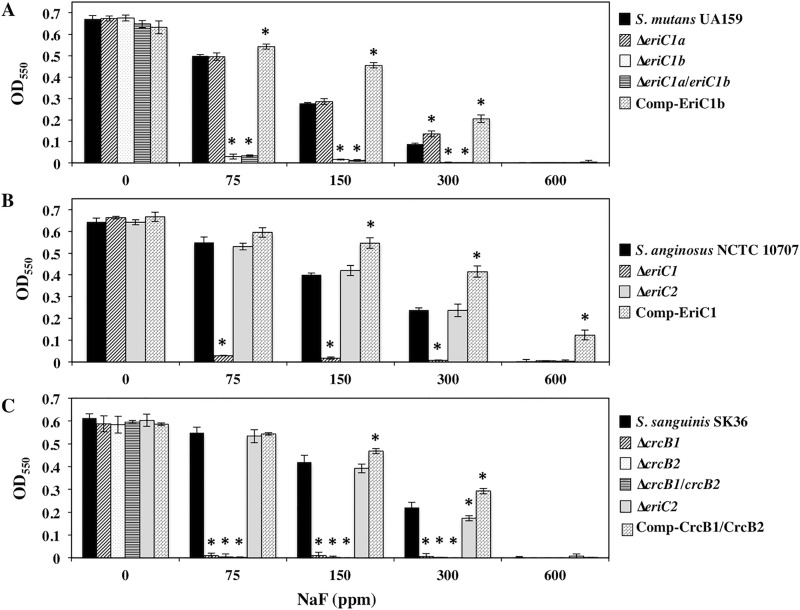
“deletion of the CLCF genes severely impairs growth of the oral bacteria S. mutans and Streptococcus anginosus in fluoride-containing media(49).”
From Membrane exporters of fluoride ion (2021) · cites this paper as [49]
Self-check
Percentages, sums and reported differences re-computed from the paper’s own numbers.
The self-check needs the paper’s full text.
Citations
Cites
No references could be resolved yet.
Research works printed but not linked: 26
- RE Marquis, 2003, Fluoride and organic weak acids as modulators of microbial physiology, FEMS Microbiol Rev, 26, 493, 10.1111/j.1574-6976.2003.tb00627.x · DOI · Paper page
- RR Mayhew, 1981, Comparative effect of SnF2, NaF, and SnCl2 on the growth of Streptococcus mutans, J Dent Res, 60, 1809, 10.1177/00220345810600101301 · DOI
- M Maltz, 1982, Susceptibility of oral bacteria to various fluoride salts, J Dent Res, 61, 786, 10.1177/00220345820610062701 · DOI
- JL Streckfuss, 1980, Fluoride resistance and adherence of selected strains of Streptococcus mutans to smooth surfaces after exposure to fluoride, J Dent Res, 59, 151, 10.1177/00220345800590021501 · DOI
- FR Bunick, 1981, Enolases from fluoride-sensitive and fluoride-resistant streptococci, Infect Immun, 34, 856, 10.1128/IAI.34.3.856-863.1981 · DOI
- LR Brown, 1983, Effect of continuous fluoride gel use on plaque fluoride retention and microbial activity, J Dent Res, 62, 746, 10.1177/00220345830620061201 · DOI
- C Van Loveren, 1991, In vitro demineralization of enamel by F-sensitive and F-resistant mutans streptococci in the presence of 0, 0.05, or 0.5 mmol/L NaF, J Dent Res, 70, 1491, 10.1177/00220345910700120401 · DOI
- C Van Loveren, 1991, Acidogenesis in relation to fluoride resistance of Streptococcus mutans, Oral Microbiol Immunol, 6, 288, 10.1111/j.1399-302X.1991.tb00494.x · DOI
- GL Hoelscher, 1996, Characterization of an unusual fluoride-resistant Streptococcus mutans isolate, Curr microbiol, 32, 156, 10.1007/s002849900028 · DOI
- K Moritani, 2015, Acetaldehyde production by major oral microbes, Oral Dis, 21, 748, 10.1111/odi.12341 · DOI
- T Takeshita, 2015, Dental plaque development on a hydroxyapatite disk in young adults observed by using a barcoded pyrosequencing approach, Sci Rep, 5, 8136, 10.1038/srep08136 · DOI · Paper page
- AH Rickard, 2003, Bacterial coaggregation: an integral process in the development of multi-species biofilms, Trends Microbiol, 11, 94, 10.1016/S0966-842X(02)00034-3 · DOI · Paper page
- S Silver, 1996, Bacterial resistances to toxic metal ions–a review, Gene, 179, 9, 10.1016/S0378-1119(96)00323-X · DOI
- JL Baker, 2012, Widespread genetic switches and toxicity resistance proteins for fluoride, Science, 35, 233, 10.1126/science.1215063 · DOI · Paper page
- Y Liao, 2015, Identification and functional analysis of genome mutations in a fluoride-resistant Streptococcus mutans strain, PloS One, 10, e0122630, 10.1371/journal.pone.0122630 · DOI · Paper page
- D Hanahan, 1983, Studies on transformation of Escherichia coli with plasmids, J Mol Biol, 166, 557, 10.1016/S0022-2836(83)80284-8 · DOI
- D Perry, 1983, Genetic transformation of putative cariogenic properties in Streptococcus mutans, Infect Immun, 41, 722, 10.1128/IAI.41.2.722-727.1983 · DOI
- D Li, 2012, A novel gene involved in the survival of Streptococcus mutans under stress conditions, Appl Environ Microbiol, 80, 97, 10.1128/AEM.02549-13 · DOI
- M Kawada-Matsuo, 2009, Role of two component signaling response regulators in acid tolerance of Streptococcus mutans, Oral Microbiol Immunol, 24, 173, 10.1111/j.1399-302X.2008.00485.x · DOI
- RB Stockbridge, 2012, Fluoride resistance and transport by riboswitch-controlled CLC antiporters, Proc Natl Acad Sci USA, 109, 15289, 10.1073/pnas.1210896109 · DOI · Paper page
- TJ Jentsch, 2002, Molecular structure and physiological function of chloride channels, Physiol rev, 82, 503, 10.1152/physrev.00029.2001 · DOI
- M Maduke, 1999, High-level expression, functional reconstitution, and quaternary structure of a prokaryotic ClC-type chloride channel, J Gen Physiol, 114, 713, 10.1085/jgp.114.5.713 · DOI
- S Li, 2013, Eukaryotic resistance to fluoride toxicity mediated by a widespread family of fluoride export proteins, Proc Natl Acad Sci USA, 110, 19018, 10.1073/pnas.1310439110 · DOI · Paper page
- Y Kawamura, 1995, Determination of 16S rRNA sequences of Streptococcus mitis and Streptococcus gordonii and phylogenetic relationships among members of the genus Streptococcus, Int J Sys Bacteriol, 45, 406, 10.1099/00207713-45-2-406 · DOI
- R Dutzler, 2002, MacKinnon, R. X-ray structure of a ClC chloride channel at 3.0 Å reveals the molecular basis of anion selectivity, Nature, 415, 287, 10.1038/415287a · DOI · Paper page
- T Murata, 2016, Contribution of chloride channel permease to fluorideresistance in Streptococcus mutans, FEMS Microbiol, 363, fnw101, 10.1093/femsle/fnw101 · DOI · Paper page
Cited by
Sorted by citations
Stockbridge, R. B., & Wackett, L. P. (2024) · Nature Communications · doi:10.1038/s41467-024-49018-1 · Cited by 80
Membrane exporters of fluoride ion
McIlwain, B. C., Ruprecht, M. T., & Stockbridge, R. B. (2021) · Annual Review of Biochemistry · doi:10.1146/annurev-biochem-071520-112507 · Cited by 69
Banerjee, A., Kang, C.-Y., An, M., Koff, B. B., Sunder, S., Kumar, A., Tenuta, L. M. A., & Stockbridge, R. B. (2024) · mBio · doi:10.1128/mbio.00184-24 · Cited by 17
Metadata
- Authors
- Men, X., Shibata, Y., Takeshita, T., & Yamashita, Y.
- Venue
- PLOS ONE
- Publisher
- Public Library of Science (PLoS)
- Published
- 2016-11-08
- Volume
- 11
- Issue
- 11
- Pages
- e0165900
- ISSN
- 1932-6203
- PMC
- PMC5100911
- Cited by
- 37
- References
- 0
- Language
- en
- Funders
- Grant-in Aid for Scientific Research from the Ministry of Education, Culture, Sports, Science and Technology of Japan (25463251, 25293428)
About these checks
Registry, retraction, Cites and statistics results are computed, not judged, with one exception: a printed reference that no index lists is read once by a model before it counts as a citation error. Claims are extracted by a model and kept only when their quote appears verbatim in the text; each cited source is then checked, with a model’s help, for whether it says what the claim relies on. Those verdicts can be wrong — read the claim’s quote and the cited source before relying on one.
Statistics and arithmetic are recomputed, not judged.
Confidence bands are shown only for fields calibrated on our annotated test set. None is calibrated yet, so no band is shown.
What counts as a claim ›How we measure confidence ›How we check this ›
Are you an author, or do you see a problem with this page? Request a review
