

An Adaptation to Low Copper in Candida albicans Involving SOD Enzymes and the Alternative Oxidase
Open accessThe DOI matches its Crossref record; 66 of the 68 references it cites were found in a registry or an index.
Abstract
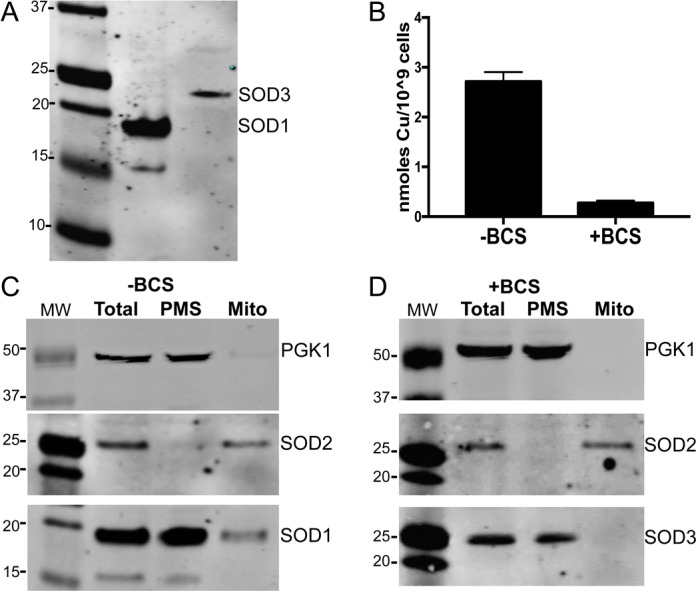
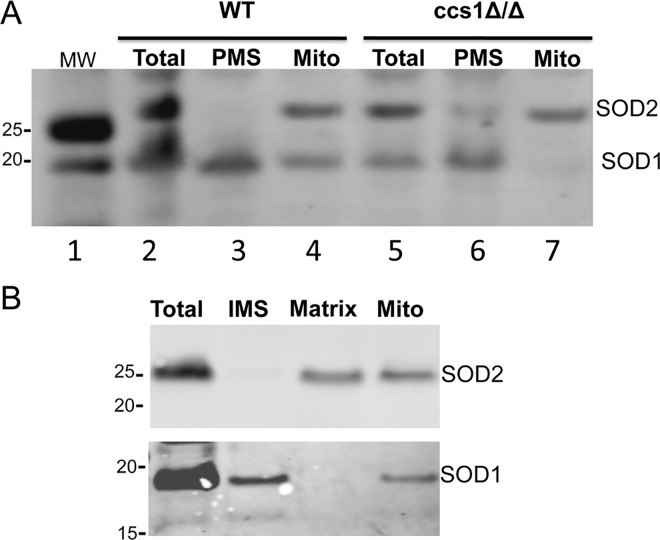
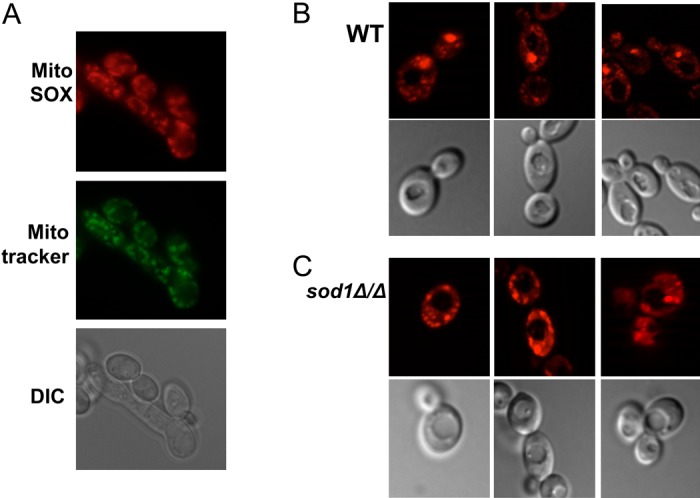
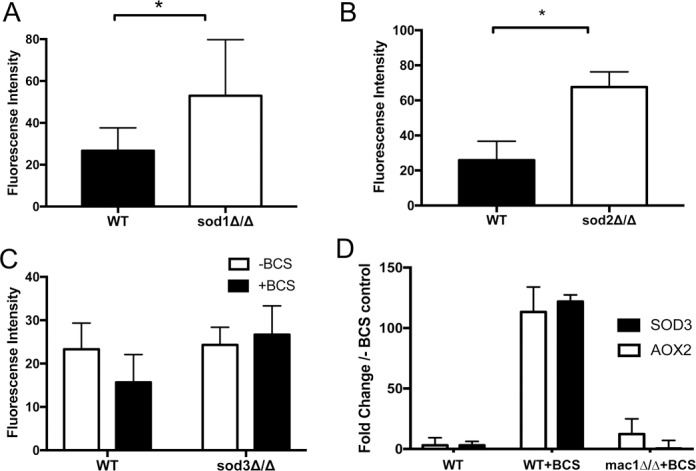
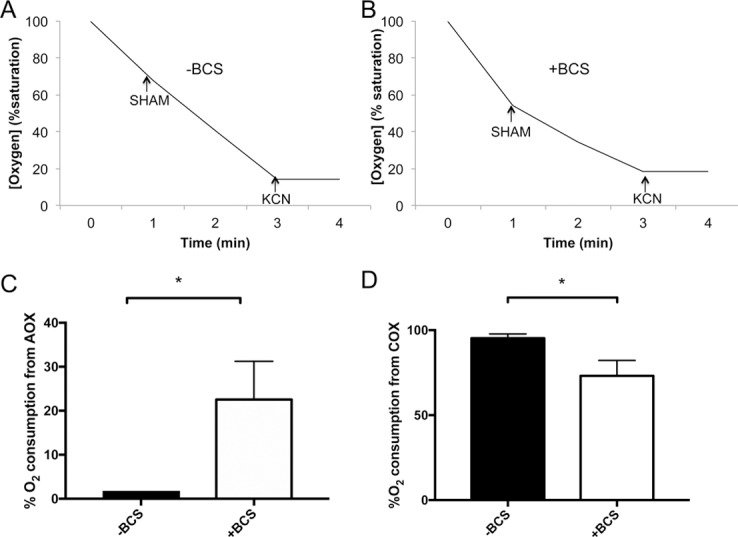
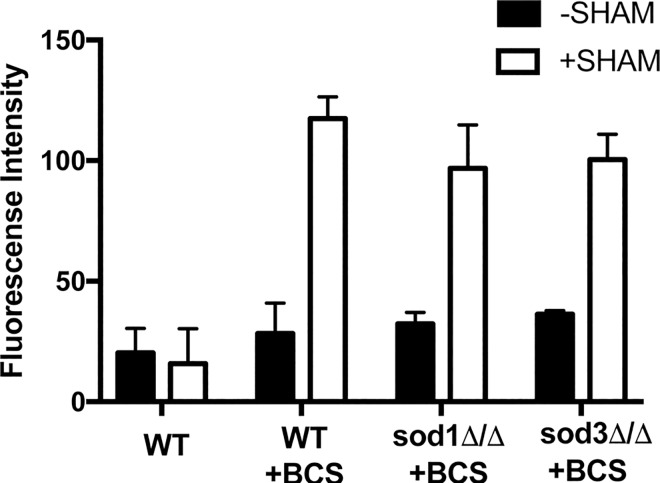
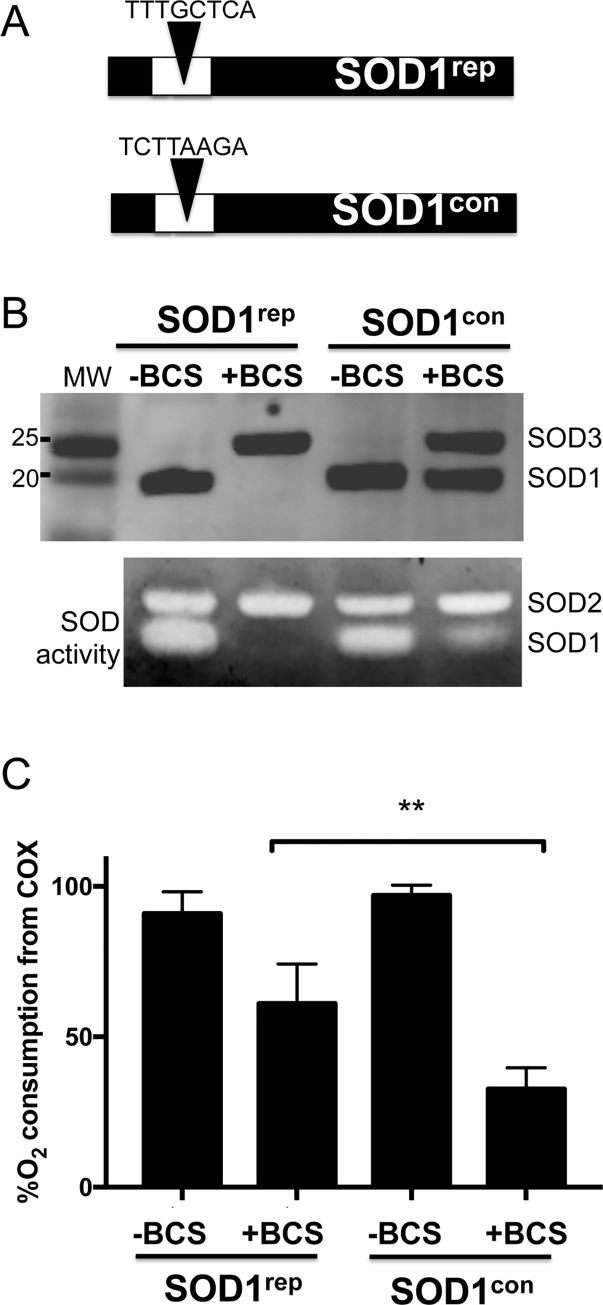
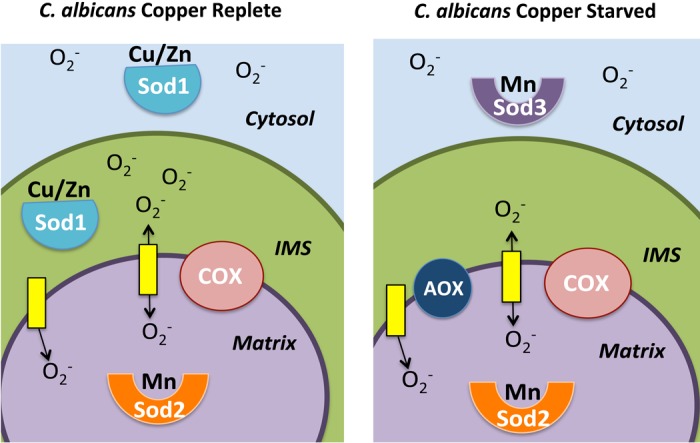
In eukaryotes, the Cu/Zn superoxide dismutase (SOD1) is a major cytosolic cuproprotein with a small fraction residing in the mitochondrial intermembrane space (IMS) to protect against respiratory superoxide. Curiously, the opportunistic human fungal pathogen Candida albicans is predicted to express two cytosolic SODs including Cu/Zn containing SOD1 and manganese containing SOD3. As part of a copper starvation response, C. albicans represses SOD1 and induces the non-copper alternative SOD3. While both SOD1 and SOD3 are predicted to exist in the same cytosolic compartment, their potential role in mitochondrial oxidative stress had yet to be investigated. We show here that under copper replete conditions, a fraction of the Cu/Zn containing SOD1 localizes to the mitochondrial IMS to guard against mitochondrial superoxide. However in copper starved cells, localization of the manganese containing SOD3 is restricted to the cytosol leaving the mitochondrial IMS devoid of SOD. We observe that during copper starvation, an alternative oxidase (AOX) form of respiration is induced that is not coupled to ATP synthesis but maintains mitochondrial superoxide at low levels even in the absence of IMS SOD. Surprisingly, the copper-dependent cytochrome c oxidase (COX) form of respiration remains high with copper starvation. We provide evidence that repression of SOD1 during copper limitation serves to spare copper for COX and maintain COX respiration. Overall, the complex copper starvation response of C. albicans involving SOD1, SOD3 and AOX minimizes mitochondrial oxidative damage whilst maximizing COX respiration essential for fungal pathogenesis.
Overview
The claims and statistics of this paper haven’t been checked yet.
Free: it reads the open-access text and checks the first 5 claims that cite a source we can check. Create a free account to check every claim.
Integrity signals
Registry
Cites
Statistics
Figures
Verification
Claims the paper makes
The claims and statistics of this paper haven’t been checked yet.
Free: it reads the open-access text and checks the first 5 claims that cite a source we can check. Create a free account to check every claim.
Self-check
Percentages, sums and reported differences re-computed from the paper’s own numbers.
The self-check needs the paper’s full text.
Citations
Cites
McCord, J. M., & Fridovich, I. (1969) · Journal of Biological Chemistry · doi:10.1016/s0021-9258(18)63504-5 · Cited by 12,952
Generation of superoxide anion by the NADH dehydrogenase of bovine heart mitochondria
Turrens, J. F., & Boveris, A. (1980) · Biochemical Journal · doi:10.1042/bj1910421 · Cited by 1,601
Ubisemiquinone is the electron donor for superoxide formation by complex III of heart mitochondria
Turrens, J. F., Alexandre, A., & Lehninger, A. L. (1985) · Archives of Biochemistry and Biophysics · doi:10.1016/0003-9861(85)90293-0 · Cited by 1,214
Complex iii releases superoxide to both sides of the inner mitochondrial membrane
Muller, F. L., Liu, Y., & Van Remmen, H. (2004) · Journal of Biological Chemistry · doi:10.1074/jbc.m407715200 · Cited by 1,036
Subcellular Distribution of Superoxide Dismutases (SOD) in Rat Liver
Okado-Matsumoto, A., & Fridovich, I. (2001) · Journal of Biological Chemistry · doi:10.1074/jbc.m105395200 · Cited by 1,013
Mitochondrial Superoxide Dismutase
Weisiger, R. A., & Fridovich, I. (1973) · Journal of Biological Chemistry · doi:10.1016/s0021-9258(19)43735-6 · Cited by 958
ALTERNATIVE OXIDASE: From Gene to Function
Vanlerberghe, G. C., & McIntosh, L. (1997) · Annual Review of Plant Physiology and Plant Molecular Biology · doi:10.1146/annurev.arplant.48.1.703 · Cited by 792
Sturtz, L. A., Diekert, K., Jensen, L. T., Lill, R., & Culotta, V. C. (2001) · Journal of Biological Chemistry · doi:10.1074/jbc.m105296200 · Cited by 718
Self-citationMattiazzi, M., D'Aurelio, M., Gajewski, C. D., Martushova, K., Kiaei, M., Beal, M. F., & Manfredi, G. (2002) · Journal of Biological Chemistry · doi:10.1074/jbc.m203065200 · Cited by 616
Noble, S. M., & Johnson, A. D. (2005) · Eukaryotic Cell · doi:10.1128/ec.4.2.298-309.2005 · Cited by 592
Cited by
Role of Calprotectin in Withholding Zinc and Copper from Candida albicans
Besold, A. N., Gilston, B. A., Radin, J. N., Ramsoomair, C., Culbertson, E. M., Li, C. X., Cormack, B. P., Chazin, W. J., Kehl-Fie, T. E., & Culotta, V. C. (2018) · Infection and Immunity · doi:10.1128/iai.00779-17 · Cited by 136
“albicans involves Cu sparing whereby the major cuproprotein Sod1 is downregulated (7, 9).”
BackgroundSelf-citationPradhan, A., Avelar, G. M., Bain, J. M., Childers, D. S., Larcombe, D. E., Netea, M. G., Shekhova, E., Munro, C. A., Brown, G. D., Erwig, L. P., et al. (2018) · mBio · doi:10.1128/mbio.01318-18 · Cited by 133
“Sod1 is the only superoxide dismutase that localizes to the mitochondrial intermembrane space (62).”
Oxidative responses and fungal infection biology
Warris, A., & Ballou, E. R. (2018) · Seminars in Cell and Developmental Biology · doi:10.1016/j.semcdb.2018.03.004 · Cited by 122
Wiemann, P., Perevitsky, A., Lim, F. Y., Shadkchan, Y., Knox, B. P., Landero Figueora, J. A., Choera, T., Niu, M., Steinberger, A. J., Wüthrich, M., et al. (2017) · Cell Reports · doi:10.1016/j.celrep.2017.04.019 · Cited by 104
Protein markers for Candida albicans EVs include claudin‐like Sur7 family proteins
Dawson, C. S., Garcia‐Ceron, D., Rajapaksha, H., Faou, P., Bleackley, M. R., & Anderson, M. A. (2020) · Journal of Extracellular Vesicles · doi:10.1080/20013078.2020.1750810 · Cited by 83
Metadata
- Authors
- Broxton, C. N., & Culotta, V. C.
- Affiliations
- Johns Hopkins University (US)
- Corresponding author
- Culotta, Valeria C.
- ORCID
- Culotta, Valeria C.
- Venue
- PLOS ONE
- Publisher
- Public Library of Science (PLoS)
- Published
- 2016-12-29
- Volume
- 11
- Issue
- 12
- Pages
- e0168400
- ISSN
- 1932-6203 (ISSN-L)
- PMC
- PMC5198983
- OpenAlex
- W2561164201
- Cited by
- 41
- References
- 68
- Citations by year
- 2026: 4 · 2025: 4 · 2023: 4 · 2022: 3 · 2021: 7 · 2020: 5 · 2019: 4 · 2018: 6 · 2017: 4
- FWCI
- 2.42
- Type
- journal article
- Language
- en
- Open access
- gold
- doi.org
- Licence
- Locations
- PLoS ONE (publishedVersion, cc-by)
- Europe PMC (PubMed Central) (publishedVersion, cc-by)
- PubMed Central (publishedVersion, cc-by)
- PubMed (publishedVersion)
- DOAJ (DOAJ: Directory of Open Access Journals) (submittedVersion, cc-by-sa)
- Funders
- National Institute of Allergy and Infectious Diseases (RO1 AI119949)
- National Institute of General Medical Sciences (F31 GM113637)
- National Cancer Institute (T32 CA009110)
- Topics
- Life Sciences › Biochemistry, Genetics and Molecular Biology › Molecular Biology › Fungal and yeast genetics research
- Life Sciences › Biochemistry, Genetics and Molecular Biology › Molecular Biology › Mitochondrial Function and Pathology
- Life Sciences › Biochemistry, Genetics and Molecular Biology › Molecular Biology › Redox biology and oxidative stress
- Keywords
- Candida albicans, superoxide dismutase, SOD1, SOD3, alternative oxidase, mitochondrial superoxide, mitochondrial intermembrane space, cytochrome c oxidase, mitochondrial respiration, copper homeostasis, fungal pathogenesis, oxidative stress
- MeSH terms
- Alternative Oxidase, Adaptation, Physiological, Candida albicans, Copper, Dose-Response Relationship, Drug, Oxidoreductases, Plant Proteins, Superoxide Dismutase, Oxidative Stress, Protein Transport, Mitochondrial Proteins, Mitochondrial Membranes
About these checks
Registry, retraction, Cites and statistics results are computed, not judged, with one exception: a printed reference that no index lists is read once by a model before it counts as a citation error. Claims are extracted by a model and kept only when their quote appears verbatim in the text; each cited source is then checked, with a model’s help, for whether it says what the claim relies on. Those verdicts can be wrong — read the claim’s quote and the cited source before relying on one.
Statistics and arithmetic are recomputed, not judged.
Confidence bands are shown only for fields calibrated on our annotated test set. None is calibrated yet, so no band is shown.
What counts as a claim ›How we measure confidence ›How we check this ›
Are you an author, or do you see a problem with this page? Request a review
How to cite
Cite CoChat for the checks on this page, and the paper for its own findings.
- This page
- CoChat. (2026). Citation check: An Adaptation to Low Copper in Candida albicans Involving SOD Enzymes and the Alternative Oxidase. https://app.cochat.ai/papers/10.1371/journal.pone.0168400
- The paper
- Broxton, C. N., & Culotta, V. C. (2016). An Adaptation to Low Copper in Candida albicans Involving SOD Enzymes and the Alternative Oxidase. PLOS ONE. https://doi.org/10.1371/journal.pone.0168400
Data sources
Bibliographic data: Semantic Scholar, OpenAlex, Crossref.
Contains information from the Semantic Scholar Academic Graph Datasets, made available under the ODC Attribution License (ODC-BY 1.0).
Semantic Scholar’s data is described in: Kinney, R., et al. (2023). The Semantic Scholar Open Data Platform. arXiv:2301.10140.
