

The DOI matches its Crossref record; 42 of the 42 references it cites were found in a registry or an index.
The Incidence of Postpartum Hemorrhage in Pregnant Women with Placenta Previa: A Systematic Review and Meta-Analysis
Open accessAbstract
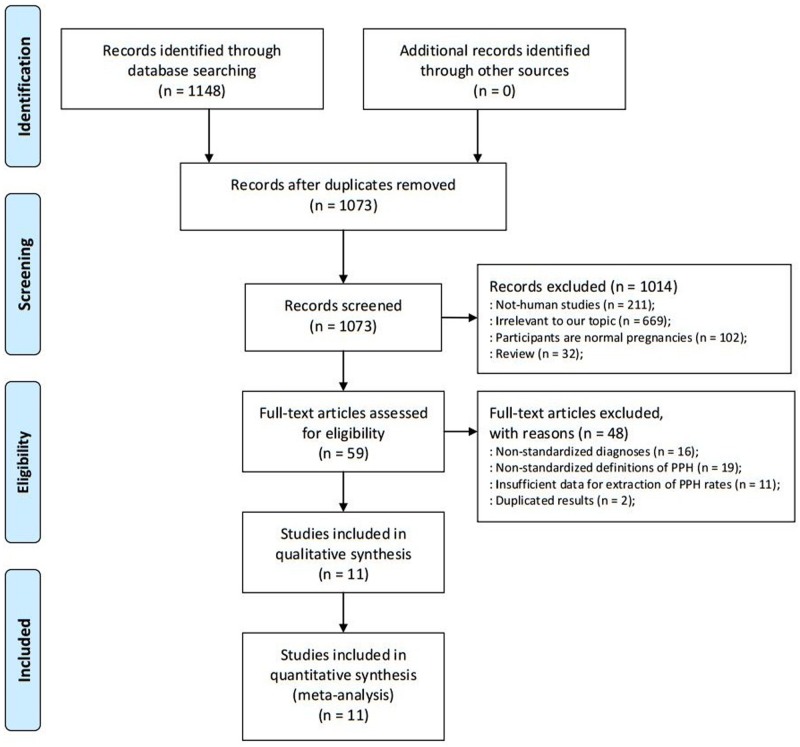
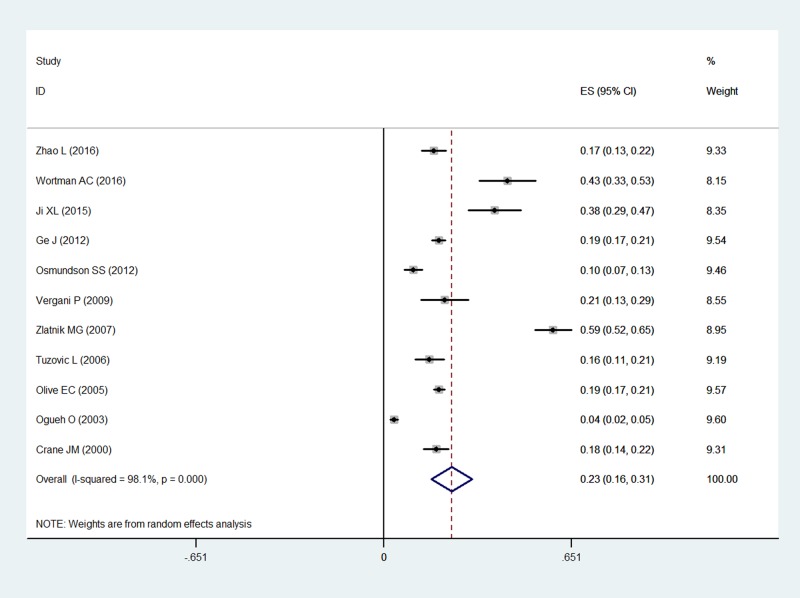
BACKGROUND: The global burden of postpartum hemorrhage (PPH) in women with placenta previa is a major public health concern. Although there are different reports on the incidence of PPH in different countries, to date, no research has reviewed them. OBJECTIVE: The aim of this study was to calculate the average point incidence of PPH in women with placenta previa. METHODS: A systematic review and meta-analysis of observational studies estimating PPH in women with placenta previa was conducted through literature searches in four databases in Jul 2016. This study was totally conducted according to the MOOSE guidelines and in accordance with the Preferred Reporting Items for Systematic Reviews and Meta-Analyses standard. RESULTS: From 1148 obtained studies, 11 included in the meta-analysis, which involved 5146 unique pregnant women with placenta previa. The overall pooled incidence of PPH was 22.3% (95% CI 15.8-28.7%). In the subgroup, the prevalence was 27.4% in placenta previas, and was 14.5% in low-lying placenta previa; the highest prevalence was estimated in Northern America (26.3%, 95%CI 11.0-41.6%), followed by the Asia (20.7%, 95%CI 12.8-28.6%), Australia (19.2%, 95% CI 17.2-21.1%) and Europe (17.8%, 95% CI, 11.5%-24.0%). CONCLUSIONS: The summary estimate of the incidence of PPH among women with placenta previa was considerable in this systematic review. The results will be crucial in prevention, treatment, and identification of PPH among pregnant women with placenta previa and will be contributed to the planning and implantation of relevant public health strategies.
Overview
The claims and statistics of this paper haven’t been checked yet.
Run the check — free, no account needed. It reads the open-access text and checks the sources it cites.
Integrity signals
Registry
Cites
Statistics
Figures
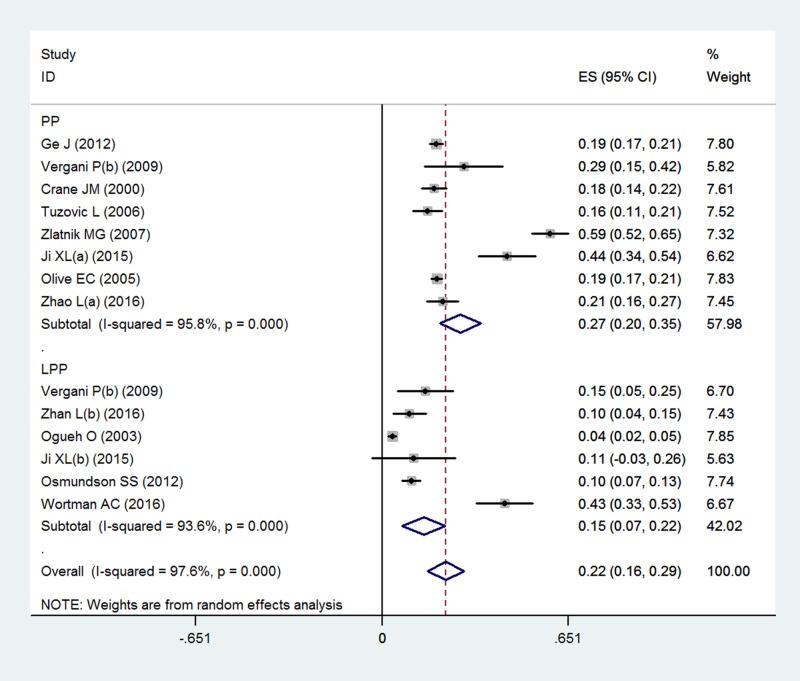
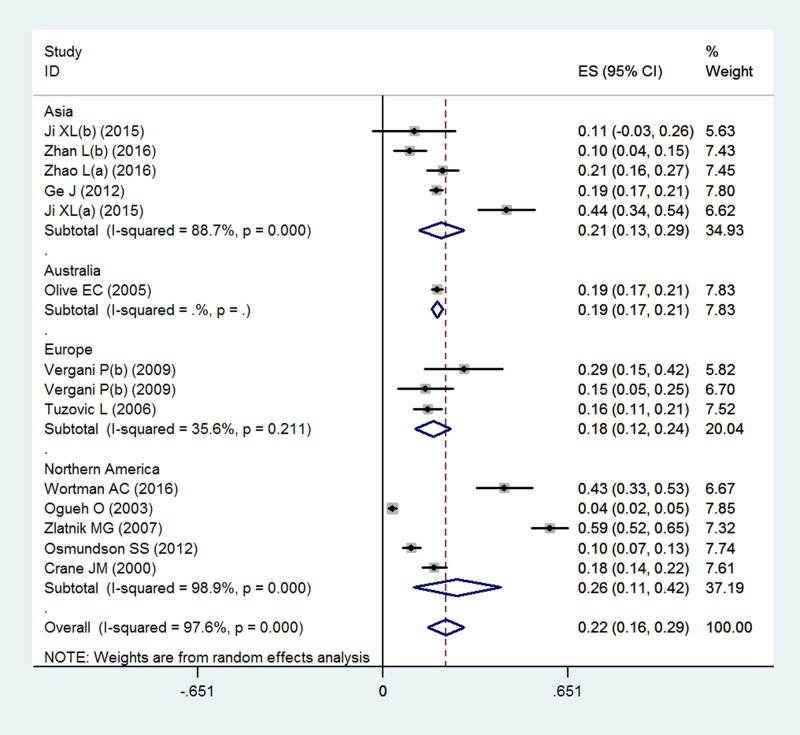
Verification
Claims the paper makes
The claims and statistics of this paper haven’t been checked yet.
Run the check — free, no account needed. It reads the open-access text and checks the sources it cites.
Claims other papers make about this one
Each is checked against this paper’s own text: does it say what the citing paper says it does?
The source backs part of the claim, not all of it — or backs it for a different population, condition or comparison.
In the citing paper
“Placenta previa and, to a lesser extent, low-lying placenta are associated with severe obstetric risks caused by blood loss in the third trimester and during delivery (Fan et al. 2017; Jansen et al. 2019).”
From Automatic Placenta Localization From Ultrasound Imaging in a Resource-Limited Setting Using a Predefined Ultrasound Acquisition Protocol and Deep Learning (2022) · cites this paper as Fan et al. 2017
Experimental — accuracy not yet measured
Self-check
Percentages, sums and reported differences re-computed from the paper’s own numbers.
The self-check needs the paper’s full text.
Citations
Cites
Dermyshi, E., Wang, Y., Yan, C., Hong, W., Qiu, G., Gong, X., & Zhang, T. (2017) · Neonatology · doi:10.1159/000454668 · Cited by 24,586
von Elm, E., Altman, D. G., Egger, M., Pocock, S. J., Gøtzsche, P. C., & Vandenbroucke, J. P. (2007) · The Lancet · doi:10.1016/s0140-6736(07)61602-x · Cited by 21,320
Meta-analysis of Observational Studies in Epidemiology<SUBTITLE>A Proposal for Reporting</SUBTITLE>
Stroup, D. F. (2000) · JAMA · doi:10.1001/jama.283.15.2008 · Cited by 20,623
Preferred reporting items for systematic reviews and meta-analyses: The PRISMA statement
Moher, D., Liberati, A., Tetzlaff, J., & Altman, D. G. (2010) · International Journal of Surgery · doi:10.1016/j.ijsu.2010.02.007 · Cited by 12,156
Global causes of maternal death: a WHO systematic analysis
Say, L., Chou, D., Gemmill, A., Tunçalp, Ö., Moller, A.-B., Daniels, J., Gülmezoglu, A. M., Temmerman, M., & Alkema, L. (2014) · The Lancet Global Health · doi:10.1016/s2214-109x(14)70227-x · Cited by 6,582
WHO analysis of causes of maternal death: a systematic review
Khan, K. S., Wojdyla, D., Say, L., Gülmezoglu, A. M., & Van Look, P. F. (2006) · The Lancet · doi:10.1016/s0140-6736(06)68397-9 · Cited by 3,978
Meta-analysis in clinical trials revisited
DerSimonian, R., & Laird, N. (2015) · Contemporary Clinical Trials · doi:10.1016/j.cct.2015.09.002 · Cited by 2,677
Transformations Related to the Angular and the Square Root
Freeman, M. F., & Tukey, J. W. (1950) · The Annals of Mathematical Statistics · doi:10.1214/aoms/1177729756 · Cited by 2,665
Practice Bulletin No. 183: postpartum hemorrhage
(2017) · Obstetrics & Gynecology · doi:10.1097/aog.0000000000002351 · Cited by 1,406
Mata, D. A., Ramos, M. A., Bansal, N., Khan, R., Guille, C., Di Angelantonio, E., & Sen, S. (2015) · JAMA · doi:10.1001/jama.2015.15845 · Cited by 1,255
Research works printed but not linked: 2
- M Knight, 2016, Beyond maternal death: improving the quality of maternal care through national studies of 'near-miss' maternal morbidity, Programme Grants for Applied Research. Southampton (UK)
- L Zhao, 2016, Effects of different types of placenta previa on pregnancy outcome, Maternal and Child Health Care of China, 31, 1163
Cited by
Sorted by citations
Items 101–117 of 117
Feto-Maternal Outcome in Patients with Placenta Previa at Aljala Maternity Hospital, Tripoli, Libya
Ammar, L., Osman, N., Morgham, A., & Alshawish, N. (2024) · AlQalam Journal of Medical and Applied Sciences · doi:10.54361/ajmas.2472008
Kong, H., Lu, Y., Li, H., Wang, F., Su, Y., Li, X., & Xin, H. (2024) · Research Square · doi:10.21203/rs.3.rs-4804963/v1
Routine Transvaginal Ultrasound at the Time of the Anatomy Scan: To Do or Not To Do?
Grubman, O., Mitchell, M., Owens, T., Heiligenstein, M. A., Kaplowitz, E., Stoffels, G. J., Al-Ibraheemi, Z., Brustman, L. E., Ashmead, G., & Hussain, F. N. (2024) · American Journal of Perinatology · doi:10.1055/a-2414-0857
Hemorragjia e paslindjes në Shqipëri: Një studim retrospektiv rast-kontroll
Bylykbashi, I., Aferdita, M., Bylykbashi, E., & Rista, M. (2024) · Optime · doi:10.55312/op.vi1.4702
Ochieng, V. O. (2024) · medtigo Journal of Medicine · doi:10.63096/medtigo30622433
A Retrospective Analysis of Cases of Postpartum Hemorrhage in the Yellow River Delta Region
姜, 亚. (2025) · Advances in Clinical Medicine · doi:10.12677/acm.2025.1582441
Placental placement on the lower uterine segment without praevia: A postpartum hemorrhage risk?
Bizet, G., Saget, E., Coulon, C., Labreuche, J., Delporte, V., Fourquet, T., Garabédian, C., & Subtil, D. (2025) · International Journal of Gynecology & Obstetrics · doi:10.1002/ijgo.70680
Surabhi, S., Ranjan, A., & Sharan, M. (2025) · International Journal of Pharmaceutical Quality Assurance · doi:10.25258/ijpqa.16.3.21
Ersak, D. T., Orhan, N., Okutucu, G., Üçyıldız, Ö., Kara, Ö., Öcal, F. D., Tanaçan, A., & Sahin, D. (2026) · BMC Pregnancy and Childbirth · doi:10.1186/s12884-026-09366-w
Predictors of Postpartum Hemorrhage Following Repeat Cesarean Section: A Retrospective Cohort Study
Banerjee, P., Sgouraki, M., Nayak, S., Tiwari, H., Kalsi, J., & Syed, A. K. (2026) · Cureus · doi:10.7759/cureus.109926
Zhang, L., Lu, Y., Hua, H., Li, Y., Jiao, J., & Huang, S. (2026) · Open Medicine · doi:10.1515/med-2026-1404
Zhou, C., Yang, S., Zhang, X., Yu, H., Song, M., & Rao, Q. (2026) · Archives of Gynecology and Obstetrics · doi:10.1007/s00404-026-08509-w
Delivery outcomes associated with resolved first‐trimester low placentation
Feiner, R., Wiley, R. L., Lamale‐Smith, L. M., Teal, E. N., & Sarker, M. R. (2026) · Pregnancy · doi:10.1002/pmf2.70368
Critical Care for the Obstetric Patient
Sinnott, C. M., Marinelli, A., & Moroz, L. A. (2026) · Springer eBooks · doi:10.1007/978-3-032-22660-0_37
Beckman, S., Anderson, A., Zeinoun, A., Ali, M. G. M., Shepherd, C., Maloney, K., Adrian, R. J., & Alerhand, S. (2026) · Journal of Emergency Medicine · doi:10.1016/j.jemermed.2026.07.019
Abiad, M., Bonanni, G., Zargarzadeh, N., Javinani, A., Shainker, S. A., Modest, A. M., Saade, G. R., Aagaard, K. M., & Shamshirsaz, A. A. (2026) · Pregnancy · doi:10.1002/pmf2.70468
Metadata
- Authors
- Fan, D., Xia, Q., Liu, L., Wu, S., Tian, G., Wang, W., Wu, S., Guo, X., & Liu, Z.
- Affiliations
- Anhui Medical University (CN)
- Anhui University of Traditional Chinese Medicine (CN)
- First Affiliated Hospital Zhejiang University (CN)
- Foshan Maternity and Child Health Care Hospital (CN)
- Corresponding author
- Guo, Xiaoling
- Venue
- PLOS ONE
- Publisher
- Public Library of Science (PLoS)
- Published
- 2017-01-20
- Volume
- 12
- Issue
- 1
- Pages
- e0170194
- ISSN
- 1932-6203 (ISSN-L)
- PMC
- PMC5249070
- OpenAlex
- W2574444842
- Cited by
- 115
- References
- 42
- Citations by year
- 2026: 8 · 2025: 13 · 2024: 12 · 2023: 11 · 2022: 18 · 2021: 18 · 2020: 10 · 2019: 12 · 2018: 8 · 2017: 4
- FWCI
- 1.74
- Type
- journal article
- Language
- en
- Open access
- gold
- doi.org
- Licence
- Locations
- PLoS ONE (publishedVersion, cc-by)
- Europe PMC (PubMed Central) (publishedVersion, cc-by)
- PubMed Central (publishedVersion, cc-by)
- PubMed (publishedVersion)
- QUT ePrints (Queensland University of Technology) (submittedVersion, cc-by)
- RePEc: Research Papers in Economics (submittedVersion)
- DOAJ (DOAJ: Directory of Open Access Journals) (submittedVersion)
- Figshare (submittedVersion, cc-by)
- Topics
- Health Sciences › Medicine › Pediatrics, Perinatology and Child Health › Maternal and fetal healthcare
- Health Sciences › Medicine › Hematology › Blood transfusion and management
- Health Sciences › Medicine › Obstetrics and Gynecology › Pregnancy and preeclampsia studies
- Keywords
- postpartum hemorrhage, placenta previa, incidence, pregnancy complications, maternal morbidity, regional variation in incidence
- MeSH terms
- Adult, Female, Postpartum Hemorrhage, Humans, Placenta Previa, Pregnancy, Incidence
About these checks
Registry, retraction, Cites and statistics results are computed, not judged, with one exception: a printed reference that no index lists is read once by a model before it counts as a citation error. Claims are extracted by a model and kept only when their quote appears verbatim in the text; each cited source is then checked, with a model’s help, for whether it says what the claim relies on. Those verdicts can be wrong — read the claim’s quote and the cited source before relying on one.
Statistics and arithmetic are recomputed, not judged.
Confidence bands are shown only for fields calibrated on our annotated test set. None is calibrated yet, so no band is shown.
What counts as a claim ›How we measure confidence ›How we check this ›
Are you an author, or do you see a problem with this page? Request a review
