

Altered resting-state intra- and inter- network functional connectivity in patients with persistent somatoform pain disorder
Open accessThe DOI matches its Crossref record; 53 of the 53 references it cites were found in a registry or an index.
Abstract
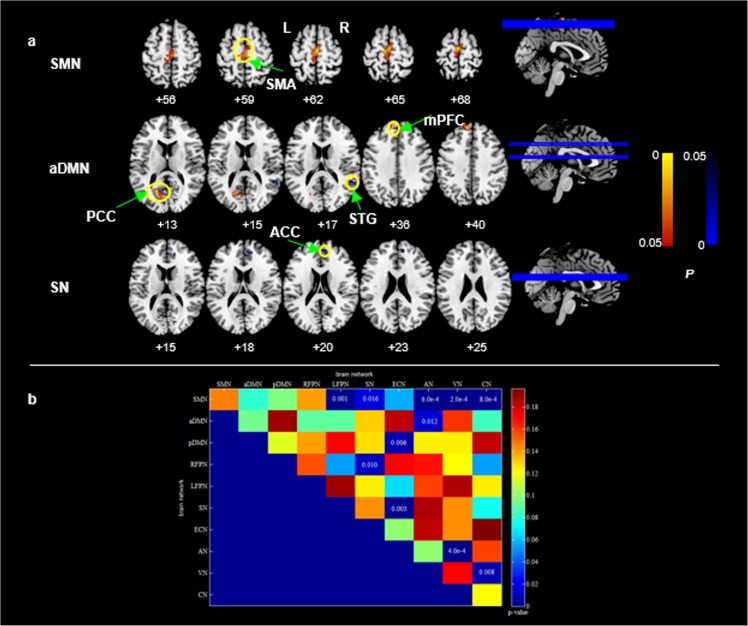
Patients with persistent somatoform pain disorder (PSPD) usually experience various functional impairments in pain, emotion, and cognition, which cannot be fully explained by a physiological process or a physical disorder. However, it is still not clear for the mechanism underlying the pathogenesis of PSPD. The present study aimed to explore the intra- and inter-network functional connectivity (FC) differences between PSPD patients and healthy controls (HCs). Functional magnetic resonance imaging (fMRI) was performed in 13 PSPD patients and 23 age- and gender-matched HCs. We used independent component analysis on resting-state fMRI data to calculate intra- and inter-network FCs, and we used the two-sample t-test to detect the FC differences between groups. Spearman correlation analysis was employed to evaluate the correlations between FCs and clinical assessments. As compared to HCs, PSPD patients showed decreased coactivations in the right superior temporal gyrus within the anterior default-mode network and the anterior cingulate cortex within the salience network, and increased coactivations in the bilateral supplementary motor areas within the sensorimotor network and both the left posterior cingulate cortex and the medial prefrontal cortex within the anterior default-mode network. In addition, we found that the PSPD patients showed decreased FNCs between sensorimotor network and audio network as well as visual network, between default-mode network and executive control network as well as audio network and between salience network and executive control network as well as right frontoparietal network, and increased FNCs between sensorimotor network and left frontoparietal network, salience network as well as cerebellum network, which were negatively correlated with the clinical assessments in PSPD patients. Our findings suggest that PSPD patients experience large-scale reorganization at the level of the functional networks, which suggests a possible mechanism underlying the pathogenesis of PSPD.
Overview
The claims and statistics of this paper haven’t been checked yet.
Free: it reads the open-access text and checks the first 5 claims that cite a source we can check. Create a free account to check every claim.
Integrity signals
Registry
Cites
Statistics
Figures


Verification
Claims the paper makes
The claims and statistics of this paper haven’t been checked yet.
Free: it reads the open-access text and checks the first 5 claims that cite a source we can check. Create a free account to check every claim.
Claims other papers make about this one
Each is checked against this paper’s own text: does it say what the citing paper says it does?
The cited source doesn’t support the claim as written.
In the citing paper
“Not only does each network independently demonstrate changes in functional connectivity in response to different types of chronic pain stimuli, it has been demonstrated that there is elevated functional connectivity among the DMN, FPN, and SN in individuals suffering from CMP [12,13,14,15,16,17,18].”
From Graph theory analysis of induced neural plasticity post-Acceptance and Commitment Therapy for chronic pain (2020) · cites this paper as [18]
Checked by a reasoning model — may be wrong.
Experimental — accuracy not yet measured
Self-check
Percentages, sums and reported differences re-computed from the paper’s own numbers.
The self-check needs the paper’s full text.
Citations
Cites
The assessment and analysis of handedness: The Edinburgh inventory
Oldfield, R. C. (1971) · Neuropsychologia · doi:10.1016/0028-3932(71)90067-4 · Cited by 35,900 · cited 1×
“Inclusion criteria for PSPD patients included: 1) right-hand dominance (The hand dominance was tested by using the Edinburgh Handness Inventory [21]); 2) ages between 18 and 65 years; 3) duration of clinical pain of at least 6 months; 4) diagnosis of PSPD according to ICD-10 criteria.”
MethodJenkinson, M., Bannister, P., Brady, M., & Smith, S. (2002) · NeuroImage · doi:10.1006/nimg.2002.1132 · Cited by 11,888 · cited 1×
“Also, there was no significant difference in the frame-wise [24] displacement between groups (t = 1.”
BackgroundFunctional connectivity in the motor cortex of resting human brain using echo‐planar mri
Biswal, B., Zerrin Yetkin, F., Haughton, V. M., & Hyde, J. S. (1995) · Magnetic Resonance in Medicine · doi:10.1002/mrm.1910340409 · Cited by 9,812
An Information-Maximization Approach to Blind Separation and Blind Deconvolution
Bell, A. J., & Sejnowski, T. J. (1995) · Neural Computation · doi:10.1162/neco.1995.7.6.1129 · Cited by 8,986 · cited 1×
“Subsequently, the independent components (ICs) were estimated using the Informax algorithm [27].”
MethodAshburner, J., & Friston, K. J. (2005) · NeuroImage · doi:10.1016/j.neuroimage.2005.02.018 · Cited by 7,507
Dissociable intrinsic connectivity networks for salience processing and executive control
Seeley, W. W., Menon, V., Schatzberg, A. F., Keller, J., Glover, G. H., Kenna, H., Reiss, A. L., & Greicius, M. D. (2007) · The Journal of Neuroscience · doi:10.1523/jneurosci.5587-06.2007 · Cited by 7,426 · cited 1×
“These networks commonly involve the processing of emotion, attention, control and cognition in human brain [18,29,30].”
BackgroundSaliency, switching, attention and control: a network model of insula function
Menon, V., & Uddin, L. Q. (2010) · Brain Structure and Function · doi:10.1007/s00429-010-0262-0 · Cited by 5,592
SMITH, S., & NICHOLS, T. (2009) · NeuroImage · doi:10.1016/j.neuroimage.2008.03.061 · Cited by 5,250 · cited 1×
“Multiple comparisons across space were corrected using the threshold-free clustering enhancement (TFCE) method [32].”
MethodCorrespondence of the brain's functional architecture during activation and rest
Smith, S. M., Fox, P. T., Miller, K. L., Glahn, D. C., Fox, P. M., Mackay, C. E., Filippini, N., Watkins, K. E., Toro, R., Laird, A. R., et al. (2009) · Proceedings of the National Academy of Sciences · doi:10.1073/pnas.0905267106 · Cited by 5,150 · cited 1×
“These networks commonly involve the processing of emotion, attention, control and cognition in human brain [18,29,30].”
BackgroundThe cognitive control of emotion
OCHSNER, K., & GROSS, J. (2005) · Trends in Cognitive Sciences · doi:10.1016/j.tics.2005.03.010 · Cited by 4,495
Human brain mechanisms of pain perception and regulation in health and disease
Apkarian, A. V., Bushnell, M. C., Treede, R., & Zubieta, J. (2005) · European Journal of Pain · doi:10.1016/j.ejpain.2004.11.001 · Cited by 3,126 · cited 1×
“These functional reorganizations in the network scale may be helpful for interpreting the complex experience of pain involving sensory-discriminative, affective-motivational and cognitive-evaluative components in PSPD patients [52].”
BackgroundGusnard, D. A., Akbudak, E., Shulman, G. L., & Raichle, M. E. (2001) · Proceedings of the National Academy of Sciences · doi:10.1073/pnas.071043098 · Cited by 2,997
Pain Affect Encoded in Human Anterior Cingulate But Not Somatosensory Cortex
Rainville, P., Duncan, G. H., Price, D. D., Carrier, B., & Bushnell, M. C. (1997) · Science · doi:10.1126/science.277.5328.968 · Cited by 2,687
Psychological and neural mechanisms of the affective dimension of pain
Price, D. D. (2000) · Science · doi:10.1126/science.288.5472.1769 · Cited by 2,092 · cited 2×
“The structure base of pain processing includes multiple ascending pathways projecting to several brainstem and cortical regions, in some of which SMA is anatomically interconnected with S1 as well as ACC and associated with the precise coding of the intensity of nociceptive stimulation [33].”
BackgroundElectrophysiological signatures of resting state networks in the human brain
Mantini, D., Perrucci, M. G., Del Gratta, C., Romani, G. L., & Corbetta, M. (2007) · Proceedings of the National Academy of Sciences · doi:10.1073/pnas.0700668104 · Cited by 1,938
Jafri, M. J., Pearlson, G. D., Stevens, M., & Calhoun, V. D. (2008) · NeuroImage · doi:10.1016/j.neuroimage.2007.11.001 · Cited by 974 · cited 1×
“Independent components analysis (ICA) have revealed aberrant resting-state networks (RSNs) in many disorder studies, such as schizophrenia [17], congenital blindness [18], amyotrophic lateral sclerosis [19] and somatoform pain disorder [20].”
BackgroundMultiple Representations of Pain in Human Cerebral Cortex
Talbot, J. D., Marrett, S., Evans, A. C., Meyer, E., Bushnell, M. C., & Duncan, G. H. (1991) · Science · doi:10.1126/science.2003220 · Cited by 971
Keeping pain out of mind: The role of the dorsolateral prefrontal cortex in pain modulation
Lorenz, J., Minoshima, S., & Casey, K. L. (2003) · Brain · doi:10.1093/brain/awg102 · Cited by 952 · cited 1×
“An fMRI study on heat stimulation suggests that the experimentally induced pain activation in the ACC correlates negatively with the intensity of clinical pain in patients [46], and the positive correlation is also found between blood flow of ACC and both pain sensation and discomfort in another PET study [47].”
BackgroundBeyond Feeling: Chronic Pain Hurts the Brain, Disrupting the Default-Mode Network Dynamics
Baliki, M. N., Geha, P. Y., Apkarian, A. V., & Chialvo, D. R. (2008) · The Journal of Neuroscience · doi:10.1523/jneurosci.4123-07.2008 · Cited by 853 · cited 1×
“These findings consistently suggest that chronic pain commonly causes disruptions of DMN in the function and structure, which may underlie the cognitive and behavioral impairments accompanying chronic pain [40].”
BackgroundComparison of multi‐subject ICA methods for analysis of fMRI data
Erhardt, E. B., Rachakonda, S., Bedrick, E. J., Allen, E. A., Adali, T., & Calhoun, V. D. (2011) · Human Brain Mapping · doi:10.1002/hbm.21170 · Cited by 712 · cited 5×
“Resting-state networks In 34 ICs estimated from ICA, the identified 12 ICs were consistent with RSNs described in previous studies [18,29–31](Fig 1).”
MethodInfluentialCentral representation of chronic ongoing neuropathic pain studied by positron emission tomography
Hsieh, J.-C., Belfrage, M., Stone-Elander, S., Hansson, P., & Ingvar, M. (1995) · Pain · doi:10.1016/0304-3959(95)00048-w · Cited by 638 · cited 1×
“Numerous studies have shown that aberrant signals, such as the reduced gray matter [34], ReHo [41], regional cortical activity [42] and increased rCBF [43], are commonly observed in the ACC of patients with chronic pain as compared to HCs.”
BackgroundSynchronized delta oscillations correlate with the resting-state functional MRI signal
Lu, H., Zuo, Y., Gu, H., Waltz, J. A., Zhan, W., Scholl, C. A., Rea, W., Yang, Y., & Stein, E. A. (2007) · Proceedings of the National Academy of Sciences · doi:10.1073/pnas.0705791104 · Cited by 417
Shilyansky, C., Williams, L. M., Gyurak, A., Harris, A., Usherwood, T., & Etkin, A. (2016) · The Lancet Psychiatry · doi:10.1016/s2215-0366(16)00012-2 · Cited by 249 · cited 1×
“All patients were previously exposed to Duloxetine with a maximum dose of 60mg/day or Venlafaxine with a maximum dose of 150mg/day, and they underwent MRI scanning after a washout period of 7 days based on the half-life of most antidepressants being used in previous studies [22,23].”
MethodAltered Resting State in Diabetic Neuropathic Pain
Cauda, F., Sacco, K., Duca, S., Cocito, D., D'Agata, F., Geminiani, G. C., & Canavero, S. (2009) · PLoS ONE · doi:10.1371/journal.pone.0004542 · Cited by 213 · cited 1×
“The power spectra analysis showed that the BOLD fluctuations were higher in the DMN than in other brain regions of patients with chronic pain disorder, especially in the high-frequency band [6,37].”
BackgroundValet, M., Gündel, H., Sprenger, T., Sorg, C., Mühlau, M., Zimmer, C., Henningsen, P., & Tölle, T. R. (2009) · Psychosomatic Medicine · doi:10.1097/psy.0b013e31818d1e02 · Cited by 170 · cited 1×
“A voxel-based morphometry (VBM) analysis also revealed decreases of gray matter density in the mPFC and PCC of pain patients compared to controls [39].”
ResultSchmithorst, V. J., & Holland, S. K. (2004) · Journal of Magnetic Resonance Imaging · doi:10.1002/jmri.20009 · Cited by 169 · cited 1×
“0h) for all fMRI data with three distinct stages [26]: First, a three-step principal component analysis (PCA) was used to decompose the data set into 34 components.”
MethodCerebral cortex modulation of pain
Xie, Y.-F., Huo, F.-Q., & Tang, J.-S. (2009) · Acta Pharmacologica Sinica · doi:10.1038/aps.2008.14 · Cited by 167
The medial pain system: Neural representations of the motivational aspect of pain
Sewards, T. V., & Sewards, M. A. (2002) · Brain Research Bulletin · doi:10.1016/s0361-9230(02)00864-x · Cited by 164
Altered cerebral response to noxious heat stimulation in patients with somatoform pain disorder
Gündel, H., Valet, M., Sorg, C., Huber, D., Zimmer, C., Sprenger, T., & Tölle, T. R. (2008) · Pain · doi:10.1016/j.pain.2007.10.003 · Cited by 146 · cited 1×
“An fMRI study on heat stimulation suggests that the experimentally induced pain activation in the ACC correlates negatively with the intensity of clinical pain in patients [46], and the positive correlation is also found between blood flow of ACC and both pain sensation and discomfort in another PET study [47].”
BackgroundStructural Brain Imaging: A Window into Chronic Pain
May, A. (2011) · The Neuroscientist · doi:10.1177/1073858410396220 · Cited by 144
Jiang, L., Xu, T., He, Y., Hou, X., Wang, J., Cao, X., Wei, G., Yang, Z., He, Y., & Zuo, X. (2014) · Brain Structure and Function · doi:10.1007/s00429-014-0795-8 · Cited by 129 · cited 1×
“ECN acts as a feasible modulator between those two networks [49], which involves the cognitive control over both emotional and non-emotional materials [50].”
BackgroundStoeter, P., Bauermann, T., Nickel, R., Corluka, L., Gawehn, J., Vučurević, G., Vossel, G., & Egle, U. T. (2007) · NeuroImage · doi:10.1016/j.neuroimage.2007.01.052 · Cited by 117 · cited 1×
“In the studies on somatoform pain disorders, more activations induced by pain are found in the SMA of patients compared with controls [35], and significant change in the signal intensity is detected in this region as responses to pain perception between patients and controls [36].”
BackgroundFunctional and structural imaging of pain-induced neuroplasticity
Seifert, F., & Maihöfner, C. (2011) · Current Opinion in Anaesthesiology · doi:10.1097/aco.0b013e32834a1079 · Cited by 117 · cited 2×
“The SMN primarily involves in the sensory-discriminative aspect of pain processing [4,5].”
BackgroundOtti, A., Guendel, H., Wohlschläger, A., Zimmer, C., & Noll-Hussong, M. (2013) · BMC Psychiatry · doi:10.1186/1471-244x-13-84 · Cited by 99 · cited 2×
“For instance, a recent study by the restingstate fMRI demonstrated that the ReHo values of DMN regions in healthy subjects were increased after a painful stimulation [6].”
BackgroundAltered resting‐state network connectivity in congenital blind
Wang, D., Qin, W., Liu, Y., Zhang, Y., Jiang, T., & Yu, C. (2014) · Human Brain Mapping · doi:10.1002/hbm.22350 · Cited by 88
A controlled study of alexithymia in adolescent patients with persistent somatoform pain disorder
Burba, B., Oswald, R., Grigaliunien, V., Neverauskiene, S., Jankuviene, O., & Chue, P. (2006) · The Canadian Journal of Psychiatry · doi:10.1177/070674370605100709 · Cited by 78 · cited 1×
“By utilizing the Toronto Alexithymia Scale and the Hospital Anxiety and Depression Scale, the study [8] found that adolescents with PSPD had higher levels of alexithymia and anxiety than healthy ones had.”
MethodTang, C., Zhao, Z., Chen, C., Zheng, X., Sun, F., Zhang, X., Tian, J., Fan, M., Wu, Y., & Jia, J. (2016) · PLoS ONE · doi:10.1371/journal.pone.0152875 · Cited by 73
Self-citationRiedl, V., Valet, M., Wöller, A. A., Sorg, C., Vogel, D., Sprenger, T., Boecker, H., Wohlschläger, A. M., & Tölle, T. R. (2011) · NeuroImage · doi:10.1016/j.neuroimage.2011.04.011 · Cited by 62
Zhao, Z., Wang, X., Fan, M., Yin, D., Sun, L., Jia, J., Tang, C., Zheng, X., Jiang, Y., Wu, J., et al. (2016) · PLoS ONE · doi:10.1371/journal.pone.0166210 · Cited by 54
Self-citationAdvances in cortical modulation of pain
Garzola, G. C. Q. (2013) · Journal of Pain Research · doi:10.2147/jpr.s45958 · Cited by 52 · cited 2×
“The SMN primarily involves in the sensory-discriminative aspect of pain processing [4,5].”
BackgroundOtti, A., Guendel, H., Henningsen, P., Zimmer, C., Wohlschlaeger, A. M., & Noll-Hussong, M. (2013) · Journal of Psychiatry and Neuroscience · doi:10.1503/jpn.110187 · Cited by 52 · cited 4×
“plays a crucial role in placebo analgesia, in which increased FC response to endogenous pain control [20].”
BackgroundInfluentialBrain Network Response to Acupuncture Stimuli in Experimental Acute Low Back Pain: An fMRI Study
Shi, Y., Liu, Z., Zhang, S., Li, Q., Guo, S.-G., Yang, J., & Wu, W. (2015) · Evidence-based Complementary and Alternative Medicine · doi:10.1155/2015/210120 · Cited by 49
Altered regional homogeneity in experimentally induced low back pain: a resting-state fMRI study
Zhang, S., Wu, W., Liu, Z., Huang, G., Guo, S.-G., & Yang, J. (2014) · Journal of NeuroEngineering and Rehabilitation · doi:10.1186/1743-0003-11-115 · Cited by 45 · cited 7×
“For instance, a recent study by the restingstate fMRI demonstrated that the ReHo values of DMN regions in healthy subjects were increased after a painful stimulation [6].”
BackgroundInfluentialClassification of somatic syndromes in ICD-11
Gureje, O. (2015) · Current Opinion in Psychiatry · doi:10.1097/yco.0000000000000186 · Cited by 39 · cited 1×
“In the recent ICD-11 beta draft, PSPD is subsumed to bodily distress disorder (BDD), a disorder characterized by bodily symptoms that are distressing to the individual and attention directed toward those symptoms that far exceeds what is warranted in relation to the symptoms’ nature and progression [1].”
BackgroundDisrupted effective connectivity of the sensorimotor network in amyotrophic lateral sclerosis
Fang, X., Zhang, Y., Wang, Y., Zhang, Y., Hu, J., Wang, J., Zhang, J., & Jiang, T. (2016) · Journal of Neurology · doi:10.1007/s00415-015-8013-z · Cited by 35 · cited 1×
“Independent components analysis (ICA) have revealed aberrant resting-state networks (RSNs) in many disorder studies, such as schizophrenia [17], congenital blindness [18], amyotrophic lateral sclerosis [19] and somatoform pain disorder [20].”
BackgroundYoshino, A., Okamoto, Y., Yoshimura, S., Shishida, K., Toki, S., Doi, M., Machino, A., Fukumoto, T., Yamashita, H., & Yamawaki, S. (2013) · NeuroImage Clinical · doi:10.1016/j.nicl.2013.06.001 · Cited by 31 · cited 1×
“In the studies on somatoform pain disorders, more activations induced by pain are found in the SMA of patients compared with controls [35], and significant change in the signal intensity is detected in this region as responses to pain perception between patients and controls [36].”
BackgroundSchönenberg, M., Mares, L., Smolka, R., Jusyte, A., Zipfel, S., & Hautzinger, M. (2014) · European Journal of Pain · doi:10.1002/j.1532-2149.2013.00440.x · Cited by 28
Huang, T., Zhao, Z., Yan, C., Lü, J., Li, X., Tang, C., Fan, M., & Luo, Y. (2016) · PLoS ONE · doi:10.1371/journal.pone.0151360 · Cited by 28 · cited 4×
“Detailed descriptions of these three assessments were elaborated in our previous study [15].”
BackgroundMethodResultInfluentialSelf-citationDysfunctional pain modulation in somatoform pain disorder patients
Stefanie, K., Peter, A., Saletu-Zyhlarz, G. M., Freidl, M., Bernd, S., Prause, W., & Aigner, M. (2010) · European Archives of Psychiatry and Clinical Neuroscience · doi:10.1007/s00406-010-0148-4 · Cited by 27 · cited 1×
“Numerous studies have shown that aberrant signals, such as the reduced gray matter [34], ReHo [41], regional cortical activity [42] and increased rCBF [43], are commonly observed in the ACC of patients with chronic pain as compared to HCs.”
BackgroundKaribe, H., Arakawa, R., Tateno, A., Mizumura, S., Okada, T., Ishii, T., Oshima, K., Ohtsu, M., Hasegawa, I., & Okubo, Y. (2010) · Psychiatry and Clinical Neurosciences · doi:10.1111/j.1440-1819.2010.02119.x · Cited by 22
Factors influencing quality of life in Chinese patients with persistent somatoform pain disorder
Luo, Y., Heeramun‐Aubeeluck, A., Huang, X., Ye, G., Wu, H., Sun, L., Liu, L., Wu, W., Lu, Z., Li, C., et al. (2014) · Psychology Health & Medicine · doi:10.1080/13548506.2013.878804 · Cited by 18 · cited 1×
“Additionally, a recent study [10] showed that PSPD patients scored lower relative to the general population on the SF-36 scale measuring quality of life, which correlated with the pain, depression and anxiety scores.”
BackgroundSelf-citationDIZZYNET: the European network for vertigo and balance research
Zwergal, A., Brandt, T., Magnusson, M., & Kennard, C. (2016) · Journal of Neurology · doi:10.1007/s00415-015-7920-3 · Cited by 13
Filho, J. H. D. S., Bonifácio, F. N., Bedor, D. C. G., Ramos, V. L. S., de Sousa, C. E. M., Lens-Sardón, L., Gonçalves, T. M., Debom, R., Leal, L. B., & de Santana, D. P. (2010) · Clinical Therapeutics · doi:10.1016/j.clinthera.2010.11.002 · Cited by 10 · cited 1×
“All patients were previously exposed to Duloxetine with a maximum dose of 60mg/day or Venlafaxine with a maximum dose of 150mg/day, and they underwent MRI scanning after a washout period of 7 days based on the half-life of most antidepressants being used in previous studies [22,23].”
Method
Cited by
Deep learning for identifying radiogenomic associations in breast cancer
Zhu, Z., Albadawy, E., Saha, A., Zhang, J., Harowicz, M. R., & Mazurowski, M. A. (2019) · Computers in Biology and Medicine · doi:10.1016/j.compbiomed.2019.04.018 · Cited by 167
Evolutionary dynamics of chloroplast genomes in subfamily Aroideae (Araceae)
Henriquez, C. L., Abdullah, Ahmed, I., Carlsen, M. M., Zuluaga, A., Croat, T. B., & McKain, M. R. (2020) · Genomics · doi:10.1016/j.ygeno.2020.01.006 · Cited by 163
Bègue, I., Adams, C., Stone, J., & Perez, D. L. (2019) · NeuroImage: Clinical · doi:10.1016/j.nicl.2019.101798 · Cited by 124
“, 2013); (3) and sensorimotor, salience and default mode network resting-state alterations (Hakala et al., 2002; Karibe et al., 2010; Li et al., 2016; Zhao et al., 2017).”
Wang, X., Yu, H., Li, F., Liu, T., Wu, W., Liu, C., Liu, C., & Zhang, X. (2018) · The Science of The Total Environment · doi:10.1016/j.scitotenv.2018.08.387 · Cited by 95
Burte, E., Leynaert, B., Marcon, A., Bousquet, J. J., Benmerad, M., Bono, R., Carsin, A., de Hoogh, K., Forsberg, B., Gormand, F., et al. (2020) · Journal of Allergy and Clinical Immunology · doi:10.1016/j.jaci.2019.11.040 · Cited by 78
Metadata
- Authors
- Zhao, Z., Huang, T., Tang, C., Ni, K., Pan, X., Yan, C., Fan, X., Xu, D., & Luo, Y.
- Affiliations
- East China Normal University (CN)
- Shanghai Changning Mental Health Center (CN)
- Fudan University (CN)
- Shanghai Mental Health Center (CN)
- Tongji University (CN)
- University of Massachusetts Chan Medical School (US)
- New York State Psychiatric Institute (US)
- Shanghai Jiao Tong University (CN)
- Corresponding author
- Xu, Dongrong
- Luo, Yanli
- Venue
- PLOS ONE
- Publisher
- Public Library of Science (PLoS)
- Published
- 2017-04-28
- Volume
- 12
- Issue
- 4
- Pages
- e0176494
- ISSN
- 1932-6203 (ISSN-L)
- PMC
- PMC5409184
- OpenAlex
- W2609643059
- Cited by
- 103
- References
- 53
- Citations by year
- 2026: 2 · 2025: 6 · 2024: 3 · 2023: 4 · 2022: 8 · 2021: 26 · 2020: 22 · 2019: 15 · 2018: 15 · 2017: 2
- FWCI
- 8.48
- Type
- journal article
- Language
- en
- Open access
- gold
- doi.org
- Licence
- Locations
- PLoS ONE (publishedVersion, cc-by)
- Europe PMC (PubMed Central) (publishedVersion, cc-by)
- PubMed Central (publishedVersion, cc-by)
- PubMed (publishedVersion)
- The Journal of the American Medical Association (JAMA) Network (American Medical Association) (submittedVersion, cc-by)
- DOAJ (DOAJ: Directory of Open Access Journals) (submittedVersion, cc-by-sa)
- Columbia Academic Commons (Columbia University)
- Funders
- National Natural Science Foundation of China (81100821, 81471734)
- Shanghai Science and Technology Committee (16ZR1432300)
- Topics
- Life Sciences › Neuroscience › Cognitive Neuroscience › Functional Brain Connectivity Studies
- Health Sciences › Medicine › Psychiatry and Mental health › Psychosomatic Disorders and Their Treatments
- Life Sciences › Neuroscience › Cognitive Neuroscience › Pain Management and Placebo Effect
- Keywords
- functional connectivity, resting-state brain networks, default mode network, salience network, sensorimotor network, frontoparietal network, anterior cingulate cortex, superior temporal gyrus, posterior cingulate cortex, medial prefrontal cortex, pathogenesis
- MeSH terms
- Adolescent, Adult, Female, Humans, Magnetic Resonance Imaging, Male, Middle Aged, Nerve Net, Pain, Rest, Somatoform Disorders, Young Adult
About these checks
Registry, retraction, Cites and statistics results are computed, not judged, with one exception: a printed reference that no index lists is read once by a model before it counts as a citation error. Claims are extracted by a model and kept only when their quote appears verbatim in the text; each cited source is then checked, with a model’s help, for whether it says what the claim relies on. Those verdicts can be wrong — read the claim’s quote and the cited source before relying on one.
Statistics and arithmetic are recomputed, not judged.
Confidence bands are shown only for fields calibrated on our annotated test set. None is calibrated yet, so no band is shown.
What counts as a claim ›How we measure confidence ›How we check this ›
Are you an author, or do you see a problem with this page? Request a review
Data sources
Bibliographic data: Semantic Scholar, OpenAlex, Crossref.
Contains information from the Semantic Scholar Academic Graph Datasets, made available under the ODC Attribution License (ODC-BY 1.0).
Semantic Scholar’s data is described in: Kinney, R., et al. (2023). The Semantic Scholar Open Data Platform. arXiv:2301.10140.
