

The DOI matches its Crossref record; 71 of the 71 references it cites were found in a registry or an index.
Microbiota in anorexia nervosa: The triangle between bacterial species, metabolites and psychological tests
Open accessAbstract
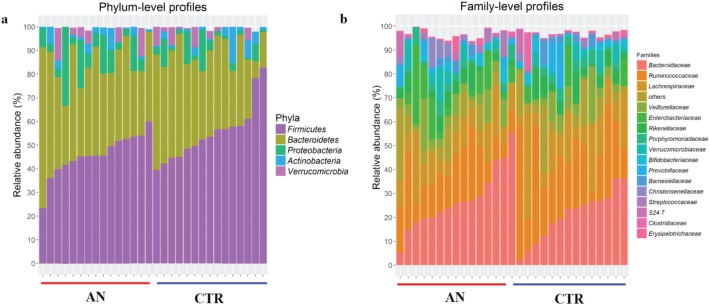
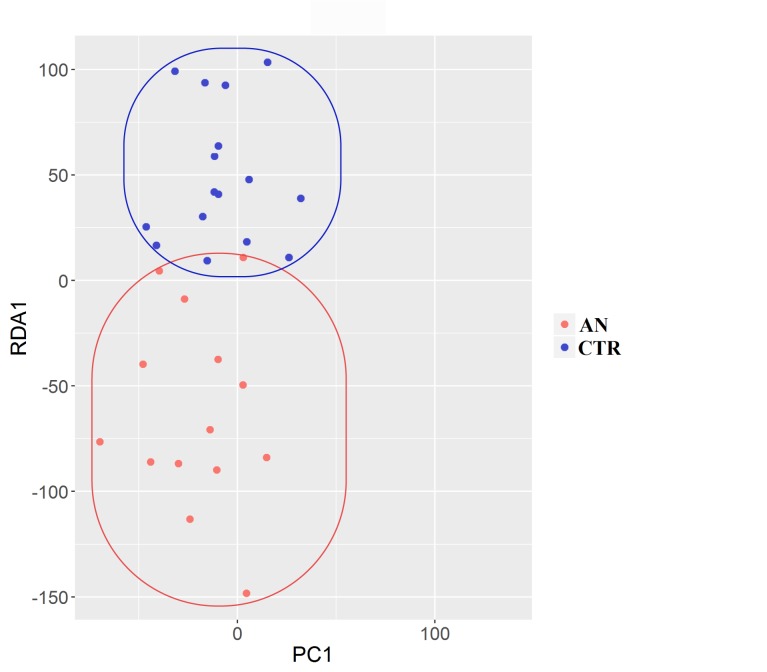
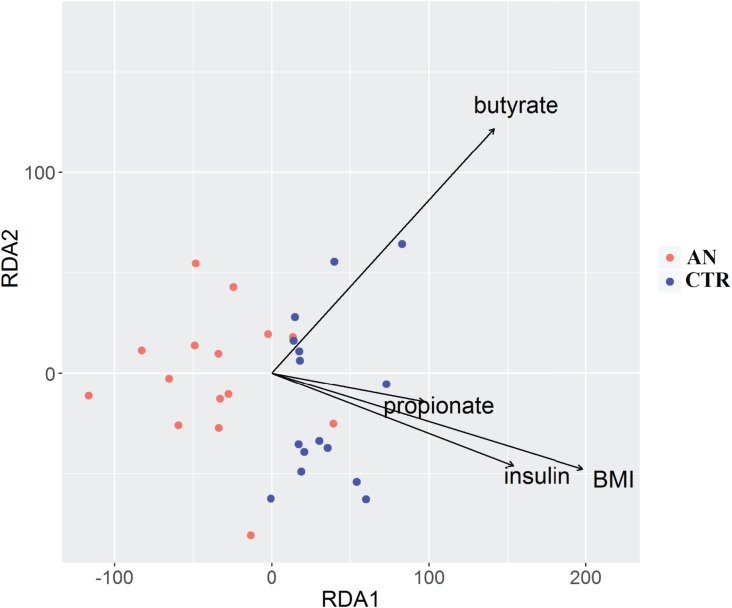
Anorexia nervosa (AN) is a psychiatric disease with devastating physical consequences, with a pathophysiological mechanism still to be elucidated. Metagenomic studies on anorexia nervosa have revealed profound gut microbiome perturbations as a possible environmental factor involved in the disease. In this study we performed a comprehensive analysis integrating data on gut microbiota with clinical, anthropometric and psychological traits to gain new insight in the pathophysiology of AN. Fifteen AN women were compared with fifteen age-, sex- and ethnicity-matched healthy controls. AN diet was characterized by a significant lower energy intake, but macronutrient analysis highlighted a restriction only in fats and carbohydrates consumption. Next generation sequencing showed that AN intestinal microbiota was significantly affected at every taxonomic level, showing a significant increase of Enterobacteriaceae, and of the archeon Methanobrevibacter smithii compared with healthy controls. On the contrary, the genera Roseburia, Ruminococcus and Clostridium, were depleted, in line with the observed reduction in AN of total short chain fatty acids, butyrate, and propionate. Butyrate concentrations inversely correlated with anxiety levels, whereas propionate directly correlated with insulin levels and with the relative abundance of Roseburia inulinivorans, a known propionate producer. BMI represented the best predictive value for gut dysbiosis and metabolic alterations, showing a negative correlation with Bacteroides uniformis (microbiota), with alanine aminotransferase (liver function), and with psychopathological scores (obsession-compulsion, anxiety, and depression), and a positive correlation with white blood cells count. In conclusion, our findings corroborate the hypothesis that the gut dysbiosis could take part in the AN neurobiology, in particular in sustaining the persistence of alterations that eventually result in relapses after renourishment and psychological therapy, but causality still needs to be proven.
Overview
The claims and statistics of this paper haven’t been checked yet.
Run the check — free, no account needed. It reads the open-access text and checks the sources it cites.
Integrity signals
Registry
Cites
Statistics
Figures
Verification
Claims the paper makes
The claims and statistics of this paper haven’t been checked yet.
Run the check — free, no account needed. It reads the open-access text and checks the sources it cites.
Claims other papers make about this one
Each is checked against this paper’s own text: does it say what the citing paper says it does?
In the citing paper
“Several studies of anorexia nervosa patients have reported decreased abundances of the butyrate producing Roseburia in combination with reduced butyrate levels and lower microbial diversity and taxa abundance compared to healthy controls [168–170].”
From The athletic gut microbiota (2020) · cites this paper as [168]
Self-check
Percentages, sums and reported differences re-computed from the paper’s own numbers.
The self-check needs the paper’s full text.
Citations
Cites
1 retracted
Pfleiderer, A., Lagier, J., Armougom, F., Robert, C., Vialettes, B., & Raoult, D. (2013) · European Journal of Clinical Microbiology & Infectious Diseases · doi:10.1007/s10096-013-1900-2 · Cited by 158
Retractedvegan: Community Ecology Package
Oksanen, J., Simpson, G. L., Blanchet, F. G., Kindt, R., Legendre, P., Minchin, P. R., O’Hara, R. B., Sólymos, P., Stevens, M. H. H., Szöcs, E., et al. (2001) · doi:10.32614/cran.package.vegan · Cited by 27,099
(1970) · Cited by 24,983
An obesity-associated gut microbiome with increased capacity for energy harvest
Turnbaugh, P. J., Ley, R. E., Mahowald, M. A., Magrini, V., Mardis, E. R., & Gordon, J. I. (2006) · Nature · doi:10.1038/nature05414 · Cited by 12,444
Diagnostic and Statistical Manual of Mental Disorders(DSM)
Leong, F. T. L. (2008) · Sage eBooks · doi:10.4135/9781412963978.n182 · Cited by 10,861
Klindworth, A., Pruesse, E., Schweer, T., Peplies, J., Quast, C., Horn, M., & Glöckner, F. O. (2013) · Nucleic Acids Research · doi:10.1093/nar/gks808 · Cited by 8,850
From inflammation to sickness and depression: when the immune system subjugates the brain
Dantzer, R., O'Connor, J. C., Freund, G. G., Johnson, R. W., & Kelley, K. W. (2008) · Nature Reviews Neuroscience · doi:10.1038/nrn2297 · Cited by 7,395
Obesity alters gut microbial ecology
Ley, R. E., Bäckhed, F., Turnbaugh, P., Lozupone, C. A., Knight, R. D., & Gordon, J. I. (2005) · Proceedings of the National Academy of Sciences · doi:10.1073/pnas.0504978102 · Cited by 6,176
Diversity, stability and resilience of the human gut microbiota
Lozupone, C. A., Stombaugh, J. I., Gordon, J. I., Jansson, J. K., & Knight, R. (2012) · Nature · doi:10.1038/nature11550 · Cited by 5,533
Functional interactions between the gut microbiota and host metabolism
Tremaroli, V., & Bäckhed, F. (2012) · Nature · doi:10.1038/nature11552 · Cited by 4,387
Cited by
Sorted by citations
Rinninella, E., Raoul, P., Cintoni, M., Franceschi, F., Miggiano, G. A. D., Gasbarrini, A., & Mele, M. C. (2019) · Microorganisms · doi:10.3390/microorganisms7010014 · Cited by 3,462
Mohr, A. E., Jäger, R., Carpenter, K. C., Kerksick, C. M., Purpura, M., Townsend, J. R., West, N. P., Black, K., Gleeson, M., Pyne, D. B., et al. (2020) · Journal of the International Society of Sports Nutrition · doi:10.1186/s12970-020-00353-w · Cited by 378
Gut–organ axis: a microbial outreach and networking
Ahlawat, S., Asha, A., & Sharma, K. K. (2020) · Letters in Applied Microbiology · doi:10.1111/lam.13333 · Cited by 372
Gut microbiota: a new path to treat obesity
Muscogiuri, G., Cantone, E., Cassarano, S., Tuccinardi, D., Barrea, L., Savastano, S., & Colao, A. (2019) · International Journal of Obesity Supplements · doi:10.1038/s41367-019-0011-7 · Cited by 370
Diet and microbiota linked in health and disease
Requena, T., Martínez‐Cuesta, M. C., & Peláez, C. (2018) · Food & Function · doi:10.1039/c7fo01820g · Cited by 191
Metadata
- Authors
- Borgo, F., Riva, A., Benetti, A., Casiraghi, M. C., Bertelli, S., Garbossa, S., Anselmetti, S., Scarone, S., Pontiroli, A. E., Morace, G., & Borghi, E.
- Affiliations
- University of Milan (IT)
- Azienda Socio Sanitaria Territoriale Santi Paolo e Carlo (IT)
- Corresponding author
- Borghi, Elisa
- ORCID
- Venue
- PLOS ONE
- Publisher
- Public Library of Science (PLoS)
- Published
- 2017-06-21
- Volume
- 12
- Issue
- 6
- Pages
- e0179739
- ISSN
- 1932-6203 (ISSN-L)
- PMC
- PMC5479564
- OpenAlex
- W2687532560
- Cited by
- 267
- References
- 71
- Citations by year
- 2026: 15 · 2025: 25 · 2024: 28 · 2023: 32 · 2022: 40 · 2021: 45 · 2020: 28 · 2019: 35 · 2018: 16 · 2017: 3
- FWCI
- 9.16
- Type
- journal article
- Language
- en
- Open access
- gold
- doi.org
- Licence
- Locations
- PLoS ONE (publishedVersion, cc-by)
- Europe PMC (PubMed Central) (publishedVersion, cc-by)
- PubMed Central (publishedVersion, cc-by)
- PubMed (publishedVersion)
- Archivio Istituzionale della Ricerca (Universita Degli Studi Di Milano) (submittedVersion, other-oa)
- DOAJ (DOAJ: Directory of Open Access Journals) (submittedVersion, cc-by-sa)
- Figshare (submittedVersion, cc-by)
- Funders
- Università degli Studi di Milano
- Topics
- Life Sciences › Biochemistry, Genetics and Molecular Biology › Molecular Biology › Gut microbiota and health
- Social Sciences › Psychology › Clinical Psychology › Eating Disorders and Behaviors
- Health Sciences › Medicine › Gastroenterology › Gastrointestinal motility and disorders
- Keywords
- anorexia nervosa, gut microbiota, gut dysbiosis, short-chain fatty acids, butyrate, propionate, Roseburia, Enterobacteriaceae, Methanobrevibacter smithii, Bacteroides uniformis, anxiety, depression, insulin, body mass index, caloric restriction, psychopathology, relapse
- MeSH terms
- Alanine Transaminase, Anorexia Nervosa, Anxiety Disorders, Aspartate Aminotransferases, Butyrates, Clostridium, Depressive Disorder, Diet, DNA, Bacterial, Fatty Acids, Volatile, Feces, Humans, Propionates, Psychological Tests, Body Mass Index, Case-Control Studies, Sequence Analysis, DNA, Gastrointestinal Tract, Ruminococcus, Microbiota, Dysbiosis
About these checks
Registry, retraction, Cites and statistics results are computed, not judged, with one exception: a printed reference that no index lists is read once by a model before it counts as a citation error. Claims are extracted by a model and kept only when their quote appears verbatim in the text; each cited source is then checked, with a model’s help, for whether it says what the claim relies on. Those verdicts can be wrong — read the claim’s quote and the cited source before relying on one.
Statistics and arithmetic are recomputed, not judged.
Confidence bands are shown only for fields calibrated on our annotated test set. None is calibrated yet, so no band is shown.
What counts as a claim ›How we measure confidence ›How we check this ›
Are you an author, or do you see a problem with this page? Request a review
