

The DOI matches its Crossref record; 51 of the 51 references it cites were found in a registry or an index.
Debunking in a world of tribes
Open accessAbstract
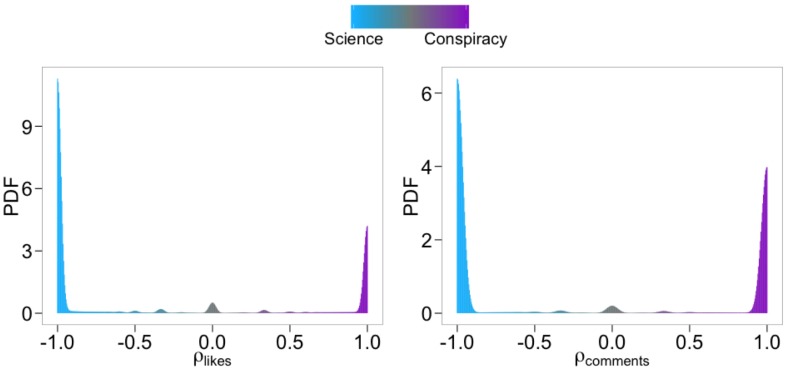
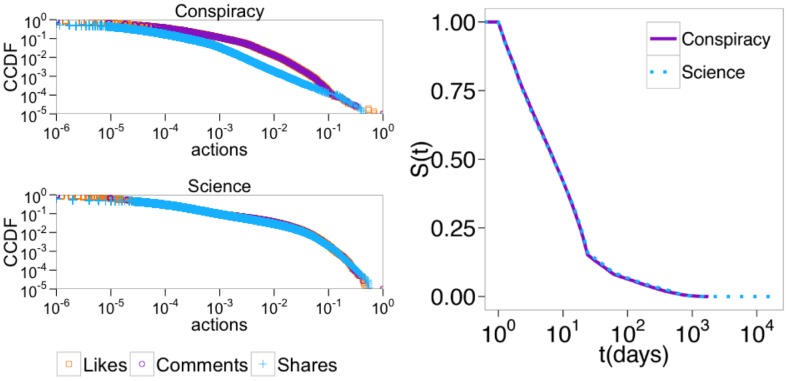
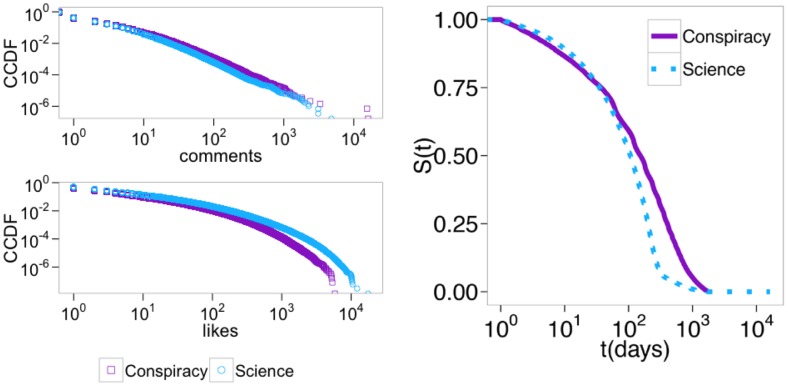
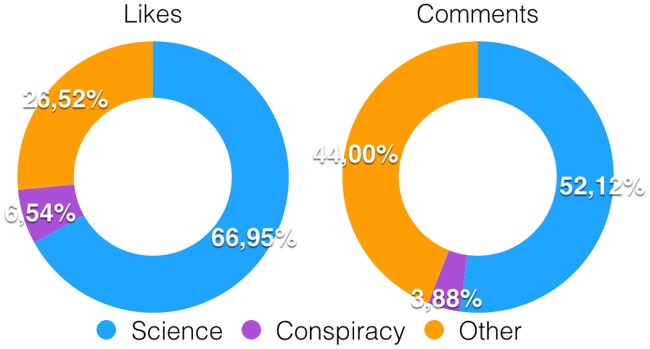
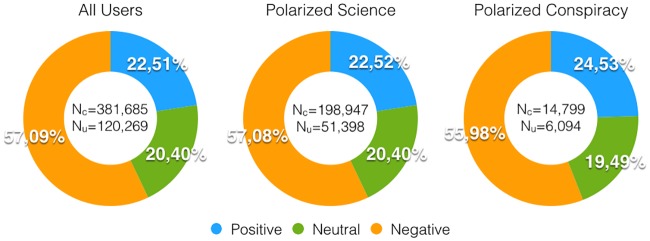
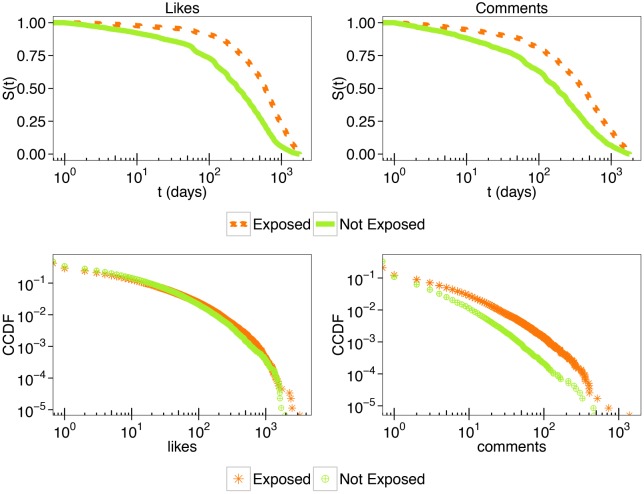
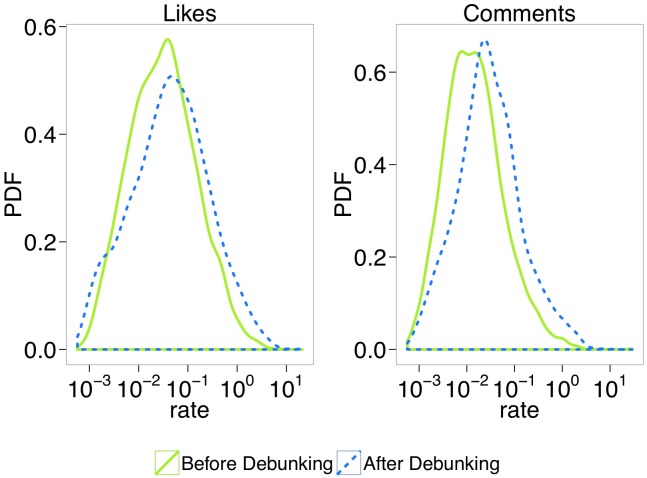
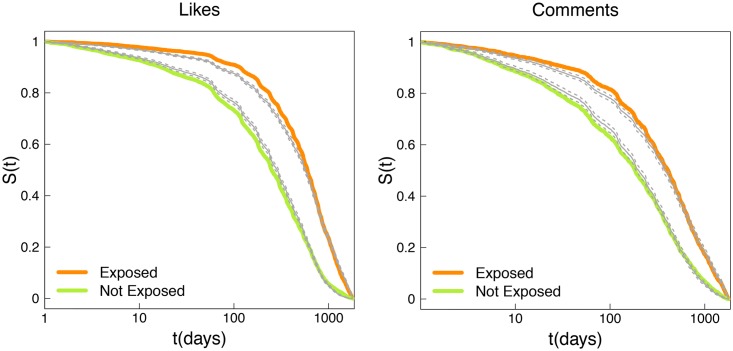
Social media aggregate people around common interests eliciting collective framing of narratives and worldviews. However, in such a disintermediated environment misinformation is pervasive and attempts to debunk are often undertaken to contrast this trend. In this work, we examine the effectiveness of debunking on Facebook through a quantitative analysis of 54 million users over a time span of five years (Jan 2010, Dec 2014). In particular, we compare how users usually consuming proven (scientific) and unsubstantiated (conspiracy-like) information on Facebook US interact with specific debunking posts. Our findings confirm the existence of echo chambers where users interact primarily with either conspiracy-like or scientific pages. However, both groups interact similarly with the information within their echo chamber. Then, we measure how users from both echo chambers interacted with 50,220 debunking posts accounting for both users consumption patterns and the sentiment expressed in their comments. Sentiment analysis reveals a dominant negativity in the comments to debunking posts. Furthermore, such posts remain mainly confined to the scientific echo chamber. Only few conspiracy users engage with corrections and their liking and commenting rates on conspiracy posts increases after the interaction.
Overview
The claims and statistics of this paper haven’t been checked yet.
Run the check — free, no account needed. It reads the open-access text and checks the sources it cites.
Integrity signals
Registry
Cites
Statistics
Figures
Verification
Claims the paper makes
The claims and statistics of this paper haven’t been checked yet.
Run the check — free, no account needed. It reads the open-access text and checks the sources it cites.
Claims other papers make about this one
Each is checked against this paper’s own text: does it say what the citing paper says it does?
The source backs part of the claim, not all of it — or backs it for a different population, condition or comparison.
In the citing paper
“This phenomenon is particularly pronounced in segregated networks, such as”
From A systematic review of echo chamber research: comparative analysis of conceptualizations, operationalizations, and varying outcomes (2025) · cites this paper as [50]
Experimental — accuracy not yet measuredThe source backs part of the claim, not all of it — or backs it for a different population, condition or comparison.
In the citing paper
“They find that the amount of media a person consumes is anti-proportional to their chance of being trapped in an echo chamber, which contradicts findings by CSS studies [48,50,66,67] that find that engagement and echo chambers are positively correlated.”
From A systematic review of echo chamber research: comparative analysis of conceptualizations, operationalizations, and varying outcomes (2025) · cites this paper as [50]
Experimental — accuracy not yet measuredIn the citing paper
“fact-checks are unlikely to reach everyone who was exposed to the initial misinformation (10);”
From Psychological inoculation improves resilience against misinformation on social media (2022) · cites this paper as [10]
Self-check
Percentages, sums and reported differences re-computed from the paper’s own numbers.
The self-check needs the paper’s full text.
Citations
Cites
Nonparametric Estimation from Incomplete Observations
Kaplan, E. L., & Meier, P. (1992) · Springer series in statistics · doi:10.1007/978-1-4612-4380-9_25 · Cited by 45,239
Regression Models and Life-Tables
Cox, D. R. (1972) · Journal of the Royal Statistical Society Series B: Statistical Methodology · doi:10.1111/j.2517-6161.1972.tb00899.x · Cited by 39,793
Nonparametric Estimation from Incomplete Observations
Kaplan, E. L., & Meier, P. (1958) · Journal of the American Statistical Association · doi:10.1080/01621459.1958.10501452 · Cited by 39,158
The Nature of Statistical Learning Theory
Vapnik, V. N. (1995) · doi:10.1007/978-1-4757-2440-0 · Cited by 39,138
Regression Models and Life-Tables
Cox, D. R. (1992) · Springer Series in Statistics · doi:10.1007/978-1-4612-4380-9_37 · Cited by 26,297
Content Analysis: An Introduction to its Methodology.
Shelley, M., & Krippendorff, K. (1984) · Journal of the American Statistical Association · doi:10.2307/2288384 · Cited by 24,346
Content Analysis: An Introduction to Its Methodology
Krippendorff, K. (2019) · doi:10.4135/9781071878781 · Cited by 15,448
On a Test of Whether one of Two Random Variables is Stochastically Larger than the Other
Mann, H. B., & Whitney, D. R. (1947) · The Annals of Mathematical Statistics · doi:10.1214/aoms/1177730491 · Cited by 14,320
Ellison, N. B., Steinfield, C., & Lampe, C. (2007) · Journal of Computer-Mediated Communication · doi:10.1111/j.1083-6101.2007.00367.x · Cited by 9,939
Power-Law Distributions in Empirical Data
Clauset, A., Shalizi, C. R., & Newman, M. E. J. (2009) · SIAM Review · doi:10.1137/070710111 · Cited by 8,019
Research works printed but not linked: 1
- Resnick P, Carton S, Park S, Shen Y, Zeffer N. RumorLens: A System for Analyzing the Impact of Rumors and Corrections in Social Media. In: Proc. Computational Journalism Conference; 2014.
Cited by
Sorted by citations
Items 201–300 of 343
Science Communication in Agriculture: The Role of the Trusted Adviser
Briese, L. (2019) · Elsevier eBooks · doi:10.1016/b978-0-12-409548-9.11936-0 · Cited by 5
(Mis)Information Operations: An Integrated PerspectivePreprint
Cinelli, M., Conti, M., Finos, L., Grisolia, F., Novak, P. K., Peruzzi, A., Tesconi, M., Zollo, F., & Quattrociocchi, W. (2019) · arXiv (Cornell University) · doi:10.48550/arxiv.1912.10795 · Cited by 6
Self-citationAgley, J. D., & Xiao, Y. (2020) · doi:10.21203/rs.3.rs-35919/v2 · Cited by 6
Are Social Media Platforms a Threat to Democracy? An Ecosystem Governance Perspective
Cennamo, C., & Karanović, J. (2026) · Journal of Management Studies · doi:10.1111/joms.70044 · Cited by 4
Lorenzo, A. D., Gesto, C. D., Graziano, F., Calandri, E., Kaakinen, M., Oksanen, A., & Rabaglietti, E. (2026) · Humanities and Social Sciences Communications · doi:10.1057/s41599-026-07130-1 · Cited by 4
Unmasking Fake News: Navigating the Landscape of Fake News Identification, Challenges and Issues
Patel, S., & Surati, S. (2024) · SN Computer Science · doi:10.1007/s42979-024-03280-8 · Cited by 4
A Framework for the Unsupervised Modeling and Extraction of Polarization Knowledge from News Media
Paschalides, D., Pallis, G., & Dikaiakos, M. D. (2024) · ACM Transactions on Social Computing · doi:10.1145/3703594 · Cited by 8
A multilayered graph-based framework to explore behavioural phenomena in social media conversations
Blanco, G., & Lourenço, A. M. G. (2023) · International Journal of Medical Informatics · doi:10.1016/j.ijmedinf.2023.105236 · Cited by 5
Mapping the global election landscape on social media in 2024
Pecile, G., Marco, N. D., Cinelli, M., & Quattrociocchi, W. (2025) · PLoS ONE · doi:10.1371/journal.pone.0316271 · Cited by 10
Self-citationIdentification of vital nodes in the fake news propagation
Zhao, Z. (2020) · Europhysics Letters (EPL) · doi:10.1209/0295-5075/131/16001 · Cited by 4
Post-Truth Çağında Pazarlama ve Tüketim
Pala, U., & İŞLEK, M. S. (2021) · Eskişehir Osmangazi Üniversitesi Sosyal Bilimler Dergisi · doi:10.17494/ogusbd.1040439 · Cited by 4
Cultural Evolution, Disinformation, and Social Division
Bentley, R. A., Horne, B. D., Borycz, J., Carrignon, S., Shteynberg, G., Vidiella, B., Valverde, S., & O’Brien, M. J. (2023) · Adaptive Behavior · doi:10.1177/10597123231186432 · Cited by 6
Whose life is it anyway? The life course as an observational medium in the education system
Corsi, G. (2020) · European Educational Research Journal · doi:10.1177/1474904120962425 · Cited by 4
Media Partisanship During Election: Indonesian Cases
Maulana, A., & Situngkir, H. (2020) · Studies in computational intelligence · doi:10.1007/978-3-030-65347-7_54 · Cited by 4
Repetitive users network emerges from multiple rumor cascadesPreprint
Li, D., Gao, J., Zhao, J., Zhao, Z., Levy, O., & Havlin, S. (2018) · arXiv (Cornell University) · doi:10.48550/arxiv.1804.05711 · Cited by 6
Self-citationSoros, Child Sacrifices, and 5G: Understanding the Spread of Conspiracy Theories on Web CommunitiesPreprint
Paudel, P., Blackburn, J., Cristofaro, E. D., Zannettou, S., & Stringhini, G. (2021) · arXiv (Cornell University) · doi:10.48550/arxiv.2111.02187 · Cited by 8
Johnson, S. S. (2022) · American Journal of Health Promotion · doi:10.1177/08901171211070957a · Cited by 8
Political Attitudes and the Processing of Misinformation CorrectionsPreprint
Ecker, U. K. H., & Ang, L. C. (2017) · PsyArXiv (OSF Preprints) · doi:10.31234/osf.io/48tcp · Cited by 4
Affective Polarization, Media Outlets, and Opinion DynamicsPreprint
Lena, S. D., Merlino, L. P., & Zénou, Y. (2023) · SSRN Electronic Journal · doi:10.2139/ssrn.4595200 · Cited by 4
Emergenza Migranti: From Metaphor to Policy
Federici, F. M. (2019) · Bloomsbury Academic eBooks · doi:10.5040/9781350097087.ch-012 · Cited by 3
Technology and Fake News: Shaping Social, Political, and Economic Perspectives
(2023) · Biomedical Science and Clinical Research · doi:10.33140/bscr.02.02.10 · Cited by 3
What To Do About Conspiracy Theories?
Drążkiewicz, E., & Harambam, J. (2024) · Routledge eBooks · doi:10.4324/9781032647463 · Cited by 3
Exploring the effect of social media on revisit intentions
Ahmad, S., Chaveesuk, S., Chaiyasoonthorn, W., & Khan, S. (2024) · Anatolia · doi:10.1080/13032917.2024.2324914 · Cited by 3
"Here's Your Evidence": False Consensus in Public Twitter Discussions of COVID-19 Science
Efstratiou, A., Efstratiou, M., Yudhoatmojo, S. B., Blackburn, J., & Cristofaro, E. D. (2024) · Proceedings of the ACM on Human-Computer Interaction · doi:10.1145/3687010 · Cited by 6
Roozenbeek, J., Lasser, J., Marks, M., Qin, T., García, D., Goldberg, B., Debnath, R., van der Linden, S., & Lewandowsky, S. (2025) · Royal Society Open Science · doi:10.1098/rsos.251377 · Cited by 3
Polanco-Levicán, K., Salvo-Garrido, S. I., Sepúlveda, J. A., & Coria, M. D. C. D. (2022) · Revista Iberoamericana de Diagnóstico y Evaluación - e Avaliação Psicológica · doi:10.21865/ridep63.2.10 · Cited by 5
The Role of Conformity in Opinion Dynamics Modelling with Multiple Social Circles
Stępień, S., Jankowski, J., Bródka, P., & Michalski, R. (2023) · Lecture notes in computer science · doi:10.1007/978-3-031-36024-4_3 · Cited by 3
Decoding Political Polarization in Social Media Interactions
Pecile, G., Marco, N. D., Cinelli, M., & Quattrociocchi, W. (2025) · Studies in computational intelligence · doi:10.1007/978-3-031-82435-7_23 · Cited by 4
Self-citationModeling the Co-evolving Polarization of Opinion and News Propagation Structure in Social Media
Prasetya, H. A., & Murata, T. (2018) · Studies in computational intelligence · doi:10.1007/978-3-030-05414-4_25 · Cited by 4
Dhamija, M. S., & Ashfaq, R. (2023) · Journal of Media Culture and Communication · doi:10.55529/jmcc.33.19.30 · Cited by 3
Neto, W. D. V. D., & Baldanza, R. F. (2018) · Mediaciones Sociales · doi:10.5209/meso.59053 · Cited by 3
Revising Misconceptions Using Multiple Documents
Butterfuss, R. (2020) · University of Minnesota Digital Conservancy (University of Minnesota) · Cited by 3
News consumption and social media regulations policyPreprint
Etta, G., Cinelli, M., Galeazzi, A., Valensise, C. M., Conti, M., & Quattrociocchi, W. (2021) · arXiv (Cornell University) · doi:10.48550/arxiv.2106.03924 · Cited by 3
Self-citationMaclay, G. J., & Ahmad, M. (2021) · PLoS ONE · doi:10.1371/journal.pone.0259625 · Cited by 2
DIGITAL TRIBALISM AND THE INTERNET OF THINGS: CHALLENGES AND OPPORTUNITIES
(2020) · Issues in Information Systems · doi:10.48009/2_iis_2020_213-220 · Cited by 2
How I learned to hate you. Parasocial interactions in echo chambers and their spillover effects
Radu, R. N. (2023) · methaodos revista de ciencias sociales · doi:10.17502/mrcs.v11i1.598 · Cited by 2
How We Evaluate the Accessibility of an Infographic: A Pilot Study Through SUS Questionnaire
Caccamo, A. (2023) · Lecture notes in business information processing · doi:10.1007/978-3-031-43088-6_12 · Cited by 2
Efstratiou, A. (2024) · International World Wide Web Conference (WWW) · doi:10.1145/3589334.3645375 · Cited by 2
Regulating Misinformation: Political Irrationality as a Feasibility Constraint
Chomanski, B. (2024) · Topoi · doi:10.1007/s11245-024-10083-2 · Cited by 3
Dijital Çağda Dezenformasyon: X'te Maymun Çiçeği Virüsü
Sarıkaya, B. (2025) · TRT Akademi · doi:10.37679/trta.1564114 · Cited by 2
Toward a Better Understanding of Emotional Dynamics on Facebook
Zollo, F., Sluban, B., Mozetič, I., & Quattrociocchi, W. (2017) · Studies in computational intelligence · doi:10.1007/978-3-319-72150-7_30 · Cited by 2
Self-citationMiliani, M. R., & Quintaliani, G. (2017) · Giornale di Techniche Nefrologiche e Dialitiche · doi:10.5301/gtnd.2017.17774 · Cited by 2
Fakten versus Fakes: Was Fact-Checking als Maßnahme gegen Desinformation leisten kann und was nicht
Sängerlaub, A. (2020) · Nomos Verlagsgesellschaft mbH & Co. KG eBooks · doi:10.5771/9783748901334-311 · Cited by 2
Paschalides, D., Pallis, G., & Dikaiakos, M. D. (2021) · IEEE/ACM International Conference on Advances in Social Networks Analysis and Mining (ASONAM) · doi:10.1145/3487351.3489443 · Cited by 4
Influencers and Major Themes in a Gifted Education Community of Practice on Twitter
Miller, E. M., Jolly, J. L., Latz, J., & Listman, K. (2022) · Journal of Advanced Academics · doi:10.1177/1932202x221099590 · Cited by 2
“Spreader of conspiracies”: How major U.S. newspapers differentiate them from Facebook
Habib, A. M. T., Yousuf, M., & Mohammed, I. (2023) · Newspaper Research Journal · doi:10.1177/07395329231187634 · Cited by 5
O conceito de teorias da conspiração em controvérsias sobre terraplanismo
de Melo, L. W. S., & de Oliveira, M. A. (2023) · Caderno Brasileiro de Ensino de Física · doi:10.5007/2175-7941.2023.e93087 · Cited by 2
"People who defend their homeland"
Siibak, A., & Masso, A. (2018) · International Conference on Social Media and Society (SMSociety) · doi:10.1145/3217804.3217948 · Cited by 2
Towards Understanding the Information Ecosystem Through the Lens of Multiple Web CommunitiesPreprint
Zannettou, S. (2019) · arXiv (Cornell University) · doi:10.48550/arxiv.1911.10517 · Cited by 4
Drifts and Shifts: Characterizing the Evolution of Users Interests on RedditPreprint
Valensise, C. M., Cinelli, M., Galeazzi, A., & Quattrociocchi, W. (2019) · arXiv (Cornell University) · doi:10.48550/arxiv.1912.09210 · Cited by 5
Self-citationLexical convergence and collective identities on FacebookPreprint
Brugnoli, E., Cinelli, M., Zollo, F., Quattrociocchi, W., & Scala, A. (2019) · arXiv (Cornell University) · doi:10.48550/arxiv.1903.11452 · Cited by 5
Self-citationExistence of Differential Belief Profiles of COVID-19 Narratives: The Role of Trust in SciencePreprint
Agley, J. D., & Xiao, Y. (2020) · doi:10.21203/rs.3.rs-35919/v1 · Cited by 2
Ballejo, F., Plaza, P. I., & Lambertucci, S. A. (2021) · Research Square · doi:10.21203/rs.3.rs-267841/v1 · Cited by 2
Feeling-Into the Civic Body: Affect, Emotions and Moods
Bakir, V., & McStay, A. (2022) · Springer eBooks · doi:10.1007/978-3-031-13551-4_5 · Cited by 2
Challenges for Research on Groups in Cyberspace
Kiesler, S. (2025) · Small Group Research · doi:10.1177/10464964251318625 · Cited by 1
Bassolas, A., Massachs, J., Cozzo, E., & Vicens, J. (2025) · Royal Society Open Science · doi:10.1098/rsos.241974 · Cited by 7
Peace, truth and the digital public sphere: A Wesleyan postcolonial theology
Reyes, C. (2026) · HTS Teologiese Studies / Theological Studies · doi:10.4102/hts.v82i1.11321 · Cited by 1
Institutional Health Communication in the Information Age
Rubinelli, S. (2026) · Cambridge University Press eBooks · doi:10.1017/9781009379984 · Cited by 1
Facilitating Scientific Communication Between Strangers: A Preregistered Lost E-Mail Experiment
Vaughan‐Johnston, T. I., Fowlie, D. I., & Jacobson, J. A. (2022) · Cyberpsychology Behavior and Social Networking · doi:10.1089/cyber.2021.0272 · Cited by 1
Exploring the echo chamber concept
Bondi, M., & Sanna, L. (2022) · Discourse approaches to politics, society and culture · doi:10.1075/dapsac.98.07bon · Cited by 1
Harms to the Civic Body from False Information Online
Bakir, V., & McStay, A. (2022) · Springer eBooks · doi:10.1007/978-3-031-13551-4_7 · Cited by 1
Divinagracia, A. A. (2023) · Philippine Political Science Journal · doi:10.1163/2165025x-bja10041 · Cited by 1
Buturoiu, R., Corbu, N., & Boţan, M. (2023) · Springer studies in media and political communication · doi:10.1007/978-3-031-41954-6_6 · Cited by 1
Greene, J. A., Cartiff, B. M., Duke, R. F., & Deekens, V. M. (2019) · Emerald Group Publishing Limited eBooks · doi:10.1108/978-1-64113-853-620251013 · Cited by 1
Kronhardt, K., Lehnert, M. J., Pascher, M., & Gerken, J. (2025) · International Conference on Mobile and Ubiquitous Multimedia (MUM) · doi:10.1145/3771882.3771896 · Cited by 1
Paccagnella, L. (2018) · International Journal of E-Politics · doi:10.4018/ijep.2018040101 · Cited by 1
Lexical convergence inside and across echo chambers.
Brugnoli, E., Cinelli, M., Zollo, F., Quattrociocchi, W., & Scala, A. (2019) · Cited by 2
Self-citationdos Reis, F. O. B., Guimarães, M. S. A., Chiacchio, A. D., & de Oliveira, N. A. (2021) · DESAFIOS Revista Interdisciplinar da Universidade Federal do Tocantins · doi:10.20873/uftv8-9631 · Cited by 1
Naumiuk, A. (2021) · Wydawnictwa Uniwersytetu Warszawskiego eBooks · doi:10.31338/uw.9788323549871 · Cited by 1
Towards the Modeling of Behavioral Trajectories of Users in Online Social MediaPreprint
Bessi, A. (2016) · arXiv (Cornell University) · doi:10.48550/arxiv.1611.05778 · Cited by 2
Self-citationTEEvil: Identity Lease via Trusted Execution EnvironmentsPreprint
Puddu, I., Lain, D., Schneider, M., Tretiakova, E., Matetić, S., & Čapkun, S. (2019) · arXiv (Cornell University) · doi:10.3929/ethz-b-000358940 · Cited by 4
Sándor, A. V. (2023) · Eötvös Loránd Tudományegyetem · doi:10.15476/elte.2023.118 · Cited by 1
Verified authors shape X/Twitter discursive communitiesPreprint
Guarino, S., Mounim, A., Caldarelli, G., & Saracco, F. (2024) · Research Square · doi:10.21203/rs.3.rs-4388361/v1 · Cited by 1
Self-citationPatterns, Models, and Challenges in Online Social Media: A SurveyPreprint
Marco, A. D., Bonetti, A., Martino, E. D., Loru, E., Nudo, J., Pandolfo, M. E., Pecile, G., Sangiorgio, E., Scalco, I., Zollo, S., et al. (2025) · SSRN Electronic Journal · doi:10.2139/ssrn.5355426 · Cited by 1
Self-citationProzesse in Kleingruppen – Intragruppenprozesse
Werth, L., Seibt, B., & Mayer, J. (2019) · Springer eBooks · doi:10.1007/978-3-662-53899-9_3
Information Consumption and Social Response in a Segregated Environment: the Case of GabPreprint
Etta, G., Galeazzi, A., Cinelli, M., Conti, M., & Quattrociocchi, W. (2020) · arXiv (Cornell University) · doi:10.48550/arxiv.2006.02181
Self-citationMiliani, M. R., & Quintaliani, G. (2017) · Giornale di Clinica Nefrologica e Dialisi · doi:10.33393/gcnd.2017.683
Machine Learning Evaluation of the Echo-Chamber Effect in Medical Forums.Preprint
Sokolova, M. (2020) · arXiv (Cornell University)
Biddle, M. W. (2021) · Wydawnictwa Uniwersytetu Warszawskiego eBooks · doi:10.31338/uw.9788323549871.pp.225-246
Le coût économique de la sécurité juridique des marchés publics
Pistone, F., & Lebon, V. (2005) · Actualité juridique. Edition droit administratif
Rethinking Media and Communication in the COVID-19 Context
Ross, T. (2021) · Springer eBooks · doi:10.1007/978-981-16-2948-8_6
Persily, N., & Tucker, J. A. (2020) · Cambridge University Press eBooks · doi:10.1017/9781108890960.001
Persily, N., & Tucker, J. A. (2020) · Cambridge University Press eBooks · doi:10.1017/9781108890960.015
Budzinski, O. (2022) · SSRN Electronic Journal · doi:10.2139/ssrn.4118640
Ferrari, F., & Moruzzi, S. (2022) · Social Epistemology · doi:10.1080/02691728.2022.2129505
Opinion Formation by Belief Propagation: A Heuristic to Identify Low-Credible Sources of InformationPreprint
Fenoaltea, E. M., & Lage-Castellanos, A. (2023) · SSRN Electronic Journal · doi:10.2139/ssrn.4566619 · Cited by 1
Albudaiwi, D. Y., Abuqamaz, B., Alhumaidan, Y., Alfadhel, M., & Gadelrab, H. F. (2023) · SSRN Electronic Journal · doi:10.2139/ssrn.4661098
The Contextual Conditions: The Factors that Today Contribute to the Successful Disinformation
Acampa, S. (2024) · Springer eBooks · doi:10.1007/978-3-031-48435-3_2
Politicisation of Science and Health Topics
Stein, R. A., & Ometa, O. (2024) · Springer eBooks · doi:10.1007/978-3-031-49084-2_21
Leveraging content producer networks and user perception to detect online discursive communities
Guarino, S., Mounim, A., Caldarelli, G., & Saracco, F. (2026) · Scientific Reports · doi:10.1038/s41598-026-39477-5
Self-citationOptimal Verification of Rumors in NetworksPreprint
Merlino, L. P., & Tabasso, N. (2024) · SSRN Electronic Journal · doi:10.2139/ssrn.4873554
Sensitivity analysis of the online fake news identification
Zhao, Z., Chang, C. K., & Zhao, M. (2024) · IEEE Advanced Information Management, Communicates, Electronic and Automation Control Conference (IMCEC) · doi:10.1109/imcec59810.2024.10575062
Contribution Classification Methods for Fake News Using Machine Learning
Nikoukar, M., & Heidari, S. (2024) · Communications in computer and information science · doi:10.1007/978-3-031-72287-5_14
de Oliveira, N. R., Medeiros, D. S. V., & Mattos, D. M. F. (2024) · Simpósio Brasileiro de Cibersegurança (SBSeg) · doi:10.5753/sbseg.2024.241730
Diffusion of COVID-19 Misinformation in Kenyan X Conversations
Ndavula, J. O., & Munuku, A. W. (2025) · International Journal of Communication and Public Relation · doi:10.47604/ijcpr.3166
MITIGATING DISINFORMATION IN SOCIAL NETWORKS THROUGH NOISE
Riazi, D., & Livan, G. (2025) · Advances in Complex Systems · doi:10.1142/s0219525925500079
Bi-Dynamic Graph ODE for Opinion Evolution
Duan, B., Deng, H., Piao, J., Wang, H., & Wang, Y. (2025) · ACM SIGKDD Conference on Knowledge Discovery and Data Mining (KDD) · doi:10.1145/3690624.3709297
Dual Narratives on Social Media and the Future of Trust and Reliability in Indian Politics
Dhanapal, K., Sivaprakkash, S., Xavier, N., & Marianand, N. (2025) · IGI Global eBooks · doi:10.4018/979-8-3693-7468-9.ch018
Metadata
- Authors
- Zollo, F., Bessi, A., Del Vicario, M., Scala, A., Caldarelli, G., Shekhtman, L., Havlin, S., & Quattrociocchi, W.
- Affiliations
- IMT School for Advanced Studies Lucca (IT)
- Istituto Universitario di Studi Superiori di Pavia (IT)
- Bar-Ilan University (IL)
- Corresponding author
- Zollo, Fabiana
- ORCID
- Venue
- PLOS ONE
- Publisher
- Public Library of Science (PLoS)
- Published
- 2017-07-24
- Volume
- 12
- Issue
- 7
- Pages
- e0181821
- ISSN
- 1932-6203 (ISSN-L)
- PMC
- PMC5524392
- OpenAlex
- W2962740444
- Cited by
- 345
- References
- 51
- Citations by year
- 2026: 19 · 2025: 39 · 2024: 32 · 2023: 34 · 2022: 39 · 2021: 53 · 2020: 55 · 2019: 30 · 2018: 21 · 2017: 16
- FWCI
- 85.15
- Type
- journal article
- Language
- en
- Open access
- gold
- doi.org
- Licence
- Locations
- PLoS ONE (publishedVersion, cc-by)
- Europe PMC (PubMed Central) (publishedVersion, cc-by)
- PubMed Central (publishedVersion, cc-by)
- PubMed (publishedVersion)
- arXiv (Cornell University) (submittedVersion)
- DOAJ (DOAJ: Directory of Open Access Journals) (submittedVersion, cc-by-sa)
- IRIS Research product catalog (Sapienza University of Rome) (submittedVersion)
- ARCA (Università Ca' Foscari Venezia) (submittedVersion)
- arXiv (Cornell University)
- Topics
- Social Sciences › Sociology and Political Science › Misinformation and Its Impacts
- Physical Sciences › Physics and Astronomy › Statistical and Nonlinear Physics › Complex Network Analysis Techniques
- Social Sciences › Communication › Social Media and Politics
- Keywords
- debunking, misinformation, conspiracy beliefs, echo chambers, Facebook, social media, user engagement, sentiment analysis, scientific information, disintermediation
- MeSH terms
- Attention, Communication, Humans, United States, Social Networking, Social Media
About these checks
Registry, retraction, Cites and statistics results are computed, not judged, with one exception: a printed reference that no index lists is read once by a model before it counts as a citation error. Claims are extracted by a model and kept only when their quote appears verbatim in the text; each cited source is then checked, with a model’s help, for whether it says what the claim relies on. Those verdicts can be wrong — read the claim’s quote and the cited source before relying on one.
Statistics and arithmetic are recomputed, not judged.
Confidence bands are shown only for fields calibrated on our annotated test set. None is calibrated yet, so no band is shown.
What counts as a claim ›How we measure confidence ›How we check this ›
Are you an author, or do you see a problem with this page? Request a review
