

The DOI matches its Crossref record; 46 of the 47 references it cites were found in a registry or an index.
Increased colon cancer risk after severe Salmonella infection
Open accessAbstract
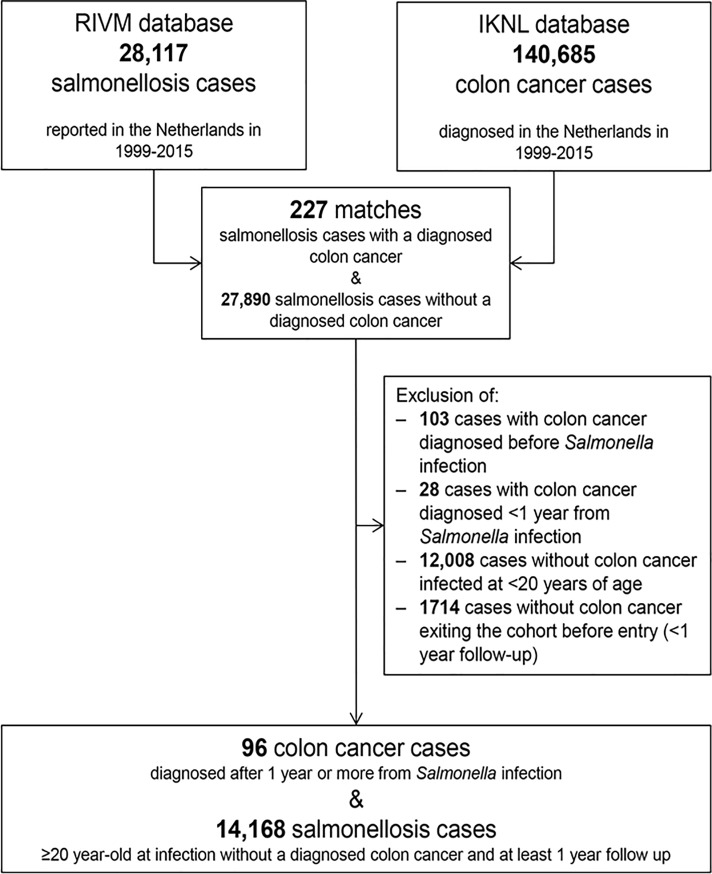
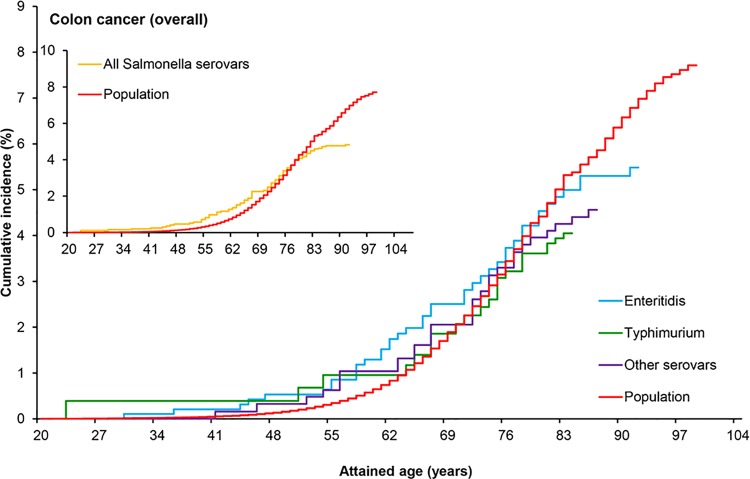
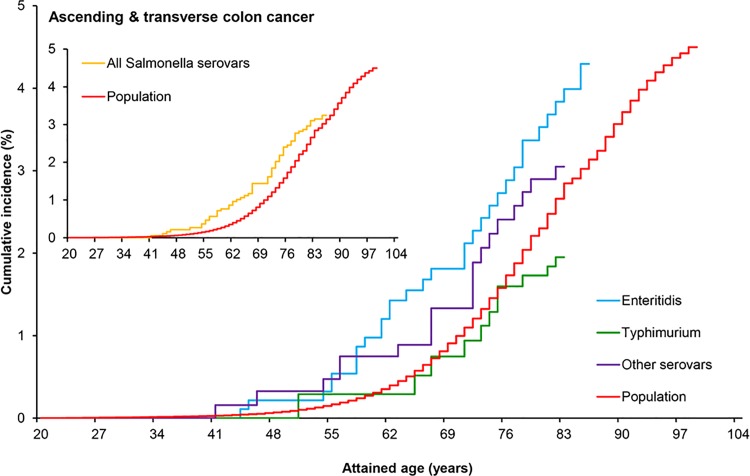
BACKGROUND: Colon cancer constitutes one of the most frequent malignancies. Previous studies showed that Salmonella manipulates host cell signaling pathways and that Salmonella Typhimurium infection facilitates colon cancer development in genetically predisposed mice. This epidemiological study examined whether severe Salmonella infection, usually acquired from contaminated food, is associated with increased colon cancer risk in humans. METHODS AND FINDINGS: We performed a nationwide registry-based study to assess colon cancer risk after diagnosed Salmonella infection. National infectious disease surveillance records (1999-2015) for Dutch residents aged ≥20 years when diagnosed with salmonellosis (n = 14,264) were linked to the Netherlands Cancer Registry. Salmonella-infected patients were laboratory-confirmed under medical consultation after 1-2 weeks of illness. These datasets also contained information on Salmonella serovar and type of infection. Colon cancer risk (overall and per colon subsite) among patients with a diagnosed Salmonella infection was compared with expected colon cancer risk in the general population. Data from the nationwide registry of histo- and cytopathology (PALGA) and Statistics Netherlands (CBS) allowed assessing potential effects of age, gender, latency, socioeconomic status, genetic predisposition, inflammatory bowel disease (IBD), and tumor features. We found that compared to the general population, colon cancer risk was significantly increased (standardized incidence ratio [SIR] 1.54; 95%CI 1.09-2.10) among patients with Salmonella infection diagnosed <60 years of age. Such increased risk concerned specifically the ascending/transverse colon (SIR 2.12; 95%CI 1.38-3.09) after S. Enteritidis infection (SIR 2.97; 95%CI 1.73-4.76). Salmonellosis occurred more frequently among colon cancer patients with pre-infectious IBD, a known risk factor for colon cancer. Colon tumors of patients with a history of Salmonella infection were mostly of low grade. CONCLUSIONS: Patients diagnosed with severe salmonellosis have an increased risk of developing cancer in the ascending/transverse parts of the colon. This risk concerns particularly S. Enteritidis infection, suggesting a contribution of this major foodborne pathogen to colon cancer development.
Overview
The claims and statistics of this paper haven’t been checked yet.
Run the check — free, no account needed. It reads the open-access text and checks the sources it cites.
Integrity signals
Registry
Cites
Statistics
Figures
Verification
Claims the paper makes
The claims and statistics of this paper haven’t been checked yet.
Run the check — free, no account needed. It reads the open-access text and checks the sources it cites.
Claims other papers make about this one
Each is checked against this paper’s own text: does it say what the citing paper says it does?
In the citing paper
“The investigators analyzed cancer registry and public health surveillance data and found an increased incidence of CRC, compared with the general population, among residents who with reported enteric (not systemic) salmonellosis.”
From Influence of the Gut Microbiome, Diet, and Environment on Risk of Colorectal Cancer (2020) · cites this paper as [70]
Self-check
Percentages, sums and reported differences re-computed from the paper’s own numbers.
The self-check needs the paper’s full text.
Citations
Cites
A genetic model for colorectal tumorigenesis
Fearon, E. R., & Vogelstein, B. (1990) · Cell · doi:10.1016/0092-8674(90)90186-i · Cited by 12,132
The Global Burden of Nontyphoidal Salmonella Gastroenteritis
Majowicz, S. E., Musto, J., Scallan, E., Angulo, F. J., Kirk, M., O’Brien, S. J., Jones, T. F., Fazil, A., & Hoekstra, R. M. (2010) · Clinical Infectious Diseases · doi:10.1086/650733 · Cited by 2,465
Colorectal Cancer Epidemiology: Incidence, Mortality, Survival, and Risk Factors
Haggar, F. A., & Boushey, R. P. (2009) · Clinics in Colon and Rectal Surgery · doi:10.1055/s-0029-1242458 · Cited by 2,018
Terzić, J., Grivennikov, S., Karin, E., & Karin, M. (2010) · Gastroenterology · doi:10.1053/j.gastro.2010.01.058 · Cited by 1,974
Molecular Genetics of Colorectal Cancer
Fearon, E. R. (2011) · Annual Review of Pathology: Mechanisms of Disease · doi:10.1146/annurev-pathol-011110-130235 · Cited by 1,805
Schwabe, R. F., & Jobin, C. (2013) · Nature Reviews Cancer · doi:10.1038/nrc3610 · Cited by 1,689
The Biology and Life-Cycle of Human Papillomaviruses
Doorbar, J., Quint, W. G. V., Banks, L., Bravo, I. G., Stoler, M. H., Tr, B., & Stanley, M. (2012) · Vaccine · doi:10.1016/j.vaccine.2012.06.083 · Cited by 1,633
Helicobacter pylori and Gastric Cancer: Factors That Modulate Disease Risk
Wroblewski, L. E., Peek, R. M., & Wilson, K. T. (2010) · Clinical Microbiology Reviews · doi:10.1128/cmr.00011-10 · Cited by 1,503
Modelling human development and disease in pluripotent stem-cell-derived gastric organoids
McCracken, K. W., Catá, E. M., Crawford, C. M., Sinagoga, K. L., Schumacher, M., Rockich, B. E., Tsai, Y.-H., Mayhew, C. N., Spence, J. R., Zavros, Y., et al. (2014) · Nature · doi:10.1038/nature13863 · Cited by 980 · cited 1×
“pylori has been shown to support gastric cell transformation by secreting toxin CagA that activates the c-Met receptor and induces signaling [16], with chronic inflammation acting as a contributing factor.”
BackgroundCasparie, M. K., Tiebosch, A. T. M. G., Burger, G., Blauwgeers, H., van de Pol, A., van Krieken, J. H. J. M., & Meijer, G. A. (2007) · Analytical Cellular Pathology · doi:10.1155/2007/971816 · Cited by 890
Cited by
Sorted by citations
Influence of the Gut Microbiome, Diet, and Environment on Risk of Colorectal Cancer
Song, M., Chan, A. T., & Sun, J. (2020) · Gastroenterology · doi:10.1053/j.gastro.2019.06.048 · Cited by 752
Autophagy as a molecular target for cancer treatment
Kocatürk, N. M., Akkoç, Y., Kığ, C., Bayraktar, O., Gözüaçık, D., & Kutlu, Ö. (2019) · European Journal of Pharmaceutical Sciences · doi:10.1016/j.ejps.2019.04.011 · Cited by 394
The Mechanism of Bacteroides fragilis Toxin Contributes to Colon Cancer Formation
Cheng, W. T., Kantilal, H. K., & Davamani, F. A. (2020) · Malaysian Journal of Medical Sciences · doi:10.21315/mjms2020.27.4.2 · Cited by 251
Bacterial infections and cancer
van Elsland, D. M., & Neefjes, J. (2018) · EMBO Reports · doi:10.15252/embr.201846632 · Cited by 221
Self-citationPrevention and Control of Human Salmonella enterica Infections: An Implication in Food Safety
Mkangara, M. (2023) · International Journal of Food Science · doi:10.1155/2023/8899596 · Cited by 192
Metadata
- Authors
- Mughini-Gras, L., Schaapveld, M., Kramers, J., Mooij, S., Neefjes-Borst, E. A., Pelt, W. V., & Neefjes, J.
- Affiliations
- The Netherlands Cancer Institute (NL)
- National Institute for Public Health and the Environment (NL)
- Leiden University Medical Center (NL)
- Corresponding author
- Neefjes, Jacques
- Venue
- PLoS ONE
- Publisher
- Public Library of Science (PLoS)
- Published
- 2018-01-17
- Volume
- 13
- Issue
- 1
- Pages
- e0189721
- ISSN
- 1932-6203 (ISSN-L)
- PMC
- PMC5771566
- OpenAlex
- W2783067021
- Cited by
- 133
- References
- 47
- Citations by year
- 2026: 7 · 2025: 12 · 2024: 15 · 2023: 29 · 2022: 14 · 2021: 21 · 2020: 17 · 2019: 13 · 2018: 5
- FWCI
- 13.13
- Type
- journal article
- Language
- en
- Open access
- gold
- doi.org
- Licence
- Locations
- PLoS ONE (publishedVersion, cc-by)
- Europe PMC (PubMed Central) (publishedVersion, cc-by)
- PubMed Central (publishedVersion, cc-by)
- PubMed (publishedVersion)
- Amsterdam UMC (VU Amsterdam) - Institutional Repository (publishedVersion, other-oa)
- Pure Amsterdam UMC (acceptedVersion, cc-by)
- Leiden Repository (Leiden University) (submittedVersion)
- Data Archiving and Networked Services (DANS) (submittedVersion, other-oa)
- DOAJ (DOAJ: Directory of Open Access Journals) (submittedVersion, cc-by-sa)
- Utrecht University Repository (Utrecht University) (submittedVersion, other-oa)
- Figshare (submittedVersion, cc-by)
- Rivm Repository (Netherlands National Institute for Public Health and the Environment) (submittedVersion)
- Rivm (National Institute for Public Health and the Environment) (submittedVersion)
- Funders
- KWF Kankerbestrijding (NKI 2013-5969)
- European Research Council
- Topics
- Life Sciences › Agricultural and Biological Sciences › Food Science › Salmonella and Campylobacter epidemiology
- Health Sciences › Medicine › Oncology › Colorectal Cancer Screening and Detection
- Life Sciences › Biochemistry, Genetics and Molecular Biology › Biotechnology › Bacterial Cancer Therapy
- Keywords
- salmonellosis, colon cancer risk, Salmonella Enteritidis, ascending colon, transverse colon, inflammatory bowel disease, foodborne pathogens, tumor latency, tumor grade, host-pathogen interaction
- MeSH terms
- Adult, Aged, Animals, Colonic Neoplasms, Female, Humans, Male, Middle Aged, Registries, Retrospective Studies, Risk Factors, Salmonella Infections, Mice, Young Adult
About these checks
Registry, retraction, Cites and statistics results are computed, not judged, with one exception: a printed reference that no index lists is read once by a model before it counts as a citation error. Claims are extracted by a model and kept only when their quote appears verbatim in the text; each cited source is then checked, with a model’s help, for whether it says what the claim relies on. Those verdicts can be wrong — read the claim’s quote and the cited source before relying on one.
Statistics and arithmetic are recomputed, not judged.
Confidence bands are shown only for fields calibrated on our annotated test set. None is calibrated yet, so no band is shown.
What counts as a claim ›How we measure confidence ›How we check this ›
Are you an author, or do you see a problem with this page? Request a review
