

Mobile and traditional cognitive behavioral therapy programs for generalized anxiety disorder: a cost-effectiveness analysis.
Open accessThe DOI matches its Crossref record; 36 of the 36 references it cites were found in a registry or an index.
Abstract
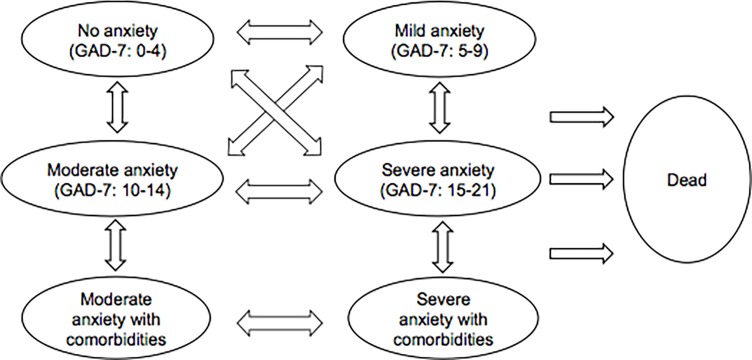
BACKGROUND: Generalized anxiety disorder (GAD) is a debilitating mental health illness that affects approximately 3.1% of U.S. adults and can be treated with cognitive behavioral therapy (CBT). With the emergence of digital health technologies, mobile CBT may be a cost-effective way to deliver care. We developed an analysis framework to quantify the cost-effectiveness of internet-based CBT for individuals with GAD. As a case study, we examined the potential value of a new mobile-delivered CBT program for GAD. METHODS: We developed a Markov model of GAD health states combined with a detailed economic analysis for a cohort of adults with GAD in the U.S. In our case study, we used pilot program efficacy data to evaluate a mobile CBT program as either prevention or treatment only and compared the strategies to traditional CBT and no CBT. Traditional CBT efficacy was estimated from clinical trial results. We calculated discounted incremental costs and quality-adjusted life-years (QALYs) over the cohort lifetime. CASE STUDY RESULTS: In the base case, for a cohort of 100,000 persons with GAD, we found that mobile CBT is cost-saving. It leads to a gain of 34,108 QALYs and 81,492 QALYs and a cost reduction of $2.23 billion and $4.54 billion when compared to traditional CBT and no CBT respectively. Results were insensitive to most model inputs and mobile CBT remained cost-saving in almost all scenarios. LIMITATIONS: The case study was conducted for illustrative purposes and used mobile CBT efficacy data from a small pilot program; the analysis should be re-conducted once robust efficacy data is available. The model was limited in its ability to measure the effectiveness of CBT in combination with pharmacotherapy. CONCLUSIONS: Mobile CBT may lead to improved health outcomes at lower costs than traditional CBT or no intervention and may be effective as either prevention or treatment.
Overview
The claims and statistics of this paper haven’t been checked yet.
Free: it reads the open-access text and checks the first 5 claims that cite a source we can check. Create a free account to check every claim.
Integrity signals
Registry
Cites
Statistics
Figures
Verification
Claims the paper makes
The claims and statistics of this paper haven’t been checked yet.
Free: it reads the open-access text and checks the first 5 claims that cite a source we can check. Create a free account to check every claim.
Claims other papers make about this one
Each is checked against this paper’s own text: does it say what the citing paper says it does?
The source backs part of the claim, not all of it — or backs it for a different population, condition or comparison.
In the citing paper
“The 3-month transition probabilities between states of well, mild symptoms, moderate symptoms, and severe symptoms following the completion of initial low-intensity CBT were obtained from the model inputs of a health economic analysis of CBT on generalized anxiety disorders [22], and were converted to monthly probabilities by the eigendecomposition approach [34].”
From Cost-effectiveness of internet-supported cognitive behavioral therapy for university students with anxiety symptoms: A Markov-model analysis (2022) · cites this paper as [22]
Experimental — accuracy not yet measuredThe cited source says what the claim attributes to it.
In the citing paper
“The results of the US analysis were similar to the present study that the mobile CBT was cost-saving and gained higher QALYs when compared with traditional CBT.”
From Cost-effectiveness of internet-supported cognitive behavioral therapy for university students with anxiety symptoms: A Markov-model analysis (2022) · cites this paper as [22]
Self-check
Percentages, sums and reported differences re-computed from the paper’s own numbers.
The self-check needs the paper’s full text.
Citations
Cites
A Brief Measure for Assessing Generalized Anxiety Disorder: The GAD-7
Spitzer, R. L., Kroenke, K., Williams, J. B. W., & Löwe, B. (2006) · Archives of Internal Medicine · doi:10.1001/archinte.166.10.1092 · Cited by 31,765
Kessler, R. C., Berglund, P., Demler, O., Jin, R., Merikangas, K. R., & Walters, E. E. (2005) · Archives of General Psychiatry · doi:10.1001/archpsyc.62.6.593 · Cited by 20,391
Kessler, R. C., Chiu, W. T., Demler, O., & Walters, E. E. (2005) · Archives of General Psychiatry · doi:10.1001/archpsyc.62.6.617 · Cited by 12,052
Grant, B. F., Stinson, F. S., Dawson, D. A., Chou, S. P., Dufour, M. C., Compton, W., Pickering, R. P., & Kaplan, K. (2004) · Archives of General Psychiatry · doi:10.1001/archpsyc.61.8.807 · Cited by 2,889
Treatment gap in mental health care.
Abramowitz, M. Z., Greenberg, D., & Levav, I. (2008) · PubMed · Cited by 1,483
The treatment gap in mental health care.
(2004) · Europe PMC (PubMed Central) · Cited by 1,419
Bruce, S. E., Yonkers, K. A., Otto, M. W., Eisen, J. L., Weisberg, R. B., Pagano, M., Shea, M. T., & Keller, M. B. (2005) · American Journal of Psychiatry · doi:10.1176/appi.ajp.162.6.1179 · Cited by 963
Generalized anxiety disorder: prevalence, burden, and cost to society
Wittchen, H.-U. (2002) · Depression and Anxiety · doi:10.1002/da.10065 · Cited by 733
Past-Year Use of Outpatient Services for Psychiatric Problems in the National Comorbidity Survey
Kessler, R. C., Zhao, S., Katz, S. J., Kouzis, A. C., Frank, R. G., Edlund, M., & Leaf, P. (1999) · American Journal of Psychiatry · doi:10.1176/ajp.156.1.115 · Cited by 610
Newman, M. G., Szkodny, L. E., Llera, S. J., & Przeworski, A. (2011) · Clinical Psychology Review · doi:10.1016/j.cpr.2010.09.008 · Cited by 480
Research works printed but not linked: 2
- Jones M, editor Enhancing engagement in digital mental health interventions: Exploring predictors and methods of engagement. International Society for Research on Internet Interventions Conference; 2016; Seattle, WA.
- N Kanuri, 2015, Beyond the barriers to mental health care: the development and implementation of a guided self-help coach training protocol for indian non-professional clinicians, Association for Behavioral and Cognitive Therapies
Cited by
The cost-effectiveness of digital health interventions: A systematic review of the literature
Gentili, A., Failla, G., Melnyk, A., Puleo, V., Tanna, G. L. D., Ricciardi, W., & Cascini, F. (2022) · Frontiers in Public Health · doi:10.3389/fpubh.2022.787135 · Cited by 444
Le, L. K.-D., Esturas, A. C., Mihalopoulos, C., Chiotelis, O., Bucholc, J., Chatterton, M. L., & Engel, L. (2021) · PLOS Medicine · doi:10.1371/journal.pmed.1003606 · Cited by 256
DeMartini, J., Patel, G., & Fancher, T. L. (2019) · Annals of Internal Medicine · doi:10.7326/aitc201904020 · Cited by 226
Smartphone Apps for the Treatment of Mental Disorders: Systematic Review
Miralles, I., Granell, C., Díaz-Sanahuja, L., Van Woensel, W., Bretón-López, J., Mira, A., Castilla, D., & Casteleyn, S. (2020) · JMIR mHealth and uHealth · doi:10.2196/14897 · Cited by 188
“For the benefit of the research community, Table 2 lists the concrete studies (by app name, when available; if the app name was not found, we put N/A) per mental disorder.”
(2019) · Europe PMC (PubMed Central) · Cited by 110
Metadata
- Authors
- Kumar, S., Jones Bell, M., & Juusola, J. L.
- Affiliations
- Evidation Health (United States) (US)
- Corresponding author
- Kumar, Shefali
- Venue
- PLOS ONE
- Publisher
- Public Library of Science (PLoS)
- Published
- 2018-01-04
- Volume
- 13
- Issue
- 1
- Pages
- e0190554
- ISSN
- 1932-6203 (ISSN-L)
- PMC
- PMC5754075
- OpenAlex
- W2781485880
- Cited by
- 47
- References
- 35
- Citations by year
- 2026: 1 · 2025: 7 · 2024: 7 · 2023: 7 · 2022: 8 · 2021: 4 · 2020: 6 · 2019: 6 · 2018: 1
- FWCI
- 5.36
- Type
- journal article
- Language
- en
- Open access
- gold
- doi.org
- Licence
- Locations
- PLoS ONE (publishedVersion, cc-by)
- Europe PMC (PubMed Central) (publishedVersion, cc-by)
- PubMed Central (publishedVersion, cc-by)
- PubMed (publishedVersion)
- RePEc: Research Papers in Economics (submittedVersion)
- DOAJ (DOAJ: Directory of Open Access Journals) (submittedVersion, cc-by-sa)
- Figshare (submittedVersion, cc-by)
- Topics
- Social Sciences › Psychology › Applied Psychology › Digital Mental Health Interventions
- Social Sciences › Economics, Econometrics and Finance › Economics and Econometrics › Health Systems, Economic Evaluations, Quality of Life
- Social Sciences › Psychology › Experimental and Cognitive Psychology › Anxiety, Depression, Psychometrics, Treatment, Cognitive Processes
- Keywords
- generalized anxiety disorder, internet-based CBT, cost-effectiveness, digital mental health interventions, quality-adjusted life years, Markov model, prevention versus treatment
- MeSH terms
- Anxiety Disorders, Cost-Benefit Analysis, Humans, Markov Chains, Cohort Studies, Cognitive Behavioral Therapy
About these checks
Registry, retraction, Cites and statistics results are computed, not judged, with one exception: a printed reference that no index lists is read once by a model before it counts as a citation error. Claims are extracted by a model and kept only when their quote appears verbatim in the text; each cited source is then checked, with a model’s help, for whether it says what the claim relies on. Those verdicts can be wrong — read the claim’s quote and the cited source before relying on one.
Statistics and arithmetic are recomputed, not judged.
Confidence bands are shown only for fields calibrated on our annotated test set. None is calibrated yet, so no band is shown.
What counts as a claim ›How we measure confidence ›How we check this ›
Are you an author, or do you see a problem with this page? Request a review
How to cite
Cite CoChat for the checks on this page, and the paper for its own findings.
- This page
- CoChat. (2026). Citation check: Mobile and traditional cognitive behavioral therapy programs for generalized anxiety disorder: a cost-effectiveness analysis. https://app.cochat.ai/papers/10.1371/journal.pone.0190554
- The paper
- Kumar, S., Jones Bell, M., & Juusola, J. L. (2018). Mobile and traditional cognitive behavioral therapy programs for generalized anxiety disorder: a cost-effectiveness analysis. PLOS ONE. https://doi.org/10.1371/journal.pone.0190554
Data sources
Bibliographic data: Semantic Scholar, OpenAlex, Crossref.
Contains information from the Semantic Scholar Academic Graph Datasets, made available under the ODC Attribution License (ODC-BY 1.0).
Semantic Scholar’s data is described in: Kinney, R., et al. (2023). The Semantic Scholar Open Data Platform. arXiv:2301.10140.
