

Validity and reliability of the Beck Depression Inventory (BDI-II) in general and hospital population of Dominican Republic
Open accessThe DOI matches its Crossref record; 63 of the 65 references it cites were found in a registry or an index.
Abstract
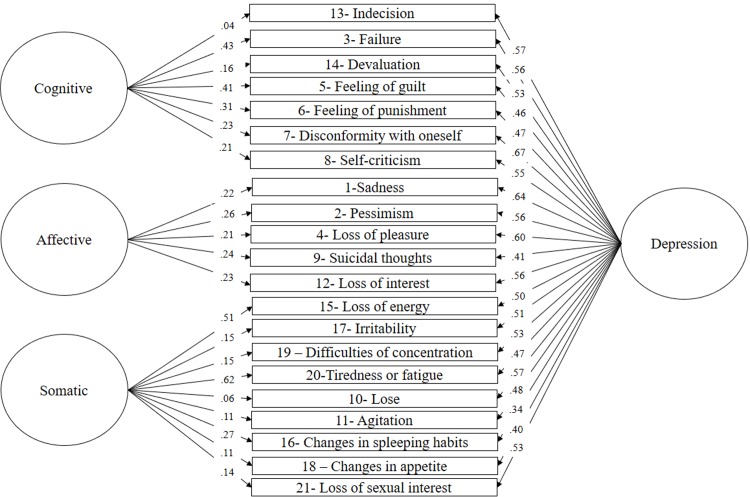
The Beck Depression Inventory-II (BDI-II) is currently one of the most widely used measures in both research and clinical practice for assessing depression. Although the psychometric properties of the scale have been well established through many studies worldwide, so far there is no study examining the validity and reliability of BDI-II in Republic Dominican. The purpose of the present study was twofold: (a) to examine the latent structure of BDI-II by testing several competing models proposed in the literature; and (b) to provide evidence of validity and reliability of the BDI-II in Republic Dominican. Confirmatory factor analysis indicated that a bifactor model with a general depression factor and three specific factors consisting of cognitive, affective and somatic showed the best fit to the data. Internal reliability was moderate to high for all subscales and for the total scale. Scores on BDI-II discriminated between clinical and general population, supporting for external validity. Practical implications are discussed and suggestions for further research are also made.
Overview
The claims and statistics of this paper haven’t been checked yet.
Free: it reads the open-access text and checks the first 5 claims that cite a source we can check. Create a free account to check every claim.
Integrity signals
Registry
Cites
Statistics
Figures
Verification
Claims the paper makes
The claims and statistics of this paper haven’t been checked yet.
Free: it reads the open-access text and checks the first 5 claims that cite a source we can check. Create a free account to check every claim.
Claims other papers make about this one
Each is checked against this paper’s own text: does it say what the citing paper says it does?
The cited source says what the claim attributes to it.
In the citing paper
“Internal consistency is good, with Cronbach’s α = 0.89 [38].”
Self-check
Percentages, sums and reported differences re-computed from the paper’s own numbers.
The self-check needs the paper’s full text.
Citations
Cites
Diagnostic and Statistical Manual of Mental Disorders
Williams, J. B. W., & First, M. (2013) · Encyclopedia of Social Work · doi:10.1093/acrefore/9780199975839.013.104 · Cited by 109,519
Principles and Practice of Structural Equation Modeling
Tabri, N., & Elliott, C. M. (2012) · Canadian Graduate Journal of Sociology and Criminology · doi:10.15353/cgjsc-rcessc.v1i1.25 · Cited by 38,891
(1998) · Cited by 36,049
Hu, L.-T., & Bentler, P. M. (1998) · Psychological Methods · doi:10.1037/1082-989x.3.4.424 · Cited by 12,298
Diagnostic and Statistical Manual of Mental Disorders
Siegel, L. J., & Fletcher‐Janzem, E. (2008) · Encyclopedia of Special Education · doi:10.1002/9780470373699.speced0655 · Cited by 8,477
(2005) · Cited by 6,097
Comparison of Beck Depression Inventories -IA and -II in psychiatric outpatients
Beck, A. T., Steer, R. A., Ball, R., & Ranieri, W. F. (1996) · Journal of Personality Assessment · doi:10.1207/s15327752jpa6703_13 · Cited by 5,965
The Epidemiology of Depression Across Cultures
Kessler, R. C., & Bromet, E. J. (2013) · Annual Review of Public Health · doi:10.1146/annurev-publhealth-031912-114409 · Cited by 2,657
Structural equations modeling: Fit Indices, sample size, and advanced topics
Iacobucci, D. (2010) · Journal of Consumer Psychology · doi:10.1016/j.jcps.2009.09.003 · Cited by 2,263
The Rediscovery of Bifactor Measurement Models
Reise, S. P. (2012) · Multivariate Behavioral Research · doi:10.1080/00273171.2012.715555 · Cited by 2,112
Research works printed but not linked: 1
- Sanz J, Perdigón AL, Vazquez C. Adaptación Española del Inventario para la Depresión de Beck (BDI-II). Clínica y Salud. 2003; 14: 121– 141
Cited by
Items 201–240 of 240
A Randomized Study Protocol for Customized Interventions in Youth Deliberate Self-harm
Kpeno, A., Sahoo, S., Sahu, A. K., & Sahu, P. K. (2024) · Journal of Indian Association for Child and Adolescent Mental Health · doi:10.1177/09731342241298735
“To investigate the effectiveness of PST and CST in reducing DSH behaviors and associated outcomes, including depressive symptoms, anxiety, and quality of life, the “Hamilton Depression Rating Scale (HAM-D)” 16 and “Hamilton Anxiety Rating Scale (HAM-A, also known as HARS)” 17 will be used.”
Lima, I. V. D. S., Mascarenhas, A. C. C., Monteiro, D. G. D. F., Dias, M. D. S., Rodrigues, F. N., da Cruz, A. G., & da Silva, Â. M. B. F. (2024) · Revista Multidisciplinar do Nordeste Mineiro · doi:10.61164/rmnm.v12i4.3243
Karaoğullarından, A., Erkan, S. O., Tuhanioğlu, B., Kurt, M., Kuran, G., & Görgülü, O. (2024) · Ankara Eğitim ve Araştırma Hastanesi Tıp Dergisi · doi:10.20492/aeahtd.994414
Mishra, K. K., & Pawar Gaurav, B. (2024) · Indian Journal of Psychological Medicine · doi:10.1177/02537176241298999
Depression in Kidney Failure Patients
Ong, S. C., Butt, M. D., & Malik, T. (2024) · Springer eBooks · doi:10.1007/978-3-031-32046-0_127-1
Cnockaert, E., Smeets, R., Beckers, L. W. M. E., Meeus, M., Pauw, R. D., & Oosterwijck, J. V. (2025) · Physiotherapy Theory and Practice · doi:10.1080/09593985.2025.2482056 · Cited by 2
AlTarrah, D., Al-Abdullah, L., Alhusayan, M., Canha, D., Almazeedi, S. M., Al‐Serri, A., Abulhasan, M., Alsomly, T., Almutawa, N., Al‐Onaizi, M., et al. (2025) · Scientific Reports · doi:10.1038/s41598-025-95614-6
“The KUAS scale, less widely applied than SCOFF and BDI, has been validated on the background study population, and was evaluated in different ethnic and geographic contexts 16,40–42 .”
Dynamic Measurement Invariance Cutoffs for Two-Group Fit Index DifferencesPreprint
McNeish, D. (2025) · PsyArXiv (OSF Preprints) · doi:10.31234/osf.io/d6rwx_v2 · Cited by 1
“As a second example, consider data from a study on depression in patients living in the Dominican Republic (García-Batista et al., 2018) using Beck’s Depression Inventory II (BDI-II; Beck et al., 1996).”
Dynamic Measurement Invariance Cutoffs for Two-Group Fit Index DifferencesPreprint
McNeish, D. (2024) · PsyArXiv (OSF Preprints) · doi:10.31234/osf.io/d6rwx_v1
Kalaydzhiev, P., Velikova, T. V., Voynova, G., Somleva, D., Spasova, N., Ilieva, R., Kinova, E., & Goudev, A. (2025) · Journal of Mind and Medical Sciences · doi:10.3390/jmms12010018
Trisiswati, M., Mardyudhiyanto, L., & Airindya, B. K. (2025) · COMSERVA Jurnal Penelitian dan Pengabdian Masyarakat · doi:10.59141/comserva.v4i12.3058
“Depresi adalah gangguan kejiwaan yang paling sering didiagnosis pada orang yang hidup dengan HIV, dengan tingkat prevalensi 2-10 kali lebih tinggi daripada populasi umum (García-Batista et al., 2018; Ginting et al., 2013; Saveanu & Nemeroff, 2012).”
Reutimann, S., Steiner, J., Hübscher, N., Voderholzer, U., Meule, A., & Augsburger, M. (2025) · JMIR Formative Research · doi:10.2196/50504 · Cited by 1
Bergunde, L., Woud, M. L., Shkreli, L., Schindler‐Gmelch, L., Garthus‐Niegel, S., Blackwell, S. E., Kirschbaum, C., Kessler, H., & Steudte‐Schmiedgen, S. (2025) · Translational Psychiatry · doi:10.1038/s41398-025-03476-3 · Cited by 1
“…we fi tted linear mixed-effects models (LMMs) with a random intercept for participants and a fi xed effect of time (pre-treatment, post-treatment, 3-month follow-up), group (CBM-APP yes/no), treatment duration, and lifetime trauma exposure for the outcomes PCL-5 and hair ECs/NAEs, respectively.”
García-Batista, Z. E., Vindel, A. C., Guerra-Peña, K., Álvarez-Hernández, A., Cruz, I., Amparo, Ó. R., & Medrano, L. A. (2025) · Suma Psicológica · doi:10.14349/sumapsi.2025.v32.n2.2 · Cited by 1
Self-citationAssessing Social, Emotional, and Behavioral Functioning in Emergent Bilingual Youth
Torres, J., Kuperman, K. L., & Wolf, J. N. (2025) · Springer eBooks · doi:10.1007/978-3-032-02084-0_11
Parietal Alpha Asymmetry as a Correlate of Internet Use Severity in Healthy Adults
Šimkutė, D., Tarailis, P., & Griškova-Bulanova, I. (2025) · Brain Sciences · doi:10.3390/brainsci15111207
“Beck’s Depression Inventory (BDI-II) [46] assesses depressive symptom severity and is widely used in both research and clinical contexts [47,48].”
Chang, Y., Wu, N., Zhang, Z., Zhang, Z., Ren, B., Liu, F., Song, X., Wu, M., Feng, X., & Yin, S. (2022) · Figshare · doi:10.6084/m9.figshare.20522639
Schultz, J., Baumeister, A., Schmotz, S., Moritz, S., & Jelinek, L. (2024) · Figshare · doi:10.6084/m9.figshare.26610066
Polese, D., Costanzi, F., Bianchi, P., Frega, A., Bellati, F., Marco, M. P. D., Parisi, P., Bruni, O., Caserta, D., & Cozza, G. (2024) · Figshare · doi:10.6084/m9.figshare.26682793
Gordon, A. R., Carrithers, B. M., Pagni, B. A., Kettner, H., MRes, A. M., Nayak, S. M., Weiss, B., Carhart-Harris, R. L., Roberts, D. E., Erritzøe, D., et al. (2025) · Psychedelic Medicine · doi:10.1177/28314425251382930
“61,64,66,67 Responses are rated on a 6-point scale ranging from 1 (strongly disagree) to 6 (strongly agree).”
Rajagopalan, A. V., & Wadsworth, M. E. (2025) · Journal of Child and Family Studies · doi:10.1007/s10826-025-03235-4 · Cited by 1
“The Beck Depression Inventory is 21 item scale that has a mean internal consistency of 0.86 and has been validated across diverse samples (e.g. Garcia-Batista et al., 2018).”
InfluentialElgendy, H. E., Shalaby, R., Owusu, E., Mao, W., Agyapong, B., Vuong, W., Eboreime, E., Nkire, N., Wei, Y., & Agyapong, V. I. O. (2026) · Archives of Psychiatric Nursing · doi:10.1016/j.apnu.2026.152054
Investigation of Eating Patterns Among Individuals With Chronic Urticaria
Akay, M., Özülkü, E., Kaya, M., Celik, B., & Saraç, G. A. (2026) · Cureus · doi:10.7759/cureus.101453
“The validity and reliability study of the Turkish version of the inventory, originally developed by Beck et al., was conducted by Hisli and Ulusoy et al., respectively [10,11].”
Polese, D., Mazzetta, A., Costanzi, F., Cozza, G., Niolu, C., Causi, F. S. L., Nardo, G. D., Caserta, D., Parisi, P., Siracusano, A., et al. (2026) · Journal of Affective Disorders · doi:10.1016/j.jad.2026.121416
Exploring the role of negative urgency in body dissatisfaction in young adults
Watkins, J. M., Herms, E. N., Schiestl, E. T., & Wisner, K. (2026) · Journal of Health Psychology · doi:10.1177/13591053261430272
“The BDI has been validated in general and hospital adult populations (García-Batista et al., 2018).”
How Temporal Predictability of Threat and Action Preparation Affect Defensive Freezing Responses
Koppold, A., Ehlers, M. R., Kastrinogiannis, A., Klaassen, F. H., Roelofs, K., & Lonsdorf, T. B. (2026) · Psychophysiology · doi:10.1111/psyp.70278 · Cited by 2
Detecting depression: employing word-embeddings and sentence transformers
Gupta, M., Balki, M., Patki, S. M., & Valadi, J. K. (2026) · Journal of Computational Social Science · doi:10.1007/s42001-026-00467-2
Yahyavi, S., Nami, M., Masjoodi, S., Kamali, A., Yalmeh, R., & Namavar, M. R. (2026) · BMC Neurology · doi:10.1186/s12883-026-04806-8
“…rule out memory issues stemming from these or lifestyle factors, participants underwent several screening assessments, including the Beck Depression Inventory (BDI) [29, 30], Pittsburgh Sleep Quality Index (PSQI) [31], Epworth Sleepiness Scale (ESS) [32], and the Geriatric Anxiety Score test [33].”
Prevalencia y caracterización de la sintomatología depresiva en estudiantes universitarios
Varela, C. A. T., Varela, J. R. T., & Ramírez, E. J. B. (2026) · CienciaUAT · doi:10.29059/cienciauat.v20i2.2064
İzgi, B., Muhcu, S. E., Berberoglu, I., Kaçar, A. Ş., & Eser, H. Y. (2026) · BMC Psychology · doi:10.1186/s40359-026-04966-9
“BDI is a 21-item, self-report rating inventory where participants are expected to report the degree (from 0 to 3) of his/her own experience for each 21 symptoms of depression [34].”
Language-Dependent Expression of Anxiety and Depression Symptoms in Japanese-English Bilinguals
Williams, A. I., Rochanavibhata, S., & Marian, V. (2026) · Clinical Psychological Science · doi:10.1177/21677026251385547 · Cited by 2
“Although clinical scales have been normed in multiple languages (Campos & Gonçalves, 2011; García-Batista et al., 2018; González et al., 2015), few studies have tested language effects in bilingual populations.”
Dar, M. A., Bhat, B. A., Dar, S. A., & Qayoom, M. I. (2026) · Journal of Psychiatry Spectrum · doi:10.4103/jopsys.jopsys_200_25
Palanisamy, S., Janakiraman, B., Arun, B., Kandasamy, M., Subramaniam, A., & Anand, G. K. (2026) · Physiotherapy Quarterly · doi:10.5114/pq/214440
“Inclusion criteria were a sedentary lifestyle (less than 30 min of moderate-intensity exercise per week, determined through the International Physical Activity Questionnaire (IPAQ) and mild-to-moderate symptoms of depression (Beck Depression Inventory-II, BDI-II) score of 10–20) [14, 15].”
Zivarifa, H., Sedaghat, H. K., Nasab, M. K., Roodi, T. A., & Ahrari, F. (2025) · Tropical Gastroenterology · doi:10.4103/tg.tg_58_25
Development and Preliminary Validation of a Brief Depression Scale in a Mexican Sample
Cadena, C. H. G., Pinales, Ó. M. L., Gutiérrez-Martínez, A. K., Trujillo, F. J. B., & Alanís, I. V. M. (2026) · Psychiatry International · doi:10.3390/psychiatryint7040171
Baxi, S., & Mody, V. (2026) · Galore International Journal of Health Sciences and Research · doi:10.52403/gijhsr.20260213
Lee, J., & Ko, M. (2026) · Healthcare · doi:10.3390/healthcare14162530
“The BDI-II has been evaluated in adolescent clinical samples [23], among adults living with HIV and family caregivers of children with chronic diseases [24,25], and in culturally or racially diverse populations [26,27].”
Niering, M., Richter, E., Riedel, J., Beurskens, R., & Seifert, J. (2026) · Frontiers in Public Health · doi:10.3389/fpubh.2026.1920866
Tang, E. E. X., Siripaopradit, Y., Thanakitcharu, J., Tang, E. E. S., & Chan, L. F. (2026) · Brain Behavior and Immunity · doi:10.1016/j.bbi.2026.106987
Kujovic, M., Bahr, C., Riesbeck, M., Deiß, M., Koncarevic, I., Lipka, T., Plewnia, C., & Meisenzahl, E. (2026) · European Archives of Psychiatry and Clinical Neuroscience · doi:10.1007/s00406-026-02341-8
Metadata
- Authors
- García-Batista, Z. E., Guerra-Peña, K., Cano-Vindel, A., Herrera-Martínez, S. X., & Medrano, L. A.
- Affiliations
- Pontificia Universidad Católica Madre y Maestra (DO)
- Universidad Arturo Michelena (VE)
- Universidad Nacional de Córdoba (AR)
- Corresponding author
- García-Batista, Zoilo Emilio
- ORCID
- Venue
- PLOS ONE
- Publisher
- Public Library of Science (PLoS)
- Published
- 2018-06-29
- Volume
- 13
- Issue
- 6
- Pages
- e0199750
- ISSN
- 1932-6203 (ISSN-L)
- PMC
- PMC6025862
- OpenAlex
- W2811436445
- Cited by
- 240
- References
- 65
- Citations by year
- 2026: 19 · 2025: 36 · 2024: 63 · 2023: 37 · 2022: 30 · 2021: 28 · 2020: 19 · 2019: 8
- FWCI
- 18.01
- Type
- journal article
- Language
- en
- Open access
- gold
- doi.org
- Licence
- Locations
- PLoS ONE (publishedVersion, cc-by)
- Europe PMC (PubMed Central) (publishedVersion, cc-by)
- PubMed Central (publishedVersion, cc-by)
- PubMed (publishedVersion)
- RePEc: Research Papers in Economics (submittedVersion)
- DOAJ (DOAJ: Directory of Open Access Journals) (submittedVersion, cc-by-sa)
- Greater South Information System
- Funders
- Fondo Nacional de Innovación y Desarrollo Científico–Tecnológico
- Topics
- Social Sciences › Psychology › Experimental and Cognitive Psychology › Anxiety, Depression, Psychometrics, Treatment, Cognitive Processes
- Social Sciences › Decision Sciences › Management Science and Operations Research › Psychometric Methodologies and Testing
- Social Sciences › Psychology › Experimental and Cognitive Psychology › Mental Health Research Topics
- Keywords
- Beck Depression Inventory-II, depression assessment, psychometric validation, bifactor model, latent structure, Dominican Republic
- MeSH terms
- Adult, Depression, Dominican Republic, Female, Hospitals, Humans, Male, Models, Psychological
About these checks
Registry, retraction, Cites and statistics results are computed, not judged, with one exception: a printed reference that no index lists is read once by a model before it counts as a citation error. Claims are extracted by a model and kept only when their quote appears verbatim in the text; each cited source is then checked, with a model’s help, for whether it says what the claim relies on. Those verdicts can be wrong — read the claim’s quote and the cited source before relying on one.
Statistics and arithmetic are recomputed, not judged.
Confidence bands are shown only for fields calibrated on our annotated test set. None is calibrated yet, so no band is shown.
What counts as a claim ›How we measure confidence ›How we check this ›
Are you an author, or do you see a problem with this page? Request a review
Data sources
Bibliographic data: Semantic Scholar, OpenAlex, Crossref.
Contains information from the Semantic Scholar Academic Graph Datasets, made available under the ODC Attribution License (ODC-BY 1.0).
Semantic Scholar’s data is described in: Kinney, R., et al. (2023). The Semantic Scholar Open Data Platform. arXiv:2301.10140.
