

Validity and reliability of the Beck Depression Inventory (BDI-II) in general and hospital population of Dominican Republic
Open accessThe DOI matches its Crossref record; 63 of the 65 references it cites were found in a registry or an index.
Abstract
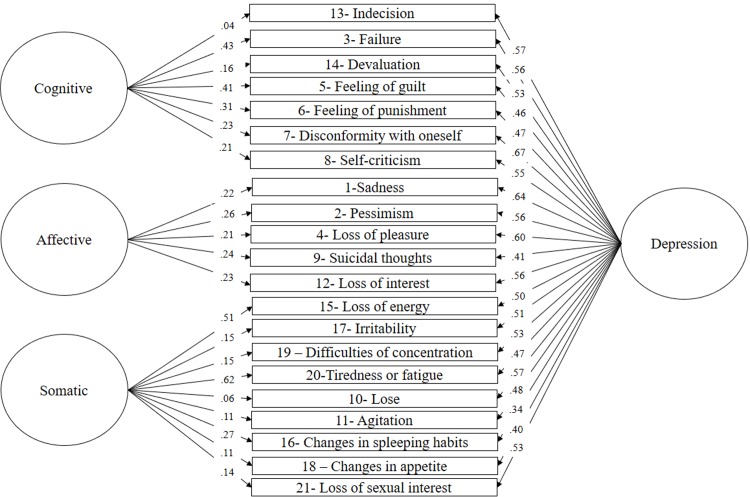
The Beck Depression Inventory-II (BDI-II) is currently one of the most widely used measures in both research and clinical practice for assessing depression. Although the psychometric properties of the scale have been well established through many studies worldwide, so far there is no study examining the validity and reliability of BDI-II in Republic Dominican. The purpose of the present study was twofold: (a) to examine the latent structure of BDI-II by testing several competing models proposed in the literature; and (b) to provide evidence of validity and reliability of the BDI-II in Republic Dominican. Confirmatory factor analysis indicated that a bifactor model with a general depression factor and three specific factors consisting of cognitive, affective and somatic showed the best fit to the data. Internal reliability was moderate to high for all subscales and for the total scale. Scores on BDI-II discriminated between clinical and general population, supporting for external validity. Practical implications are discussed and suggestions for further research are also made.
Overview
The claims and statistics of this paper haven’t been checked yet.
Free: it reads the open-access text and checks the first 5 claims that cite a source we can check. Create a free account to check every claim.
Integrity signals
Registry
Cites
Statistics
Figures
Verification
Claims the paper makes
The claims and statistics of this paper haven’t been checked yet.
Free: it reads the open-access text and checks the first 5 claims that cite a source we can check. Create a free account to check every claim.
Claims other papers make about this one
Each is checked against this paper’s own text: does it say what the citing paper says it does?
The cited source says what the claim attributes to it.
In the citing paper
“Internal consistency is good, with Cronbach’s α = 0.89 [38].”
Self-check
Percentages, sums and reported differences re-computed from the paper’s own numbers.
The self-check needs the paper’s full text.
Citations
Cites
Diagnostic and Statistical Manual of Mental Disorders
Williams, J. B. W., & First, M. (2013) · Encyclopedia of Social Work · doi:10.1093/acrefore/9780199975839.013.104 · Cited by 109,519
Principles and Practice of Structural Equation Modeling
Tabri, N., & Elliott, C. M. (2012) · Canadian Graduate Journal of Sociology and Criminology · doi:10.15353/cgjsc-rcessc.v1i1.25 · Cited by 38,891
(1998) · Cited by 36,049
Hu, L.-T., & Bentler, P. M. (1998) · Psychological Methods · doi:10.1037/1082-989x.3.4.424 · Cited by 12,298
Diagnostic and Statistical Manual of Mental Disorders
Siegel, L. J., & Fletcher‐Janzem, E. (2008) · Encyclopedia of Special Education · doi:10.1002/9780470373699.speced0655 · Cited by 8,477
(2005) · Cited by 6,097
Comparison of Beck Depression Inventories -IA and -II in psychiatric outpatients
Beck, A. T., Steer, R. A., Ball, R., & Ranieri, W. F. (1996) · Journal of Personality Assessment · doi:10.1207/s15327752jpa6703_13 · Cited by 5,965
The Epidemiology of Depression Across Cultures
Kessler, R. C., & Bromet, E. J. (2013) · Annual Review of Public Health · doi:10.1146/annurev-publhealth-031912-114409 · Cited by 2,657
Structural equations modeling: Fit Indices, sample size, and advanced topics
Iacobucci, D. (2010) · Journal of Consumer Psychology · doi:10.1016/j.jcps.2009.09.003 · Cited by 2,263
The Rediscovery of Bifactor Measurement Models
Reise, S. P. (2012) · Multivariate Behavioral Research · doi:10.1080/00273171.2012.715555 · Cited by 2,112
(2012) · SpringerReference · doi:10.1007/springerreference_179754 · Cited by 2,089
Psychometric properties of the Beck Depression Inventory-II: a comprehensive review
Wang, Y.-P., & Gorenstein, C. (2013) · Revista Brasileira de Psiquiatria · doi:10.1590/1516-4446-2012-1048 · Cited by 1,577
Poverty and common mental disorders in low and middle income countries: A systematic review
Lund, C., Breen, A., Flisher, A. J., Kakuma, R., Corrigall, J., Joska, J. A., Swartz, L., & Patel, V. (2010) · Social Science & Medicine · doi:10.1016/j.socscimed.2010.04.027 · Cited by 1,375
Adjusting for multiple testing when reporting research results: the Bonferroni vs Holm methods.
Aickin, M., & Gensler, H. (1996) · American Journal of Public Health · doi:10.2105/ajph.86.5.726 · Cited by 1,346
Ferrari, A. J., Somerville, A. J., Baxter, A. J., Norman, R., Patten, S. B., Vos, T., & Whiteford, H. A. (2013) · Psychological Medicine · doi:10.1017/s0033291712001511 · Cited by 1,230
Beck, A. T., Ward, C. H., Mendelson, M., Mock, J., & Erbauch, J. (2011) · PsycTESTS Dataset · doi:10.1037/t00741-000 · Cited by 815
Ghassemzadeh, H., Mojtabai, R., Karamghadiri, N., & Ebrahimkhani, N. (2005) · Depression and Anxiety · doi:10.1002/da.20070 · Cited by 813
(2001) · PubMed · Cited by 713
The world is flat : the globalized world in the twenty-first century
Friedman, T. L. (2006) · Penguin Books · Cited by 696
Scale Construction and Psychometrics for Social and Personality Psychology
Furr, R. M. (2011) · SAGE Publications Ltd eBooks · doi:10.4135/9781446287866 · Cited by 636
Dimensions of the Beck depression inventory-II in clinically depressed outpatients
Steer, R. A., Ball, R., Ranieri, W. F., & Beck, A. T. (1999) · Journal of Clinical Psychology · doi:10.1002/(sici)1097-4679(199901)55:1<117::aid-jclp12>3.0.co;2-a · Cited by 577
Gomes-Oliveira, M. H., Gorenstein, C., Neto, F. L., Andrade, L. H., & Wang, Y. P. (2012) · Revista Brasileira de Psiquiatria · doi:10.1016/j.rbp.2012.03.005 · Cited by 565
Cross-cultural validation of the Beck Depression Inventory-II in Japan
Kojima, M., Furukawa, T. A., Takahashi, H., Kawai, M., Nagaya, T., & Tokudome, S. (2002) · Psychiatry Research · doi:10.1016/s0165-1781(02)00106-3 · Cited by 496
An evaluation of dual-process theories of reasoning
Osman, M. (2004) · Psychonomic Bulletin & Review · doi:10.3758/bf03196730 · Cited by 444
Segal, D. L., Coolidge, F. L., Cahill, B. S., & O'Riley, A. A. (2008) · Behavior Modification · doi:10.1177/0145445507303833 · Cited by 335
Díaz, M. Á. R., & Ayán, M. N. R. (2008) · DOAJ (DOAJ: Directory of Open Access Journals) · Cited by 305
Self-report bias and underreporting of depression on the BDI-II
Hunt, M., Auriemma, J., & Cashaw, A. C. A. (2003) · Journal of Personality Assessment · doi:10.1207/s15327752jpa8001_10 · Cited by 301
Murray, A. L., & Johnson, W. (2013) · Intelligence · doi:10.1016/j.intell.2013.06.004 · Cited by 300
Use of the Beck Depression Inventory-II with depressed geriatric inpatients
Steer, R. A., Rissmiller, D. J., & Beck, A. T. (2000) · Behaviour Research and Therapy · doi:10.1016/s0005-7967(99)00068-6 · Cited by 238
Factor structure and psychometric characteristics of the beck depression inventory-II
Osman, A., Downs, W. R., Barrios, F. X., Kopper, B. A., Gutierrez, P. M., & Chiros, C. E. (1997) · Journal of Psychopathology and Behavioral Assessment · doi:10.1007/bf02229026 · Cited by 235
Sanz, J., Perdigón, A. L., & Vázquez, C. (2003) · DOAJ (DOAJ: Directory of Open Access Journals) · Cited by 235
Psychometric properties of the Beck Depression Inventory‐II in nonclinical adolescent samples
Osman, A., Barrios, F. X., Gutierrez, P. M., Williams, J. E., & Bailey, J. (2008) · Journal of Clinical Psychology · doi:10.1002/jclp.20433 · Cited by 199
Grothe, K. B., Dutton, G. R., Jones, G. N., Bodenlos, J., Ancona, M., & Brantley, P. J. (2005) · Psychological Assessment · doi:10.1037/1040-3590.17.1.110 · Cited by 180
The Factor Structure of the Beck Depression Inventory–II: An Evaluation
Vanheule, S., Desmet, M., Groenvynck, H., Rosseel, Y., & Fontaine, J. (2008) · Assessment · doi:10.1177/1073191107311261 · Cited by 170
Harris, C. A., & D’Eon, J. L. (2008) · Pain · doi:10.1016/j.pain.2007.10.022 · Cited by 167
Comparison of factor structure models for the Beck Depression Inventory--II.
Ward, L. C. (2006) · Psychological Assessment · doi:10.1037/1040-3590.18.1.81 · Cited by 151
On the factor structure of the Beck Depression Inventory–II: G is the key.
Brouwer, D., Meijer, R. R., & Zevalkink, J. (2013) · Psychological Assessment · doi:10.1037/a0029228 · Cited by 150
Carmody, D. P. (2005) · International Journal of Psychiatry in Clinical Practice · doi:10.1080/13651500510014800 · Cited by 137
Campos, R. C., & Gonçalves, B. (2011) · European Journal of Psychological Assessment · doi:10.1027/1015-5759/a000072 · Cited by 109
Arnarson, Þ. Ö., Ólason, D. Þ., Smári, J., & SigurÐsson, J. F. (2008) · Nordic Journal of Psychiatry · doi:10.1080/08039480801962681 · Cited by 91
Subica, A. M., Fowler, J. C., Elhai, J. D., Frueh, B. C., Sharp, C., Kelly, E. L., & Allen, J. G. (2014) · Psychological Assessment · doi:10.1037/a0036998 · Cited by 87
VanVoorhis, C. R. W., & Blumentritt, T. L. (2007) · Journal of Child and Family Studies · doi:10.1007/s10826-006-9125-y · Cited by 83
Talking sensibly about depression
Patel, V. (2017) · PLOS Medicine · doi:10.1371/journal.pmed.1002257 · Cited by 80
Kim, Y., Pilkonis, P. A., Frank, E., Thase, M. E., & Reynolds, C. F. (2002) · Psychology and Aging · doi:10.1037//0882-7974.17.3.379 · Cited by 79
Quilty, L. C., Zhang, K. A., & Bagby, R. M. (2010) · Psychological Assessment · doi:10.1037/a0019698 · Cited by 75
Byrne, B. M., Stewart, S. M., Kennard, B. D., & Lee, P. W. H. (2007) · International Journal of Testing · doi:10.1080/15305050701438058 · Cited by 68
Factor analysis of the Beck Depression Inventory-II with patients with chronic fatigue syndrome
Brown, M. M., Kaplan, C. A., & Jason, L. A. (2011) · Journal of Health Psychology · doi:10.1177/1359105311424470 · Cited by 67
Propiedades Psicométricas del Inventario de Depresión de Beck-II en Adolescentes Chilenos
Melipillán Araneda, R., Cova Solar, F., Rincón González, P., & Valdivia Peralta, M. (2008) · Terapia psicológica · doi:10.4067/s0718-48082008000100005 · Cited by 67
Mallinckrodt, C. H., Prakash, A., Houston, J. P., Swindle, R., Detke, M. J., & Fava, M. (2007) · Neuropsychobiology · doi:10.1159/000111537 · Cited by 59
Gary, F. A., & Yarandi, H. N. (2004) · Nursing Research · doi:10.1097/00006199-200407000-00008 · Cited by 51
Aspectos a tener en cuenta cuando se realiza una adaptación de test entre diferentes culturas
Chahín-Pinzón, N. (2014) · Psychologia · doi:10.21500/19002386.1225 · Cited by 48
Mahmud, W. M. R. W., Awang, A., Herman, I., & Mohamed, M. N. (2004) · PubMed Central · Cited by 43
McElroy, E., Casey, P., Adamson, G., Filippopoulos, P. C., & Shevlin, M. E. (2017) · Irish Journal of Psychological Medicine · doi:10.1017/ipm.2017.52 · Cited by 42
Aasen, H. (2001) · NVA (Nasjonalt vitenarkiv) · Cited by 40
Cross-Cultural Validation of the Beck Depression Inventory–II Across U.S. and Turkish Samples
Canel-Çınarbaş, D., Cui, Y., & Lauridsen, E. (2011) · Measurement and Evaluation in Counseling and Development · doi:10.1177/0748175611400289 · Cited by 39
Validez de constructo del Inventario de Depresión de Beck II para adolescentes
Contreras-Valdez, J. A., Hernández‐Guzmán, L., & Freyre, M.-Á. (2015) · Terapia psicológica · doi:10.4067/s0718-48082015000300004 · Cited by 38
Beck Depression Inventory for depression screening in substance-abusing adolescents
Subramaniam, G., Harrell, P., Huntley, E., & Tracy, M. (2009) · Journal of Substance Abuse Treatment · doi:10.1016/j.jsat.2008.09.008 · Cited by 33
Wu, P. (2010) · Journal of Psychoeducational Assessment · doi:10.1177/0734282909360772 · Cited by 33
Factor structure of the Beck Depression Inventory-Second Edition (BDI-II) with Puerto Rican elderly.
Rodríguez-Gómez, J., Dávila-Martínez, M. G., & Collazo-Rodríguez, L. C. (2006) · PubMed · Cited by 21
Aranda, B. D. E., Álvarez, C. D., Hernández, R. L., & Ramírez, M. T. G. (2014) · Universitas Psychologica · doi:10.11144/javeriana.upsy14-1.ppmb · Cited by 18
Tendencias de los Artículos en Psicología Clínica en Iberoamérica
Anacona, C. A. R., Gómez, J. A. M., & Rodríguez, S. I. G. (2009) · Terapia psicológica · doi:10.4067/s0718-48082009000100006 · Cited by 18
Considerations to keep in mind when a test is adapted from one culture to another
Chahín-Pinzón, N. (2014) · Cited by 3
Reseña de "Emociones infantiles. Evolución, evaluación y prevención" de V. DEL BARRIO
Ortíz, M. Á. C. (2003) · DOAJ (DOAJ: Directory of Open Access Journals) · Cited by 3
Research works printed but not linked: 1
- Sanz J, Perdigón AL, Vazquez C. Adaptación Española del Inventario para la Depresión de Beck (BDI-II). Clínica y Salud. 2003; 14: 121– 141
Cited by
dynamic : An R Package for Deriving Dynamic Fit Index Cutoffs for Factor Analysis
Wolf, M. G., & McNeish, D. (2023) · Multivariate Behavioral Research · doi:10.1080/00273171.2022.2163476 · Cited by 170
Brewis, A., Choudhary, N., & Wutich, A. (2019) · Social Science & Medicine · doi:10.1016/j.socscimed.2019.112520 · Cited by 103
A High Polyphenol Diet Improves Psychological Well-Being: The Polyphenol Intervention Trial (PPhIT)
Kontogianni, M. D., Vijayakumar, A., Rooney, C., Noad, R. L., Appleton, K. M., McCarthy, D., Donnelly, M., Young, I. S., McKinley, M. C., McKeown, P. P., et al. (2020) · Nutrients · doi:10.3390/nu12082445 · Cited by 83
“The current study employed validated and previously used measures to collect information on individuals’ personal experiences and emotions [58,59].”
MethodNabwera, H., Shah, V., Neville, R., Sosseh, F., Saidykhan, M., Faal, F., Sonko, B. J., Keita, O., Schmidt, W., & Torondel, B. (2021) · PLoS ONE · doi:10.1371/journal.pone.0247554 · Cited by 94
“A score of> 16 is suggestive of clinical depression [31] and among adolescents in Malawi had a specificity of>80% for depression [30].”
BackgroundNadali, J., Ghavampour, N., Beiranvand, F., Takhtegahi, M. M., Heidari, M. E., Salarvand, S., Arabzadeh, T., & Charan, O. N. (2022) · Brain and Behavior · doi:10.1002/brb3.2840 · Cited by 68
Metadata
- Authors
- García-Batista, Z. E., Guerra-Peña, K., Cano-Vindel, A., Herrera-Martínez, S. X., & Medrano, L. A.
- Affiliations
- Pontificia Universidad Católica Madre y Maestra (DO)
- Universidad Arturo Michelena (VE)
- Universidad Nacional de Córdoba (AR)
- Corresponding author
- García-Batista, Zoilo Emilio
- ORCID
- Venue
- PLOS ONE
- Publisher
- Public Library of Science (PLoS)
- Published
- 2018-06-29
- Volume
- 13
- Issue
- 6
- Pages
- e0199750
- ISSN
- 1932-6203 (ISSN-L)
- PMC
- PMC6025862
- OpenAlex
- W2811436445
- Cited by
- 240
- References
- 65
- Citations by year
- 2026: 19 · 2025: 36 · 2024: 63 · 2023: 37 · 2022: 30 · 2021: 28 · 2020: 19 · 2019: 8
- FWCI
- 18.01
- Type
- journal article
- Language
- en
- Open access
- gold
- doi.org
- Licence
- Locations
- PLoS ONE (publishedVersion, cc-by)
- Europe PMC (PubMed Central) (publishedVersion, cc-by)
- PubMed Central (publishedVersion, cc-by)
- PubMed (publishedVersion)
- RePEc: Research Papers in Economics (submittedVersion)
- DOAJ (DOAJ: Directory of Open Access Journals) (submittedVersion, cc-by-sa)
- Greater South Information System
- Funders
- Fondo Nacional de Innovación y Desarrollo Científico–Tecnológico
- Topics
- Social Sciences › Psychology › Experimental and Cognitive Psychology › Anxiety, Depression, Psychometrics, Treatment, Cognitive Processes
- Social Sciences › Decision Sciences › Management Science and Operations Research › Psychometric Methodologies and Testing
- Social Sciences › Psychology › Experimental and Cognitive Psychology › Mental Health Research Topics
- Keywords
- Beck Depression Inventory-II, depression assessment, psychometric validation, bifactor model, latent structure, Dominican Republic
- MeSH terms
- Adult, Depression, Dominican Republic, Female, Hospitals, Humans, Male, Models, Psychological
About these checks
Registry, retraction, Cites and statistics results are computed, not judged, with one exception: a printed reference that no index lists is read once by a model before it counts as a citation error. Claims are extracted by a model and kept only when their quote appears verbatim in the text; each cited source is then checked, with a model’s help, for whether it says what the claim relies on. Those verdicts can be wrong — read the claim’s quote and the cited source before relying on one.
Statistics and arithmetic are recomputed, not judged.
Confidence bands are shown only for fields calibrated on our annotated test set. None is calibrated yet, so no band is shown.
What counts as a claim ›How we measure confidence ›How we check this ›
Are you an author, or do you see a problem with this page? Request a review
Data sources
Bibliographic data: Semantic Scholar, OpenAlex, Crossref.
Contains information from the Semantic Scholar Academic Graph Datasets, made available under the ODC Attribution License (ODC-BY 1.0).
Semantic Scholar’s data is described in: Kinney, R., et al. (2023). The Semantic Scholar Open Data Platform. arXiv:2301.10140.
