

The DOI matches its Crossref record; 48 of the 48 references it cites were found in a registry or an index.
Depression and anxiety in patients with different rare chronic diseases: A cross-sectional study.
Open accessAbstract
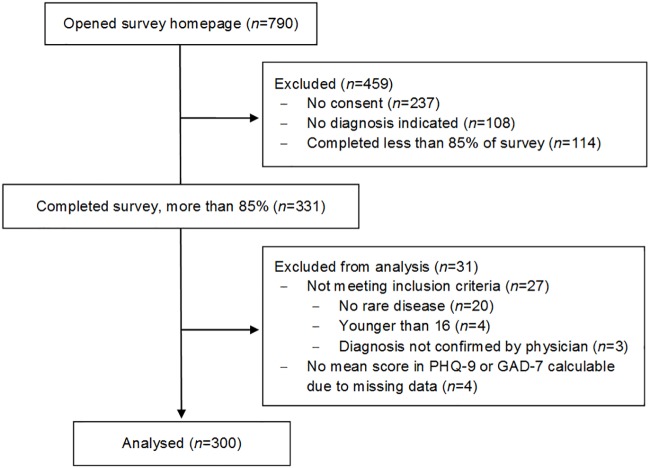
OBJECTIVE: Empirical evidence on depression and anxiety in patients with rare diseases is scarce but can help improve comprehensive treatment. The objectives of this study were to investigate the frequency of depression and anxiety in this heterogeneous population and to examine aspects associated with increased psychopathology. METHODS: N = 300 patients with 79 different rare diseases (female:80%, age:M = 44.3(12.8), range:16-74 years) participated in a cross-sectional online study. We determined the percentages of patients reporting elevated depression (PHQ-9) and anxiety (GAD-7) scores. We calculated two linear regressions with depression and anxiety as outcomes. Predictor variables were diagnosis-related aspects (diagnosis assigned to ICD-10 chapter, visibility of symptoms, time since diagnosis, comorbid diseases), perceived somatic-symptom-severity (PHQ-15), illness-perceptions (consequences, control, identity, concern, understanding and treatment control; B-IPQ-R), coping mechanisms (constructive attitudes, active engagement in life) and social support (heiQ). We controlled for gender, age and depression or anxiety depending on the outcome. RESULTS: 42% of the patients (95%CI [36.41%,47.59%]) reported depression scores indicating moderately or severely elevated symptom levels. Regarding anxiety, this applies to 23% (95%CI [18.54%,28.06%]). Variables significantly associated with depression were higher perceived somatic-symptom-severity (B = 0.41,p < .001), less control (B = .17,p < .05), lower levels of concern (B = -0.32,p < .01) and less constructive attitudes (B = -1.40,p < .001). No diagnosis-related variables were associated with depression. Variables significantly associated with anxiety were diseases of the circulatory system compared to congenital malformations (B = 1.88,p < .05), less consequences (B = -0.32,p < .05) and more concern (B = -0.32,p < .01). CONCLUSION: The data reveal first insights into depression and anxiety in patients with different rare diseases. High percentages of patients showed clinically relevant symptom burden. No diagnosis-related differences were found in depression while anxiety seems to be particularly frequent in patients with rare diseases of the circulatory system. Besides perceived somatic symptom severity, cognitive appraisal seems to be linked to depression. Supporting patients in coping with their disease may help reduce psychopathology and therefore improve overall health.
Overview
The claims and statistics of this paper haven’t been checked yet.
Run the check — free, no account needed. It reads the open-access text and checks the sources it cites.
Integrity signals
Registry
Cites
Statistics
Figures
Verification
Claims the paper makes
The claims and statistics of this paper haven’t been checked yet.
Run the check — free, no account needed. It reads the open-access text and checks the sources it cites.
Claims other papers make about this one
Each is checked against this paper’s own text: does it say what the citing paper says it does?
The source backs part of the claim, not all of it — or backs it for a different population, condition or comparison.
In the citing paper
“Youths with chronic medical conditions (CMCs) represent a high-risk group for comorbid anxiety, depression, or behavioral problems, with a reported prevalence of 10% to 42%.1,2,3,4,5,6”
From Efficacy of Motivational Interviewing to Improve Utilization of Mental Health Services Among Youths With Chronic Medical Conditions: A Cluster Randomized Clinical Trial (2021) · cites this paper as [1]
Experimental — accuracy not yet measured
Self-check
Percentages, sums and reported differences re-computed from the paper’s own numbers.
The self-check needs the paper’s full text.
Citations
Cites
Diagnostic and Statistical Manual of Mental Disorders
Williams, J. B. W., & First, M. B. (2013) · Oxford University Press eBooks · doi:10.1093/acrefore/9780199975839.013.104 · Cited by 109,845
The PHQ-9: Validity of a brief depression severity measure
Kroenke, K., Spitzer, R. L., & Williams, J. B. W. (2001) · Journal of General Internal Medicine · doi:10.1046/j.1525-1497.2001.016009606.x · Cited by 44,910
A Brief Measure for Assessing Generalized Anxiety Disorder: The GAD-7
Spitzer, R. L., Kroenke, K., Williams, J. B. W., & Löwe, B. (2006) · Archives of Internal Medicine · doi:10.1001/archinte.166.10.1092 · Cited by 31,765
(2017) · Cited by 16,319
Diagnostic and Statistical Manual of Mental Disorders
Siegel, L. J., & Fletcher‐Janzen, E. (2008) · Wiley eBooks · doi:10.1002/9780470373699.speced0655 · Cited by 8,467
The PHQ-9: A New Depression Diagnostic and Severity Measure
Kroenke, K., & Spitzer, R. L. (2002) · Psychiatric Annals · doi:10.3928/0048-5713-20020901-06 · Cited by 5,898
Anxiety disorders in primary care: prevalence, impairment, comorbidity, and detection
Kroenke, K., Spitzer, R. L., Williams, J. B. W., Monahan, P. O., & Löwe, B. (2007) · Annals of Internal Medicine · doi:10.7326/0003-4819-146-5-200703060-00004 · Cited by 4,741
Löwe, B., Decker, O., Müller, S., Brähler, E., Schellberg, D., Herzog, W., & Herzberg, P. Y. (2008) · Medical Care · doi:10.1097/mlr.0b013e318160d093 · Cited by 4,527
Self-citationDiMatteo, M. R., Lepper, H. S., & Croghan, T. W. (2000) · Archives of Internal Medicine · doi:10.1001/archinte.160.14.2101 · Cited by 4,177
Kroenke, K., Spitzer, R. L., Williams, J. B. W., & Löwe, B. (2010) · General Hospital Psychiatry · doi:10.1016/j.genhosppsych.2010.03.006 · Cited by 4,057
Depression and Pain Comorbidity: A Literature Review
Bair, M. J., Robinson, R. L., Katon, W., & Kroenke, K. (2003) · Archives of Internal Medicine · doi:10.1001/archinte.163.20.2433 · Cited by 3,463
Shared decision making — The pinnacle of patient-centered care
Barry, M. J., & Edgman-Levitan, S. (2012) · New England Journal of Medicine · doi:10.1056/nejmp1109283 · Cited by 3,433
The Brief Illness Perception Questionnaire
Broadbent, E., Petrie, K. J., Main, J., & Weinman, J. (2006) · Journal of Psychosomatic Research · doi:10.1016/j.jpsychores.2005.10.020 · Cited by 3,431
The PHQ-15: Validity of a New Measure for Evaluating the Severity of Somatic Symptoms
Kroenke, K., Spitzer, R. L., & Williams, J. B. W. (2002) · Psychosomatic Medicine · doi:10.1097/00006842-200203000-00008 · Cited by 3,415
Validity of the brief patient health questionnaire mood scale (PHQ-9) in the general population
Martin, A., Rief, W., Klaiberg, A., & Braehler, E. (2006) · General Hospital Psychiatry · doi:10.1016/j.genhosppsych.2005.07.003 · Cited by 1,379
Lichtman, J. H., Froelicher, E. S., Blumenthal, J. A., Carney, R. M., Doering, L. V., Frasure-Smith, N., Freedland, K. E., Jaffe, A. S., Leifheit-Limson, E. C., Sheps, D. S., et al. (2014) · Circulation · doi:10.1161/cir.0000000000000019 · Cited by 1,208
LOWE, B. (2004) · Journal of Affective Disorders · doi:10.1016/s0165-0327(02)00237-9 · Cited by 1,060
Katon, W., Lin, E. H. B., & Kroenke, K. (2007) · General Hospital Psychiatry · doi:10.1016/j.genhosppsych.2006.11.005 · Cited by 965
Anxiety and Risk of Incident Coronary Heart Disease
Roest, A. M., Martens, E. J., de Jonge, P., & Denollet, J. (2010) · Journal of the American College of Cardiology · doi:10.1016/j.jacc.2010.03.034 · Cited by 865
Möller-Leimkühler, A. M. (2002) · Journal of Affective Disorders · doi:10.1016/s0165-0327(01)00379-2 · Cited by 851
Screening psychischer Störungen mit dem “Gesundheitsfragebogen für Patienten (PHQ-D)“
Gräfe, K., Zipfel, S., Herzog, W., & Löwe, B. (2004) · Diagnostica · doi:10.1026/0012-1924.50.4.171 · Cited by 805
Health Psychology: Psychological Adjustment to Chronic Disease
Stanton, A. L., Revenson, T. A., & Tennen, H. A. (2006) · Annual Review of Psychology · doi:10.1146/annurev.psych.58.110405.085615 · Cited by 749
Kocalevent, R.-D., Hinz, A., & Brähler, E. (2013) · General Hospital Psychiatry · doi:10.1016/j.genhosppsych.2013.04.006 · Cited by 748
Depression, anxiety and somatization in primary care: Syndrome overlap and functional impairment
Löwe, B., Spitzer, R. L., Williams, J. B. W., Mussell, M., Schellberg, D., & Kroenke, K. (2008) · General Hospital Psychiatry · doi:10.1016/j.genhosppsych.2008.01.001 · Cited by 706
Clarke, D. M., & Currie, K. C. (2009) · Medical Journal of Australia · doi:10.5694/j.1326-5377.2009.tb02471.x · Cited by 661
Osborne, R. H., Elsworth, G. R., & Whitfield, K. (2007) · Patient Education and Counseling · doi:10.1016/j.pec.2006.12.002 · Cited by 556
Scott, K. M., Bruffaerts, R., Tsang, A., Ormel, J., Alonso, J., Angermeyer, M. C., Benjet, C., Bromet, E., de Girolamo, G., de Graaf, R., et al. (2007) · Journal of Affective Disorders · doi:10.1016/j.jad.2007.01.015 · Cited by 529
A systematic review of resilience in the physically ill
Stewart, D. E., & Yuen, T. (2011) · Psychosomatics · doi:10.1016/j.psym.2011.01.036 · Cited by 491
The role of illness perceptions in patients with medical conditions
Petrie, K. J., Jago, L. A., & Devcich, D. A. (2007) · Current Opinion in Psychiatry · doi:10.1097/yco.0b013e328014a871 · Cited by 451
Sareen, J., Cox, B. J., Clara, I., & Asmundson, G. J. G. (2005) · Depression and Anxiety · doi:10.1002/da.20072 · Cited by 389
Living with a rare disorder: a systematic review of the qualitative literature
von der Lippe, C., Diesen, P. S., & Feragen, K. B. (2017) · Molecular Genetics & Genomic Medicine · doi:10.1002/mgg3.315 · Cited by 378
Watkins, L. L., Koch, G. G., Sherwood, A., Blumenthal, J. A., Davidson, J. R. T., O’Connor, C. J., & Sketch, M. H. (2013) · Journal of the American Heart Association · doi:10.1161/jaha.112.000068 · Cited by 307
Löwe, B., Gräfe, K., Zipfel, S., Witte, S., Loerch, B., & Herzog, W. (2004) · Psychotherapy and Psychosomatics · doi:10.1159/000080393 · Cited by 301
Self-citationQuality of Life in Rare Genetic Conditions: A Systematic Review of the Literature
Cohen, J., & Biesecker, B. B. (2010) · American Journal of Medical Genetics. Part A · doi:10.1002/ajmg.a.33380 · Cited by 193
Adjusting to Chronic Health Conditions
Helgeson, V. S., & Zajdel, M. (2017) · Annual Review of Psychology · doi:10.1146/annurev-psych-010416-044014 · Cited by 191
El-Gabalawy, R. M., Mackenzie, C. S., Shooshtari, S., & Sareen, J. (2011) · General Hospital Psychiatry · doi:10.1016/j.genhosppsych.2011.07.005 · Cited by 155
Stafford, L., Berk, M., & Jackson, H. J. (2008) · Journal of Psychosomatic Research · doi:10.1016/j.jpsychores.2008.09.005 · Cited by 123
Blöß, S., Klemann, C., Rother, A.-K., Mehmecke, S., Schumacher, U., Mücke, U., Mücke, M., Stieber, C., Klawonn, F., Kortum, X., et al. (2017) · PLoS ONE · doi:10.1371/journal.pone.0172532 · Cited by 121
The overlap of somatic, anxious and depressive syndromes: A population-based analysis
Kohlmann, S., Gierk, B., Hilbert, A., Brähler, E., & Löwe, B. (2016) · Journal of Psychosomatic Research · doi:10.1016/j.jpsychores.2016.09.004 · Cited by 95
Regression Analysis in Health Services Research: The Use of Dummy Variables
Polissar, L., & Dieha, P. (1982) · Medical Care · doi:10.1097/00005650-198209000-00008 · Cited by 94
O’Connor, T. M., Hanks, H. A., Elcock, M., Turner, R. C., & Veitch, C. (2009) · The Medical Journal of Australia · doi:10.5694/j.1326-5377.2009.tb02274.x · Cited by 77
Systematic review of the psychosocial aspects of living with Marfan syndrome
Velvin, G., Bathen, T., Rand‐Hendriksen, S., & Geirdal, A. Ø. (2014) · Clinical Genetics · doi:10.1111/cge.12422 · Cited by 64
Sumpton, D., Thakkar, V., O'Neill, S. G., Singh‐Grewal, D., Craig, J. C., & Tong, A. (2017) · Arthritis Care & Research · doi:10.1002/acr.23207 · Cited by 43
“We don't wear it on our sleeve”: Sickle cell disease and the (in)visible body in parts
Ciribassi, R. M., & Patil, C. L. (2015) · Social Science & Medicine · doi:10.1016/j.socscimed.2015.11.033 · Cited by 40
Löwe, B., Blankenberg, S., Wegscheider, K., König, H., Walter, D., Murray, A., Gierk, B., & Kohlmann, S. (2016) · The British Journal of Psychiatry · doi:10.1192/bjp.bp.116.184168 · Cited by 36
Olney, M. F., & Brockelman, K. F. (2005) · The Journal of Postsecondary Education and Disability · Cited by 33
Dyspnea, depression and health related quality of life in pulmonary arterial hypertension patients
Talwar, A., Sahni, S., Kim, E. J., Verma, S., & Kohn, N. E. (2015) · Journal of Exercise Rehabilitation · doi:10.12965/jer.150230 · Cited by 22
Heath, J., Lehman, E., Saunders, E. F. H., & Craig, T. (2016) · Allergy and Asthma Proceedings · doi:10.2500/aap.2016.37.3977 · Cited by 21
Research works printed but not linked: 1
- K Gräfe, 2004, Gesundheitsfragebogen für Patienten (PHQ-D). Ergebnisse der deutschen Validierungsstudie. [Screening for psychiatric disorders with the Patient Health Questionnaire (PHQ). Results from the German validation study.], Diagnostica, 50, 171
Cited by
Sorted by citations
Comorbid depression in medical diseases
Gold, S. M., Köhler‐Forsberg, O., Moss-Morris, R. E., Mehnert-Theuerkauf, A., Miranda, J. J., Bullinger, M., Steptoe, A., Whooley, M. A., & Otte, C. (2020) · Nature Reviews Disease Primers · doi:10.1038/s41572-020-0200-2 · Cited by 583
Medical students' knowledge and opinions about rare diseases: A case study from Poland
Domaradzki, J., & Walkowiak, D. (2019) · Intractable & Rare Diseases Research · doi:10.5582/irdr.2019.01099 · Cited by 95
Perceived burden in dealing with different rare diseases: a qualitative focus group study
Uhlenbusch, N., Löwe, B., & Depping, M. K. (2019) · BMJ Open · doi:10.1136/bmjopen-2019-033353 · Cited by 87
Supportive care needs of patients with rare chronic diseases: multi-method, cross-sectional study
Depping, M., Uhlenbusch, N., Kodolitsch, Y. V., Klose, H. F. E., Mautner, V., & Löwe, B. (2021) · Orphanet Journal of Rare Diseases · doi:10.1186/s13023-020-01660-w · Cited by 78
Rare disease education in Europe and beyond: time to act
Tumiene, B., Peters, H., Melegh, B., Peterlin, B., Utkus, A., Fatkulina, N., Pfliegler, G., Graeßner, H., Hermanns, S., Scarpa, M., et al. (2022) · Orphanet Journal of Rare Diseases · doi:10.1186/s13023-022-02527-y · Cited by 66
Metadata
- Authors
- Uhlenbusch, N., Löwe, B., Härter, M., Schramm, C., Weiler-Normann, C., & Depping, M. K.
- Affiliations
- University Medical Center Hamburg-Eppendorf (DE)
- Corresponding author
- Uhlenbusch, Natalie
- Venue
- PLoS ONE
- Publisher
- Public Library of Science (PLoS)
- Published
- 2019-02-20
- Volume
- 14
- Issue
- 2
- Pages
- e0211343
- ISSN
- 1932-6203 (ISSN-L)
- PMC
- PMC6382125
- OpenAlex
- W2915720434
- Cited by
- 111
- References
- 48
- Citations by year
- 2026: 5 · 2025: 17 · 2024: 24 · 2023: 20 · 2022: 10 · 2021: 18 · 2020: 11 · 2019: 6
- FWCI
- 14.14
- Type
- journal article
- Language
- en
- Open access
- gold
- doi.org
- Licence
- Locations
- PLoS ONE (publishedVersion, cc-by)
- Europe PMC (PubMed Central) (publishedVersion, cc-by)
- PubMed Central (publishedVersion, cc-by)
- PubMed (publishedVersion)
- RePEc: Research Papers in Economics (submittedVersion)
- DOAJ (DOAJ: Directory of Open Access Journals) (submittedVersion, cc-by-sa)
- Funders
- Robert Bosch Stiftung
- Topics
- Health Sciences › Medicine › Psychiatry and Mental health › Mental Health Treatment and Access
- Social Sciences › Psychology › Experimental and Cognitive Psychology › Anxiety, Depression, Psychometrics, Treatment, Cognitive Processes
- Health Sciences › Medicine › Psychiatry and Mental health › Psychosomatic Disorders and Their Treatments
- Keywords
- depression, anxiety, rare diseases, chronic disease, psychopathology, illness perception, coping strategies, social support, somatic symptom severity, circulatory diseases, congenital malformations, comorbidities, time since diagnosis, PHQ-9, GAD-7, quality of life, patient mental health
- MeSH terms
- Adolescent, Adult, Aged, Anxiety, Chronic Disease, Cross-Sectional Studies, Depression, Female, Humans, Male, Middle Aged, Surveys and Questionnaires, Severity of Illness Index, Linear Models, Internet, Rare Diseases, Young Adult, Self Report
About these checks
Registry, retraction, Cites and statistics results are computed, not judged, with one exception: a printed reference that no index lists is read once by a model before it counts as a citation error. Claims are extracted by a model and kept only when their quote appears verbatim in the text; each cited source is then checked, with a model’s help, for whether it says what the claim relies on. Those verdicts can be wrong — read the claim’s quote and the cited source before relying on one.
Statistics and arithmetic are recomputed, not judged.
Confidence bands are shown only for fields calibrated on our annotated test set. None is calibrated yet, so no band is shown.
What counts as a claim ›How we measure confidence ›How we check this ›
Are you an author, or do you see a problem with this page? Request a review
