

The DOI matches its Crossref record; 37 of the 37 references it cites were found in a registry or an index.
Disparities in outcomes of patients admitted with diabetic foot infections.
Open accessAbstract
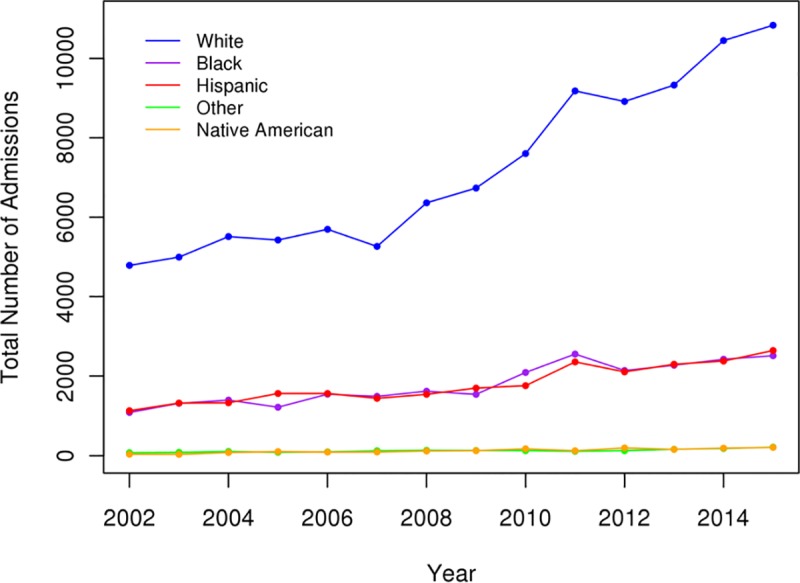
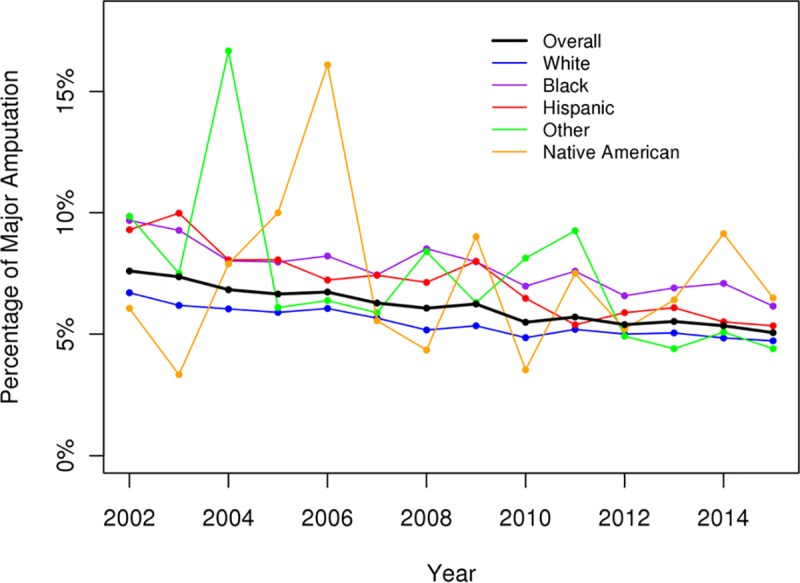
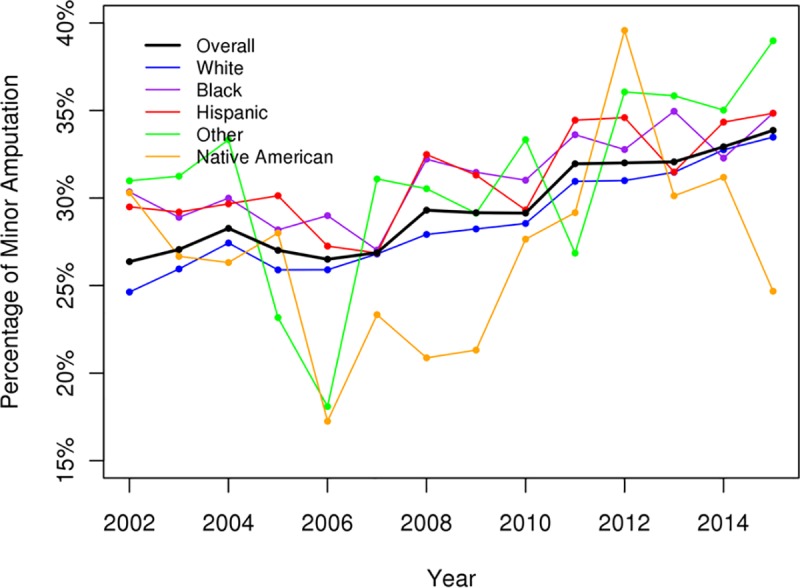
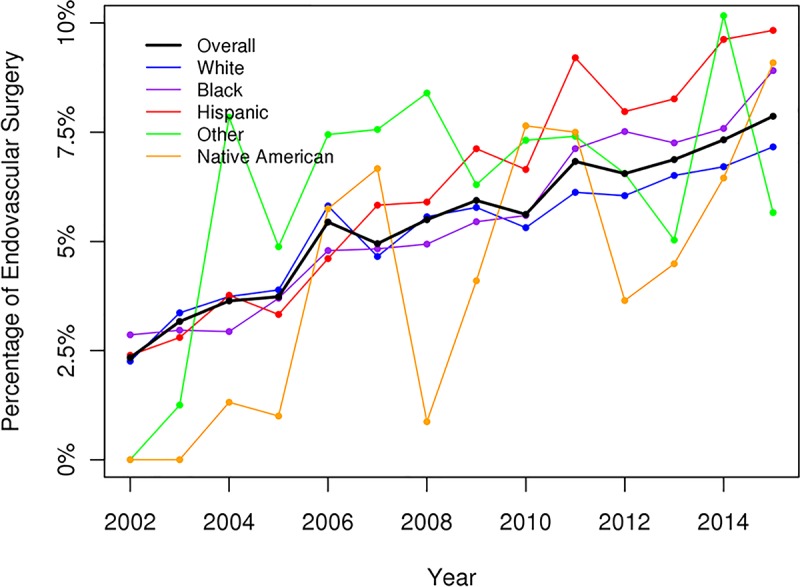
OBJECTIVE: The purpose of this study was to evaluate the disparities in the outcomes of White, African American (AA) and non-AA minority (Hispanics and Native Americans (NA)), patients admitted in the hospitals with diabetic foot infections (DFIs). RESEARCH DESIGN AND METHODS: The HCUP-Nationwide Inpatient Sample (2002 to 2015) was queried to identify patients who were admitted to the hospital for management of DFI using ICD-9 codes. Outcomes evaluated included minor and major amputations, open or endovascular revascularization, and hospital length of stay (LOS). Incidence for amputation and open or endovascular revascularization were evaluated over the study period. Multivariable regression analyses were performed to assess the association between race/ethnicity and outcomes. RESULTS: There were 150,701 admissions for DFI, including 98,361 Whites, 24,583 AAs, 24,472 Hispanics, and 1,654 Native Americans (NAs) in the study cohort. Overall, 45,278 (30%) underwent a minor amputation, 9,039 (6%) underwent a major amputation, 3,151 underwent an open bypass, and 8,689 had an endovascular procedure. There was a decreasing incidence in major amputations and an increasing incidence of minor amputations over the study period (P < .05). The risks for major amputation were significantly higher (all p<0.05) for AA (OR 1.4, 95%CI 1.4,1.5), Hispanic (OR 1.3, 95%CI 1.3,1.4), and NA (OR 1.5, 95%CI 1.2,1.8) patients with DFIs compared to White patients. Hispanics (OR 1.3, 95%CI 1.2,1.5) and AAs (OR 1.2, 95%CI 1.1,1.4) were more likely to receive endovascular intervention or open bypass than Whites (all p<0.05). NA patients with DFI were less likely to receive a revascularization procedure (OR 0.6, 95%CI 0.3, 0.9, p = 0.03) than Whites. The mean hospital length of stay (LOS) was significantly longer for AAs (9.2 days) and Hispanics (8.6 days) with DFIs compared to Whites (8.1 days, p<0.001). CONCLUSION: Despite a consistent incidence reduction of amputation over the past decade, racial and ethnic minorities including African American, Hispanic, and Native American patients admitted to hospitals with DFIs have a consistently significantly higher risk of major amputation and longer hospital length of stay than their White counterparts. Native Americans were less likely to receive revascularization procedures compared to other minorities despite exhibiting an elevated risk of an amputation. Further study is required to address and limit racial and ethnic disparities and to further promote equity in the treatment and outcomes of these at-risk patients.
Overview
The claims and statistics of this paper haven’t been checked yet.
Run the check — free, no account needed. It reads the open-access text and checks the sources it cites.
Integrity signals
Registry
Cites
Statistics
Figures
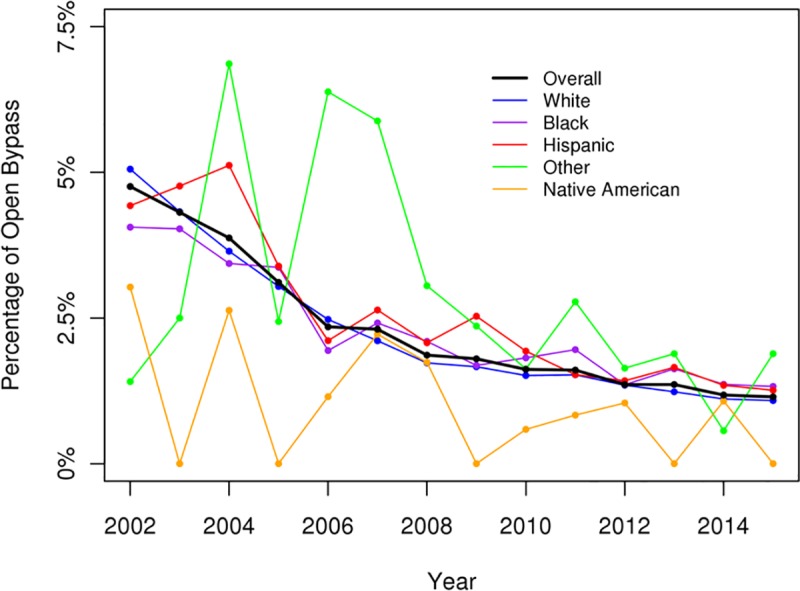
Verification
Claims the paper makes
The claims and statistics of this paper haven’t been checked yet.
Run the check — free, no account needed. It reads the open-access text and checks the sources it cites.
Claims other papers make about this one
Each is checked against this paper’s own text: does it say what the citing paper says it does?
The check wasn’t confident either way, so it gives no verdict — never disputed.
In the citing paper
“The diagnosis of diabetic foot infection is primarily based on clinical assessment and is suggested by presence of more than 2 signs of inflammation, such as erythema, swelling and possibly purulence, fluctuance, or lymphangiitis.7,13”
From Diabetic Foot Ulcers: A Review (2023) · cites this paper as [13]
Experimental — accuracy not yet measuredThe check wasn’t confident either way, so it gives no verdict — never disputed.
In the citing paper
“Randomized clinical trial data are not available to support obtaining wound cultures from all patients with diabetic foot ulcers.7,13”
From Diabetic Foot Ulcers: A Review (2023) · cites this paper as [13]
Experimental — accuracy not yet measuredThe check wasn’t confident either way, so it gives no verdict — never disputed.
In the citing paper
“For diagnosing osteomyelitis, bone biopsy and culture remain the gold standard.7,13”
From Diabetic Foot Ulcers: A Review (2023) · cites this paper as [13]
Experimental — accuracy not yet measured
Self-check
Percentages, sums and reported differences re-computed from the paper’s own numbers.
The self-check needs the paper’s full text.
Citations
Cites
Diabetic foot ulcers and their recurrence
Armstrong, D. G., Boulton, A. J. M., & Bus, S. A. (2017) · New England Journal of Medicine · doi:10.1056/nejmra1615439 · Cited by 4,376
Preventing Foot Ulcers in Patients With Diabetes
Singh, N. K. (2005) · JAMA · doi:10.1001/jama.293.2.217 · Cited by 3,152
The Effect of Race and Sex on Physicians' Recommendations for Cardiac Catheterization
Schulman, K. A., Berlin, J. A., Harless, W., Kerner, J. F., Sistrunk, S., Gersh, B. J., Dubé, R., Taleghani, C. K., Burke, J. E., Williams, S., et al. (1999) · New England Journal of Medicine · doi:10.1056/nejm199902253400806 · Cited by 1,934
Prompers, L., Huijberts, M., Apelqvist, J., Jude, E., Piaggesi, A., Bakker, K., Edmonds, M., Holstein, P., Jirkovska, A., Mauricio, D., et al. (2007) · Diabetologia · doi:10.1007/s00125-006-0491-1 · Cited by 1,023
National trends in lower extremity bypass surgery, endovascular interventions, and major amputations
Goodney, P. P., Beck, A. W., Nagle, J., Welch, H. G., & Zwolak, R. M. (2009) · Journal of Vascular Surgery · doi:10.1016/j.jvs.2009.01.035 · Cited by 674
Long‐term prognosis for diabetic patients with foot ulcers
Apelqvist, J., Larsson, J., & AGARDH, C. ‐. (1993) · Journal of Internal Medicine · doi:10.1111/j.1365-2796.1993.tb01003.x · Cited by 493
Prognosis of the infected diabetic foot ulcer: a 12‐month prospective observational study
Ndosi, M. E., Wright-Hughes, A. M., Brown, S. T., Backhouse, M. R., Lipsky, B. A., Bhogal, M., Reynolds, C., Vowden, P., Jude, E. B., Nixon, J., et al. (2017) · Diabetic Medicine · doi:10.1111/dme.13537 · Cited by 296
Arya, S., Binney, Z. O., Khakharia, A., Brewster, L. P., Goodney, P. P., Patzer, R. E., Hockenberry, J. M., & Wilson, P. W. F. (2018) · Journal of the American Heart Association · doi:10.1161/jaha.117.007425 · Cited by 253
Mebane, E. W., Oman, R., Kroonen, L. T., & Goldstein, M. K. (1999) · Journal of The American Geriatrics Society · doi:10.1111/j.1532-5415.1999.tb02573.x · Cited by 209
Eslami, M. H., Zayaruzny, M., & FitzGerald, G. (2007) · Journal of Vascular Surgery · doi:10.1016/j.jvs.2006.09.044 · Cited by 209
Cited by
Sorted by citations
Diabetic Foot Ulcers: A Review
Armstrong, D. G., Tan, T.-W., Boulton, A. J. M., & Bus, S. A. (2023) · JAMA · doi:10.1001/jama.2023.10578 · Cited by 1,928
Self-citationEtiology, Epidemiology, and Disparities in the Burden of Diabetic Foot Ulcers
McDermott, K. M., Fang, M., Boulton, A. J. M., Selvin, E., & Hicks, C. W. (2022) · Diabetes Care · doi:10.2337/dci22-0043 · Cited by 1,510
Lipsky, B. A., Senneville, É., Abbas, Z. G., Aragón‐Sánchez, J., Diggle, M. A., Embil, J. M., Kono, S., Lavery, L. A., Malone, M., van Asten, S. A. V., et al. (2020) · Diabetes/Metabolism Research and Reviews · doi:10.1002/dmrr.3280 · Cited by 811
Senneville, É., Albalawi, Z., van Asten, S. A. V., Abbas, Z. G., Allison, G. M., Aragón‐Sánchez, J., Embil, J. M., Lavery, L. A., Al‐Hasan, M. N., Öz, O. K., et al. (2023) · Diabetes/Metabolism Research and Reviews · doi:10.1002/dmrr.3687 · Cited by 330
Diabetes complications in racial and ethnic minority populations in the USA.
Haw, J. S., Shah, M., Turbow, S., Egeolu, M., & Umpierrez, G. (2021) · Current Diabetes Reports · doi:10.1007/s11892-020-01369-x · Cited by 240
Metadata
- Authors
- Tan, T.-W., Shih, C.-D., Concha-Moore, K. C., Diri, M. M., Hu, B., Marrero, D., Zhou, W., & Armstrong, D. G.
- Affiliations
- University of Arizona (US)
- University of Southern California (US)
- Cleveland Clinic (US)
- Corresponding author
- Tan, Tze-Woei
- Venue
- PLoS ONE
- Publisher
- Public Library of Science (PLoS)
- Published
- 2019-02-04
- Volume
- 14
- Issue
- 2
- Pages
- e0211481
- ISSN
- 1932-6203 (ISSN-L)
- PMC
- PMC6361439
- OpenAlex
- W2913555931
- Cited by
- 111
- References
- 37
- Citations by year
- 2026: 3 · 2025: 13 · 2024: 27 · 2023: 22 · 2022: 14 · 2021: 11 · 2020: 18 · 2019: 2
- FWCI
- 9.13
- Type
- journal article
- Language
- en
- Update notices
- correction (2019-04-11)
- Open access
- gold
- doi.org
- Licence
- Locations
- PLoS ONE (publishedVersion, cc-by)
- Europe PMC (PubMed Central) (publishedVersion, cc-by)
- PubMed Central (publishedVersion, cc-by)
- PubMed (publishedVersion)
- UA Campus Repository (The University of Arizona) (acceptedVersion, cc-by)
- DOAJ (DOAJ: Directory of Open Access Journals) (submittedVersion, cc-by-sa)
- Figshare (submittedVersion, cc-by)
- Funders
- National Institute of Diabetes and Digestive and Kidney Diseases (P30DK111022)
- Topics
- Health Sciences › Medicine › Endocrinology, Diabetes and Metabolism › Diabetic Foot Ulcer Assessment and Management
- Health Sciences › Medicine › Surgery › Peripheral Artery Disease Management
- Health Sciences › Medicine › Infectious Diseases › Streptococcal Infections and Treatments
- Keywords
- diabetic foot infection, racial disparities, ethnic disparities, amputation, major amputation, minor amputation, revascularization, endovascular intervention, length of hospital stay, African American patients, Hispanic patients, Native American patients, hospital admission outcomes, health care access disparities, health care quality disparities
- MeSH terms
- Amputation, Surgical, Ethnicity, Female, Hospitalization, Humans, Male, Middle Aged, Prognosis, Cohort Studies, Treatment Outcome, Diabetic Foot, Racial Groups, Healthcare Disparities, Endovascular Procedures
About these checks
Registry, retraction, Cites and statistics results are computed, not judged, with one exception: a printed reference that no index lists is read once by a model before it counts as a citation error. Claims are extracted by a model and kept only when their quote appears verbatim in the text; each cited source is then checked, with a model’s help, for whether it says what the claim relies on. Those verdicts can be wrong — read the claim’s quote and the cited source before relying on one.
Statistics and arithmetic are recomputed, not judged.
Confidence bands are shown only for fields calibrated on our annotated test set. None is calibrated yet, so no band is shown.
What counts as a claim ›How we measure confidence ›How we check this ›
Are you an author, or do you see a problem with this page? Request a review
