

Optimizing the intrinsic parallel diffusivity in NODDI: An extensive empirical evaluation
Open accessPublished version of a preprint
The DOI matches its Crossref record; 39 of the 39 references it cites were found in a registry or an index.
Abstract
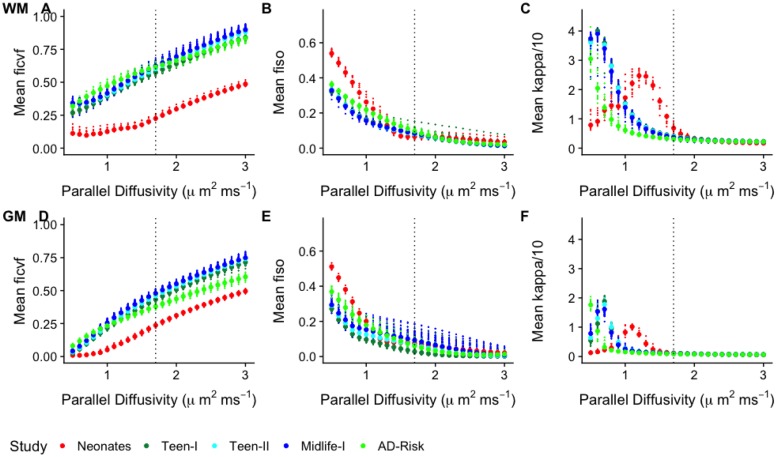
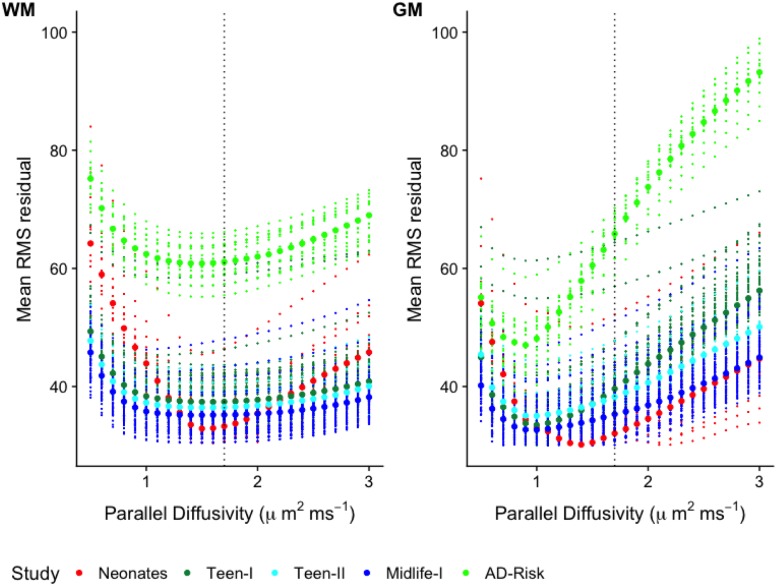
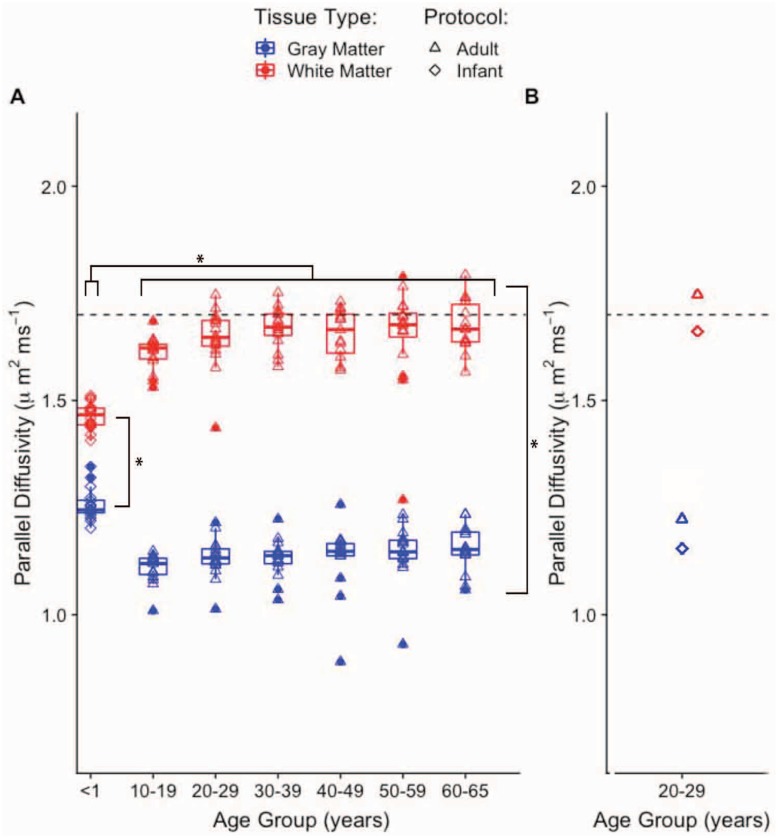
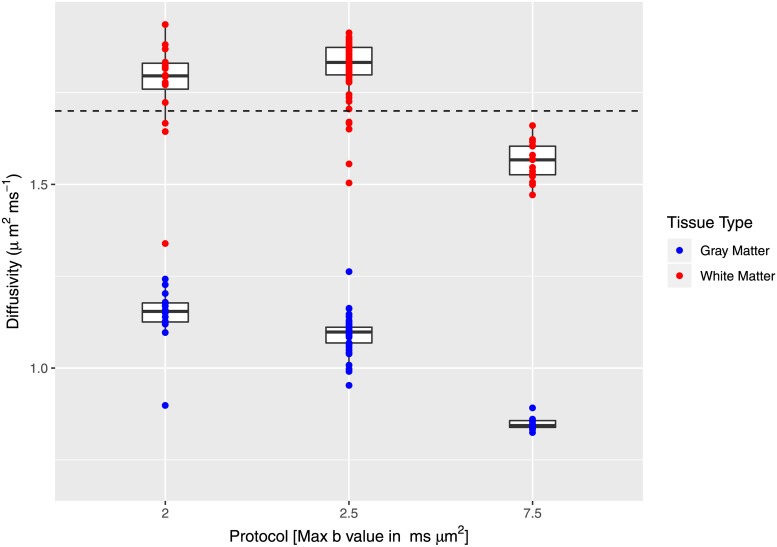
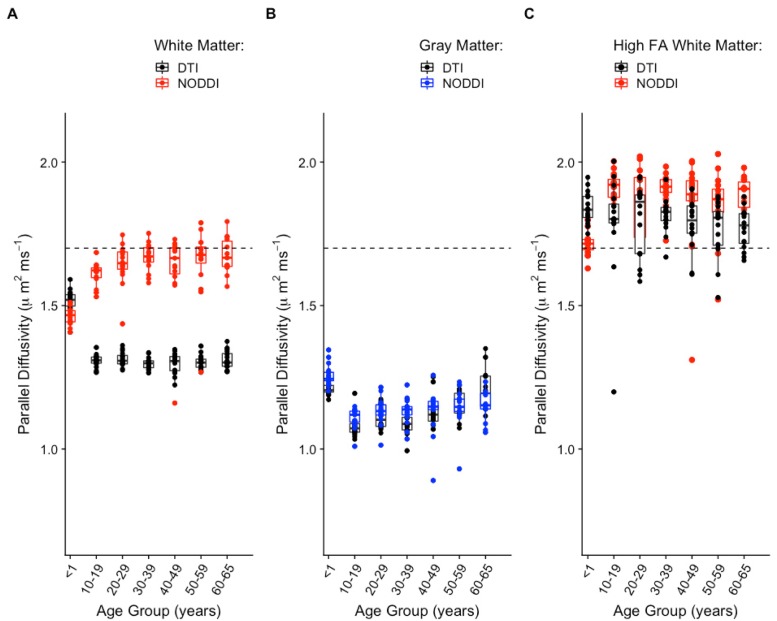
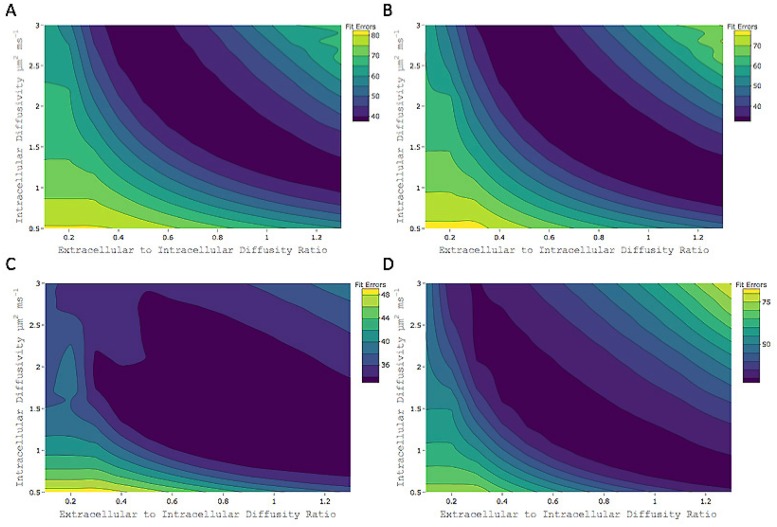
PURPOSE: NODDI is widely used in parameterizing microstructural brain properties. The model includes three signal compartments: intracellular, extracellular, and free water. The neurite compartment intrinsic parallel diffusivity (d∥) is set to 1.7 μm2⋅ms-1, though the effects of this assumption have not been extensively explored. This work investigates the optimality of d∥ = 1.7 μm2⋅ms-1 under varying imaging protocol, age groups, sex, and tissue type in comparison to other biologically plausible values of d∥. METHODS: Model residuals were used as the optimality criterion. The model residuals were evaluated in function of d∥ over the range from 0.5 to 3.0 μm2⋅ms-1. This was done with respect to tissue type (i.e., white matter versus gray matter), sex, age (infancy to late adulthood), and diffusion-weighting protocol (maximum b-value). Variation in the estimated parameters with respect to d∥ was also explored. RESULTS: Results show d∥ = 1.7 μm2⋅ms-1 is appropriate for adult brain white matter but it is suboptimal for gray matter with optimal values being significantly lower. d∥ = 1.7 μm2⋅ms-1 was also suboptimal in the infant brain for both white and gray matter with optimal values being significantly lower. Minor optimum d∥ differences were observed versus diffusion protocol. No significant sex effects were observed. Additionally, changes in d∥ resulted in significant changes to the estimated NODDI parameters. CONCLUSION: The default (d∥) of 1.7 μm2⋅ms-1 is suboptimal in gray matter and infant brains.
Overview
The claims and statistics of this paper haven’t been checked yet.
Free: it reads the open-access text and checks the first 5 claims that cite a source we can check. Create a free account to check every claim.
Integrity signals
Registry
Cites
Statistics
Figures
Verification
Claims the paper makes
The claims and statistics of this paper haven’t been checked yet.
Free: it reads the open-access text and checks the first 5 claims that cite a source we can check. Create a free account to check every claim.
Claims other papers make about this one
Each is checked against this paper’s own text: does it say what the citing paper says it does?
The cited source says what the claim attributes to it.
In the citing paper
“Also, even within usual multi-shell acquisition (linear tensor encoding), the optimal value of d i, seems different between neonates and adults, as well as between white matter (WM) and gray matter (GM) (Guerrero et al., 2019).”
From NODDI in clinical research (2020) · cites this paper as Guerrero et al., 2019
The cited source says what the claim attributes to it.
In the citing paper
“Focusing on the fixed diffusivity assumption, (Guerrero et al., 2019) have suggested that the default value of 1.7 μm 2 /ms is likely suboptimal for neonates brain and GM, and that the age-dependence of NDI and ODI is affected by the choice of fixed diffusivity value.”
From NODDI in clinical research (2020) · cites this paper as Guerrero et al., 2019
Self-check
Percentages, sums and reported differences re-computed from the paper’s own numbers.
The self-check needs the paper’s full text.
Citations
Cites
Jenkinson, M., Beckmann, C. F., Behrens, T. E. J., Woolrich, M. W., & Smith, S. M. (2012) · NeuroImage · doi:10.1016/j.neuroimage.2011.09.015 · Cited by 11,314
Zhang, Y., Brady, M., & Smith, S. (2001) · IEEE Transactions on Medical Imaging · doi:10.1109/42.906424 · Cited by 6,982
NODDI: Practical in vivo neurite orientation dispersion and density imaging of the human brain
Zhang, H., Schneider, T., Wheeler-Kingshott, C. A., & Alexander, D. C. (2012) · NeuroImage · doi:10.1016/j.neuroimage.2012.03.072 · Cited by 3,288
Self-citationMardia, K. V., & Jupp, P. E. (1999) · Wiley Series in Probability and Statistics · doi:10.1002/9780470316979 · Cited by 3,203
Composite hindered and restricted model of diffusion (CHARMED) MR imaging of the human brain
Assaf, Y., & Basser, P. J. (2005) · NeuroImage · doi:10.1016/j.neuroimage.2005.03.042 · Cited by 856
Axcaliber: A method for measuring axon diameter distribution from diffusion MRI
Assaf, Y., Blumenfeld‐Katzir, T., Yovel, Y., & Basser, P. J. (2008) · Magnetic Resonance in Medicine · doi:10.1002/mrm.21577 · Cited by 849
Orientationally invariant indices of axon diameter and density from diffusion MRI
Alexander, D. C., Hubbard, P. L., Hall, M. G., Moore, E. A., Ptito, M., Parker, G. J. M., & Dyrby, T. B. (2010) · NeuroImage · doi:10.1016/j.neuroimage.2010.05.043 · Cited by 683
Accelerated microstructure imaging via Convex Optimization (AMICO) from diffusion MRI data
Daducci, A., Canales-Rodríguez, E. J., Zhang, H., Dyrby, T. B., Alexander, D. C., & Thiran, J.-P. (2015) · NeuroImage · doi:10.1016/j.neuroimage.2014.10.026 · Cited by 593
Self-citationWhite matter characterization with diffusional kurtosis imaging
Fieremans, E., Jensen, J. H., & Helpern, J. A. (2011) · NeuroImage · doi:10.1016/j.neuroimage.2011.06.006 · Cited by 561
Theoretical Model for Water Diffusion in Tissues
Szafer, A., Zhong, J., & Gore, J. C. (1995) · Magnetic Resonance in Medicine · doi:10.1002/mrm.1910330516 · Cited by 521
Research works printed but not linked: 2
- Guerrero J, Adluru N, Kecskemeti S, Davidson R, Alexander A. Investigating the effects of intrinsic diffusivity on neurite orientation dispersion and density imaging (NODDI). International Society for Magnetic Resonance in Medicine (ISMRM) Singapore 2016;.
- Veraart J, Fieremans E, Rudrapatna U, Jones D, Novikov DS. Biophysical modeling of the gray matter: does the “stick” model hold? Proceedings of the 27th Annual Meeting of ISMRM, Paris, France 2018;.
Cited by
Kamiya, K., Hori, M., & Aoki, S. (2020) · Journal of Neuroscience Methods · doi:10.1016/j.jneumeth.2020.108908 · Cited by 321
Dimitrova, R., Pietsch, M., Ciarrusta, J., Fitzgibbon, S. P., Williams, L. Z. J., Christiaens, D., Cordero‐Grande, L., Batallé, D., Makropoulos, A., Schuh, A., et al. (2021) · NeuroImage · doi:10.1016/j.neuroimage.2021.118488 · Cited by 106
Kraguljac, N. V., Guerreri, M., Strickland, M. J., & Zhang, H. G. (2022) · Biological Psychiatry Global Open Science · doi:10.1016/j.bpsgos.2021.12.012 · Cited by 82
Self-citationLynch, K. M., Cabeen, R. P., Toga, A. W., & Clark, K. A. (2020) · NeuroImage · doi:10.1016/j.neuroimage.2020.116672 · Cited by 79
Gong, T., Tong, Q., He, H., Sun, Y., Zhong, J., & Zhang, H. (2020) · NeuroImage · doi:10.1016/j.neuroimage.2020.116906 · Cited by 76
Self-citation
Metadata
- Authors
- Guerrero, J. M., Adluru, N., Bendlin, B. B., Goldsmith, H. H., Schaefer, S. M., Davidson, R. J., Kecskemeti, S. R., Zhang, H., & Alexander, A. L.
- Affiliations
- University of Wisconsin–Madison (US)
- University College London (GB)
- Corresponding author
- Adluru, Nagesh
- ORCID
- Venue
- PLOS ONE
- Publisher
- Public Library of Science (PLoS)
- Published
- 2019-09-25
- Volume
- 14
- Issue
- 9
- Pages
- e0217118
- ISSN
- 1932-6203 (ISSN-L)
- PMC
- PMC6760776
- OpenAlex
- W2975734873
- Cited by
- 98
- References
- 39
- Citations by year
- 2026: 14 · 2025: 13 · 2024: 14 · 2023: 15 · 2022: 16 · 2021: 16 · 2020: 10
- FWCI
- 6.94
- Type
- journal article
- Language
- en
- Open access
- gold
- doi.org
- Licence
- Locations
- PLoS ONE (publishedVersion, cc-by)
- PubMed Central (publishedVersion, cc-by)
- PubMed (publishedVersion)
- DOAJ (DOAJ: Directory of Open Access Journals) (submittedVersion, cc-by-sa)
- UCL Discovery (University College London) (submittedVersion)
- Funders
- National Science Foundation (EB022883, AI117924)
- Bill and Melinda Gates Foundation
- Waisman Center (HD090256, U54 HD090256)
- National Institutes of Health (MH101504, MH084051, AI117924, HD090256, AG037639)
- Intellectual and Developmental Disabilities Research Center
- National Institute on Aging (R01AG037639, RF1AG059312, P50AG033514, P01AG020166, R01AG027161, U19AG051426)
- National Institute of Mental Health (MH084051, R01MH101504, R01 MH59785, P01-AG020166, P50MH100031, P50MH084051, R01MH059785, R01MH043454)
- National Cancer Institute (T32CA009206)
- National Institute of Allergy and Infectious Diseases (U54AI117924)
- National Institute of Neurological Disorders and Stroke (R01NS092870)
- National Institute of Biomedical Imaging and Bioengineering (R01EB022883)
- National Institute of Child Health and Human Development (HD090256)
- Eunice Kennedy Shriver National Institute of Child Health and Human Development (U54HD090256)
- Topics
- Health Sciences › Medicine › Radiology, Nuclear Medicine and Imaging › Advanced Neuroimaging Techniques and Applications
- Health Sciences › Medicine › Radiology, Nuclear Medicine and Imaging › Advanced MRI Techniques and Applications
- Life Sciences › Neuroscience › Cognitive Neuroscience › Functional Brain Connectivity Studies
- Keywords
- NODDI, diffusion MRI, white matter, gray matter, infant brain, model parameter optimization, model residuals, sex differences, age differences
- MeSH terms
- Adolescent, Adult, Age Factors, Aged, Brain, Child, Child, Preschool, Female, Humans, Image Processing, Computer-Assisted, Infant, Infant, Newborn, Male, Middle Aged, Sex Factors, Diffusion Magnetic Resonance Imaging, Young Adult, Functional Neuroimaging, White Matter, Gray Matter
About these checks
Registry, retraction, Cites and statistics results are computed, not judged, with one exception: a printed reference that no index lists is read once by a model before it counts as a citation error. Claims are extracted by a model and kept only when their quote appears verbatim in the text; each cited source is then checked, with a model’s help, for whether it says what the claim relies on. Those verdicts can be wrong — read the claim’s quote and the cited source before relying on one.
Statistics and arithmetic are recomputed, not judged.
Confidence bands are shown only for fields calibrated on our annotated test set. None is calibrated yet, so no band is shown.
What counts as a claim ›How we measure confidence ›How we check this ›
Are you an author, or do you see a problem with this page? Request a review
How to cite
Cite CoChat for the checks on this page, and the paper for its own findings.
- This page
- CoChat. (2026). Citation check: Optimizing the intrinsic parallel diffusivity in NODDI: An extensive empirical evaluation. https://app.cochat.ai/papers/10.1371/journal.pone.0217118
- The paper
- Guerrero, J. M., Adluru, N., Bendlin, B. B., Goldsmith, H. H., Schaefer, S. M., Davidson, R. J., Kecskemeti, S. R., Zhang, H., & Alexander, A. L. (2019). Optimizing the intrinsic parallel diffusivity in NODDI: An extensive empirical evaluation. PLOS ONE. https://doi.org/10.1371/journal.pone.0217118
Data sources
Bibliographic data: Semantic Scholar, OpenAlex, Crossref.
Contains information from the Semantic Scholar Academic Graph Datasets, made available under the ODC Attribution License (ODC-BY 1.0).
Semantic Scholar’s data is described in: Kinney, R., et al. (2023). The Semantic Scholar Open Data Platform. arXiv:2301.10140.
